127e. Developing a Hermeneutical Lens to Consider the Place of Women in Ministry—Part 5

Recognizing the many influences that shape how we read and obey the Bible can make us more aware of our limitations, lead us to interpret with greater care and skill, foster a humble posture of ongoing dialogue, and help preserve our unity. All readers are invited to respond and challenge what I have written. I will be grateful for your insights and for continuing the conversation.

Some material in this article is based on my Intercultural Theology course given as an instructional lecture series with Northwest Baptist Seminary. 

NOTE: Chatgpt was used for editing, but not generative purposes.

Part 5: Developing theology through the hermeneutic of reading the Bible as revelation

After posting Part 4: A Framework to Guide the Process of Interpretation, a close friend wrote to express concern that, if the linguistic and cultural limitations I described are indeed the realities we face, then interpreting Scripture begins to feel “hopeless,” and the Bible risks becoming “a mystery and a magical goal that Christians can never hope to truly understand.” Such a conclusion, my friend warned, easily leads to a relativistic claim that “everyone’s interpretation is as good as another because nobody properly knows.” If this is the outcome, many readers will simply dismiss the argument as an overly academic complication of what is ordinarily a simple, everyday act of reading and understanding—something people do quite naturally.

Rejecting this kind of relativism, readers may instead default to their instincts, overlook cultural and linguistic limitations, and assume that their own reading of the Bible is transcultural and grounded solely in God’s universal revelation. This “realist” posture treats truth as essentially equivalent to one’s own perception of it and is often captured in the saying, “If the plain sense makes good sense, seek no other sense.”

Moreover, if this complex cultural and linguistic “veil” truly obscures God’s word, how can I then turn around and commend the Discovery Bible Study (DBS) method of reading Scripture—which I do? DBS is grounded in the perspicuity of Scripture and affirms that all people—children and adults, the literate and illiterate, believers and seekers alike—can read God’s word and understand its message.

These concerns are worth taking seriously. Because we cannot remove ourselves from the inherent limitations of language or from our cultural location, our knowledge of God, truth, and reality is necessarily perspectival rather than absolute. Yet this is not a flaw in the system, but a feature of God’s design and one that is consistent with Scripture itself. It reminds us that we are called to live by faith—that is, by trust—and not by sight. The apostle Paul speaks of seeing “as in a mirror, dimly” (1 Cor. 13:12), rather than possessing certainty grounded in proof, logical mastery, or confidence in our own capacity to know without remainder. Given that this is the reality established by God’s creative purpose, the question remains: how can we be confident that what we believe—beliefs shaped by our limited perspective—are nevertheless true? How are we rescued from the twin concerns of “hopelessness” and “relativism” that my friend raises?

Establishing faith by engaging God’s self-revelation in and through culture

The answer, I believe, emerges in this article and can be summed up in the word theology. By theology, I do not mean the weighty tomes written by spiritual giants of the past that line pastors’ shelves, but the lived reality of pursuing God. It is not primarily the abstract reasoning of trained scholars, but the daily practice of believers as they together discern what it means to follow Jesus. Theology is what we are doing whenever we reflect on our faith as we engage God’s self-revelation given through his word.

Within the Christian faith, we affirm that there is an Absolute—God—who speaks authoritatively into our lives. For evangelicals, it is the word God has spoken that guards us from chaos and relativism. God has demonstrated that he communicates sufficiently through the languages he has entrusted to us and the cultures in which he has placed us. The following seven culturally shaped ways through which God has chosen to communicate underscore this claim: our languages and contexts are not obstacles to revelation, but part of God’s design, serving as sufficient and effective means by which he makes known his will, character, and mission.

  1. God has communicated through the culturally shaped Old Testament revelation.
    God accommodated to our human condition by revealing his nature and will through local languages and literary forms, including poetry and historical narratives that recount God’s actions in the world. This revelation employed concepts, symbols, and forms intelligible to the audiences who lived within those particular cultural contexts.

  2. God has communicated through the culturally shaped incarnation.
    God’s ultimate act of revelation and contextual accommodation is the incarnation of his Son. Within a particular human context, God revealed what it means to be truly human through the life and actions of the one who is truly God. When Jesus declared, “I am the truth” (Jn 14:6), at least part of that claim is that through him we see who God is, and through him we discover what it means to live in faithful relationship with God. This entire revelation is necessarily culturally shaped.
           The incarnation cannot be understood apart from a concrete historical and cultural setting. The gospel, therefore, is neither acultural nor ahistorical. It exists—and carries meaning—only within culture and history and is communicated to other contexts through translation. Consequently, we cannot claim that there is a single, absolute, acultural theology and that our own theology represents that standard. Rather, we know absolute truth only perspectivally, within our context, and through forms that are themselves contextually shaped. Our confidence that such understanding is both meaningful and genuinely corresponds to truth rests in faith in God’s purposeful design.

  3. God has communicated through the culturally shaped New Testament revelation
    The New Testament shows us how to think about the gospel. When we ask, “What should this incarnation or this gospel look like in our setting?” we are following the pattern of the apostles themselves. The New Testament reveals the message and actions of Jesus worked out in context—truth discerned and embodied within particular cultural situations. This provides a revelation to be formed by, not a manual to replicate. We are not called to adopt the cultural practices of the New Testament world, but to faithfully work out that same gospel in our own contexts, just as the first believers did in theirs. This argument will be developed further with examples in Part 6: Biblical Support for the Proposed Hermeneutic.

  4. God the Holy Spirit communicates in culturally shaped ways.
    Scripture itself is an example. The Bible is “God-breathed” (2 Tim 3:16) into contextual forms and its prophetic message came as people were “carried along by the Holy Spirit” (2 Pet 1:21). Moreover, the apostles explicitly attributed many of their contextually meaningful actions to the guidance of the Spirit (e.g., Acts 16:6-7; 20:22; Gal 5:25). This testimony gives us confidence that God will successfully communicate what he intends to communicate. When Jesus promised to send a helper (Jn 14:16, 26), he was not referring to the Bible, but to the Spirit. The Spirit guides us into all truth as expressed through our lives and social situations.
           When we lived in Pakistan, we observed a mystical Islamic practice in which a guru and his disciples would chant “Allah hu” (“God is one”) for hours in an attempt to enter a trance state. This is mysticism and stands in contrast to Christianity. The Spirit does not remove us from our cultural context or bypass our humanity; rather, the Spirit gives life in and through the ordinary realities of daily life.

  5. God’s mission is contextual.
    The mission of the kingdom does not depend on us. Jesus declared, “I will build my church,” and the book of Revelation proclaims the victory of the Lamb. Yet all of this unfolds within concrete cultural contexts. God’s mission is inherently contextual: we discern what God is doing in and through diverse settings. This is not an accident but God’s intention, and it confirms that God’s message can be faithfully expressed within any cultural context.

  6. God builds our confidence through our experience in the community of faith.
    Growth in understanding occurs through dialogue, shared discernment, and mutual learning—processes that are always culturally shaped. It is God’s intention that we mature together in community, learning how to express the gospel in ways that are faithful and contextually meaningful. This is what Lesslie Newbigin famously described as the “Congregation as Hermeneutic of the Gospel.”[1]

  7. God provides culturally shaped covenants of truth and faithfulness.
    A covenant involves a total commitment of self grounded in faithfulness. Vanhoozer in his book Is there meaning in this text? builds on the biblical covenant theme to argue that communication itself rests on a covenantal relationship between author and reader.[2] That is, communication is possible because the author commits to communicate truthfully, and the reader commits to listen and interpret with integrity. On this basis, understanding can occur. We therefore trust that communication is possible and have faith that God uses cultural means to communicate truthfully and effectively, accomplishing what the Spirit intends.

Theology as a journey with God

Running through all of these points is the recognition of culture’s formative influence on theology. Determining which aspects of a theology are faithful to God’s absolute truth and which are not cannot be accomplished through a purely academic or logical comparison of doctrines measured against some fixed, absolute theology—because no such universal theology is available to us. Theology is a human reflection on God’s word, and as such it is always perspectival and contextually shaped. We do not have access to a neutral or universal theological standard that stands outside culture.

Yet this is not a deficiency; it is a gift.

For a long time, I found this frustrating. Why do we rely on summarized explanations of the gospel, with a verse drawn from one passage and another verse drawn from elsewhere? Why do gospel presentations so often consist of someone explaining the gospel rather than simply letting Scripture speak for itself? Why is the Bible not “plain enough” without our additions and commentary?

That frustration arose from my own culturally shaped view of the world. In a rational, scientific framework, we ask questions, receive answers, summarize those answers clearly and logically, and then move on. Each question is meant to be resolved, closed, and left behind. But life is not meant to be so mechanical. Theology is far richer than logical summaries, and God intends us to engage in creating contextual expressions of theology rather than to have access to a single, overarching, universal system.

If that is the case, then theology is:

  • A lifelong journey, not merely the accumulation of information.
  • Primarily relational, focused on knowing rather than simply knowing about—relationships cannot be reduced to summaries. It’s like a piece of music, when you speed it up or take out the pauses, you lose the essence.
  • A leveling of the playing field, in which no one has privileged access, everyone participates and all theology remains partial and incomplete.[3]
  • Dialogical, shaped by many voices learning from one another in community.
  • Multifaceted, flourishing through intercultural engagement rather than static universal claims.

Culture and theology are therefore inseparably linked in a way that actually strengthens our confidence in God’s communication. We are called to know God “in Christ” while living within our limited, perspectival contexts. Culture is not a barrier that keeps us from truth; it is the means by which we engage truth—much like glasses enable us to see clearly without ever becoming the thing we see.

We can be confident in our knowledge of truth because God has taken the initiative to speak within human contexts. Above all, Jesus Christ is the fullest revelation of the Father, and this revelation is relationally sufficient for our deepest spiritual need. As Jesus says in John 17:3, “Eternal life is to know you, the only true God, and to know Jesus Christ, the one you sent.”

By way of analogy, I truly know my wife, Karen—but not exhaustively or completely. I do not see through her eyes, hear through her ears, or think her thoughts. Yet through our shared experiences and contextually shaped relationship, I know her truly and meaningfully. That knowledge is sufficient for love, trust, and commitment. In a similar way, God’s self-revelation in the incarnation—though limited in scope—remains full, true, and profoundly sufficient. In Jesus, a finite expression of the infinite God has entered our world, revealing grace and truth in a way that meets us relationally.

How the hermeneutic of reading Scripture as revelation overcomes contextual limitations

We cannot read Scripture from a neutral standpoint, since our own cultural and linguistic location both shapes and limits our ability to understand and apply God’s Word. Consequently, approaches that directly adopt biblical patterns, commands, or promises addressed to the original audience—such as interpreting the so-called prohibition passages as straightforward restrictions on women in pastoral leadership—are likely to result in misapplication when transferred uncritically into contemporary contexts.

The hermeneutic of reading the Bible as revelation, or what may also be called a contextually sensitive hermeneutic, is proposed as a way of navigating this God-ordained limitation. When the telos of our engagement with Scripture is the discernment of God’s will, character, and mission, as is emphasized in Discovery Bible Study (DBS) method, we are better positioned to avoid the pitfalls that arise when interpretation remains at the level of the text’s surface meaning. Rather than seeking a “promise to claim,” a “sin to avoid,” or a “command to obey,” our goal becomes the development of a robust and coherent theology of God—one that shapes our lives and guides our expressions of what it means to be the people of God within our particular context.

Encountering the eternal God at work within cultures unlike our own, yet recognizable as the same faithful God, is the formation of theology. That theology then addresses the reader’s own life, calling forth submission, repentance, and worship. At its most basic level, engaging Scripture means reading—or hearing—and being drawn into a transforming relationship with God. This is something people can do at any stage of their spiritual journey, because it is grounded not in mastery of doctrine, but in encounter with the living God at their level of understanding.

This hermeneutic also guards against the opposite error of ignoring or filtering out passages that do not resonate with the values and beliefs of our context. All Scripture remains “useful for teaching, rebuking, correcting and training in righteousness” (2 Tim 3:16). Cultural dissonance is addressed not by dismissing difficult texts, but by reading Scripture as a revelation of God’s will, character, and mission rather than as a set of instructions directly addressed to us as the audience.

Finally, the hermeneutic of reading the Bible as revelation recognizes that we never approach Scripture as blank slates. We come with theological frameworks already in place. By prioritizing the ongoing formation of our theology of God, this approach prevents us from prematurely or naïvely assuming that a command or instruction applies directly or universally. Instead, it calls us to read with awareness of our theological assumptions and cultural embeddedness, remaining open to having our theology reshaped in light of what we discover in the text.

In essence, this hermeneutic creates a dynamic dialogue between our existing theology and the biblical passage before us. We attend carefully to how the text reveals God’s will, character, and mission, and then, drawing on the broader theological understanding formed through prior study and communal reflection, we discern how to respond faithfully. Once we recognize how a passage discloses God’s purposes—and how this aligns with what we already know of God—we can live and act in contextually appropriate and obedient ways.

Conforming to theology is not the same as conforming to commands. The difference is akin to memorizing a driving rulebook versus becoming a mature, responsible driver. A mature driver understands road conditions, respects others, and adapts wisely to changing circumstances while maintaining direction and purpose. In the same way, a theology that orients our lives toward God’s mission fulfills Jesus’ purposes far more effectively than treating individual rules as fixed absolutes. Indeed, insisting on universal behaviors drawn from particular commands can undermine their intended purpose when contexts change.

Ultimately, we are called to something deeper than a religion in which acceptance is measured by obedience to commands. The Bible was not designed to function as a set of laws to follow but for relationship. It is primarily a covenantal text that draws people into right relationship with God through the Lord Jesus Christ. We are called to imitate Jesus—the living Word—and to live as beloved children of our heavenly Father. Reading Scripture as the revelation of God’s will, character, and mission provides the proper orientation that leads us to experience and live out that covenant relationship with God.

Reading the Bible to know God

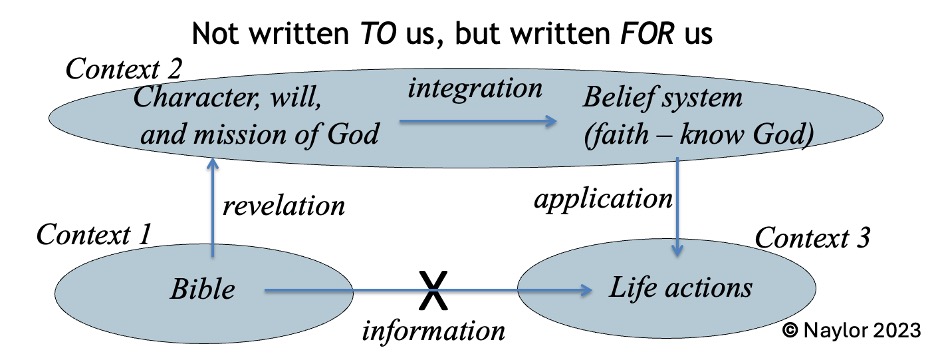
As illustrated in the contextually sensitive hermeneutical diagram presented in previous articles and reproduced here, it is not possible to move directly from Scripture to application. Rather, we read biblical texts through our contextual lenses, shaped by prior assumptions. The hermeneutic proposed here offers guidance by keeping the focus of interpretation aligned with the Bible’s primary purpose: to draw us into relationship with God in Christ. It helps us navigate the dangers of unexamined cultural assumptions by framing interpretation as a process of theological and relational formation—one that seeks faithful contextual expressions of God’s revealed will, character, and mission, rather than assuming that the instructions of the text address equivalent situations in our own context.

This hermeneutic acknowledges and accommodates the interpretive lenses we bring to Scripture. It recognizes and facilitates a dialogical engagement between God’s self-revelation in the Bible and our prior theological convictions and cultural assumptions, enabling us to avoid both uncritical readings that ignore cultural dynamics and inflexibility that resists the reshaping of our theology.

Theology is, by nature, limited and human-derived—a finite attempt to comprehend God from within our particular cultural and linguistic location. We should therefore expect our understanding to be incomplete, recognizing the need for ongoing development in order to interpret any passage of Scripture in a manner consistent with God’s intent.[4] In other words, the Bible is designed to nurture in us, as God’s children, an ever-deepening sense of wonder, delight, and love for our Father.

Before we were married, Karen and I lived on opposite sides of the country. This was before the internet, and I lived for her letters. I worked in construction, and at break time I would pull her most recent letter from my pocket and read it again. Why? I already knew what it said—I had read it a dozen times! But I reread it because it made me feel close to her. I wanted to sense her presence. I wanted to connect with her.

I suggest that this is how we should read our Bible—not primarily to get answers, to improve our lives, or to find teachings to apply, but to know God. When I went to Pakistan, my role was not to teach people what they should believe about Jesus, but to expose them to Jesus. It was essential that the Bible be the curriculum, not so they could extract lessons to apply, but so they could encounter God’s love letter and see Jesus.

All biblical passages should be read as part of a larger theological movement through which we discern God’s will, character, and redemptive mission, culminating in Christ. No command, law, or teaching should be applied in isolation from this broader theological framework, since doing so allows our cultural biases and assumptions to dominate interpretation. This error is addressed through the ongoing work of theology—an ever-deepening understanding of God—cultivated by communal engagement with Scripture as the revelation of God’s will, character, and mission. Theology, then, is a creative and continuing dialogue between our faith, God’s Word, and the lived realities of our lives.

Tiers of Theology

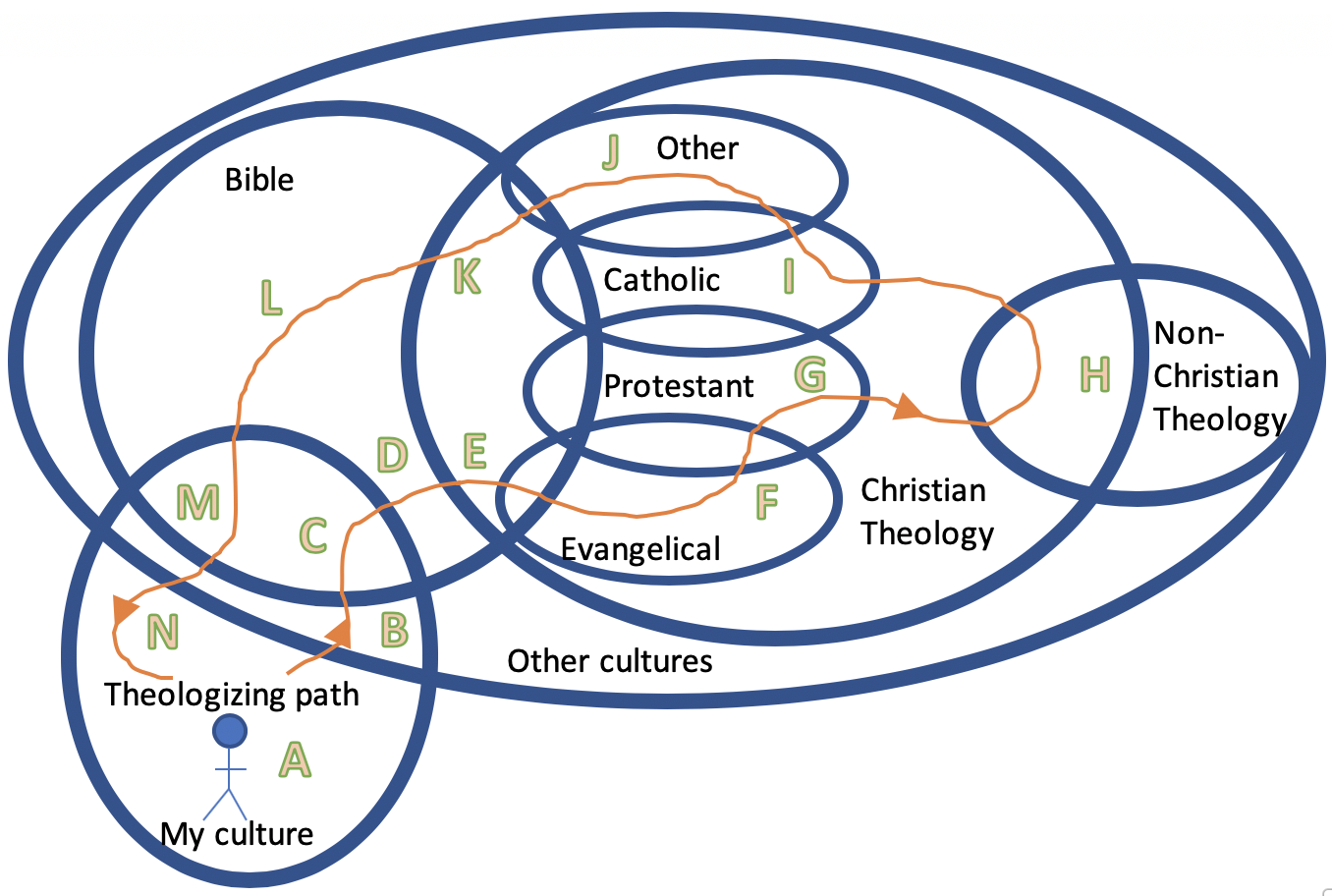
Theologies differ according to the contexts in which they emerge. While careful theological work employs shared methodologies—such as exegesis, logical reasoning, systematic categories, and attention to biblical themes—what ultimately distinguishes one theology from another is its particular context. A failure to attend to this reality often leads people, who may otherwise be skilled in exegesis and logic, to interpret and apply New Testament patterns and commands directly to their modern context, without recognizing that faithful obedience to Scripture in different contexts necessarily requires different expressions.

Different histories, perspectives, questions, priorities, and conceptual frameworks shape how a theologian reads Scripture and seeks to understand God. The following Theologizing in Context diagram represents this dominant contextual reality that influences every theological effort. Theological methodology (the inner circle) includes both systematic theology—asking our questions of the text—and biblical theology—discerning the theology of the text. All of this work employs tools such as exegesis and logic. However, the primary point of the diagram is to illustrate that all theology is inevitably worked out using the language and assumptions of our context, the lenses by which we view reality. Even as God communicates in and through an accommodation to our particular location, so we use the contextual lenses of the our context to engage God’s word and develop our theology (experience and expressions of faith).

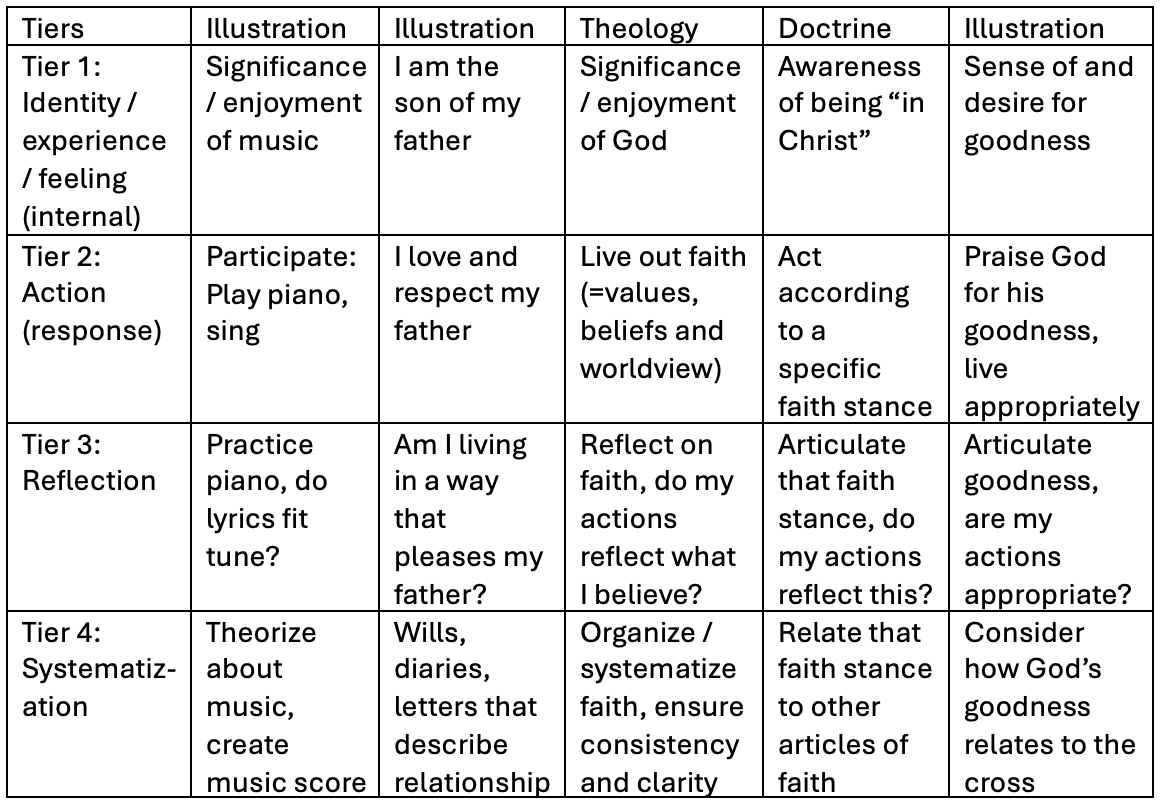
This reality does not diminish or undermine the work of theologizing. On the contrary, acknowledging the contextual dimension as an essential part of the theological process affirms that our understanding of God must be expressed within a community of believers who embody the kingdom in their particular setting. This recognition expands our view of theology beyond a purely scholarly pursuit, revealing it as a lived reality. The following chart, outlining four “tiers of theology,” helps us see how all of us are theologians as we learn to live out our beliefs.[5]

Tier 1 is the experience of reality, of identity or of knowing God.
Tier 2 is our response to that experience.
Tier 3 is a reflection on the experience or the response.
Tier 4 is the articulation of the experience, response and reflection.

The point is that tier 1 theology is where we are meant to live as Christians and is the primary motive for reading Scripture—to know God. We might read about a mother hugging her child (tier 4), reflect on the meaning of that hug (tier 3), or consider the child’s response (tier 2), but the experience of the hug itself is what truly matters (tier 1).

In the same way, when we read God’s Word, we may organize its content (tier 4), reflect on its significance for our lives (tier 3), or respond through appropriate action (tier 2). Yet it is the encounter with God (tier 1) that is central. All of these activities are legitimate expressions of theology, but we are called to prioritize tier 1: encountering God. Only through meeting God can we respond, reflect, and live out the meaning of Scripture in ways that are faithful and appropriate to our context.

Another example is recognizing that knowing about prayer is secondary to the experience of praying. George MacDonald captures this contrast well when he says, “To know a primrose is a higher thing than to know all the botany of it—just as to know Christ is an infinitely higher thing than to know all theology, all that is said about his person, or babbled about his work.”[6]

Alister McGrath helpfully describes cognitive statements or doctrinal propositions—tier 4 systematization—as a map that symbolically represents the relationships among elements of reality. Maps are valuable, but they are not the reality itself. They serve an essential function by orienting us to the world; they can be accurate in a limited sense, yet they lack the depth and immediacy of lived experience. Thus, as McGrath affirms, the purpose of doctrine (tier 4) is to guide us in reading Scripture so that we might know Jesus in our actual lives (tier 1). Doctrine is a theological map—indispensable for orientation, but never a substitute for the reality it depicts.[7] 

This perspective does not dismiss or diminish tier 4 doctrine. When we are confused or disoriented, a map can help us regain our bearings. McGrath notes that doctrine “gives us a framework for making sense of the contradictions of experience.”[8] In moments of pain, loss, betrayal, or anguish, returning to the doctrinal affirmation that God is love can realign us with what God is truly doing in our lives. In this way, tier 4 doctrine becomes a lens that connects biblical truth to our lived experience.

The relevance of this discussion for considering the role of women in ecclesial leadership is that categorical restrictions on women in pastoral roles based solely on gender often reflect limited attention to both the contextual dynamics of the New Testament witness and one’s own cultural location. In constructing a systematic theology—the tier 4 “map”—such approaches may overlook the extent to which the cultural distance between the first and twenty-first centuries calls for different expressions if the biblical concerns that gave rise to the original commands are to be faithfully expressed today. Because the meaning and function of leadership are shaped by cultural assumptions and social practices, care is needed to avoid transferring one cultural pattern directly onto another in ways that do not fully reflect the author’s intention.

The view that ecclesial leadership reflects a divinely intended gender hierarchy, and therefore limits the roles of elder or pastor to men, arises from particular readings of the New Testament’s first-century concerns and from differing judgments about how Paul’s pastoral aims are to be embodied within contemporary contexts. Greater attention to both the historical setting of these texts and how the authors’ concerns can be expressed differently in the cultural realities of the present should, at the very least, foster a gracious sensitivity and tolerance for how those aims can be faithfully practiced today.

Scripture is, above all, a covenantal text that draws people into right relationship with God through the Lord Jesus Christ. Consequently, any doctrine or principle we derive from Scripture, and any application we formulate, is secondary to the primary reality of encountering the presence of God. This emphasis underscores the importance of the hermeneutic of reading the Bible as revelation as fundamentally a process of theological development—one that is centered on knowing and encountering God (tier 1).

In the next article, I will provide biblical support for this proposed hermeneutic by examining the teaching of Jesus and the apostles. Their orientation and practice challenges approaches that apply commands or instructions directly without accounting for the cultural distance between the biblical text and our contemporary context.

Footnotes:

[1] This is the title of Chapter 18 in Lesslie Newbigin’s book, The Gospel in a Pluralist Society (Grand Rapids: Eerdmans, 1989), 222.

[2] Kevin J. Vanhoozer, Is There a Meaning in This Text? The Bible, the Reader, and the Morality of Literary Knowledge (Grand Rapids, MI: Zondervan, 1998), 206.

[3] This is not intended to disparage the role of teachers or theological scholars. The point is simply that we are all theologians. Some of us may be far more mature and advanced in our walk with God than others, but all have access to God’s self-revelation and are invited to reflect faithfully on it within the community of faith.

[4] By “God’s intent” or “the author’s intent,” I am not suggesting access to some extra-biblical resource by which Scripture can be interpreted. Rather, the phrase refers to the text’s meaning that has been generated by the author and communicated through the written words. This meaning exists independently of any particular reader’s understanding—a critical-realist orientation. It therefore stands in contrast to purely subjective readings such as “what this means to me” or “what this means in this situation.” The language of “author’s intent” directs our attention to the text itself, inviting us to discern, as faithfully as possible, what it meant within its original context and for its original audience. That context includes attentiveness to the broader scope of the author’s writings and arguments, which together help guide our understanding of the message being communicated.

[5] This chart was inspired by Millard J. Erickson’s 3-tiered model of theology in Christian Theology. Baker Academic, 2013. Pp. 42-43.

[6] George MacDonald, “The Voice of Job,” in Unspoken Sermons, Series II (Kindle ed., 1885), 219.

[7] Alister E. McGrath, Understanding Doctrine (Grand Rapids, MI: Zondervan, 1990), 41–42.

[8] Ibid., 50.


127d. Developing a Hermeneutical Lens to Consider the Place of Women in Ministry—Part 4

Recognizing the many influences that shape how we read and obey the Bible can make us more aware of our limitations, lead us to interpret with greater care and skill, foster a humble posture of ongoing dialogue, and help preserve our unity. All readers are invited to respond and challenge what I have written. I will be grateful for your insights and for continuing the conversation.

Some material in this article is based on my 2013 DTh thesis: “Mapping Theological Trajectories that Emerge in Response to a Bible Translation.”

NOTE: Chatgpt was used for editing, but not generative purposes.

Part 4: A Framework to guide the Process of Interpretation

Years of evangelism, Bible translation, and disciple making in Pakistan influenced my development of a consistent hermeneutic—a way of faithfully interpreting the Bible without privileging one passage over another on the basis of extra-biblical standards. One incident stands out as formative. During a Bible study with new Sindhi believers, our discussion centered around Korah’s rebellion in Numbers 16. I had been uncomfortable with God’s judgment which included not only the rebellious Korah but also his entire household and relatives:

The earth opened its mouth and swallowed them and their households, and all those associated with Korah, together with their possessions. They went down alive into the realm of the dead, with everything they owned; the earth closed over them, and they perished and were gone from the community (Num 16:32-33 NIV).

One man sins and everyone related to him perishes. Where is the justice in that? I wondered. Yet, in our discussion, I discovered that my Sindhi brothers had no such reservations. In their communal orientation, identity is not grounded in the individual—my Western assumption—but in familial relationships. Korah, as the head of the family, fully represented all its members; they rose or fell on the basis of his actions. In Sindhi eyes, this outcome was not only appropriate but expected. One brother even remarked, “The reason we understand the Old Testament and you do not is that it is just like our culture!”

What I came to realize is that our engagement with—and interpretation of—Scripture always takes place within unavoidable social and cultural frameworks. Our cultural background and history shape our values and beliefs, and the assumptions and questions we bring to the text influence the meaning we draw from it. This is true not only for difficult or puzzling passages, but for every verse of Scripture. It is not just certain texts with cultural implications that are filtered through our cultural lenses, but all texts, because all texts are culturally shaped. Whether it is John 3:16, the food laws of the Torah, household instructions in the Epistles, or Paul’s prohibitions concerning women, each passage is culturally located and is engaged through our own cultural lenses. We cannot study, understand, or apply God’s Word without being immersed in and shaped by culture—like a fish in water.

This reality is not a bug or a flaw; it is a feature designed by God. Scripture does not invite us to identify abstract, absolute propositions by which to order our lives and relationships. Rather, it calls us to engage the will, character, and mission of God through our limited cultural perspectives, in order to discern how to live in faithful relationship with Jesus within our particular cultural, historical, and social contexts. Only God is absolute, and we truly encounter God only through our finite, culturally situated understandings.

Like a healthy marriage, our relationship with God through Scripture is shaped by ongoing interaction, motivated by a desire to live out faithful and life-giving expressions of love and grace. Boundaries, roles, and patterns emerge in order to protect and nurture the relationship, but they are secondary rather than foundational. No single marriage represents a universal ideal; instead, diverse, culturally shaped marriages can faithfully embody God’s design and intention for husband and wife. Therefore, it is inappropriate to impose one cultural pattern of marriage onto another context.

This same interpretive posture guides how we apply biblical commands today—not as fixed patterns to be transferred directly, but as inspired, contextually shaped expressions that reveal God’s will, character, and mission and invite discernment of faithful, culturally appropriate expressions in our own setting.

The tension between text and context becomes especially vivid for communities of faith when biblical descriptions and commands conflict with the normative values and behaviors of a particular community. Such clashes highlight a universal reality: cultural context plays a decisive role in every act of interpretation. When a biblical command or description resonates with a culture, the tendency is to identify a perceived cultural equivalent and invest it with divine authority. When it does not resonate, the tendency is to reinterpret or sidestep the text in order to accommodate prevailing cultural norms. This series of articles point towards a third option. At this stage, however, the primary aim is to underscore the influence of culture and the need to take it seriously.

In the previous article we were confronted with how cultural and linguistic constraints limit our ability to interpret Scripture. The point was not to make us despair of understanding and applying God’s word, but to help us avoid approaches to Scripture that ignore—or remain unaware of—those limitations. Now that these realities—realities ordained by God—have been brought to our attention, we can consider a framework to help us confidently engage God’s word in spite of the limitations of our context.

The proposal is that we

  1. Adopt a posture of both humility and confidence through a critical realist epistemology.
  2. Pursue truth within our limitations through three key practices:
    1. Reading Scripture with the expectation of encountering God,
    2. Engaging Scripture with sensitivity to our contextual lenses, and
    3. Exploring the Scriptural insights of those who live in other cultural settings.
  3. Welcome humble intercultural interpretation of Scripture.

A Critical Realist Epistemology

Epistemology concerns how we can know truth and reality. Because our understanding is shaped by culture, Critical Realism offers a way to pursue truth while acknowledging those limitations. It recognizes that all knowledge is mediated through particular perspectives. For Christians, this approach involves trust—confidence that God both desires and is able to reveal His character, will, and mission to those who are open to receive His revelation.

The only Absolute is God and, as human beings located in historically, socially and culturally bounded contexts, we have only relative access to God. “God is and human beings become”[1] and therefore all theology “needs to be understood in sociocultural context.”[2] Truth and reality not subject to the common conditions of human knowledge are only found in God, not in our concepts of God nor in our statements about God.  Our access to the Absolute is through personal experience that is culturally shaped. Yet the Christian conviction is that it is true and significant access, because God is the Triune Creator who communicates with creation. “Total relativism destroys the possibility of meaning”[3] and the faith stance that God is and that the Absolute communicates successfully with humanity affirms the possibility of meaning.[4]

Critical Realism assumes that

  1. There exists a reality independent of our individual experience, a reality that is true in and of itself, whether or not we perceive it. Ultimately, this is God himself, but secondarily it is what God has created and established as the world we live in.

For example, we have a tree in our front yard and I believe the tree is there; however, the tree exists independent of my perception or belief.

  1. We have access to this reality (truth), through our senses and through our relationships.

I can see the tree, touch it, climb it or cut it down.

  1. Our access to reality is perspectival, not absolute. We experience reality through the interpretive lens shaped by our cultural and personal context. Just because perspectives are limited or incomplete does not make them incorrect. Yet any one perspective will be less than a comprehensive expression of reality.

The tree is experienced differently depending on the one engaging it. An environmentalist, logger, child, squirrel, or bird each experience the same tree differently but that does not mean their perspectives are incorrect, yet neither are they fully equivalent to the reality of what the tree is in and of itself.

In summary, Critical Realism affirms that reality exists independently of our perceptions and that we can know it truly, though always from a particular and limited perspective. It calls for humility even as it enables us to speak with confidence. We acknowledge our limitations while trusting that we can grasp real truth and express it in culturally appropriate ways.

N.T. Wright describes critical realism as “a way of describing the process of ‘knowing’ that acknowledges the reality of the thing known, as something other than the knower (hence ‘realism’), while fully acknowledging that the only access we have to this reality lies along the spiralling path of appropriate dialogue or conversation between the knower and the thing known (hence ‘critical’).”[5]

Peter Laughlin puts it this way, “A critical realist account does not claim that there is no objectivity to be had at all, but that there is no subject-less objectivity.”[6]

This culturally conditioned perspective applies both to the biblical authors conveying God’s revelation and to our own reading of the text. It also determines how we apply Scripture. All ethical values, priorities, and practices are expressed through culture. Because Scripture itself is culturally conditioned, it does not function as a universal rulebook for behaviors and ethics. Instead, we trust that its (culturally embedded) revelation is a true revelation, and that our (culturally conditioned) reading can genuinely reveal God’s will, character, and mission. With confidence in God’s faithful self-disclosure, we seek not merely to follow rules, but to conform our lives to the likeness of the Father revealed in Jesus Christ.

Three Practices to Pursue Truth within our Limitations

When we embrace a critical realist epistemology, we can identify three practices that enable proper interpretation of Scripture.

  1. We can read with expectation that God’s will, character and mission can be discovered through the biblical text. Engaging Scripture as revelation rests in God’s promise, “You will seek me and find me when you seek me with all your heart” (Jer 29:13).
  2. We can pursue a dialogical engagement between text and context that will move us towards ever increasing understanding. Because culture is our lens for engaging Scripture, we require the dynamic process of a “hermeneutical spiral” (described below) to test assumptions and find appropriate contextual expressions of kingdom living.
  3. We can engage believers in other times and contexts. This is the practice of exploring the wisdom and godliness of the broader community of believers throughout history and those who live in other cultural settings. Such interactions and challenges provide checks and balances for the way we live out our faith.

These three practices[7] move us towards contextually relevant Christ-centered expressions of faith and enable us “to test and approve what God’s will is—his good, pleasing and perfect will” (Rom 12:2).

The first practice that we can read Scripture with expectation that “God’s will, character and mission can be discovered” will be explored in the next article, “Part 5: Developing theology through the hermeneutic of reading the Bible as revelation,” as this is a key dynamic of the hermeneutic being proposed.

The second practice of the dialogical engagement between text and context is illustrated by the Faith-Text-Context Tension diagram:

The three corners of the faith–text–context triangle illustrate that people live in a context, and their faith (worldview, beliefs and values) is the “grid” through which they give meaning and order to that context. Text is the self-revelation of God given to us through the Bible. The reciprocating arrows between each aspect indicate the interactive dynamic or creative tension that occurs between each of the three pairs as people discuss their understanding. Tension emphasizes that while affirmation and support occur, each interaction includes both a challenge and critique that call for resolution and that shape the faith of the community.

The interaction can be expressed through D.A. Carson’s “hermeneutical spiral.”[8] The interpretation of the word of God through the text–faith and faith–context tensions is not a linear process but involves a (hopefully) upward spiral that implies an ever-increasing conformity to God’s revelation. The upward direction indicates a sincere engagement of the text that further develops a faith stance. This dynamic is not accomplished by the text alone nor by the culture alone, but by the intersection of the two as believers develop their faith. This process of dialogue “spirals with each question toward a better understanding of the salvation that comes through faith and that leads to grace and humility.”[9]

Furthermore, any adjusted faith perspective is tested for consistency and benefit within the life experiences of the community. With increasing insight into how God’s revelation speaks into the life and context of believers there is greater convergence between the meaning of the text and the outworking of that meaning in speech and behavior. This communal pursuit of God through the text and context tension is governed by God’s Spirit through the believers’ devotional posture of prayer and submission.

For the third practice of engaging believers in other times and contexts, Hiebert (The Gospel in Human Contexts, 2009. p. 29) explains the necessity and function of dialogue with others:

A critical realist epistemology differentiates between revelation and theology. The former is God-given truth; the latter is human understandings of that truth and cannot be equated fully with it. Human knowledge is always partial and schematic, and does not correspond one-to-one with reality. Our theology is our understanding of Scripture in our contexts. It may be true, but it is always partial and perspectival. It seeks to answer the questions we raise. This calls for a community-based hermeneutics in which dialogue serves to correct the biases of individuals. On the global scale, this calls for both local and global theologies. Local churches have the right to interpret and apply the gospel in their contexts, but also a responsibility to join the larger church community around the world in seeking to overcome the limited perspectives each brings, and the biases each has that might distort the gospel.[10]

Our own local theology is culturally embedded, just as everyone’s theology is—shaped by distinct cultures, histories, emphases, and languages. By engaging each another across these differences, we develop a more complete and robust theology.

The Benefit of Humble Intercultural Engagement

Each community of believers develops their own expressions of biblical faith through the process illustrated in the Contextually Sensitive Hermeneutic diagram provided in an earlier article:

Engaging God’s Word within a culturally embedded community is not a simple matter of applying the Bible’s “plain sense” directly (the “information” arrow). Each context necessitates a particular expression of faith, a translated rather than diffused expression.[11] The embedded cultural dimension of Scripture resonates differently within different communities, and the questions each community brings to the text inevitably give rise to diverse expressions of faith—each with its own strengths and weaknesses.

Interpretation is a complex, dialogical, and theological process that always moves through the “revelation,” “integration,” and “application” arrows of the diagram whether or not the reader of Scripture is aware of it. Because this process is mediated through cultural lenses, it results in differing priorities and emphases depending on the context. This is comparable to the tree illustration given above: different perspectives view the tree truthfully, yet differently.

This diversity of faith expressions exposes areas of weakness in our own theological orientation and challenges us to make corrections. At the same time, it can affirm culturally shaped expressions as we discern a shared pursuit of God’s will, character and mission—one that requires contextual nuance because of our particular location.

Through the Spirit’s guidance, communal discernment, dialogue with other theologies and faithful obedience, this process leads to expressions of God’s truth that maintain integrity with God’s desires and are genuinely contextualized.

In the next article we will explore how the hermeneutic of reading the Bible as revelation guides theological development and results in robust and coherent expressions of faith.

Footnotes:

[1] G.L. Barney, “The Challenge of Anthropology to Current Missiology,” in International Bulletin of Missionary Research 5, no. 4 (1981):174.

[2] Ibid.

[3] C. R. Taber, The World Is Too Much with Us: “Culture” in Modern Protestant Missions (Macon, GA: Mercer University Press, 1991), 172.

[4] Mark Naylor, Mapping Theological Trajectories that Emerge in Response to a Bible Translation (DTh thesis, University of South Africa, 2013), 276.

[5] N. T. Wright, “The Challenge of Dialogue: A Partial and Preliminary Response,” in God and the Faithfulness of Paul: A Critical Examination of the Pauline Theology of N. T. Wright, ed. Christoph Heilig, J. Thomas Hewitt, and Michael F. Bird (Tübingen, Germany: Mohr Siebeck, 2016).

[6] Peter Laughlin, Jesus and the Cross: Necessity, Meaning, and the Atonement (2014), chap. 3.

[7] These three practices can be compared to and contrasted with the Wesleyan Quadrilateral of Scripture, tradition, reason and experience. All four dimensions of the quadrilateral are integrated into the three practices presented here. See T. A. Noble, “Wesleyan Quadrilateral,” in New Dictionary of Theology: Historical and Systematic, ed. Martin Davie et al. (London; Downers Grove, IL: Inter-Varsity Press; InterVarsity Press, 2016), 955.

[8] D. A. Carson, “A Sketch of the Factors Determining Current Hermeneutical Debate in Cross-Cultural Contexts,” in Biblical Interpretation and the Church: The Problem of Contextualization, ed. D. A. Carson (New York: Thomas Nelson Publishers, 1984), 13–15.

[9] D. Kirkpatrick, “From Biblical Text to Theological Formulation,” in Biblical Hermeneutics: A Comprehensive Introduction to Interpreting Scripture, ed. Bruce Corley, Steve Lemke, and Grant Lovejoy (Nashville: Broadman & Holman, 1996), 277.

[10] Paul G. Hiebert, The Gospel in Human Contexts: Anthropological Explorations for Contemporary Missions (Grand Rapids, MI: Baker Academic), 29.

[11] This is Lamin Sanneh’s terminology. See Part 3: Why we ask “why”: The Limits of Culture and Language.


127c. Developing a Hermeneutical Lens to Consider the Place of Women in Ministry—Part 3

Recognizing the many influences that shape how we read and obey the Bible can make us more aware of our limitations, lead us to interpret with greater care and skill, foster a humble posture of ongoing dialogue, and help preserve our unity.

This article uses material from my Intercultural Theology course given as an instructional lecture series with Northwest Baptist Seminary. All readers are invited to respond and challenge what I have written. I will be grateful for your insights and for continuing the conversation.

NOTE: Chatgpt was used for editing, but not generative purposes.

Part 3: Why we ask “why”: The Limits of Culture and Language

Asking “why” when confronting a biblical command acknowledges our limited ability, as enculturated human beings, to grasp the heart and purposes of God amid the cultural and linguistic realities that shape our interpretation. A hermeneutic that reads the Bible as revelation begins by recognizing that we are created with inherent cultural and linguistic limitations that constrain our understanding of Scripture. These limitations call for humility and caution, reminding us that our context influences how we interpret a passage and can lead us to mistaken conclusions.

The Cultural Dimension

In my intercultural theology class, I ask students, “How much of the Bible is God’s word, and how much is cultural?” The answer, of course, is that the Bible is 100% God’s word and 100% cultural because Scripture is, by its nature, a culturally conditioned document. It is easy to demonstrate that the Bible includes the words of human beings. For example, in 1 Samuel 9, Saul says to his servant, “Come, let us go back, or my father will stop thinking about the donkeys and start worrying about us” (v. 5, NIV). Clearly, these are the recorded words of a person in history. Moreover, every part of Scripture was written by human authors, so in this sense the Bible is fully the word of human beings.

How, then, can the Bible be the word of God while simultaneously being fully cultural? The task of the exegete is not to separate what is “God-breathed” (2 Tim 3:16, NIV) from what is cultural, but to recognize that God communicates his truth through the whole Bible—through human language, human understanding, human history, and human culture. The message is God’s; the medium is the cultural dimension of the Bible.

This stands in sharp contrast to the Islamic view of the Qur’an. According to Muslims, the Qur’an was written in Arabic in heaven and an original copy exists eternally with God. This heavenly message was dictated to Muhammad, and therefore, in their understanding, the Qur’an contains no human element whatsoever.

A neighbor of mine in Pakistan, a Muslim religious teacher, once borrowed a New Testament from me. When he returned it, he said, “This is not God’s word; it contains God’s word.” I asked what he meant and he pointed to a passage that said, “Jesus got into a boat.” “That,” he said, “is narrative—history. That is not what God actually said.” Then he turned to the Sermon on the Mount and read a few verses. Smiling, he said, “Now that is God’s word.”

What is the Christian, evangelical response to this?

It is this: Jesus did not merely deliver God’s word like a prophet; he is God’s Word. God’s self-revelation is not limited to spoken messages but is embodied in a person. Everything Jesus did—every action, every story—is a revelation of God.

In a similar, but limited way, throughout all of Scripture, God engages human authors and accommodates himself to human language and contexts in order to reveal his truth, character, will, and mission. By definition, the gospel must be expressed within the human realm—using human language and concepts—because it is, fundamentally, the communication of good news.

Not only is the Bible itself culturally shaped, but every reader approaches the text through culturally shaped lenses. The worldview in which we have been enculturated provides the interpretive framework we use to determine what is significant in a passage of Scripture. All theology—the human study of God—is perspectival. These cultural lenses can blind us to unfamiliar contexts, and it is easy to uncritically impose the theological assumptions we bring to the text. As a result, interpretations based on the “plain sense” can reflect our expectations and assumptions more than the intentions of the biblical authors.

There is no one-to-one correspondence between cultures. Concepts may overlap, but they require unique expressions depending on context. Universals can be expressed only in broad terms (e.g., love, grace), yet they must be defined and developed metaphorically or by stories within the parameters of each cultural setting in order to be applied appropriately.[1]

One evening, while traveling on the ferry, I noticed a star appear. It seemed to be behaving strangely—rocking back and forth and moving around. My first thought was, “What is wrong with that star?” The problem was my point of reference. Because I was moving with the ferry, everything on the vessel appeared stable, making the star look as though it were wavering. Only when more stars appeared did it become clear that the star was stable in relation to the others.

In a similar way, when we encounter a concept that lies outside our interpretive framework, it can seem absurd or illogical because we lack the contextual frame that would give it stability and coherence. We naturally rely on the “obvious” assumptions of our worldview or perceived framework of reality when forming conclusions. Ideas outside our worldview can appear incorrect because they fall beyond our frame of reference.

Even more subtle is the way we can be misled by concepts and words that seem obvious to us. We bring an enculturated understanding of ideas such as authority and the implications of gender to the biblical text, inevitably assuming meanings that seem normative and fit logically within our conceptual framework.

The message originates with God, but it is interpreted and expressed through human cultural lenses. While we can—and do—discover God’s truth in Scripture, the cultural dimension of that communication must be taken seriously.

The Linguistic Dimension

The nature of language also makes the interpretive task complex.

Imagine I find a lamp that I want to buy for our home. When I try to describe it to Karen, I quickly realize that a photo would communicate far better than my words. Seeing the item for herself gives a clearer, more accurate sense than any description I could give. Why is that?

Joel Green identifies four limitations of language:[2]

  1. Language Is Linear. To describe the lamp, I would have to begin with one feature and then sequentially describe others, one after another. Verbal description reshapes meaning differently from visual perception, which is holistic, immediate, and comprehensive. Language presents ideas in sequence through symbols (words) that refer to shared experiences and concepts. These cumulative descriptions gradually construct a complex understanding in the mind of the hearer.
  2. Language Is Selective. Each lamp contains details that a photo can capture instantly but that I cannot describe without selecting certain features and leaving out others. A speaker’s choice of words is shaped by personal assumptions and experiences which inevitably leaves “gaps” that the listener must fill in—sometimes in ways the speaker never intended.
  3. Language Is Ambiguous. Every sentence evokes a mental image in the hearer that may approximate—but never fully match—the speaker’s intended meaning. If I say, “I painted the steps in my house last summer,” you can understand the sentence easily enough. But what image comes to mind? How many steps were there? What were they made of? Were they inside or outside the house? What tools did I use—a brush or spray paint? And did I actually apply paint to the steps, or did I perhaps paint a picture of the steps on a canvas?
  4. Language Is Culturally Embedded. When we read the New Testament, we inevitably interpret it through the lens of our own cultural experience. Every reading of the New Testament is therefore an act of cross-cultural communication—an engagement between our world and the world of the biblical text. For example, our experience of a communion service shapes how we read Paul’s description in 1 Corinthians 11:17–34. The passage, in turn, helps us interpret our practice. But in reality, our experience tends to dominate what comes to mind when we think about celebrating communion or reading that passage. This is not surprising since the text is commonly used during communion services. Yet one of the major themes Paul emphasizes—the idea of a community meal, where everyone eats together—plays only a small role in the way most Canadians understand or practice communion.

In addition to these four limitations of language, the communicative process itself is not straightforward. Every written or spoken expression requires a language system, and that system cannot function without a wide range of shared understandings between speaker and listener. Words operate as symbols—labels that point beyond themselves to the physical or conceptual realities they represent.

For example, the single syllable “God” refers to the Creator of the universe—an infinite reality far greater than the word that names him. Readers or listeners can grasp the biblical author’s intended meaning only by drawing on their own experiential and cultural frameworks to approximate what is meant. When Scripture describes God as “Father,” for instance, the hearer interprets this image through personal exposure to the concept and through experiences of having or being a father, all of which are shaped by a cultural understanding of what “fatherhood” entails.

According to Charles Kraft,[3] communication occurs as we recreate the author’s meaning in our own minds, using the concepts and words familiar to us—because these are the only tools we possess for understanding. Once we form this perceived meaning, we can do several things with it:

  1. we can articulate it in our own words,
  2. we can respond to it, or
  3. we can draw conclusions from it.

Articulating the meaning is not an act of theologizing but an act of translation—rendering a perceived meaning within a context different from the original text. The latter two actions—responding and drawing conclusions—constitute theology, as we infer doctrinal or ethical positions from the text. The key point is that this entire process takes place within our cultural context and is shaped by it at every step.

For example, after reading Gen 1-2 we can articulate that God created the world and everything in it (translation). However, when we conclude from this text that God is greater than us and greater than the universe, or that God is good, we are theologizing.

There is no “middle step” in which we extract a culturally neutral proposition from Scripture and then insert it unchanged into our linguistic framework. Rather, theology is always a contextualized reflection, shaped by culture at every stage—from translation, to interpretation, to application.

The translation dimension

A further implication of the cultural and linguistic dimensions of interpretation concerns translation, which itself is a form of interpretation. If we assume that we possess the “universal truths” of the gospel in a pure, culture-free form, then the expressions of other cultures need not concern us; people in other contexts would simply be expected to adopt what we already have. Yet such “universal truths” are always experienced as local, contextualized expressions because they are perceived through our own cultural location.

This raises an important question: How do we communicate truths through other languages and cultural forms—whether in translating the Bible, sharing the gospel or communicating theology—when we ourselves can only access those truths in a limited fashion through our own cultural lenses?

Lamen Sanneh distinguishes between mission by diffusion and mission by translation.[4] The former characterizes Islam, while the latter is the pattern of Christianity. Mission by diffusion means that a religion is tied to a particular cultural identity and therefore maintains its integrity by transplanting that culture wherever it spreads. This is evident in the central role of Mecca, the Qur’an in Arabic, and Shariah Law in Islam. Muslims believe that the truth of their faith can only be expressed in Arabic: the Qur’an is memorized in Arabic, prayers are offered in Arabic, and religious writing and art are shaped by Arabic language and culture.

In contrast, mission by translation recognizes that the receptor culture need not be rejected or replaced. Instead, Christian faith, the Bible, the gospel, and theology are contextualized within the new setting. As Kraft defines it, contextualization is “the process of learning to express genuine Christianity in socioculturally appropriate ways.”[5] Timothy Tennent (2007:2) similarly describes “theological translatability” as the ongoing reality in which “the universal truths of the gospel are being revisited and retold in new, global context.”[6]

As an example, consider the Psalms. Although originally written in Hebrew poetry, they can be reshaped into another language to convey their depth of meaning. In Pakistan, a significant part of church worship involves the Punjabi Zaboors found in the popular Punjabi hymnal—select Psalms that have not merely been translated but rephrased in Punjabi poetic style by a respected Christian poet. These songs resonate deeply with the Punjabi Christian community.

Bible translation, which I have been involved in for more than 35 years, is an example of the conviction that Scripture is fully translatable—a conviction affirmed throughout Christian history and expressed today in translation efforts around the world. Theologically, this rests in part on the coming of the Spirit at Pentecost, when the apostles proclaimed the same gospel in many different languages (Acts 2). In that moment, other languages and cultures were affirmed as fully suitable vehicles for expressing the gospel.

These cultural, linguistic, and translational complexities create a challenge in relation to the Fellowship’s statement of faith. The article on the Bible affirms our belief that “the Bible is the final authority in all matters of faith and practice and the true basis of Christian union.” But how are we to interpret Scripture in light of the contextual displacement we inevitably experience whenever we read the biblical text or seek to communicate it in another cultural setting?

This is the question we will address in the next article.

[1] The important relationship between metaphor and theology, as opposed to propositions and theology, will be developed in Part 5: Developing theology as key to the hermeneutic of reading the Bible as revelation.

[2] Joel Green, “The Challenge of Hearing the New Testament” in Hearing the New Testament: Strategies for Interpretation (Eerdmans, 1995).

[3] Charles Kraft, Communication theory for Christian Witness (Maryknoll: Orbis, 1991), 72-80.

[4] Lamin Sanneh, Translating the Message (Maryknoll: Orbis, 1989), 7,8.

[5] Charles Kraft, Anthropology for Christian Witness (Maryknoll: Orbis 1996), 376.

[6] Timothy Tennent, Theology in the context of world Christianity : how the global church is influencing the way we think about and discuss theology (Grand Rapids: Zondervan 2007), 2.

127b. Developing a Hermeneutical Lens to Consider the Place of Women in Ministry—Part 2

Recognizing the many influences that shape how we read and obey the Bible can make us more aware of our limitations, lead us to interpret with greater care and skill, foster a humble posture of ongoing dialogue, and help preserve our unity.

I know I have blindspots; the trouble is I can’t see where they are. My desire is not to be right, but to pursue truth and so I am open to correction. All readers are invited to respond and challenge what I have written. I will be grateful for your insights and for continuing the conversation.

NOTE: Chatgpt was used for editing, but not generative purposes

Part 2: True Obedience: Embracing the Heart of God

As an evangelical Christian committed to the authority of Scripture, I hold an egalitarian[1] view of male-female relationships in the church and family. A complementarian friend once asked me: “How can you believe that a woman can serve as a pastor or leader in the church when the Bible clearly commands that a woman is not to teach or have authority over a man (1 Tim 2:12)?” In his reading, it seems obvious that God’s created order excludes women from leadership or decision making over men.

The challenge is to demonstrate that I am legitimately and faithfully submitting to God’s will—something both I and my friend are committed to—while ensuring that I am not being swayed by cultural narratives that distort God’s design for his church. This concern is legitimate, since the values of any time and culture inevitably shape our perspectives and decision-making (for both my views and the views of my friend).

The Path of “Why?”

The path to answering my friend’s question is neither to reject this command of the apostle Paul nor to accept it in the rigid manner my friend insists is the only faithful option. Rather, the call is to ask “Why?” This is not the rebellious question of disobedience—“Why should I obey?”—nor a skeptical question shaped by worldly values—“Why should this command overrule our superior understanding?” It is, instead, the sincere question of a child seeking to fulfill the Father’s will: “Why was this command given?”

True obedience follows a path of discerning the gospel meaning and purpose behind any and every command in order to live it out contextually and faithfully. In so doing, we aim to embody light and life, so that God’s will, character, and purposes are demonstrated in our lives.

The Complexity of Obedience

While my friend’s question could be examined on exegetical grounds, I believe it is more important to challenge the hermeneutical assumption behind it, namely, that understanding and application are straightforward. I suggest that moving from a command in Scripture to obedient action requires a reliable and consistent hermeneutical process in order to answer the question, “What does it mean to fulfill this Scripture in my life as a sincere follower of Jesus?”

At first glance, obedience may seem straightforward: “God said it, I believe it, that settles it.” God commands and we obey. While such trust is admirable—and genuine faith does require obedience—I believe this formula oversimplifies what it means to be faithful children of God in at least three ways:

  1. It overlooks the essential step of interpretation that lies between “God said it” and “I believe it.” We must ask to whom God was speaking, why the command was given, and what response was intended—contextual questions necessary for understanding what we claim to believe. Because our reason is limited and fallible, humility and faith are required so we do not assume too quickly that we have understood.
  2. It fails to account for the cultural distance between the original setting and our own. Meaning is embedded in culture, and without sensitivity to the differences, misunderstanding and misapplication are inevitable. Because culture shapes all communication and perception, our understanding is always perspectival rather than absolute.
  3. It emphasizes conformity to a specific command without discerning its purpose in light of the deeper realities of God’s will, character, and mission. Grounding obedience in theology (faith) is powerful because it keeps the divine Author central and aligns us with our created purpose—to know God. Yet theology remains a human construct, shaped by our interpretation and cultural context.

These three dimensions of what obedience requires are what I hope to draw out through this hermeneutic in order to provide a consistent and transformative way of conforming our lives to the gospel.

Embracing the Heart of God

Scripture calls us not to live merely as rule-followers—an inadequate approach that overlooks the interpretive lenses we inevitably bring—but to use Scripture to discern the heart, character, and mission of the One who gives the commands. Following Jesus means moving beyond conformity to rules in order to embrace a relational, Spirit-led participation in God’s purposes. It is not enough to know the content of God’s commands and then conform our lives to those commands. That approach will likely lead to misapplication, and even to a prideful spirit that criticizes those who interpret the commands differently. True obedience is rooted in theology: embracing and embodying the heart of God. Such an approach fosters humility and grace as we recognize that fellow believers may obey differently, yet with the same desire to please God.

This hermeneutic is based on the claim that reading Scripture begins by asking, “Why does God command this?” Our aim is to know the heart of God—his purposes and intentions behind the command. We are building a theology that moves us beyond the status of servants toward being children of God (Rom 8:14–17; Gal 4:4–7) and friends of Jesus (Jn 15:14–15). We share his heart, are guided by his Spirit, and live under the new covenant in which God has written his law on our hearts (Heb 8:10).

Obedience, then, is not a matter of choosing between compliance and rebellion; it is about cultivating a relationship with God that goes beyond mere conformity to commands. We long not simply to do what he says, but to be like him. This practice of asking “why” allows us to draw appropriate boundaries for life because we prioritize understanding God’s desires and, like the apostles, we work out fresh expressions of God’s purposes in our own contexts.

In the next article, we will explore the limits of culture and language that make it necessary for us to ask “why?”.

Footnotes:

[1] The complementarian position maintains that the distinct roles of men and women as established in creation point to a universal pattern of male headship, particularly significant for church leadership and family decision making. By contrast, the egalitarian position affirms the complementary nature of male and female and their roles but denies that these distinctions necessitate male authority or primacy in decision making in the church or family.


127a. Developing a Hermeneutical Lens to Consider the Place of Women in Ministry—Part 1

My experience as a Bible translator living cross-culturally, along with completing a missiology DTh in intercultural studies, has given me an understanding of how language and culture affect communication. I have come to believe that the dynamics of human interpretation—both its power and its limitations—point us toward a hermeneutical lens that can guide our faithful interpretation of God’s communication in Scripture.

Some material in these articles has been taken from my Intercultural Theology course given as an instructional lecture series with Northwest Baptist Seminary. That course provides a more extensive examination of some concepts introduced here.

I know I have blindspots; the trouble is I can’t see where they are. My desire is not to be right, but to pursue truth and so I am open to correction. All readers are invited to respond and challenge what I have written. I will be grateful for your insights and for continuing the conversation.

The occasion for this reflection is the dispute over women in church leadership—a disagreement that may lead to division within our Canadian Fellowship of churches. My aim is to propose a biblically faithful way of reading Scripture that allows for the affirmation of women in leadership. I hope to show that this position does not arise from cultural compromise, disobedience, or a rejection of Scripture. While it may not change convictions about male-only leadership, I pray that it will encourage a gracious recognition that this view is rooted in a high regard for Scripture, a desire to glorify Jesus, and a passion for God’s kingdom. Therefore, rather than separation, I pray for a response marked by grace and continued mutually beneficial partnership.

Recognizing the many influences that shape how we read and obey the Bible can make us more aware of our limitations, lead us to interpret with greater care and skill, foster a humble posture of ongoing dialogue, and help preserve our unity.

There are seven articles that develop the hermeneutic as follows:

  1. Reading the Bible as revelation: An introduction to the hermeneutic
    • Rather than reading the Bible as a manual of commands to obey, the Bible is a revelation of God’s will, character and mission to which we conform
  2. Obedience as conformity to the heart of God
    • Obedience is about children striving to be like their father rather than servants following rules
  3. Why we ask “why:” The Limits of Culture and Language
    • Recognizing the limitation of our cultural location gives us pause so that we do not take illegitimate shortcuts in our understanding.
  4. A Framework to guide the Process of Interpretation
    • Useful responses to help navigate cultural limitations and lead us to a more robust interpretation of Scripture.
  5. Developing theology through the hermeneutic of reading the Bible as revelation
    • Since we generate our interpretation through a theological grid and within a cultural context, the development of theology needs to be done with care.
  6. Biblical support for the proposed hermeneutic
    • Discovering Jesus’ and the apostles’ hermeneutic of reading the Bible as revelation.
  7. Addressing disputed verses on women in leadership through the hermeneutical lens
    • Examining verses that are used to forbid women from ecclesial leadership through the hermeneutic of reading the Bible as revelation.

NOTE: Chatgpt was used for editing, but not generative purposes

Part 1: Reading the Bible as Revelation: An introduction to the hermeneutic

Hermeneutics “is the science and art of interpreting the Bible.”[1] It involves discerning how we move from the biblical text to theological understanding taking into account the complexity of that process. Hermeneutics can be described as reading Scripture in community for the purpose of bringing our beliefs, commitments and behaviors into alignment with God’s revealed purposes. This work is complex because of the historical, geographical, linguistic, and cultural distance between the world of the biblical authors and audiences and the contexts of modern readers.

The hermeneutic proposed in this series of articles arises from the process of theological development that naturally takes place among believers in their contexts: Readers engage with the text through the assumptions, questions, and priorities they bring to it, and they shape their theological understanding according to the perceived relevance of the message within their setting. When they are committed to being faithful to the intention of the divine Author, the Holy Spirit guides them to understand and embody the will, character, and mission of Jesus.

The hermeneutic I will propose is grounded in the understanding that we are not called to obey and follow the Bible; instead, the Bible calls us to obey and follow Jesus. For those who struggle with discerning the difference, consider the Pharisees who diligently studied the OT scriptures. They had obedience to God—known as the tradition of the ancestors (Mt 15)—down to a science, but in their attempts to obey God’s commands, they missed (and dismissed) the incarnate Word.

Jesus claimed he brought “new wine” that disrupted those traditions (Mt 9:17; Mk 2:22; Lu 5:37-39). He challenged the religious teachers to re-evaluate their understanding through the lens of who he was, the nature of his kingdom, and what it would mean to follow and obey him. Jesus declared to the Pharisees in Matthew 12 that “something greater” than the temple, the law and the insight of Solomon was present, something that not only overthrew nationalistic visions, legal foundations and established wisdom, but also established a kingdom-centered way to engage life beyond conformity to commands—a kingdom with a person, Jesus, on the throne, who rules by his Spirit.

The implications of these passages for this hermeneutic will be explored in a later article, but these comments establish at least one reason to clarify how we are to discern God’s will from our reading of Scripture: we are not responsible to maintain the theology of godly leaders of the past, no matter how much we respect them. Instead, we are called to test the spirits, the theologies, and the narratives that surround us according to Jesus’ “new wine.” A hermeneutic that does justice to Jesus’ new wine should help us address conflicting theologies of gender, theologies of hierarchy, and theologies of human authority in the kingdom God.

Summary Description of the Hermeneutic

The following is a summary of the “hermeneutic of reading the Bible as revelation,” or the “contextually sensitive hermeneutic,”[2] which will be referred to throughout the articles:

We are called to read Scripture as God’s self-revelation, given through prophets and apostles within their historical and cultural settings. By discerning God’s will, character, and mission in each passage, we focus on the divine Author, engage a broad theological framework and acknowledge the differences between the biblical context and our own. This keeps us from assuming that culturally shaped instructions or practices in Scripture must be reproduced today. Instead, we pursue obedience by conforming our lives to God’s revealed character and purposes. God’s people express obedience in ways that (1) navigate cultural differences, (2) remain consistent with what we have discerned about God from Scripture, and (3) embody God’s mission within the local body of Christ through contextually meaningful behaviors.

This hermeneutic addresses the following challenges to interpretation that will be explored in these articles:

  1. We always interpret from a theological perspective—a human construct developed over time through exposure to God’s revelation and other influences.
  2. We always interpret from an enculturated position, using the language and concepts granted to us from our context.
  3. Communication is complex and requires dialogue within community in order to move to appropriate action and application.
  4. As fallen humans, we are limited and susceptible to misunderstanding and inconsistency. Humility before God and openness to correction is required.
  5. A biblical understanding of concepts such as authority and the implications of gender should not be assumed when reading a verse. Instead, we need to recognize the influences and assumptions that shape our theology (faith) and then test them.
  6. We cannot assume that even a “clear” verse is properly understood. Because of the historical and conceptual distance between us and the original author/audience, there are contextual dilemmas and tensions that are not immediately obvious.
  7. Obedience is not about following rules and emulating biblical patterns, but conforming to God’s revealed will, character and mission.
  8. Conforming to God’s revealed will, character and mission requires expressions that are contextually meaningful.
  9. We are constantly engaging in a dialogical process between theology (faith), text (Scripture) and context (the influences that shape our thinking and understanding of reality). This liminal reality is our human condition and it encourages us not to establish practices based on a few verses but on a robust theology that reveals God’s deeper purposes. Only then can we confidently apply our conclusions to ecclesial contexts today.

This hermeneutic welcomes dialogue with others—across history, within our own culture, and interculturally—to confirm that our interpretation aligns with Scripture and that our application genuinely reflects the message we aim to live out.

It also implies that it is not appropriate to take any narrative, command or promise in the Bible and apply it directly to our situation today. Nor is it possible to extract a “kernel” of truth or a timeless principle that can be understood apart from a cultural context or that can be applied universally. All communication is culturally embedded.

The following Contextually Sensitive Hermeneutic diagram illustrates the process:

The bottom (information) arrow with the “X” shows that we should not read the Bible as if its teachings move directly from the text to our situation without interpretation. We cannot simply take biblical instructions and apply them straight to our context because we are dealing with two different cultural contexts—the biblical culture and our own. A direct, culture-to-culture transfer is impossible because of assumptions, priorities, and questions that shape our beliefs.

Instead, we approach Scripture as God’s self-revelation—his nature, will, and mission—communicated in a time, place, and cultural setting different from our own (left arrow—revelation). From that revelation, we develop a theological understanding of who God is and what he desires (top arrow—integration). Only then can we express our obedience in culturally appropriate actions today (right arrow—application).

In summary: The meaning of any passage reveals God’s intention within a particular context distinct from our own. Discerning God’s will, character, and mission from that intention calls us to trust in him and to shape our lives in conformity with his purposes—grounded in our relationship with God in Christ, rather than by mere adherence to instructions or commands found in the passage[3].

Examples of how the hermeneutic is used

It may be helpful at this stage to point out how the discovery method of disciple making uses this hermeneutic to engage God’s word in order to develop theology. In disciple making the goal is not to pass on a theological system or doctrinal statements, but to assist believers in their discovery of who God is, what he wants, and what he is doing in this world. Group participants learn to read the Bible as revelation. Thus, key questions for any passage are, “How does this message show us God’s will, God’s character and God’s mission?” Once agreement is reached on what God is like, what he wants and what he is accomplishing, participants are challenged to conform their life to that vision[4].

A personal motivation for promoting this hermeneutic arises from my experience ministering among orthodox Muslims in Pakistan whose religious orientation parallels that of the Pharisees. When our focus is on submitting to Scripture as the primary way of following Jesus, we risk adopting an Islamic understanding of obedience—submission to Allah by conforming to traditions and laws. We evangelicals distort our theology when we treat Scripture as a collection of commands to obey rather than as a revelation of God our Father to whom we conform our lives.

Without doubt, the Bible has been given to us as a guide into obedience, but how that process should be worked out is the question.

No text is directly applicable to us or our context today, no matter how “plain” the meaning may appear. Scripture is written for us (2 Tim 3:16 NIV: “All Scripture is God-breathed and is useful for teaching, rebuking, correcting and training in righteousness”) but it is not written to us, because we are not the original audience being addressed.

What does it mean for the Bible to be given “for us” but not “to us”? The point of the Bible is not primarily to help us live a moral life pleasing to God but to bring us into relationship with God through Christ (Jn 3:16; 20:31). We come alive “in the Spirit” so that we can live out our adoption as children (Rom 8). Our ultimate aspiration is not to be obedient servants but children whose lives are conformed to the image of Christ.

Obedience that is not rooted in the outworking of the gospel drifts toward the legalism of the Pharisees. In orthodox Islam, the true believer is the one who submits to Allah’s will—a noble aim as far as it goes, evoking the image of a servant awaiting the master’s command. When the master is God, such devotion is honorable. But this is not the orientation of a follower of Jesus. We are called to embody the vision of the kingdom which goes beyond keeping commands to sharing the heart and desires of the One who gives them. Our task is to discern the purposes of Jesus in each situation and respond out of love for the King, desiring what he desires. Jesus loved the Rich Young Ruler not because he had kept the commands from his youth, but because he hungered for the kingdom in a way that reached beyond the commands.

We are called to live under a new covenant of grace—not to bind ourselves to commands, however clear they may appear. Consider children being told, “Do not touch the stove!” This is a clear command, and obedience means staying away from danger by literally not touching the stove. But maturity means learning to touch the stove properly; understanding both the command and the purpose behind it allows the command to be obeyed by appropriately touching the stove.

This conviction is parallel to the theological realization that Jesus did not come primarily to save us from guilt, shame and fear. Those conditions are the result of sin—rebellion against God—and therefore, they are appropriate consequences. Rather, by saving us from sin (Mt 1:21; Jn 1:29; 2 Tim 1:15; 1 Jn 3:5) and bringing us into a right relationship with God, Jesus simultaneously frees us from guilt, shame and fear. Our focus, then, is not on the secondary symptoms but on the primary issue—rebellion from which we must repent. To be saved from sin is to be redeemed into a right relationship with God (Rom 3:21-26[5]) with a desire is to live “in Christ.” 

Similarly, but with a profound hermeneutical rather than theological reorientation, our primary use of Scripture is not to find commands to obey—that would be focusing on secondary concerns. We first discover and then conform ourselves to God’s will, character and mission as good children who want what their father desires for them. This does not lead to disobedience but to conforming to the “new wine” of kingdom living expressed in ways fitting for our context. For the believer, it is the only way to be truly obedient.

The pathway from text to application

The pathway from the biblical text to its appropriate application is not straightforward or simple and there is potential for error—even for those who desire to follow God’s will. It is possible even for dedicated biblical scholars to misinterpret or misapply God’s word, missing God’s intent for a specific time and place. The Pharisees in the time of Jesus are an obvious example of this danger. Nevertheless, by remaining aware of interpretive pitfalls and by following the hermeneutical patterns and priorities evident in Jesus’ own ministry—reflected and reiterated throughout the New Testament—we can live out biblically informed expressions of our faith.

At the same time, it would be unwise to ignore the wealth of understanding and insight provided by godly scholars throughout the centuries who have guided the church in how to live out the Christian life in a worshipful and impacting manner. What is required is to refresh our theology in each new setting and generation by revisiting the authoritative text (the Bible). This allows us to benefit from and critique the wisdom and traditions of our past by giving priority to how Jesus dealt with Scripture and the issues of his day.

This wrestling between traditional theologies and Scripture does not happen in a vacuum. We struggle to be “in the world, but not of the world” (John 17:14-16) and every generation and culture is faced with narratives that clash with kingdom values. Like the churches of Pergamum and Thyatira (Rev 20:14-15, 20), we can be tempted towards compromise. How can we find expressions of our faith that both resonate authentically with our context and uncompromisingly reflect the light of Jesus and what is true to God’s will, character and mission?

As an example of how our interpretive process can go wrong, one of my students reported that in Africa some tribes “are Christian, but still practice polygamy and believe it is biblical. These tribes argue their case by stating that the fathers of our faith (Abraham, Jacob, David, etc.) practiced polygamy, showing that it is a cultural matter—not a sin issue.”[6]

I view this interpretation as poor contextualization based on an inappropriate hermeneutic. It reveals a legalistic approach to Scripture (i.e., look for biblical examples to follow, commands to obey, or promises to claim by using the Bible as a “manual”), rather than developing theologies of marriage and gender by discovering the will, character and mission of God. Developing our theology through the lens of how Jesus revealed the Father is key for Scripture interpretation and prevents us from building theological frameworks and practices based on select biblical practices and commands.

In the following articles, I will seek to demonstrate the necessity of this less direct approach to interpreting Scripture, explain how this hermeneutic guides us toward appropriate application, show how it is employed within Scripture itself, and finally use it to examine passages often cited to restrict women’s roles in ecclesial leadership. Because the controversy prompting this reflection arises from a shared desire to obey God, the next article will explore what it means to be obedient to God’s Word.

Footnotes:

[1] Donald K. Campbell, “Foreword,” in Basic Bible Interpretation: A Practical Guide to Discovering Biblical Truth, ed. Craig Bubeck Sr. (Colorado Springs, CO: David C. Cook, 1991), 19.

[2] Both of these descriptions are used in these articles. “Hermeneutic of reading the Bible as revelation” focuses on how the Bible is to be read, while “Contextually Sensitive Hermeneutic” emphasizes the intimate connection between meaning and context.

[3] Scholars will recognize this approach as a version of theological hermeneutics. “When we speak of theological exegesis, particularly when we acknowledge the Spirit’s role… we are speaking … of the way that God, working through the text, is reshaping us.” from Richard B. Hays, “Reading the Bible with Eyes of Faith: The Practice of Theological Exegesis,” ed. Joel B. Green, Journal of Theological Interpretation, Volume 1, no. 1–2 (2007): 15.

[4] This approach affirms the sufficiency of Scripture as the curriculum, the Holy Spirit as the teacher, and the dynamic of the community for challenge and correction. This foundational engagement of believers with God’s revelation does not negate or neglect God’s blessing in the church of those with apostolic (missions), prophetic (proclamation), evangelistic (gospel message), shepherding (pastoral), and teaching (training in righteousness) callings (APEST, see Eph 4:11).

[5] “If then sin as unrighteous activity means activity that ruptures our relationship with God, righteousness or being ‘made righteous’ means to have the effects of sin nullified by entering into a restored relationship with God” (Achtemeier, P. J. (1985). Romans (p. 63). Atlanta, GA: John Knox Press).

[6] J. Claybaugh, CICA: Transforming Discipleship session 2, Fall 2025. Used with permission.


106. Theologizing Map

Theologizing is the personal rational exploration, development, and reflection of theological understanding. It is “faith seeking understanding” (Anslem of Canterbury).

  • We all do this because we are constantly making sense of our world. 
  • We all do this differently because we start in different contexts with a variety of experiences. There are many paths to choose from and questions to prioritize; a multitude of voices clamor for our attention and there are innumerable distractions. Moreover, we are limited in time, ability and interest.
  • Some do this better than others. Teachers of theology have spent considerable time exploring different areas of Christian doctrine and can provide important information like a tour guide in the holy land. Without a guide, all we see isa pile of bricks and dirt, but with a guide we are able to connect history with the Bible.
  • It is possible to get lost. Inadequate or inappropriate theology is a real danger. The danger cannot be avoided by ignoring theological development; that will only ensure a weak or misguided theological position. Instead, diligence and ongoing interaction with God’s word, other believers, and trusted teachers can keep us growing in our understanding of how God’s revelation of his will and nature can be expressed appropriately within our cultural context.

The following “theologizing map” of interlocking circles is a visual aid to understand some key interactions that influence people in the development of their theological perspective.

THEOLOGIZING MAP

Explanation of circles:

  • Culture is “a way of life – everything that people say, do, have, make, and think – that is learned and shared of a particular society” (Vanhoozer, Everyday Theology, 2007). All of us live and perceive reality through cultural lenses; culture is the “language” through which we perceive, engage, and communicate reality.
  • My culture is, of course, just one of many cultural settings. The point is that all people begin their theologizing from within a particular orientation and evaluate all other cultures and teaching from that perspective.
  • Bible is located within the culture circle because it is a contextually shaped accommodation for the sake of communication. It is 100% human language and culture and 100% God’s word since it is the channel through which God has revealed his will and nature.
  • The four small circles (F, G, I, J) within Christian theology represent foundational doctrines that are formative for particular Christian traditions and they intersect with each other to some extent.
    • Doctrine is the “making sense” of faith. That is, it is the rational articulation of faith that categorizes and justifies, from a biblical basis, the questions and challenges of a cultural context. It is characterized by group support, historical longevity, and traditional affirmation, and provides the necessary foundational beliefs that define group identity.
  • Christian theology is the study of God rooted in God’s self-revelation found in theBible. This can be formal or informal, profound or simple, written or unarticulated, reasoned or assumed.
  • Non-Christian theology is all development of theology not based on biblical sources, including general revelation and the beliefs of non-Christian religious systems.

Explanation of the points on the map:

  • Theologizing path is a visual representation of key interactions that are possible in the development of a personal theology. 
  • The image of the person indicates that as we enter into a theologizing process, we do so located in our cultural context. All that we are taught is perspectival and the questions raised and challenges faced are contextual in origin.
  • A –initial theologizing consists of our enculturation in a social context. Like language, ideas about reality are absorbed, worldviews are learned and then assumed, feelings of identity or foreignness are adopted, questions and concerns are all acquired from others. The meanings of theological beliefs, such as heaven, hell, God, angels, demons, soul, and spirit, are assigned from cultural idioms, images and concepts.
  • B –indicates the way our initial theologizing is reshaped when we realize that our way of understanding is not absolute.
  • C –reflects the beginning of the development of true Christian theology as we engage God’s word.
  • D – occurs when there is a realization that the Bible has been influenced by cultural influences other than our own and we begin to explore how those contextual realities have shaped the message.
  • E –is the interaction with others who are also engaged in Christian theological development.
  • F,G,I,J –are the doctrinal stances of different Christian traditions that can be explored through the writings of those who represent those beliefs.
  • H –is the interaction and influence that comes from non-Christian sources or nature (general revelation). Questions, challenges and insights from these sources influence the way we see the world and thus how we describe and understand our theology.
  • K –is parallel to E, except that the interaction with other theologizers includes an exploration of their orientation to Christian traditions.
  • L –is parallel to D but with the added ability to evaluate how the Christian traditions have interpreted God’s word in light of our own exegetical study ofGod’s word.
  • M –is parallel to C but more robust since we have explored and evaluated the theology of others.
  • N –represents the need to express our theology verbally and through action in the context of life. Theology that does not shape faith and behavior is a futile exercise. Living out our theology provides further motivation to continue our theologizing as we are faced with more questions and deeper challenges.

103. Religious Preciseness and Baptism

In the article Baptism and Jesus’ orientation to the law I cited Luke 11.39-42 as evidence that Jesus’ concern is with the purpose or heart of God’s commands that can often be fulfilled without word for word compliance. A reader responded that such an understanding ignores the final phrase of the last verse: “it is these [justice and the love of God] you ought to have practiced, without neglecting the others [tithing mint and rue and herbs of all kinds].” The person understood this last phrase (“without neglecting the others”) as a commendation of the Pharisees’ carefulness in following the literal instructions of the law and derivatively as an indication of how Jesus would like us to follow God’s commands. In other words, Jesus is advocating full and radical obedience by following BOTH the heart of the command AND by being precise about the literal wording.

This comment is helpful in illustrating how my interpretation of Scripture contrasts with that of the Immersionists. If Jesus’ point is that we are intended to follow a both / and scenario in obeying biblical commands, then the Immersionists are correct in their insistence that baptism means BOTH full and radical commitment to Jesus AND being fully immersed in water. Leaving out either would be disobedience and invalidate the act, just as the Pharisees would be disobedient even if they practiced justice and the love of God and yet failed to “tithe mint and rue and herbs of all kinds.” Following this line of reasoning Jesus’ commendation to the Pharisees for their carefulness in fulfilling the literal description of the law in the smallest detail would then be a critical guide for how we should interpret and apply God’s laws. This is a powerful argument because Jesus is our Lord and Master whom we follow radically and without reservation. If this was indeed Jesus’ concern and message then, like Jesus indicates with the Pharisees, we too need to be religiously precise in following all of God’s laws.

I would like to argue that this understanding is not consistent with Jesus’ concerns and does not appropriately appreciate Jesus’ and Paul’s message about how believers are to follow biblical commands. I suggest that Jesus was not commending the Pharisees for their preciseness in following the law, but for their concern to obey God’s law. Jesus’ actions and message throughout his ministry do not point to a precise following of the words of God’s commands, but to a hunger for the complete fulfillment of the will of God. Fulfilling the will of God is such a weighty notion that, in comparison, a ritual fulfillment of any symbolism has little significance. Thus through the rebuke to the Pharisees Jesus was not communicating to his disciples, “Make sure that you practice justice and the love of God AND also be sure to tithe any mint and rue and herbs of all kinds.” Instead he was saying, “Make sure that you practice justice and the love of God AND also be sure to follow God’s will in every command he gives, whether large or small.” In this latter interpretation the focus is not on the preciseness of the wording but on the intent of God’s concern and purposes.

The difference can be illustrated by contrasting an artist’s painting with those who seek to replicate a great artist’s work by following a paint-by-number kit. In the original the artist is immersed in the light, colors and message of the painting. In the kit colors and numbers are matched as the person attempts to paint within the lines. Such a stilted process does not do justice to the artwork and a true artist can break commonly understood rules (such as what constitutes proper perspective) in order to fulfill the purpose of the painting. Similarly, a “word for word” approach to God’s law can miss the point of the commands and this becomes evident when the obedience of those who have been less precise, yet have fulfilled the purpose of the commands, is not recognized and valued.

Sometimes unions call upon their members to “work to rule” when they are not to do any work beyond the precise instructions of their contract. As a result, even though they do their job and technically fulfill their responsibilities, they do not fulfill the heart and purpose of their position. However, when a person’s heart is in their profession, they are capable of judging when a precise reading of the rules is unnecessary based on the accomplishment of the intent.

My argument is that when a believer has received baptism through another mode it is as legitimate as full immersion baptism, as long as the purpose of baptism as commitment to Christ is fulfilled. The greater consideration of the meaning of baptism makes the preciseness of the word “immerse” insignificant. To put it another way, the Immersionists’ dismissal of the legitimacy of baptism where immersion is not practiced is a form of setting aside the weightier aspects of God’s concerns. There is a vast difference between being religiously precise and following the heart of God, and I believe that Jesus teaches us that the weightier matters do fulfill the command completely, even if the preciseness of the wording has not been followed. In fact, I would go so far to suggest that the religious preciseness of any command needs to be constantly revisited and questioned in order to determine whether or not we are actually following the heart of Christ in the way God desires.

Once when Jesus was asked about the greatest command and he gave his famous answer (Lu 10.25-37), the response came back, “Who is my neighbor?” This was a request for preciseness; in order to fulfill the command, “Love your neighbor as yourself,” the man needed to identify his “neighbor.” Jesus transcended his thinking and answered a different question. He taught the man what it meant to BE a neighbor. The hero of the story is not a mint and cumin tithing Pharisee, but a rejected Samaritan. Jesus was not commending someone focused on being precise about God’s laws but someone who believed and lived out the heart of God despite a lack of religious preciseness.

My conclusion about Jesus’ response to the Pharisee in Luke 11 is that Jesus is not advocating for literal preciseness in following God’s laws, but he is advocating the posture of attending to all of the laws. As Christians we do not attend the Bible in order find commands that we can obey with religious preciseness, as if the center of our lives is about obeying the laws of God. Instead we study the commands of God in order to grasp the heart and character of God so that we can be true image bearers and children of our Father. Jesus is not advocating that we be BOTH precise AND understand the heart of God. Rather it is by following God’s heart that the purpose of the law is fulfilled, whether or not we are religiously precise. In baptism, this principle should also hold. The precise word is “immerse,” but the heart of the command is turning from self and committing to Christ. To deny the fulfillment of the heart of the command in someone’s life because of strict adherence to the literal wording places us on the side of the Pharisees and undermines the concerns of Christ. Such a posture sets aside the weightier aspects of the law for the sake of the symbolism that only serves as a means to embrace the significant purpose of baptism.

94. God as Artist: Expressions of Goodness

In the Beginning: the Word

When I was a young boy, one of the mysterious verses in the Bible was John 1:1, “In the beginning was the word.”  I remember puzzling over this phrase and thinking it must mean the Bible, because that was “God’s word.”  But when I realized that the Bible was written long after “the beginning,” I began to wonder if it referring to one special “word” (maybe “Jesus”?) that God spoke.  Of course, most people just looked ahead in the passage and said, “The answer is in verse 14: ‘The word became a human being.’  It’s Jesus!”  But that won’t do; we cannot substitute “Jesus” for “word” in verse 1 because that undermines John’s message. He wants us to first think about “word” before we get to the incarnation. We are not intended to equate the “word” with Jesus until we get to that verse.  The amazing revelation is that this “word” – whatever it is – actually becomes a human being. But in order to appreciate why this is astounding, we first need to understand John’s use of “word” as something other than Jesus in verse 1.

Translating the “Word”

In order to translate, we must first understand

When casually reading the Bible, we can skip over phrases that are puzzling.  However, that is not true for Bible translation. In order to translate, we must first understand.  Currently our Bible translation team is engaged in a review of the Sindhi New Testament1 and is partway through the book of John. So when we read, “In the beginning was the Word,” we had to think through what “word” referred to.

John does not begin his book with Jesus, a man who was born and lived in Israel 2000 years ago.  He doesn’t start with the Messiah, the chosen one of God to bring salvation to the nations, which is where Matthew starts. He does not commence with the title “Son of God,” which is Mark’s preference.  Instead, John describes something other than the man Jesus, the Messiah, the Son of God.  He turns our attention to the “word.”  But what is it that we are to understand?

It is surprisingly difficult to obtain a clear meaning of this term.  Commentaries and theological dictionaries tend to provide English equivalents of the Greek word, logos, such as wisdom, teaching, speech, reflection, knowledge, truth, the fundamental law and order of the universe, understanding, comprehension, and rationality.2 But while these are all legitimate terms, they are not sufficient to allow us to grasp the significance and impact of John’s phrase.

Another approach is to explore the equivalent Hebrew words used for logos in the Greek translation of the Old Testament – after all, that was Jesus’ and John’s Bible at that time.  In the Old Testament, God’s “word” refers to a revelation of his character and will, a declaration of truth, or a command.

These insights are the basis for the Sindhi translation of “kalam” – that which God declares, the message that God speaks – used for a Muslim audience. The Scriptures are commonly referred to among Muslims as God’s kalam.  For a Hindu audience, on the other hand, we used the word “vachan,” which refers to a promise, God’s declaration that cannot be broken, his covenant. However, these legitimate translations still do not bring us much closer to understanding John’s purpose in using this phrase to set the stage for the climatic declaration that “the word became a human being.”

pay close attention to the context

Fortunately, there is a way to discover John’s meaning. An important translation principle is to pay close attention to the context.  The primary context used by John is the creation story in the first chapter of Genesis.  The meaning of “word” in John 1 is drawn directly from the image of God’s creative activity. In the first verses of Genesis, God’s Spirit is “moving” over the chaos, a reference to the formless, empty, dark ocean. It is as if God is studying a blank canvas and since God is a God of order, not of chaos, and of light, not of darkness, something magnificent happens.

God as Artist

Creation is God’s artwork that reflects his character and nature. When he speaks, he expresses himself and light appears. God reveals himself in the form of light – and it is good. God then separates that light from the darkness because light, as an expression of his goodness, reflects his holy and pure nature: “God is light and in him is no darkness at all” (1 Jn 1:5).

As God continues to speak, he expresses his goodness in visible, tangible forms, and the world comes into being.  He separates the waters (chaos) and brings land (order).  Again he says, “This is good.”  Finally, he creates human beings.  We become expressions of God, little icons created to reveal the goodness and character of God. This time God says, “This is very good.”

CS Lewis plays on the picture of God as artist in the Narnia series.  In the founding of Narnia, Aslan brings the world into being through a song.  It is an art form that expresses Aslan’s heart, passion, will, and desire.  A deep singing voice brings out the stars; the grass grows through the sound of gentle, rippling music, while lighter notes produce primroses. All this beauty comes out of the lion’s mouth – the word, the expression of Aslan.3

The Word: God expresses himself

With that image in mind, consider this rephrasing of the first verses of John’s gospel:

In the beginning God expressed himself,
He revealed his nature and his goodness.
And that expression which resulted in light and goodness, truth, order and beauty was with God,
It surrounded him, was part of him, because it showed who God was,
It was God’s nature and character overflowing into revelation.
God’s act of expressing his goodness was from the beginning.
In fact, everything was made by God as he revealed his nature.
Nothing was made that did not make him known in some way.
Everything has the stamp of God on it.
All creation says, “This is what God is like.”
In addition, when God expresses himself, when he speaks, when he reveals who he truly is, the result is life.

The “word” shows us God, is God; and God is good.

What does it look like in real life?  How can we grasp this grand picture of God expressing his glory and goodness and beauty so that it means something to us personally?  God answered that question for us:

The Word became flesh and blood, and moved into the neighborhood. We saw the glory with our own eyes, the one-of-a-kind glory, like Father, like Son, Generous inside and out, true from start to finish (John 1:14 msg).

God shows us what he is like in a language we can understand

God shows us what he is like in a language we can understand.  He expresses himself in a way that makes sense to us, in a way that can be heard, and seen, and touched (1 Jn 1:1).  Jesus is “God with skin on,” a living, walking, breathing, talking human being who reveals God. We look at Jesus and see God.  When Philip said, “Just show us the Father, that will be enough,”  Jesus replied, “Philip, open your eyes. When you look at me, you see God” (Jn 14:8-9, paraphrased).

    ____________________


  • 1 As a Pakistan Bible Society project, a translation of the Sindhi New Testament is being prepared for a Hindu audience, while simultaneously reviewing the version for a Muslim audience completed over 25 years ago.
  • 2 Brown, C 1971. The Occurrence and Significance of logos and legō in the NT in The New International Dictionary of New Testament Theology, Vol 3. Grand Rapids, Zondervan, 1106-1119.
  • 3 Lewis, CS 1955. The Magician’s Nephew. Harmandsworth: Puffin books, 93-99.