127g. Developing a Hermeneutical Lens to Consider the Place of Women in Ministry—Part 7

Recognizing the many influences that shape how we read and obey the Bible can make us more aware of our limitations, lead us to interpret with greater care and skill, foster a humble posture of ongoing dialogue, and help preserve our unity. All readers are invited to respond and challenge what I have written. I will be grateful for your insights and for continuing the conversation.

NOTE: Chatgpt was used for editing, but not generative purposes.

Part 7: Addressing disputed verses on women in leadership through the hermeneutical lens

God created men and women to complement one another. Their differences are intended to meet and supplement each other’s needs, producing a unity and synergy that neither sex can fully embody alone. This complementarity is expressed most clearly in marriage, but it is also a vital dimension of life in the body of Christ. The church is meant to display the kingdom of God—an initial answer to the prayer, “your kingdom come on earth as it is in heaven.” Sexual difference, therefore, is a gift from God to be affirmed, protected, and celebrated in families and in the church, with the expectation that God’s kingdom vision—with full validation of that complementarian dimension—will one day be fulfilled throughout the earth.

This biblical vision of male–female complementarity is not disputed within our Fellowship of churches; it is strongly affirmed. What is disputed is how that complementarity should be expressed in ecclesial leadership, and how much diversity between churches should be permitted in the way men and women share responsibility as they work together to fulfill God’s purposes for his kingdom.

Three Complementarian Approaches

Within a complementarian framework, at least three approaches to ecclesial leadership are possible. All three affirm that God created men and women to complement one another; they differ in how they understand the relationship between gender and authority and in the contextual expressions they consider acceptable. All three perspectives are currently represented in Fellowship churches:

1. Hierarchical complementarianism (fixed pattern)

This position holds that complementarity includes a hierarchical order in which women are always under male authority, and that this order should be reflected in both church and family. The patterns and commands found in Scripture are understood as universally binding not culturally conditioned. Therefore, women are excluded from serving as pastors, elders, or leaders with spiritual oversight in any cultural context. Even if some women are gifted for pastoral ministry, God’s design reserves authoritative leadership roles for men in order to preserve distinct complementary roles and maintain stable ecclesial and family structures. Compromising this order is seen as undermining God’s purposes for both church and home.

2. Hierarchical complementarianism (contextual expression)

This approach also affirms male authority in church and family as part of God’s created intention and as a signpost toward the kingdom in its fullness. However, in contrast with the “fixed pattern” approach, it recognizes that cultures differ and therefore leadership structures need appropriate contextual expression in order to uphold both complementarity and the church’s mission. It therefore acknowledges the gifting and calling of women to serve in significant pastoral or ministry roles (for example, as associate pastors), while reserving the role of lead pastor or highest oversight for men. In this view, pastoral ministry is primarily functional—an act of service—while hierarchical order is maintained through male-only senior leadership.

3. Non-hierarchical complementarianism (the view advanced in these articles)

This position also affirms male–female complementarity as a created good that produces wholeness and shared strength. However, in contrast with hierarchical complementarianism, it argues that God-ordained gender differences do not include hierarchy or restrictions in leadership roles. Authority and decision-making based on male–female distinctions are understood as cultural expressions rather than timeless divine mandates. While women may, in many settings, pursue leadership less often than men, exceptions are not viewed as violations of God’s order. In the kingdom inaugurated by Christ, spiritual gifting, authority, and responsibility are not distributed according to gender.

The proposal of these articles is that complementarity in creation should be affirmed, protected, expressed, and celebrated in both church and home, while also believing that prohibiting women from ecclesial leadership is not required in order to remain complementarian. These articles seek to demonstrate that the full participation of both men and women in kingdom service—including ecclesial leadership—can be understood as biblically faithful and consistent with a complementarian reading of Scripture.

If this is accepted, unity within the Fellowship can be upheld by acknowledging that context legitimately shapes how complementarity is expressed. What follows is an application of the hermeneutical approach advocated in these articles, which points to the belief that hierarchy and authority based on gender is not part of God’s design for kingdom living. On that basis, excluding women from ecclesial leadership can be understood as a contextual expression in some settings, while other contexts may—without compromising biblical faithfulness and with God’s blessing—appoint women as pastors, leaders, and elders.

Applying the hermeneutic to explore the validity of non-hierarchical complementarianism

Cultural limitations that require the hermeneutic

As has been argued in previous articles, our interpretation of the culturally conditioned biblical text is inevitably shaped by our own cultural context.[1] The questions we bring to the text and the way we move from text to application are guided by our social location. Those living in settings where their culture is dominant may be less aware of how culture influences interpretation, but by learning from others with different perspectives we gain a deeper appreciation for how God uses his word to communicate his message and build his kingdom.

The biblical world was patriarchal, and the teachings of Scripture reflect that hierarchy. In our Western society, such patterns feel inappropriate or even offensive. The idea of Sarah calling Abraham her “lord” (1 Pet 3:6), or Paul’s instructions about head coverings based on the claims that “the head of every woman is man” and “woman is the glory of man” (1 Cor 11) are not practices commonly found in Canadian churches. Yet in New Testament times, these were accepted and meaningful cultural expressions of male–female relationships.

Are we, as Western evangelical Christians, required to adopt the cultural practices reflected in Scripture even when our own culture views them negatively or when they carry little or no significance? For example, head coverings today may be worn by either sex for warmth, protection from rain and sun, or fashion. In our low-context culture, they are seldom symbolic or invested with relational or theological meaning.

So, are the social patterns assumed in these passages transcultural—universal structures ordained by God—or do they represent one of several legitimate human social arrangements through which God can accomplish his purposes? Can God work through different cultural structures and priorities without endorsing the culturally conditioned hierarchies described in the biblical world? Is it possible to interpret texts that appear to limit women’s leadership through alternative social lenses, resulting in a biblically faithful yet non-patriarchal theology? Or is gender-based authoritative hierarchy part of God’s design for the church?

How do we faithfully move from the culturally embedded message in the New Testament context to appropriately contextualized obedience in our own without distorting the divine message?

At least three responses are possible, corresponding to the three approaches described above:

  1. Hierarchical complementarianism (fixed pattern): Patriarchy is accepted as God-ordained; women should relate to their husbands as Sarah did in her declaration of Abraham’s authority and wear head coverings to show submission. This reflects a diffusion approach[2] in which New Testament cultural structures are transplanted directly into our context.
  2. Hierarchical complementarianism (contextual expression): Gender hierarchy is viewed as God’s intended design, but the biblical expressions require adaptation in order to communicate the same message in culturally acceptable forms today.
  3. Non-hierarchical complementarianism: Patriarchy is understood not as God’s design but as a human cultural construct, unnecessary in other contexts. Nevertheless, God’s intentions for relationships between men and women can be discerned within these passages. These truths reveal kingdom values and should be expressed in ways that resonate within our own culture.

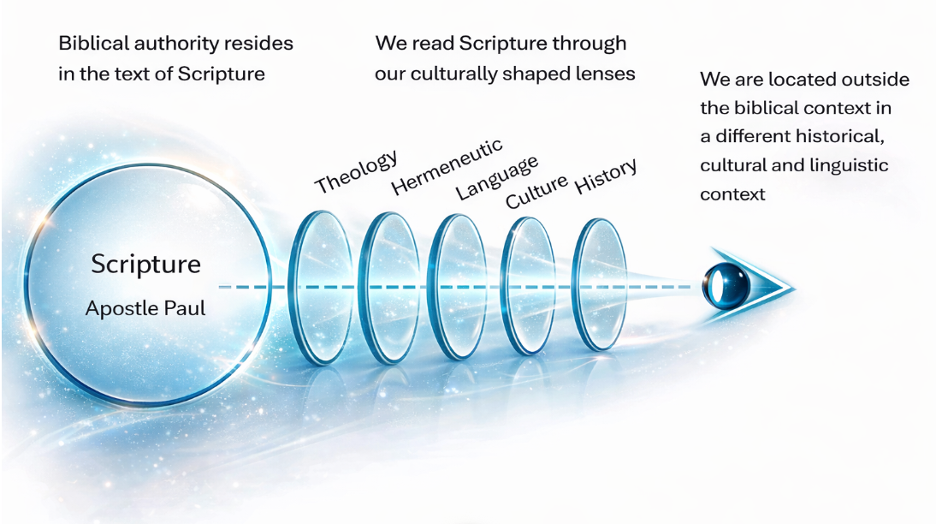
Although people may (and do) hold any of these positions, arguing for one over the others often has limited value because each begins with different assumptions. Accepting this frees us from beginning discussions focused on specific passages or even by considering our assumptions. Instead, we can acknowledge our shared limitations in understanding God’s Word: we can only obey after interpretation, we can only interpret through a cultural lens, and we can only do theology from a human perspective.[3]

For that reason, clarifying how we read the Bible provides the necessary foundation for evaluating our assumptions and for engaging thoughtfully with the passages at the center of the discussion. The hermeneutic proposed here reads Scripture as God’s revelation of His will, character, and mission so that we may be conformed to the likeness of Christ. By engaging the divine Author before anything else, we create space for grace toward others even as we evaluate our assumptions, convictions, and applications.

The hermeneutical process of reading the Bible as revelation addresses human limitations when determining how to be obedient to the word of God. These limitations were described in the article “Part 1: Reading the Bible as Revelation,” and duplicated here. When we read the Bible,

  1. We always interpret from a theological perspective, which is a human construct developed over time through exposure to God’s revelation and other influences.
  2. We always interpret from an enculturated position, using the language and concepts granted to us from our context.
  3. Communication is complex and requires dialogue within community to move to appropriate action and application.
  4. As fallen humans we are limited and prone to misunderstanding and inconsistency. Humility before God and openness to correction is required.
  5. Biblical concepts such as “authority” and the implications of “gender” should not be assumed when reading a verse. Rather, we need to recognize the influences and assumptions that shape our theology (faith) and then test them.
  6. We cannot assume that even a “clear” verse is properly understood. Because of the historical and conceptual distance between us and the original author/audience, there are contextual dilemmas and tensions that are not immediately obvious.
  7. Obedience is not about following rules and emulating biblical patterns, but conforming to God’s revealed will, character and mission.
  8. Conforming to God’s revealed will, character and mission requires expressions that are contextually meaningful.
  9. We are constantly engaging in a dialogical process between theology (faith), text (Scripture) and context (the influences that shape our thinking and understanding of reality).[4] This liminal reality is our human condition that encourages us not to establish practices based on a few verses, but on a robust theology[5] that reveals God’s deeper purposes. Only then can we confidently apply our conclusions to ecclesial contexts today.
Steps to examine disputed verses

The following steps taken from the summary of the hermeneutic of reading the Bible as revelation, also found in “Part 1: Reading the Bible as Revelation,”will be used in the consideration of the disputed verses:

1. Approach the passage as God’s self-revelation. Read Scripture primarily to know God, not as a manual of instructions to follow.

2. Recognize the differences between the biblical context and your own. Acknowledge the cultural, linguistic, and historical distance between the ancient world and today, and avoid assuming that biblical commands or practices can be applied directly to your setting.

3. Focus on the divine Author to avoid misapplying cultural forms. Discern God’s will, character, and mission in the passage and avoid treating culturally conditioned behaviors as timeless mandates.

4. Form a theological framework for the text. Asking what the passage reveals about who God is, what God desires, and what God is doing, requires consideration of a broader theological vision of Scripture in order to discern God’s kingdom purposes and gospel-shaped intentions.

5. Conform your life to God’s self-revelation in order to know him. Let the character, purposes, and mission of God—seen both in the passage and in Scripture as a whole—shape your response to the passage.

6. Develop a culturally appropriate expression of obedience. Live out the text in a way that

  1. Navigates cultural differences,
  2. Remains faithful to what Scripture reveals about God, and
  3. Embodies God’s purposes in the local body of Christ.
Applying the hermeneutic

The verses we will address with this hermeneutic are 1 Timothy 2:11–15
“Let a woman learn quietly with all submissiveness. I do not permit a woman to teach or to exercise authority over a man; rather, she is to remain quiet. For Adam was formed first, then Eve; and Adam was not deceived, but the woman was deceived and became a transgressor. Yet she will be saved through childbearing—if they continue in faith and love and holiness, with self-control” (ESV).

and 1 Corinthians 14:34–35
“The women should keep silent in the churches. For they are not permitted to speak, but should be in submission, as the Law also says. If there is anything they desire to learn, let them ask their husbands at home. For it is shameful for a woman to speak in church” (ESV).

The following description outlines the proposed hermeneutical process for considering these verses. Rather than an attempt to be comprehensive or even to consider all the questions, it provides examples and a framework within which a fuller exploration—including careful exegesis and ongoing dialogue—can take place.

1. Approach the passage as God’s self-revelation

Read the passage with the desire to discern God’s will, character, and mission that will guide us to participate more fully in His kingdom. We do not read the passage to extract directives (e.g., women must be silent, not teach, or refrain from authority), but to ask how it reveals God’s character, expresses His desire for the gathered church, and advances His mission. In other words, we ask the sincere question of a child seeking to fulfill the Father’s will, “Why was this command given?”[6]

2. Recognize the differences between the biblical context and our own

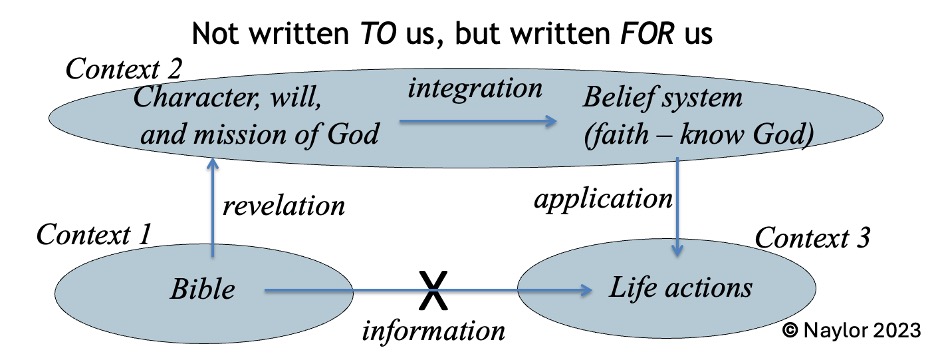
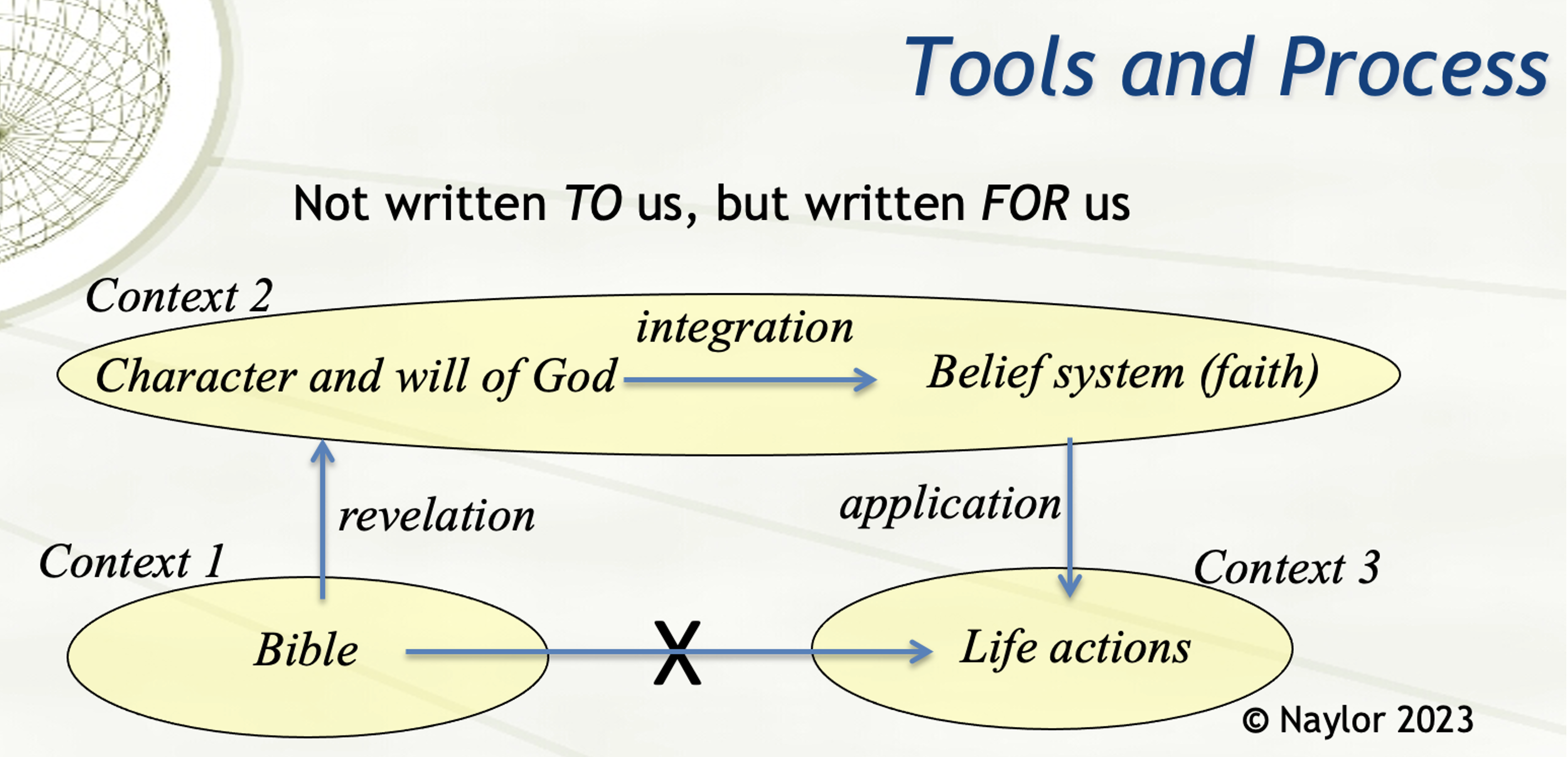
Because of the nine limitations outlined above and explored throughout these articles, the epistles should not be read as universal, normative instructions but as case studies of how the writers guided first-century believers to live out the gospel in their specific contexts. They were not written “to us,” but they were written “for us.” Therefore, they continue to guide us authoritatively as we submit to their teaching within the larger context of God’s purposes.

A rigid, literal application of Scripture without attention to differing contexts leads to conclusions that distort Jesus’ intentions for us. The universal intent of a command is realized only as we faithfully embody God’s kingdom and mission within our own context. In this, we follow the apostles’ example—discerning the way of the cross and expressing the gospel in concrete, contextually fitting ways.

3. Focus on the divine Author to avoid misapplying cultural forms

Submission to these passages is not fulfilled by adopting the practices of the early church or by following commands literally. We should avoid transplanting culturally conditioned first-century practices into our context as if they carry the same meaning or as if literal compliance constitutes obedience. Instead, we translate God’s intention into faithful and contextually appropriate expressions.

Appropriate translation occurs by discerning the kingdom purposes behind the practices described—how they reveal the will, character, and mission of God. We then conform ourselves to that vision and seek fitting ways to express God’s purposes within our own cultural setting. In this way, the congregation becomes “the hermeneutic of the gospel,”[7] following the apostolic pattern of engaging culture through the lens of the gospel and embodying it in forms that communicate God’s truth today.

4. Form a theological framework for the text.

We engage these passages theologically when we recognize that the commands they contain are not intended as universal, literal directives for all times and places. Rather, Paul was expressing the will, character, and mission of God in ways appropriate to a particular audience within its historical and cultural context. Our task, then, is to ask why Paul gave these instructions and how they helped believers live as God’s people in that situation.

We do this by considering Paul’s concerns and responses through the lens of our gospel-shaped theology—the faith by which we have learned to live and act as a Christ-centered community. Even as we come to these verses, we already hold theological convictions about leadership and gender grounded in Jesus’ teaching and expressed within our own cultural context. These form the lens through which we approach the text, even as the passages themselves refine our theology by revealing more of God’s will, character, and mission.

In short, these verses are not fixed rules to replicate but case studies that contribute to an ongoing dialogue through which we grow as God’s people. They are examples from which we learn how to embody redemption and cultivate Christ-centered relationships within our community. The following are examples of a prior theologies that we can bring to the text.

Kingdom theology as primary

Because we are Christians and believe that the coming of the kingdom overturns worldly values and priorities, placing them in their proper order under heavenly priorities, it is essential that any theology of gender and authority be developed within the framework of what it means to be “in Christ.” When we take Jesus’ kingdom priorities and values seriously, we begin by considering the shared status of all believers—men and women alike—as heirs and co-heirs with Christ (Rom 8:16-17). This shared status provides the primary theological context within which questions of gender roles in the church must be addressed.

For example, Jesus revealed kingdom priorities by (1) reworking the commands of the Law to disclose God’s intention (Mt 5)[8] and by (2) articulating God’s purpose for marriage as an indissoluble union (Mt 19:3–9). That is, Jesus did not reiterate the commands of the Laws; he emphasized the intent of those laws in a way that revealed God’s purpose and heart. Similarly, the revealed status of men and women within the kingdom must serve as the lens through which we engage the so-called prohibition passages and develop a theology of gender and authority.

We therefore begin by asking what it means for both men and women, as members of the kingdom, to be included as “brothers” (adelphoi; Rom 1:13; 8:12, 1 Co 1:10-11), counted among “sons of God” (huioi theou; Rom 8:14–16; Gal 3:26ff), named as “kings and priests” (1 Pet 2:9–10; Rev 1:5–6), receive the Spirit, see visions and prophesy (Acts 2), assigned to serve, make disciples, and build up the body of Christ (1 Co 12), called to reign (Rom 5:17, 2 Tim 2:12, Rev 5:9-10, 20:4), and crowned with authority to lay before the throne (Rev 4:10).

These kingdom realities provide a key theological foundation for our ecclesiology, since every contextual expression of the body of Christ should faithfully reflect the values, identity, and structures of the kingdom itself. Therefore, expressions of church ministry—for both men and women—should make room for the full range of what it means to live “in Christ.”

Creation as a guide towards a theology of gender

Beyond a consideration of gender status within the kingdom, we might also approach these passages through a theology of gender rooted in God’s intention for male–female and husband–wife relationships in Genesis. This is especially fitting in light of Paul’s reference to Adam and Eve in the passages we are considering. Adam is created first, and Eve is created as a “helper” (Gen 2:18). The Hebrew term ezer does not imply a secondary or inferior role within a hierarchy. Rather, it describes Eve’s role in completing what Adam lacks so that together they become one (Gen 2:21–24). Notably, ezer is most often used of God as our “helper” in times of need (Ex 18:4; Deut 33:7; Ps 70:5), indicating strength and essential support rather than subordination.

Thus, the biblical picture of husband–wife relationship is fundamentally complementary, rather than hierarchical. This complementary unity is presented as the basis of their shared purpose and life together. As George MacDonald[9] observes:

one of the great goods that come of having two parents, is that the one balances and rectifies the motions of the other. No one is good but God. No one holds the truth, or can hold it, in one and the same thought, but God. Our human life is often, at best, but an oscillation between the extremes which together make the truth; and it is not a bad thing in a family, that the pendulums of father and mother should differ in movement so far, that when the one is at one extremity of the swing, the other should be at the other, so that they meet only in the point of indifference, in the middle; that the predominant tendency of the one should not be the predominant tendency of the other.

Much more could be said in forming a robust theology of gender, but this illustrates why such theology matters when engaging disputed passages. We seek to live faithfully with the insight we have, while remaining open to continued refinement through dialogue with Scripture, with other believers, and with our cultural context.

A theology of authority

We can also consider a theology of authority in leadership as it relates to these verses: How does authority function in the kingdom according to Jesus’ teaching?

In the Gospels, the disciples frequently worried about rank and power—who would sit at Jesus’ right and left, who was greatest, who had authority over whom (Mt 18:1; 20:20–24; Mk 9:33–34; Lk 9:46; 22:24). Jesus rebuked such thinking and demonstrated the true nature of leadership in the kingdom by washing His disciples’ feet (John 13).

In the kingdom, those who lead are those who serve. Both women and men are called to serve one another and metaphorically wash each other’s feet—this is the true standard of leadership in the church. Jesus did not establish a human hierarchy of dominance. Authority rests not in status or position but in relationship to Jesus. God has not delegated authority for individuals to rule over others in the church (Jesus alone is head of the church – Eph 1:22-23; Col 1:18); authority remains in his Word and is exercised through His Spirit. The focus for leaders is that of responsibility for others for which they will give an account (Heb 13:17; Jas 3:1; 1 Pet 5:2-4).

Viewed through this lens, Paul’s concern in these verses about the exercise of authority can reasonably be interpreted as a condemnation of the misuse of authority—not the establishment of gender-specific authority.

When we approach these verses within a broader theology that understands women as full participants in the life of the church, we can affirm that the spiritual equality of men and women should be reflected in forms of servant leadership that embody the will, character, and mission of God. A well-formed theological framework enables us to discern God’s priorities and protects us from treating culturally conditioned biblical instructions as rigid rules to be replicated. As argued above, kingdom identity precedes and guides role differentiation, and the authority shared by all believers is exercised as worshipful participation in—and submission to—God’s rule.

5. Conform your life to God’s self-revelation in order to know him

The question remains: if the non-hierarchical complementarian theology presented here aligns with Paul’s own theology, what concern is driving these two verses that appear to restrict women’s leadership in the Corinthian and Ephesian churches? Many reasonable explanations—based on exegesis and historical context—suggest that Paul was addressing local rather than universal issues. Still, even if we set those possibilities aside, the hermeneutical approach proposed here invites us to discern how these verses express God’s will, character, and mission in ways that advance the kingdom and build up the community—rather than using them to restrict the freedom and calling believers—including women—have in Christ. Such actions may be elevating a perceived law above “doing good,” even as the Pharisees’ use of the Sabbath offended Jesus (Lu 6:6-11; 13:10-17; 14:1-6, Jn 5:1-18; Jn 9:1-41).

A robust ecclesial theology that reflects God’s will, character, and mission helps us understand Paul’s concern in these passages. His aim is not to impose universal restrictions but to address specific local issues recognizable to the original audience. Because those concerns arise from God’s purposes, they remain relevant for us—these teachings are “for us.” But faithfulness does not mean shortcutting interpretation or applying commands universally through our own cultural lens. Instead, we must discern God’s heart for the churches being addressed and then pursue contextually appropriate expressions of the same kingdom priorities in our setting.

Obedience as ultimately intended by the Father is not demonstrated by literal compliance to a command (although the spirit of submission in such compliance is pleasing to God), but by engaging each command within the broader theology of God’s purposes—developing a vision of the Father and a desire to live in a manner that pleases Him.

This paradigm for obedience is not contrived as if the motive is that we find these specific verses offensive and want to explain them away—that would be inappropriate and unfaithful. Instead, this hermeneutic applies consistently to all biblical commands. Jesus emphasized this in Matthew 5 by moving beyond rule-keeping to a deeper, transformative obedience: “Be perfect, therefore, as your heavenly Father is perfect.” We pursue that perfection not by rigidly following commands but by understanding God’s heart and aligning our lives with his character and purposes.[10]

As noted earlier,[11] biblical commands function like a parent saying to a child, “Don’t touch the stove!” Maturity involves discerning the loving intention behind the instruction. A grown child honors the parent’s heart—not by avoiding the stove forever, but by using it wisely. Likewise, as we grow in our understanding of God’s purposes, we learn how to live out His commands in ways that express the life he desires, not mere compliance.

As a caution to those who use these verses to rebuke women in their calling to ecclesial leadership, we should consider Jesus’ interaction with the Pharisees and teachers of the law in Matthew 15. They had elevated certain laws—specifically vows to God—above the biblical command to honor parents. Their issue was not ignorance of God’s law, but a misinterpretation shaped by human cultural assumptions. As a result, their application of Scripture harmed relationships and opposed God’s intention, and so Jesus rebuked them. 

In that same passage, Jesus declared that strict adherence to food laws—clear biblical commands—does not determine a person’s purity before God. Instead, purity and acceptance by God is a matter of the heart. Insisting on rules that hinder a person’s desire to serve God may become a form of “quenching the Spirit” (1 Thess 5:19) undermining God’s desire for that person.

The purpose of this hermeneutical step is to allow these verses to play a role in shaping our theology and then to live according to that theology so that we may know Christ. Misapplication of commands arises when we fail to account for our contextual limitations and do not discern God’s heart behind those commands.

6. Develop a culturally appropriate expression of obedience

Understanding is not enough; we are called to act and to conform our lives to God’s will. Faithful obedience requires navigating the tension between the cultural values of our setting—many of which resist biblical teaching—and God’s contextually conditioned commands, which reveal His will, character, and mission and must be embodied appropriately in our own context. Jesus himself faced such a dilemma when asked about paying taxes to Rome (Mt 22:15–22). Rather than choosing between two rigid options, he redirected attention to the deeper reality: God’s image is stamped on humanity. Faithfulness begins by recognizing our identity and the One to whom we belong. We obey by using every passage to align our lives to his desires and purposes.

In response to my friend’s question[12]—“How can you believe that a woman can serve as a pastor or leader in the church when the Bible clearly commands otherwise?”—the issue is not whether we reject Scripture on one hand or adhere to it in only one acceptable way on the other. The deeper call is to ask, “Why was this command given?” That is not rebellion or worldly doubt, but the sincere posture of a child seeking the Father’s will. True obedience means discerning the gospel purpose behind the command and expressing it in contextually appropriate ways that reveal God’s will, character, and mission today.

Afterword: Appeal to Unity

We do not follow trends, nor do we cling to traditions—we follow Jesus. Whatever convictions churches have discerned from Scripture, we want to ensure freedom to apply those convictions with joy rather than compulsion. Obedience to God’s revelation is worship: a declaration that his kingdom purposes are good. We encourage churches to submit to God’s authority and trust his word, even when their conclusions are unpopular or others disagree.

No side of the debate over women in ecclesial leadership should be characterized as rebelling against God or as having capitulated to cultural pressures. Fears that those who hold a different position have been unduly influenced—or even seduced—by culture are misplaced. In the book of Revelation, John offers a vivid portrayal of the conflict between two kingdoms. As de Silva observes, “When John takes us to look even closer into the activity of the world in rebellion against God, we see a movement afoot to steal away the worship due the One God and to draw as many people as possible into a lie that leads them away from the true center.”[13] On every side of this debate within our Fellowship, there is admirable jealousy for the “worship due the One God,” a shared passion for the kingdom of God and a common prayer, offered with Jesus: “Thy kingdom come” (Matt 6:9 KJV).

Therefore, we must not reject churches that affirm women in ecclesial leadership as disobedient or rebellious. Nor should we shame as legalistic those who hold to male-only leadership. This is not a salvation issue, but a discipleship issue—a matter of conscience and of ordering our lives in ways we believe honor God. Whatever path is taken must arise from submission to God and joyful conformity to his purposes.

Our desire as members of Fellowship churches is to learn with humility, seeking to read and apply Scripture in ways that reflect God’s heart. Dialogue with those who hold different convictions is essential—marked by grace, patience, and openness—so that together we may see what we have not yet seen. Our brothers and sisters throughout the Fellowship love and serve God wholeheartedly; we are called to affirm that devotion and pursue unity in diversity as we seek to glorify God together.

Let us resist the temptation to relieve the tension through division. Instead, let us practice patience with those who differ, recognizing that we are all on a journey of theological growth—a journey shaped by love, clarity, gentleness, and reverence. Rather than shaming or dismissing one another, we shepherd one another as followers of Jesus.

Practically, all sides of this issue offer valuable perspectives and encourage healthy tension. We are tethered to each other, able to challenge, inform, and correct one another. If we divide, that tether is cut, and each side becomes more susceptible to extremes without the balancing influence of the other.

This is not an issue worth dividing over—nor should it be ignored. When we focus on what unites us and our service and obedience are sincerely directed toward honoring God, we can make space for contextualized expressions of faith that glorify his name and welcome differing perspectives that help us continue questioning and growing.

Soli Deo gloria.


[1] See Part 3: Why we ask “why”: The Limits of Culture and Language.

[2] Lamin Sanneh, Translating the Message (Maryknoll: Orbis, 1989), 7,8 (see Part 3: Why we ask “why”: The Limits of Culture and Language).

[3] See Part 5: Developing theology through the hermeneutic of reading the Bible as revelation.

[4] See Part 4: A Framework to guide the Process of Interpretation.

[5] A good friend challenged the idea of a “robust theology,” stating that “Even many in my acquaintance who have been believers for decades would hesitate to say that they have a robust Biblical theology.” As explained in Part 5: Developing theology through the hermeneutic of reading the Bible as revelation, “robust theology”refers to the ongoing development of sincere faith as believers—”children and adults, the literate and illiterate, believers and seekers alike”—live out their commitment to follow Jesus as they find him revealed in God’s word.

[6] See Part 5: Developing theology through the hermeneutic of reading the Bible as revelationfor a detailed explanation of how this interpretive process can be applied.

[7] This is based on the title of Chapter 18 in Lesslie Newbigin’s book, The Gospel in a Pluralist Society (Grand Rapids: Eerdmans, 1989), 222.

[8] See Part 6: Biblical support for the proposed hermeneutic.

[9] George MacDonald. “The Seaboard Parish,” Chapter 2 in George MacDonald: The Complete Novels, (Kindle Edition 1869), 1496.

[10] See Part 6: Biblical support for the proposed hermeneutic for a further development of this argument.

[11] See Part 1: Reading the Bible as Revelation.

[12] See Part 2: True Obedience: Embracing the Heart of God.

[13] David A. deSilva, Unholy Allegiances: Heeding Revelation’s Warnings (Peabody, MA: Hendrickson Publishers, 2013), 43.

127f. Developing a Hermeneutical Lens to Consider the Place of Women in Ministry—Part 6

Recognizing the many influences that shape how we read and obey the Bible can make us more aware of our limitations, lead us to interpret with greater care and skill, foster a humble posture of ongoing dialogue, and help preserve our unity. All readers are invited to respond and challenge what I have written. I will be grateful for your insights and for continuing the conversation.

NOTE: Chatgpt was used for editing, but not generative purposes.

Part 6: Biblical support for the proposed hermeneutic

The central claim of this series of articles is that the debate over women in ecclesial leadership is fundamentally hermeneutical rather than merely exegetical. Every biblical command must be interpreted with careful attention both to the cultural setting of its original audience and to the cultural lenses through which we apply God’s word today. We cannot apply Scripture apart from the assumptions shaped by our enculturation into the particular context in which God has placed us. Theology, therefore, emerges through an ongoing dialogue between the biblical text and our context, rendering it both local and provisional.

At the same time, because God has truly communicated his will, we can affirm that Scripture gives us access to what is genuinely true about life and faith. Holding these commitments together—confidence in God’s revelation alongside humility about our interpretations—requires attentiveness to the Spirit, openness to correction, and a deep commitment to Jesus’ mission as we interpret and apply Scripture within contemporary ecclesial life.

To follow an interpretive pathway that is consistent and faithful to the purpose of Scripture, I have argued for a hermeneutic that reads the Bible as the revelation of God’s will, character, and mission. In this article, I will demonstrate how this hermeneutical approach is grounded in patterns and practices of the New Testament. Applied faithfully, this hermeneutic guards against isolating a verse, command or promise that is addressed to a community in a different social and historical setting and transferring it directly to our own. Instead, as we pursue the goal of knowing God and living according to kingdom principles, we seek to embody God’s purposes and mission in ways that are faithful to Scripture and fitting for our particular context.

Jesus’ New Wine

When God sought to bring people into a right relationship with himself, he did not send a second Moses—a prophet to deliver a new law. Instead, he came himself: the Logos incarnate, revealing his will, character and mission. Jesus did not map out a path to follow in the manner of Old Testament prophets; he declared himself to be “the way, the truth, and the life” (Jn 14:6).

The new life of the kingdom—the fulfillment of the gospel—was established not through a covenant of laws and commands, but through a covenant of body and blood (Lk 22:19–20; Jn 6:53–58). Under the old covenant, loving and fulfilling the law was the expected expression of faithfulness. But the new covenant, as Paul explains in Galatians, is grounded in Christ himself. Jesus lived under the law in order to free us from it and make us children of God (Gal 4).

Within this new covenant, obedience is not about following biblical commands, but about conforming to the person, purpose, and mission of Jesus as revealed through those commands. Our Redeemer leads us into life by prioritizing relationship over rules.

I will argue that this paradigm shift permeates the entire New Testament and reframes kingdom living in relational terms. Reading the New Testament primarily for “teachings to obey” is a categorical mistake that overlooks the full implications of the “new wine” Jesus proclaimed. This new wine fulfills the prophetic vision: “I will put my law in their minds and write it on their hearts. I will be their God, and they will be my people” (Jer 31:33 NIV).

I believe this corresponds to Ezekiel’s promise: “I [God] will give you a new heart and put a new spirit in you; I will remove from you your heart of stone and give you a heart of flesh. And I will put my Spirit in you and move you to follow my decrees and be careful to keep my laws. Then you will live in the land I gave your ancestors; you will be my people, and I will be your God” (Eze 36:26-28 NIV).

Ezekiel speaks within the framework of the old covenant, where faithfulness was expressed through obedience to the law. Yet his vision anticipates an unimaginable paradigm shift: God incarnate inviting us into relationship with himself. The focus moves from “following decrees” and “keeping laws” to receiving God’s Spirit, who enables us to live in imitation of our Lord—just as Jesus submitted himself to the Father.

The gospel is not a collection of universal teachings and commands to obey, but the revelation of the person of Christ whom we are called to emulate. The teachings and commands in both the Old and New Testaments are contextually specific expressions of God’s will, character, and mission—examples from which we learn to follow and know Jesus. There is no command that applies directly and universally; rather, every teaching and instruction is a culturally situated revelation of who God is, what he desires, and how he is working to bring about redemption.

Emulating Jesus and the Apostles as we engage Scripture

Our Lord and Saviour Jesus Christ is the incarnate Word—God revealed—not only in human flesh, but within a specific cultural context. We are called to emulate him (Mt 4:19). In revealing God and engaging people in his setting, Jesus continued the pattern of divine accommodation that God has practiced from the beginning in his relationship with humanity. God’s desire is that his grace and truth be reflected in every society through faithful, contextualized expressions—his kingdom coming on earth as it is in heaven.

What, then, is our calling? We are called to follow the apostles’ example of discerning culturally appropriate expressions of God’s will, character, and mission through engagement with Scripture. Because our cultural setting differs from that of the New Testament, faithful obedience will inevitably require fresh expressions shaped by our context. We enter into a dialogue with Scripture in order to discern what it means to submit to our heavenly Father in ways that are culturally appropriate and biblically faithful.

This dialogical approach to Scripture is not a compromise with modern or worldly values, as though we were reshaping God’s intent to suit contemporary expectations. Nor is it an arrogant claim that we possess insights that improve on God’s communication. Rather, it is a recognition that we must grasp God’s heart and intention in a manner consistent with Scripture and express that intention in ways that resonate with the dynamics of our context.

To fulfill this commission, Scripture must first be interpreted according to its original intended meaning and only then applied. Yet because that meaning is itself culturally embedded, it cannot be transferred directly into our setting. Instead, each biblical teaching is to be understood as an expression of kingdom living within a specific historical and cultural environment—an expression that invites us to discern a faithful, contextualized embodiment in our own time and place. What we are not given is a set of universal commands untouched by cultural considerations. I believe this is God’s good intention, ensuring that our focus remains on being his obedient children rather than prioritizing laws.

I will now show how Jesus himself models the hermeneutic advocated in these articles, and how the apostles follow his approach as they work out the implications of the gospel within their New Testament context. This, in turn, calls us to continue the same theological process. We are to imitate Jesus’ use of Scripture and his teaching about the gospel, as well as the apostles’ practice of discerning how best to embody the gospel within their first-century world.

The New Testament therefore provides a model for gospel-shaped living. Our task is not to replicate the apostles’ specific conclusions as a fixed pattern for church practice, but to follow their example by discerning what faithful gospel embodiment looks like in our own context—always consistent with the apostolic witness and guided by their commitment to contextualize the gospel faithfully.

The Sermon on the Mount

In the Sermon on the Mount, Jesus models a way of reading the law that invites us to discern the heart, character, and mission of God through an unexpected reading of the commands. Jesus reveals that obedience is not conformity to the command itself but using the commands as windows into the heart of God. The goal is conformity to the divine purpose that those commands represent.

In Matthew 5:17–20, Jesus declared:

“Whoever disobeys even the least important of the commandments and teaches others to do the same will be least in the kingdom of heaven. But whoever obeys the Law and teaches others to do the same will be great in the kingdom of heaven. I tell you, then, that you will be able to enter the kingdom of heaven only if you are more faithful than the teachers of the Law and the Pharisees in doing what God requires” (TEV).

What does it mean to be “more faithful” or “more righteous” in doing what God requires? Jesus ultimately clarifies this in the final verse of the chapter, calling us to “be perfect, as your heavenly Father is perfect” (5:48). This corresponds, I believe, to his emphasis on the greatest commandment: “Love the Lord your God with all your heart and with all your soul and with all your mind” (Mt 22:37 ESV). Such obedience is not achieved through conformity to rules, but through conformity to the character, purposes, and heart of God.

How this perfection of love for the Father is accomplished is illustrated by the examples given between those key verses 20 and 48 of Matthew 5. Jesus provides an interpretive process that parallels the hermeneutical approach advocated in these articles. He shows not only how we are to read commands but also how those commands are meant to shape us.

When he quotes the Torah—“You have heard that it was said, ‘You shall not kill,’ but I say to you…”—he is not replacing one command with another, nor is he calling for mere behavioral compliance (as in, “I have not murdered, therefore I have obeyed”). Instead, he reveals the heart of God and directs us toward the deeper orientation to which we are to conform. We are called to adopt a posture of love and care toward those for whom our natural inclination might be anger, mockery, or contempt. These descriptions are not new rules meant to restrict us at the behavioral level; they are an invitation to understand God’s heart for people and to reflect that heart in our desires and relationships.

This is the pattern and guide for what it truly means to obey God’s commands. Obedience is not mere behavioral conformity, no matter how clear a command may appear. Rather, it is understanding and conforming to the character, will, and mission of God—from which genuine fulfillment and appropriate response become possible. Notice that Jesus did not dismiss or reject God’s commands. Instead, he embraced them as revelation rather than rulebook. Commands were to be obeyed by discerning and applying the purpose behind them—the “why.” The apostles, and especially Paul, adopt this hermeneutic throughout the New Testament. God’s commands are not to be rejected, nor are they to be applied directly according to their “plain meaning.” Instead, to “be perfect, as your heavenly Father is perfect” (Mt 5:48) is to discover how the purpose of a command—the “why”—can be faithfully fulfilled.

The Good Samaritan

We see the same dynamic in the parable of the Good Samaritan. The questioner sought a clear command to obey—something specific that would allow him to feel justified in his righteousness: “Who is my neighbor?” But Jesus reverses the question, asking instead, “Who acted as a neighbor?” In doing so, he shifts the focus from defining limits about a command to cultivating sacrificial generosity that extends to anyone in need.

Confronting the Pharisees – Matthew 15

In Matthew 15, the Pharisees complain that the disciples do not wash their hands before eating. Jesus responds by accusing them of failing to honor their parents, and to drive home his point he quotes Isaiah 29:13: “These people honor me with their lips, but their hearts are far from me. Their worship is a farce, for they teach man-made ideas as commands from God” (NLT). At first glance, it may appear that Jesus is merely contrasting God’s laws with human traditions and dismissing rules not rooted in Scripture. But as he continues teaching the crowd in verse 10, it becomes evident that his concern goes far deeper than the source of a command. He goes on to challenge the food laws themselves—laws that come directly from the Torah. This is unsettling not only for the Pharisees, but also for the disciples.

Verses 16–20 reveal that Jesus is not focused on deciding which laws should be obeyed and which set aside. Instead, he directs his audience to the deeper principle: we are not called to merely apply commands mechanically but to discern the heart of God behind the command. The real issue is not about commands at all, but “evil thoughts, murder, adultery, all sexual immorality, theft, lying, and slander. These are what defile you. Eating with unwashed hands will never defile you” (Mt 15:19–20 NLT).

Something greater is here – Matthew 12

In Matthew 12, as the disciples walk through a field eating grain on the Sabbath, the Pharisees accuse them of violating the Mosaic law, essentially asking, “What kind of rabbi allows his disciples to ignore the law?” Jesus does not dispute their interpretation; he accepts that the action could be viewed as unlawful. Instead, he argues that there are situations in which breaking the law is permissible, offering two examples: David eating the sacred bread of the sanctuary, and the priests working in the Temple on the Sabbath. In both cases, something more important takes precedence over strict legal observance. David, the Lord’s anointed, was in desperate need, so the rules of the sanctuary—God’s own law for God’s sacred space—were set aside. Likewise, the duties of the Temple override the Sabbath law because the priests are serving God. Jesus then delivers his decisive point: just as these examples warranted exceptions, so too does the situation with his disciples, for “one greater than the Temple” is here.

Jesus is, in effect, saying, “Take note—God is doing something new, something greater than the Temple. Look around and discern what is happening: God is breaking in with his kingdom, his rule, his transformation. Open your eyes to the reality before you.” The kingdom of God is being established, and Jesus is the King. This “new wine” surpasses the old pattern of conforming to commands. The inbreaking of God’s kingdom is a greater work—one that takes precedence over the law.

This reorientation toward a hermeneutic that prioritizes God’s heart rather than mere command-keeping continues throughout the chapter. In verse 12, Jesus declares, “The law permits a person to do good on the Sabbath.” He is not quoting a verse from the Torah; no such explicit exception exists. The Pharisees are technically correct that Jesus should not violate the Sabbath law. Jesus’ frustration is not that they misunderstand the law, but that they do not know his heavenly Father who gave it (a constant refrain in the gospel of John). If they understood God’s heart, they would not elevate the Sabbath law above doing good. Ultimately, in verse 50, Jesus articulates the central principle—one that stands in sharp contrast to the Pharisees’ orientation to the law: “Anyone who does the will of my Father in heaven is my brother and sister and mother!”

The apostles after Pentecost

With the coming of the Spirit at Pentecost, the apostles began to reorient their understanding of Jesus, the gospel, and the kingdom—including their perspectives on Scripture, the temple, and the law. They had seen Jesus, listened to him, lived with him, and received his Spirit, yet they now faced unfamiliar situations with no direct command from the Lord. This did not leave them unprepared; knowing the Father, knowing the Son, and being led by the Spirit enabled them to navigate new and unexpected cultural scenarios.

As the implications of the gospel unfolded, they sought to express the kingdom appropriately within their own settings. In doing so, they developed a contextual theology, working out the will, character, and mission of Jesus in the circumstances they encountered. This is the pattern we are meant to follow—a hermeneutical pattern of expressing the gospel in new contexts—not a rote adoption of contextually specific practices that addressed people living in another time and cultural setting.

The contextualized expressions of the gospel established by the apostles are recorded for us not as ecclesial mandates, but as inspired examples from their time. The book of Acts does not end as though the work of the Spirit were complete and we now simply follow the Bible as a manual containing universal practices for all eras. Instead, we are called to work out the implications of the gospel in our own context by emulating the way the New Testament writers worked out the gospel in theirs.

The inclusive nature of the gospel – Acts 8 and 10

In Acts 8, the Holy Spirit leads Philip to a lonely road, where he encounters an Ethiopian eunuch. When the eunuch asks in Acts 8:36, “Why can’t I be baptized?” Philip does not respond, “First, you are an Ethiopian, so you cannot be baptized—this is a Jewish Messiah. You may listen to our teaching when you visit, but you cannot be part of us. Second, you are a eunuch, and therefore damaged; you cannot truly be a member or citizen of the new kingdom, though you are welcome to look in from the outside.” Instead, Philip baptizes him immediately. This act was profoundly radical and subversive—an astonishing example of working out the gospel in a way that broke through every expected boundary.

Verse 37 is absent from the best manuscripts. In the narrative, the eunuch asks, “Why can’t I be baptized?” Later scribes—likely concerned with clarifying the meaning of baptism—added a response in which Philip says, “You can, if you believe with all your heart,” followed by the eunuch’s confession, “I believe that Jesus Christ is the Son of God.” This verse was not original to Luke’s account and distracts from the focus of the passage which is not on defining the theology of baptism but on the contextualization of the gospel. The story emphasizes that the good news is inclusive of all nations and all people—even the marginalized. Philip’s actions are not guided by written commands but by the leading of the Holy Spirit and by his understanding of Jesus as the fulfillment of the Law and the Prophets.

A similar dynamic appears in Acts 10. Peter has a vision commanding him to eat unclean food—something that would have been profoundly difficult for him. Obeying this command meant engaging in practices he believed were wrong and that would render him unfit for God’s presence. It required him to set aside clear biblical commands; in his mind, such food would make him impure and unholy. And yet God says, “Eat.” First Pentecost opened the door to Jews of other languages and cultures, then the gospel embraced eunuchs, and now Peter is being told to eat pork. Peter must have thought, “Where is this going to end?” He immediately found out because gentiles sent from Cornelius knocked at the door.

This subversive nature of the gospel—and the way it continually produces new and unexpected expressions in different contexts—is a central New Testament theme. We are not called to obey commands mechanically but to conform our lives to Jesus’ “new wine” and to live out the kingdom in ways that are faithful and appropriate in our own context.

The question of circumcision

Two contrasting hermeneutical approaches emerge in Acts 15 during the early church conflict over whether circumcision was required for inclusion in the body of Christ. Verse 5 reports, “Some of the believers who belonged to the party of the Pharisees stood up and said, ‘The Gentiles must be circumcised and told to obey the Law of Moses’” (TEV). For the Jewish community, circumcision—established as far back as Abraham—was the sign of commitment to God, acceptance by God, and identity as God’s people. The law given through Moses was to be obeyed to the letter. The “plain sense” of the command was unmistakable, and it carried severe penalties for disobedience (Gen 17:14).

But this path was rejected as normative for believers by the apostles, most notably by Paul, himself a former Pharisee. The “new wine” Jesus brought was not a replacement set of laws that substituted new commands for the Torah, as though the new covenant followed the same legal pattern as the old. Rather, the way of the Spirit—and Christ’s own approach to commands and the law—was fundamentally different. God’s commands were not discarded; instead, the hermeneutic changed.

The apostles were re-evaluating all scriptural injunctions in light of the gospel. In Jesus, everything has been fulfilled. Now that God has revealed himself fully in Christ and given the Spirit, we are not called to be rule-keepers but grace-shaped followers of Jesus who discern God’s will, character, and mission through every command, discovering fresh and faithful expressions of God’s heart and purposes within our own context.

Obeying the commands to the Gentiles

James’s speech in Acts 15:19–21 reinforces this hermeneutic. Guided by the discernment of the gathered believers and the leading of the Holy Spirit, James concludes that gentile believers should abstain from three behaviors:

  1. Eating food polluted by idols,
  2. Sexual immorality, and
  3. Eating strangled animals and blood.

James was not constructing a new Christian law, nor was he attempting to impose Jewish restrictions on gentile believers. These directives are not commands to be added to our statements of faith, used as the basis of a covenant, or posted in our churches. To insist on literal application in every context would be harmful in two ways:

  1. First, misapplication and unintended restrictions would arise from failing to recognize the contextual realities that give these commands their meaning.
  2. Second, without discerning the heart and purposes of God that prompted the directives, people could demand compliance in ways that merely impose their own cultural values rather than reflect God’s intentions.

For example, concepts of “sexual immorality” can take distinctly cultural forms that do not necessarily match God’s purposes. A theology of sexual ethics shaped by a hermeneutic that reads the Bible as God’s self-revelation directs us to interpret passages such as Acts 15:19–21 in contextually sensitive ways that reflect what God desires for his people.

James’ response was a Holy Spirit–guided declaration shaped for the cultural realities of his day, and from it we can still learn. These commands should neither be dismissed as irrelevant as if they are “just cultural,” nor embraced as if they were written directly “to us.” Rather, they are truly “for us” in the sense we have been discussing: they reveal God’s will, character, and mission.

James’ directives addressed patterns of life appropriate for gentile believers in that time, enabling them to live “in Christ” and embody their identity as children of God. His conclusions disclose God’s heart for his people—an orientation we must also learn to express appropriately in our own time.

For this reason, we approach these commands by asking “why”: Why were these instructions given? How do they reflect the will, character, and mission of God? Only with that understanding can we craft faithful responses and expressions that reflect God’s purposes and desires within our own context.

The Spirit brings life, the Law brings death – Romans 7

In Romans 7, Paul explains that the effect of the Law was to introduce the element of rebellion into the human propensity toward sinful action. The Law places human behavior within the category of relationship with God. Prior to the Law, sinful actions were wrong, but not necessarily rebellious—much like trespassing when one is unaware that an authority has forbidden access. Once a person is informed that a particular action is forbidden by God and chooses to do it anyway—like deliberate trespassing—that action becomes an act of rebellion that damages or fractures the relationship. Under the old pattern, life was oriented toward obedience to the Law as a means of pleasing God and avoiding rebellion. To knowingly disobey a command that one understands to be from God is, therefore, to live in rebellion.

For when we lived according to our human nature, the sinful desires stirred up by the Law were at work in our bodies, and all we did ended in death (Rom 7:5 TEV).

To live by the Spirit changes the dynamic. We no longer obey laws in order to please God. Rather, we read the laws as a window into the heart of God—a revelation from the Spirit of God. Relationship comes first; laws are expressions of God’s will, character, and mission that guide us within that relationship. The goal is no longer obedience to laws as a means of pleasing God, for, as argued throughout these articles, new contexts call for fresh expressions if kingdom values are to be fully embodied. We interpret biblical commands through the lens of the gospel, as the apostles did, and we apply that interpretation through the lens of our cultural contexts, even as the apostles did in their context.

Now, however, we are free from the Law, because we died to that which once held us prisoners. No longer do we serve in the old way of a written law, but in the new way of the Spirit (Rom 7:6 TEV).

In the final article, I will apply the proposed hermeneutic to some of the disputed verses on women in leadership to suggest how those verses can be addressed.   

127e. Developing a Hermeneutical Lens to Consider the Place of Women in Ministry—Part 5

Recognizing the many influences that shape how we read and obey the Bible can make us more aware of our limitations, lead us to interpret with greater care and skill, foster a humble posture of ongoing dialogue, and help preserve our unity. All readers are invited to respond and challenge what I have written. I will be grateful for your insights and for continuing the conversation.

Some material in this article is based on my Intercultural Theology course given as an instructional lecture series with Northwest Baptist Seminary. 

NOTE: Chatgpt was used for editing, but not generative purposes.

Part 5: Developing theology through the hermeneutic of reading the Bible as revelation

After posting Part 4: A Framework to Guide the Process of Interpretation, a close friend wrote to express concern that, if the linguistic and cultural limitations I described are indeed the realities we face, then interpreting Scripture begins to feel “hopeless,” and the Bible risks becoming “a mystery and a magical goal that Christians can never hope to truly understand.” Such a conclusion, my friend warned, easily leads to a relativistic claim that “everyone’s interpretation is as good as another because nobody properly knows.” If this is the outcome, many readers will simply dismiss the argument as an overly academic complication of what is ordinarily a simple, everyday act of reading and understanding—something people do quite naturally.

Rejecting this kind of relativism, readers may instead default to their instincts, overlook cultural and linguistic limitations, and assume that their own reading of the Bible is transcultural and grounded solely in God’s universal revelation. This “realist” posture treats truth as essentially equivalent to one’s own perception of it and is often captured in the saying, “If the plain sense makes good sense, seek no other sense.”

Moreover, if this complex cultural and linguistic “veil” truly obscures God’s word, how can I then turn around and commend the Discovery Bible Study (DBS) method of reading Scripture—which I do? DBS is grounded in the perspicuity of Scripture and affirms that all people—children and adults, the literate and illiterate, believers and seekers alike—can read God’s word and understand its message.

These concerns are worth taking seriously. Because we cannot remove ourselves from the inherent limitations of language or from our cultural location, our knowledge of God, truth, and reality is necessarily perspectival rather than absolute. Yet this is not a flaw in the system, but a feature of God’s design and one that is consistent with Scripture itself. It reminds us that we are called to live by faith—that is, by trust—and not by sight. The apostle Paul speaks of seeing “as in a mirror, dimly” (1 Cor. 13:12), rather than possessing certainty grounded in proof, logical mastery, or confidence in our own capacity to know without remainder. Given that this is the reality established by God’s creative purpose, the question remains: how can we be confident that what we believe—beliefs shaped by our limited perspective—are nevertheless true? How are we rescued from the twin concerns of “hopelessness” and “relativism” that my friend raises?

Establishing faith by engaging God’s self-revelation in and through culture

The answer, I believe, emerges in this article and can be summed up in the word theology. By theology, I do not mean the weighty tomes written by spiritual giants of the past that line pastors’ shelves, but the lived reality of pursuing God. It is not primarily the abstract reasoning of trained scholars, but the daily practice of believers as they together discern what it means to follow Jesus. Theology is what we are doing whenever we reflect on our faith as we engage God’s self-revelation given through his word.

Within the Christian faith, we affirm that there is an Absolute—God—who speaks authoritatively into our lives. For evangelicals, it is the word God has spoken that guards us from chaos and relativism. God has demonstrated that he communicates sufficiently through the languages he has entrusted to us and the cultures in which he has placed us. The following seven culturally shaped ways through which God has chosen to communicate underscore this claim: our languages and contexts are not obstacles to revelation, but part of God’s design, serving as sufficient and effective means by which he makes known his will, character, and mission.

  1. God has communicated through the culturally shaped Old Testament revelation.
    God accommodated to our human condition by revealing his nature and will through local languages and literary forms, including poetry and historical narratives that recount God’s actions in the world. This revelation employed concepts, symbols, and forms intelligible to the audiences who lived within those particular cultural contexts.

  2. God has communicated through the culturally shaped incarnation.
    God’s ultimate act of revelation and contextual accommodation is the incarnation of his Son. Within a particular human context, God revealed what it means to be truly human through the life and actions of the one who is truly God. When Jesus declared, “I am the truth” (Jn 14:6), at least part of that claim is that through him we see who God is, and through him we discover what it means to live in faithful relationship with God. This entire revelation is necessarily culturally shaped.
           The incarnation cannot be understood apart from a concrete historical and cultural setting. The gospel, therefore, is neither acultural nor ahistorical. It exists—and carries meaning—only within culture and history and is communicated to other contexts through translation. Consequently, we cannot claim that there is a single, absolute, acultural theology and that our own theology represents that standard. Rather, we know absolute truth only perspectivally, within our context, and through forms that are themselves contextually shaped. Our confidence that such understanding is both meaningful and genuinely corresponds to truth rests in faith in God’s purposeful design.

  3. God has communicated through the culturally shaped New Testament revelation
    The New Testament shows us how to think about the gospel. When we ask, “What should this incarnation or this gospel look like in our setting?” we are following the pattern of the apostles themselves. The New Testament reveals the message and actions of Jesus worked out in context—truth discerned and embodied within particular cultural situations. This provides a revelation to be formed by, not a manual to replicate. We are not called to adopt the cultural practices of the New Testament world, but to faithfully work out that same gospel in our own contexts, just as the first believers did in theirs. This argument will be developed further with examples in Part 6: Biblical Support for the Proposed Hermeneutic.

  4. God the Holy Spirit communicates in culturally shaped ways.
    Scripture itself is an example. The Bible is “God-breathed” (2 Tim 3:16) into contextual forms and its prophetic message came as people were “carried along by the Holy Spirit” (2 Pet 1:21). Moreover, the apostles explicitly attributed many of their contextually meaningful actions to the guidance of the Spirit (e.g., Acts 16:6-7; 20:22; Gal 5:25). This testimony gives us confidence that God will successfully communicate what he intends to communicate. When Jesus promised to send a helper (Jn 14:16, 26), he was not referring to the Bible, but to the Spirit. The Spirit guides us into all truth as expressed through our lives and social situations.
           When we lived in Pakistan, we observed a mystical Islamic practice in which a guru and his disciples would chant “Allah hu” (“God is one”) for hours in an attempt to enter a trance state. This is mysticism and stands in contrast to Christianity. The Spirit does not remove us from our cultural context or bypass our humanity; rather, the Spirit gives life in and through the ordinary realities of daily life.

  5. God’s mission is contextual.
    The mission of the kingdom does not depend on us. Jesus declared, “I will build my church,” and the book of Revelation proclaims the victory of the Lamb. Yet all of this unfolds within concrete cultural contexts. God’s mission is inherently contextual: we discern what God is doing in and through diverse settings. This is not an accident but God’s intention, and it confirms that God’s message can be faithfully expressed within any cultural context.

  6. God builds our confidence through our experience in the community of faith.
    Growth in understanding occurs through dialogue, shared discernment, and mutual learning—processes that are always culturally shaped. It is God’s intention that we mature together in community, learning how to express the gospel in ways that are faithful and contextually meaningful. This is what Lesslie Newbigin famously described as the “Congregation as Hermeneutic of the Gospel.”[1]

  7. God provides culturally shaped covenants of truth and faithfulness.
    A covenant involves a total commitment of self grounded in faithfulness. Vanhoozer in his book Is there meaning in this text? builds on the biblical covenant theme to argue that communication itself rests on a covenantal relationship between author and reader.[2] That is, communication is possible because the author commits to communicate truthfully, and the reader commits to listen and interpret with integrity. On this basis, understanding can occur. We therefore trust that communication is possible and have faith that God uses cultural means to communicate truthfully and effectively, accomplishing what the Spirit intends.

Theology as a journey with God

Running through all of these points is the recognition of culture’s formative influence on theology. Determining which aspects of a theology are faithful to God’s absolute truth and which are not cannot be accomplished through a purely academic or logical comparison of doctrines measured against some fixed, absolute theology—because no such universal theology is available to us. Theology is a human reflection on God’s word, and as such it is always perspectival and contextually shaped. We do not have access to a neutral or universal theological standard that stands outside culture.

Yet this is not a deficiency; it is a gift.

For a long time, I found this frustrating. Why do we rely on summarized explanations of the gospel, with a verse drawn from one passage and another verse drawn from elsewhere? Why do gospel presentations so often consist of someone explaining the gospel rather than simply letting Scripture speak for itself? Why is the Bible not “plain enough” without our additions and commentary?

That frustration arose from my own culturally shaped view of the world. In a rational, scientific framework, we ask questions, receive answers, summarize those answers clearly and logically, and then move on. Each question is meant to be resolved, closed, and left behind. But life is not meant to be so mechanical. Theology is far richer than logical summaries, and God intends us to engage in creating contextual expressions of theology rather than to have access to a single, overarching, universal system.

If that is the case, then theology is:

  • A lifelong journey, not merely the accumulation of information.
  • Primarily relational, focused on knowing rather than simply knowing about—relationships cannot be reduced to summaries. It’s like a piece of music, when you speed it up or take out the pauses, you lose the essence.
  • A leveling of the playing field, in which no one has privileged access, everyone participates and all theology remains partial and incomplete.[3]
  • Dialogical, shaped by many voices learning from one another in community.
  • Multifaceted, flourishing through intercultural engagement rather than static universal claims.

Culture and theology are therefore inseparably linked in a way that actually strengthens our confidence in God’s communication. We are called to know God “in Christ” while living within our limited, perspectival contexts. Culture is not a barrier that keeps us from truth; it is the means by which we engage truth—much like glasses enable us to see clearly without ever becoming the thing we see.

We can be confident in our knowledge of truth because God has taken the initiative to speak within human contexts. Above all, Jesus Christ is the fullest revelation of the Father, and this revelation is relationally sufficient for our deepest spiritual need. As Jesus says in John 17:3, “Eternal life is to know you, the only true God, and to know Jesus Christ, the one you sent.”

By way of analogy, I truly know my wife, Karen—but not exhaustively or completely. I do not see through her eyes, hear through her ears, or think her thoughts. Yet through our shared experiences and contextually shaped relationship, I know her truly and meaningfully. That knowledge is sufficient for love, trust, and commitment. In a similar way, God’s self-revelation in the incarnation—though limited in scope—remains full, true, and profoundly sufficient. In Jesus, a finite expression of the infinite God has entered our world, revealing grace and truth in a way that meets us relationally.

How the hermeneutic of reading Scripture as revelation overcomes contextual limitations

We cannot read Scripture from a neutral standpoint, since our own cultural and linguistic location both shapes and limits our ability to understand and apply God’s Word. Consequently, approaches that directly adopt biblical patterns, commands, or promises addressed to the original audience—such as interpreting the so-called prohibition passages as straightforward restrictions on women in pastoral leadership—are likely to result in misapplication when transferred uncritically into contemporary contexts.

The hermeneutic of reading the Bible as revelation, or what may also be called a contextually sensitive hermeneutic, is proposed as a way of navigating this God-ordained limitation. When the telos of our engagement with Scripture is the discernment of God’s will, character, and mission, as is emphasized in Discovery Bible Study (DBS) method, we are better positioned to avoid the pitfalls that arise when interpretation remains at the level of the text’s surface meaning. Rather than seeking a “promise to claim,” a “sin to avoid,” or a “command to obey,” our goal becomes the development of a robust and coherent theology of God—one that shapes our lives and guides our expressions of what it means to be the people of God within our particular context.

Encountering the eternal God at work within cultures unlike our own, yet recognizable as the same faithful God, is the formation of theology. That theology then addresses the reader’s own life, calling forth submission, repentance, and worship. At its most basic level, engaging Scripture means reading—or hearing—and being drawn into a transforming relationship with God. This is something people can do at any stage of their spiritual journey, because it is grounded not in mastery of doctrine, but in encounter with the living God at their level of understanding.

This hermeneutic also guards against the opposite error of ignoring or filtering out passages that do not resonate with the values and beliefs of our context. All Scripture remains “useful for teaching, rebuking, correcting and training in righteousness” (2 Tim 3:16). Cultural dissonance is addressed not by dismissing difficult texts, but by reading Scripture as a revelation of God’s will, character, and mission rather than as a set of instructions directly addressed to us as the audience.

Finally, the hermeneutic of reading the Bible as revelation recognizes that we never approach Scripture as blank slates. We come with theological frameworks already in place. By prioritizing the ongoing formation of our theology of God, this approach prevents us from prematurely or naïvely assuming that a command or instruction applies directly or universally. Instead, it calls us to read with awareness of our theological assumptions and cultural embeddedness, remaining open to having our theology reshaped in light of what we discover in the text.

In essence, this hermeneutic creates a dynamic dialogue between our existing theology and the biblical passage before us. We attend carefully to how the text reveals God’s will, character, and mission, and then, drawing on the broader theological understanding formed through prior study and communal reflection, we discern how to respond faithfully. Once we recognize how a passage discloses God’s purposes—and how this aligns with what we already know of God—we can live and act in contextually appropriate and obedient ways.

Conforming to theology is not the same as conforming to commands. The difference is akin to memorizing a driving rulebook versus becoming a mature, responsible driver. A mature driver understands road conditions, respects others, and adapts wisely to changing circumstances while maintaining direction and purpose. In the same way, a theology that orients our lives toward God’s mission fulfills Jesus’ purposes far more effectively than treating individual rules as fixed absolutes. Indeed, insisting on universal behaviors drawn from particular commands can undermine their intended purpose when contexts change.

Ultimately, we are called to something deeper than a religion in which acceptance is measured by obedience to commands. The Bible was not designed to function as a set of laws to follow but for relationship. It is primarily a covenantal text that draws people into right relationship with God through the Lord Jesus Christ. We are called to imitate Jesus—the living Word—and to live as beloved children of our heavenly Father. Reading Scripture as the revelation of God’s will, character, and mission provides the proper orientation that leads us to experience and live out that covenant relationship with God.

Reading the Bible to know God

As illustrated in the contextually sensitive hermeneutical diagram presented in previous articles and reproduced here, it is not possible to move directly from Scripture to application. Rather, we read biblical texts through our contextual lenses, shaped by prior assumptions. The hermeneutic proposed here offers guidance by keeping the focus of interpretation aligned with the Bible’s primary purpose: to draw us into relationship with God in Christ. It helps us navigate the dangers of unexamined cultural assumptions by framing interpretation as a process of theological and relational formation—one that seeks faithful contextual expressions of God’s revealed will, character, and mission, rather than assuming that the instructions of the text address equivalent situations in our own context.

This hermeneutic acknowledges and accommodates the interpretive lenses we bring to Scripture. It recognizes and facilitates a dialogical engagement between God’s self-revelation in the Bible and our prior theological convictions and cultural assumptions, enabling us to avoid both uncritical readings that ignore cultural dynamics and inflexibility that resists the reshaping of our theology.

Theology is, by nature, limited and human-derived—a finite attempt to comprehend God from within our particular cultural and linguistic location. We should therefore expect our understanding to be incomplete, recognizing the need for ongoing development in order to interpret any passage of Scripture in a manner consistent with God’s intent.[4] In other words, the Bible is designed to nurture in us, as God’s children, an ever-deepening sense of wonder, delight, and love for our Father.

Before we were married, Karen and I lived on opposite sides of the country. This was before the internet, and I lived for her letters. I worked in construction, and at break time I would pull her most recent letter from my pocket and read it again. Why? I already knew what it said—I had read it a dozen times! But I reread it because it made me feel close to her. I wanted to sense her presence. I wanted to connect with her.

I suggest that this is how we should read our Bible—not primarily to get answers, to improve our lives, or to find teachings to apply, but to know God. When I went to Pakistan, my role was not to teach people what they should believe about Jesus, but to expose them to Jesus. It was essential that the Bible be the curriculum, not so they could extract lessons to apply, but so they could encounter God’s love letter and see Jesus.

All biblical passages should be read as part of a larger theological movement through which we discern God’s will, character, and redemptive mission, culminating in Christ. No command, law, or teaching should be applied in isolation from this broader theological framework, since doing so allows our cultural biases and assumptions to dominate interpretation. This error is addressed through the ongoing work of theology—an ever-deepening understanding of God—cultivated by communal engagement with Scripture as the revelation of God’s will, character, and mission. Theology, then, is a creative and continuing dialogue between our faith, God’s Word, and the lived realities of our lives.

Tiers of Theology

Theologies differ according to the contexts in which they emerge. While careful theological work employs shared methodologies—such as exegesis, logical reasoning, systematic categories, and attention to biblical themes—what ultimately distinguishes one theology from another is its particular context. A failure to attend to this reality often leads people, who may otherwise be skilled in exegesis and logic, to interpret and apply New Testament patterns and commands directly to their modern context, without recognizing that faithful obedience to Scripture in different contexts necessarily requires different expressions.

Different histories, perspectives, questions, priorities, and conceptual frameworks shape how a theologian reads Scripture and seeks to understand God. The following Theologizing in Context diagram represents this dominant contextual reality that influences every theological effort. Theological methodology (the inner circle) includes both systematic theology—asking our questions of the text—and biblical theology—discerning the theology of the text. All of this work employs tools such as exegesis and logic. However, the primary point of the diagram is to illustrate that all theology is inevitably worked out using the language and assumptions of our context, the lenses by which we view reality. Even as God communicates in and through an accommodation to our particular location, so we use the contextual lenses of the our context to engage God’s word and develop our theology (experience and expressions of faith).

This reality does not diminish or undermine the work of theologizing. On the contrary, acknowledging the contextual dimension as an essential part of the theological process affirms that our understanding of God must be expressed within a community of believers who embody the kingdom in their particular setting. This recognition expands our view of theology beyond a purely scholarly pursuit, revealing it as a lived reality. The following chart, outlining four “tiers of theology,” helps us see how all of us are theologians as we learn to live out our beliefs.[5]

Tier 1 is the experience of reality, of identity or of knowing God.
Tier 2 is our response to that experience.
Tier 3 is a reflection on the experience or the response.
Tier 4 is the articulation of the experience, response and reflection.

The point is that tier 1 theology is where we are meant to live as Christians and is the primary motive for reading Scripture—to know God. We might read about a mother hugging her child (tier 4), reflect on the meaning of that hug (tier 3), or consider the child’s response (tier 2), but the experience of the hug itself is what truly matters (tier 1).

In the same way, when we read God’s Word, we may organize its content (tier 4), reflect on its significance for our lives (tier 3), or respond through appropriate action (tier 2). Yet it is the encounter with God (tier 1) that is central. All of these activities are legitimate expressions of theology, but we are called to prioritize tier 1: encountering God. Only through meeting God can we respond, reflect, and live out the meaning of Scripture in ways that are faithful and appropriate to our context.

Another example is recognizing that knowing about prayer is secondary to the experience of praying. George MacDonald captures this contrast well when he says, “To know a primrose is a higher thing than to know all the botany of it—just as to know Christ is an infinitely higher thing than to know all theology, all that is said about his person, or babbled about his work.”[6]

Alister McGrath helpfully describes cognitive statements or doctrinal propositions—tier 4 systematization—as a map that symbolically represents the relationships among elements of reality. Maps are valuable, but they are not the reality itself. They serve an essential function by orienting us to the world; they can be accurate in a limited sense, yet they lack the depth and immediacy of lived experience. Thus, as McGrath affirms, the purpose of doctrine (tier 4) is to guide us in reading Scripture so that we might know Jesus in our actual lives (tier 1). Doctrine is a theological map—indispensable for orientation, but never a substitute for the reality it depicts.[7] 

This perspective does not dismiss or diminish tier 4 doctrine. When we are confused or disoriented, a map can help us regain our bearings. McGrath notes that doctrine “gives us a framework for making sense of the contradictions of experience.”[8] In moments of pain, loss, betrayal, or anguish, returning to the doctrinal affirmation that God is love can realign us with what God is truly doing in our lives. In this way, tier 4 doctrine becomes a lens that connects biblical truth to our lived experience.

The relevance of this discussion for considering the role of women in ecclesial leadership is that categorical restrictions on women in pastoral roles based solely on gender often reflect limited attention to both the contextual dynamics of the New Testament witness and one’s own cultural location. In constructing a systematic theology—the tier 4 “map”—such approaches may overlook the extent to which the cultural distance between the first and twenty-first centuries calls for different expressions if the biblical concerns that gave rise to the original commands are to be faithfully expressed today. Because the meaning and function of leadership are shaped by cultural assumptions and social practices, care is needed to avoid transferring one cultural pattern directly onto another in ways that do not fully reflect the author’s intention.

The view that ecclesial leadership reflects a divinely intended gender hierarchy, and therefore limits the roles of elder or pastor to men, arises from particular readings of the New Testament’s first-century concerns and from differing judgments about how Paul’s pastoral aims are to be embodied within contemporary contexts. Greater attention to both the historical setting of these texts and how the authors’ concerns can be expressed differently in the cultural realities of the present should, at the very least, foster a gracious sensitivity and tolerance for how those aims can be faithfully practiced today.

Scripture is, above all, a covenantal text that draws people into right relationship with God through the Lord Jesus Christ. Consequently, any doctrine or principle we derive from Scripture, and any application we formulate, is secondary to the primary reality of encountering the presence of God. This emphasis underscores the importance of the hermeneutic of reading the Bible as revelation as fundamentally a process of theological development—one that is centered on knowing and encountering God (tier 1).

In the next article, I will provide biblical support for this proposed hermeneutic by examining the teaching of Jesus and the apostles. Their orientation and practice challenges approaches that apply commands or instructions directly without accounting for the cultural distance between the biblical text and our contemporary context.

Footnotes:

[1] This is the title of Chapter 18 in Lesslie Newbigin’s book, The Gospel in a Pluralist Society (Grand Rapids: Eerdmans, 1989), 222.

[2] Kevin J. Vanhoozer, Is There a Meaning in This Text? The Bible, the Reader, and the Morality of Literary Knowledge (Grand Rapids, MI: Zondervan, 1998), 206.

[3] This is not intended to disparage the role of teachers or theological scholars. The point is simply that we are all theologians. Some of us may be far more mature and advanced in our walk with God than others, but all have access to God’s self-revelation and are invited to reflect faithfully on it within the community of faith.

[4] By “God’s intent” or “the author’s intent,” I am not suggesting access to some extra-biblical resource by which Scripture can be interpreted. Rather, the phrase refers to the text’s meaning that has been generated by the author and communicated through the written words. This meaning exists independently of any particular reader’s understanding—a critical-realist orientation. It therefore stands in contrast to purely subjective readings such as “what this means to me” or “what this means in this situation.” The language of “author’s intent” directs our attention to the text itself, inviting us to discern, as faithfully as possible, what it meant within its original context and for its original audience. That context includes attentiveness to the broader scope of the author’s writings and arguments, which together help guide our understanding of the message being communicated.

[5] This chart was inspired by Millard J. Erickson’s 3-tiered model of theology in Christian Theology. Baker Academic, 2013. Pp. 42-43.

[6] George MacDonald, “The Voice of Job,” in Unspoken Sermons, Series II (Kindle ed., 1885), 219.

[7] Alister E. McGrath, Understanding Doctrine (Grand Rapids, MI: Zondervan, 1990), 41–42.

[8] Ibid., 50.


127d. Developing a Hermeneutical Lens to Consider the Place of Women in Ministry—Part 4

Recognizing the many influences that shape how we read and obey the Bible can make us more aware of our limitations, lead us to interpret with greater care and skill, foster a humble posture of ongoing dialogue, and help preserve our unity. All readers are invited to respond and challenge what I have written. I will be grateful for your insights and for continuing the conversation.

Some material in this article is based on my 2013 DTh thesis: “Mapping Theological Trajectories that Emerge in Response to a Bible Translation.”

NOTE: Chatgpt was used for editing, but not generative purposes.

Part 4: A Framework to guide the Process of Interpretation

Years of evangelism, Bible translation, and disciple making in Pakistan influenced my development of a consistent hermeneutic—a way of faithfully interpreting the Bible without privileging one passage over another on the basis of extra-biblical standards. One incident stands out as formative. During a Bible study with new Sindhi believers, our discussion centered around Korah’s rebellion in Numbers 16. I had been uncomfortable with God’s judgment which included not only the rebellious Korah but also his entire household and relatives:

The earth opened its mouth and swallowed them and their households, and all those associated with Korah, together with their possessions. They went down alive into the realm of the dead, with everything they owned; the earth closed over them, and they perished and were gone from the community (Num 16:32-33 NIV).

One man sins and everyone related to him perishes. Where is the justice in that? I wondered. Yet, in our discussion, I discovered that my Sindhi brothers had no such reservations. In their communal orientation, identity is not grounded in the individual—my Western assumption—but in familial relationships. Korah, as the head of the family, fully represented all its members; they rose or fell on the basis of his actions. In Sindhi eyes, this outcome was not only appropriate but expected. One brother even remarked, “The reason we understand the Old Testament and you do not is that it is just like our culture!”

What I came to realize is that our engagement with—and interpretation of—Scripture always takes place within unavoidable social and cultural frameworks. Our cultural background and history shape our values and beliefs, and the assumptions and questions we bring to the text influence the meaning we draw from it. This is true not only for difficult or puzzling passages, but for every verse of Scripture. It is not just certain texts with cultural implications that are filtered through our cultural lenses, but all texts, because all texts are culturally shaped. Whether it is John 3:16, the food laws of the Torah, household instructions in the Epistles, or Paul’s prohibitions concerning women, each passage is culturally located and is engaged through our own cultural lenses. We cannot study, understand, or apply God’s Word without being immersed in and shaped by culture—like a fish in water.

This reality is not a bug or a flaw; it is a feature designed by God. Scripture does not invite us to identify abstract, absolute propositions by which to order our lives and relationships. Rather, it calls us to engage the will, character, and mission of God through our limited cultural perspectives, in order to discern how to live in faithful relationship with Jesus within our particular cultural, historical, and social contexts. Only God is absolute, and we truly encounter God only through our finite, culturally situated understandings.

Like a healthy marriage, our relationship with God through Scripture is shaped by ongoing interaction, motivated by a desire to live out faithful and life-giving expressions of love and grace. Boundaries, roles, and patterns emerge in order to protect and nurture the relationship, but they are secondary rather than foundational. No single marriage represents a universal ideal; instead, diverse, culturally shaped marriages can faithfully embody God’s design and intention for husband and wife. Therefore, it is inappropriate to impose one cultural pattern of marriage onto another context.

This same interpretive posture guides how we apply biblical commands today—not as fixed patterns to be transferred directly, but as inspired, contextually shaped expressions that reveal God’s will, character, and mission and invite discernment of faithful, culturally appropriate expressions in our own setting.

The tension between text and context becomes especially vivid for communities of faith when biblical descriptions and commands conflict with the normative values and behaviors of a particular community. Such clashes highlight a universal reality: cultural context plays a decisive role in every act of interpretation. When a biblical command or description resonates with a culture, the tendency is to identify a perceived cultural equivalent and invest it with divine authority. When it does not resonate, the tendency is to reinterpret or sidestep the text in order to accommodate prevailing cultural norms. This series of articles point towards a third option. At this stage, however, the primary aim is to underscore the influence of culture and the need to take it seriously.

In the previous article we were confronted with how cultural and linguistic constraints limit our ability to interpret Scripture. The point was not to make us despair of understanding and applying God’s word, but to help us avoid approaches to Scripture that ignore—or remain unaware of—those limitations. Now that these realities—realities ordained by God—have been brought to our attention, we can consider a framework to help us confidently engage God’s word in spite of the limitations of our context.

The proposal is that we

  1. Adopt a posture of both humility and confidence through a critical realist epistemology.
  2. Pursue truth within our limitations through three key practices:
    1. Reading Scripture with the expectation of encountering God,
    2. Engaging Scripture with sensitivity to our contextual lenses, and
    3. Exploring the Scriptural insights of those who live in other cultural settings.
  3. Welcome humble intercultural interpretation of Scripture.

A Critical Realist Epistemology

Epistemology concerns how we can know truth and reality. Because our understanding is shaped by culture, Critical Realism offers a way to pursue truth while acknowledging those limitations. It recognizes that all knowledge is mediated through particular perspectives. For Christians, this approach involves trust—confidence that God both desires and is able to reveal His character, will, and mission to those who are open to receive His revelation.

The only Absolute is God and, as human beings located in historically, socially and culturally bounded contexts, we have only relative access to God. “God is and human beings become”[1] and therefore all theology “needs to be understood in sociocultural context.”[2] Truth and reality not subject to the common conditions of human knowledge are only found in God, not in our concepts of God nor in our statements about God.  Our access to the Absolute is through personal experience that is culturally shaped. Yet the Christian conviction is that it is true and significant access, because God is the Triune Creator who communicates with creation. “Total relativism destroys the possibility of meaning”[3] and the faith stance that God is and that the Absolute communicates successfully with humanity affirms the possibility of meaning.[4]

Critical Realism assumes that

  1. There exists a reality independent of our individual experience, a reality that is true in and of itself, whether or not we perceive it. Ultimately, this is God himself, but secondarily it is what God has created and established as the world we live in.

For example, we have a tree in our front yard and I believe the tree is there; however, the tree exists independent of my perception or belief.

  1. We have access to this reality (truth), through our senses and through our relationships.

I can see the tree, touch it, climb it or cut it down.

  1. Our access to reality is perspectival, not absolute. We experience reality through the interpretive lens shaped by our cultural and personal context. Just because perspectives are limited or incomplete does not make them incorrect. Yet any one perspective will be less than a comprehensive expression of reality.

The tree is experienced differently depending on the one engaging it. An environmentalist, logger, child, squirrel, or bird each experience the same tree differently but that does not mean their perspectives are incorrect, yet neither are they fully equivalent to the reality of what the tree is in and of itself.

In summary, Critical Realism affirms that reality exists independently of our perceptions and that we can know it truly, though always from a particular and limited perspective. It calls for humility even as it enables us to speak with confidence. We acknowledge our limitations while trusting that we can grasp real truth and express it in culturally appropriate ways.

N.T. Wright describes critical realism as “a way of describing the process of ‘knowing’ that acknowledges the reality of the thing known, as something other than the knower (hence ‘realism’), while fully acknowledging that the only access we have to this reality lies along the spiralling path of appropriate dialogue or conversation between the knower and the thing known (hence ‘critical’).”[5]

Peter Laughlin puts it this way, “A critical realist account does not claim that there is no objectivity to be had at all, but that there is no subject-less objectivity.”[6]

This culturally conditioned perspective applies both to the biblical authors conveying God’s revelation and to our own reading of the text. It also determines how we apply Scripture. All ethical values, priorities, and practices are expressed through culture. Because Scripture itself is culturally conditioned, it does not function as a universal rulebook for behaviors and ethics. Instead, we trust that its (culturally embedded) revelation is a true revelation, and that our (culturally conditioned) reading can genuinely reveal God’s will, character, and mission. With confidence in God’s faithful self-disclosure, we seek not merely to follow rules, but to conform our lives to the likeness of the Father revealed in Jesus Christ.

Three Practices to Pursue Truth within our Limitations

When we embrace a critical realist epistemology, we can identify three practices that enable proper interpretation of Scripture.

  1. We can read with expectation that God’s will, character and mission can be discovered through the biblical text. Engaging Scripture as revelation rests in God’s promise, “You will seek me and find me when you seek me with all your heart” (Jer 29:13).
  2. We can pursue a dialogical engagement between text and context that will move us towards ever increasing understanding. Because culture is our lens for engaging Scripture, we require the dynamic process of a “hermeneutical spiral” (described below) to test assumptions and find appropriate contextual expressions of kingdom living.
  3. We can engage believers in other times and contexts. This is the practice of exploring the wisdom and godliness of the broader community of believers throughout history and those who live in other cultural settings. Such interactions and challenges provide checks and balances for the way we live out our faith.

These three practices[7] move us towards contextually relevant Christ-centered expressions of faith and enable us “to test and approve what God’s will is—his good, pleasing and perfect will” (Rom 12:2).

The first practice that we can read Scripture with expectation that “God’s will, character and mission can be discovered” will be explored in the next article, “Part 5: Developing theology through the hermeneutic of reading the Bible as revelation,” as this is a key dynamic of the hermeneutic being proposed.

The second practice of the dialogical engagement between text and context is illustrated by the Faith-Text-Context Tension diagram:

The three corners of the faith–text–context triangle illustrate that people live in a context, and their faith (worldview, beliefs and values) is the “grid” through which they give meaning and order to that context. Text is the self-revelation of God given to us through the Bible. The reciprocating arrows between each aspect indicate the interactive dynamic or creative tension that occurs between each of the three pairs as people discuss their understanding. Tension emphasizes that while affirmation and support occur, each interaction includes both a challenge and critique that call for resolution and that shape the faith of the community.

The interaction can be expressed through D.A. Carson’s “hermeneutical spiral.”[8] The interpretation of the word of God through the text–faith and faith–context tensions is not a linear process but involves a (hopefully) upward spiral that implies an ever-increasing conformity to God’s revelation. The upward direction indicates a sincere engagement of the text that further develops a faith stance. This dynamic is not accomplished by the text alone nor by the culture alone, but by the intersection of the two as believers develop their faith. This process of dialogue “spirals with each question toward a better understanding of the salvation that comes through faith and that leads to grace and humility.”[9]

Furthermore, any adjusted faith perspective is tested for consistency and benefit within the life experiences of the community. With increasing insight into how God’s revelation speaks into the life and context of believers there is greater convergence between the meaning of the text and the outworking of that meaning in speech and behavior. This communal pursuit of God through the text and context tension is governed by God’s Spirit through the believers’ devotional posture of prayer and submission.

For the third practice of engaging believers in other times and contexts, Hiebert (The Gospel in Human Contexts, 2009. p. 29) explains the necessity and function of dialogue with others:

A critical realist epistemology differentiates between revelation and theology. The former is God-given truth; the latter is human understandings of that truth and cannot be equated fully with it. Human knowledge is always partial and schematic, and does not correspond one-to-one with reality. Our theology is our understanding of Scripture in our contexts. It may be true, but it is always partial and perspectival. It seeks to answer the questions we raise. This calls for a community-based hermeneutics in which dialogue serves to correct the biases of individuals. On the global scale, this calls for both local and global theologies. Local churches have the right to interpret and apply the gospel in their contexts, but also a responsibility to join the larger church community around the world in seeking to overcome the limited perspectives each brings, and the biases each has that might distort the gospel.[10]

Our own local theology is culturally embedded, just as everyone’s theology is—shaped by distinct cultures, histories, emphases, and languages. By engaging each another across these differences, we develop a more complete and robust theology.

The Benefit of Humble Intercultural Engagement

Each community of believers develops their own expressions of biblical faith through the process illustrated in the Contextually Sensitive Hermeneutic diagram provided in an earlier article:

Engaging God’s Word within a culturally embedded community is not a simple matter of applying the Bible’s “plain sense” directly (the “information” arrow). Each context necessitates a particular expression of faith, a translated rather than diffused expression.[11] The embedded cultural dimension of Scripture resonates differently within different communities, and the questions each community brings to the text inevitably give rise to diverse expressions of faith—each with its own strengths and weaknesses.

Interpretation is a complex, dialogical, and theological process that always moves through the “revelation,” “integration,” and “application” arrows of the diagram whether or not the reader of Scripture is aware of it. Because this process is mediated through cultural lenses, it results in differing priorities and emphases depending on the context. This is comparable to the tree illustration given above: different perspectives view the tree truthfully, yet differently.

This diversity of faith expressions exposes areas of weakness in our own theological orientation and challenges us to make corrections. At the same time, it can affirm culturally shaped expressions as we discern a shared pursuit of God’s will, character and mission—one that requires contextual nuance because of our particular location.

Through the Spirit’s guidance, communal discernment, dialogue with other theologies and faithful obedience, this process leads to expressions of God’s truth that maintain integrity with God’s desires and are genuinely contextualized.

In the next article we will explore how the hermeneutic of reading the Bible as revelation guides theological development and results in robust and coherent expressions of faith.

Footnotes:

[1] G.L. Barney, “The Challenge of Anthropology to Current Missiology,” in International Bulletin of Missionary Research 5, no. 4 (1981):174.

[2] Ibid.

[3] C. R. Taber, The World Is Too Much with Us: “Culture” in Modern Protestant Missions (Macon, GA: Mercer University Press, 1991), 172.

[4] Mark Naylor, Mapping Theological Trajectories that Emerge in Response to a Bible Translation (DTh thesis, University of South Africa, 2013), 276.

[5] N. T. Wright, “The Challenge of Dialogue: A Partial and Preliminary Response,” in God and the Faithfulness of Paul: A Critical Examination of the Pauline Theology of N. T. Wright, ed. Christoph Heilig, J. Thomas Hewitt, and Michael F. Bird (Tübingen, Germany: Mohr Siebeck, 2016).

[6] Peter Laughlin, Jesus and the Cross: Necessity, Meaning, and the Atonement (2014), chap. 3.

[7] These three practices can be compared to and contrasted with the Wesleyan Quadrilateral of Scripture, tradition, reason and experience. All four dimensions of the quadrilateral are integrated into the three practices presented here. See T. A. Noble, “Wesleyan Quadrilateral,” in New Dictionary of Theology: Historical and Systematic, ed. Martin Davie et al. (London; Downers Grove, IL: Inter-Varsity Press; InterVarsity Press, 2016), 955.

[8] D. A. Carson, “A Sketch of the Factors Determining Current Hermeneutical Debate in Cross-Cultural Contexts,” in Biblical Interpretation and the Church: The Problem of Contextualization, ed. D. A. Carson (New York: Thomas Nelson Publishers, 1984), 13–15.

[9] D. Kirkpatrick, “From Biblical Text to Theological Formulation,” in Biblical Hermeneutics: A Comprehensive Introduction to Interpreting Scripture, ed. Bruce Corley, Steve Lemke, and Grant Lovejoy (Nashville: Broadman & Holman, 1996), 277.

[10] Paul G. Hiebert, The Gospel in Human Contexts: Anthropological Explorations for Contemporary Missions (Grand Rapids, MI: Baker Academic), 29.

[11] This is Lamin Sanneh’s terminology. See Part 3: Why we ask “why”: The Limits of Culture and Language.


127c. Developing a Hermeneutical Lens to Consider the Place of Women in Ministry—Part 3

Recognizing the many influences that shape how we read and obey the Bible can make us more aware of our limitations, lead us to interpret with greater care and skill, foster a humble posture of ongoing dialogue, and help preserve our unity.

This article uses material from my Intercultural Theology course given as an instructional lecture series with Northwest Baptist Seminary. All readers are invited to respond and challenge what I have written. I will be grateful for your insights and for continuing the conversation.

NOTE: Chatgpt was used for editing, but not generative purposes.

Part 3: Why we ask “why”: The Limits of Culture and Language

Asking “why” when confronting a biblical command acknowledges our limited ability, as enculturated human beings, to grasp the heart and purposes of God amid the cultural and linguistic realities that shape our interpretation. A hermeneutic that reads the Bible as revelation begins by recognizing that we are created with inherent cultural and linguistic limitations that constrain our understanding of Scripture. These limitations call for humility and caution, reminding us that our context influences how we interpret a passage and can lead us to mistaken conclusions.

The Cultural Dimension

In my intercultural theology class, I ask students, “How much of the Bible is God’s word, and how much is cultural?” The answer, of course, is that the Bible is 100% God’s word and 100% cultural because Scripture is, by its nature, a culturally conditioned document. It is easy to demonstrate that the Bible includes the words of human beings. For example, in 1 Samuel 9, Saul says to his servant, “Come, let us go back, or my father will stop thinking about the donkeys and start worrying about us” (v. 5, NIV). Clearly, these are the recorded words of a person in history. Moreover, every part of Scripture was written by human authors, so in this sense the Bible is fully the word of human beings.

How, then, can the Bible be the word of God while simultaneously being fully cultural? The task of the exegete is not to separate what is “God-breathed” (2 Tim 3:16, NIV) from what is cultural, but to recognize that God communicates his truth through the whole Bible—through human language, human understanding, human history, and human culture. The message is God’s; the medium is the cultural dimension of the Bible.

This stands in sharp contrast to the Islamic view of the Qur’an. According to Muslims, the Qur’an was written in Arabic in heaven and an original copy exists eternally with God. This heavenly message was dictated to Muhammad, and therefore, in their understanding, the Qur’an contains no human element whatsoever.

A neighbor of mine in Pakistan, a Muslim religious teacher, once borrowed a New Testament from me. When he returned it, he said, “This is not God’s word; it contains God’s word.” I asked what he meant and he pointed to a passage that said, “Jesus got into a boat.” “That,” he said, “is narrative—history. That is not what God actually said.” Then he turned to the Sermon on the Mount and read a few verses. Smiling, he said, “Now that is God’s word.”

What is the Christian, evangelical response to this?

It is this: Jesus did not merely deliver God’s word like a prophet; he is God’s Word. God’s self-revelation is not limited to spoken messages but is embodied in a person. Everything Jesus did—every action, every story—is a revelation of God.

In a similar, but limited way, throughout all of Scripture, God engages human authors and accommodates himself to human language and contexts in order to reveal his truth, character, will, and mission. By definition, the gospel must be expressed within the human realm—using human language and concepts—because it is, fundamentally, the communication of good news.

Not only is the Bible itself culturally shaped, but every reader approaches the text through culturally shaped lenses. The worldview in which we have been enculturated provides the interpretive framework we use to determine what is significant in a passage of Scripture. All theology—the human study of God—is perspectival. These cultural lenses can blind us to unfamiliar contexts, and it is easy to uncritically impose the theological assumptions we bring to the text. As a result, interpretations based on the “plain sense” can reflect our expectations and assumptions more than the intentions of the biblical authors.

There is no one-to-one correspondence between cultures. Concepts may overlap, but they require unique expressions depending on context. Universals can be expressed only in broad terms (e.g., love, grace), yet they must be defined and developed metaphorically or by stories within the parameters of each cultural setting in order to be applied appropriately.[1]

One evening, while traveling on the ferry, I noticed a star appear. It seemed to be behaving strangely—rocking back and forth and moving around. My first thought was, “What is wrong with that star?” The problem was my point of reference. Because I was moving with the ferry, everything on the vessel appeared stable, making the star look as though it were wavering. Only when more stars appeared did it become clear that the star was stable in relation to the others.

In a similar way, when we encounter a concept that lies outside our interpretive framework, it can seem absurd or illogical because we lack the contextual frame that would give it stability and coherence. We naturally rely on the “obvious” assumptions of our worldview or perceived framework of reality when forming conclusions. Ideas outside our worldview can appear incorrect because they fall beyond our frame of reference.

Even more subtle is the way we can be misled by concepts and words that seem obvious to us. We bring an enculturated understanding of ideas such as authority and the implications of gender to the biblical text, inevitably assuming meanings that seem normative and fit logically within our conceptual framework.

The message originates with God, but it is interpreted and expressed through human cultural lenses. While we can—and do—discover God’s truth in Scripture, the cultural dimension of that communication must be taken seriously.

The Linguistic Dimension

The nature of language also makes the interpretive task complex.

Imagine I find a lamp that I want to buy for our home. When I try to describe it to Karen, I quickly realize that a photo would communicate far better than my words. Seeing the item for herself gives a clearer, more accurate sense than any description I could give. Why is that?

Joel Green identifies four limitations of language:[2]

  1. Language Is Linear. To describe the lamp, I would have to begin with one feature and then sequentially describe others, one after another. Verbal description reshapes meaning differently from visual perception, which is holistic, immediate, and comprehensive. Language presents ideas in sequence through symbols (words) that refer to shared experiences and concepts. These cumulative descriptions gradually construct a complex understanding in the mind of the hearer.
  2. Language Is Selective. Each lamp contains details that a photo can capture instantly but that I cannot describe without selecting certain features and leaving out others. A speaker’s choice of words is shaped by personal assumptions and experiences which inevitably leaves “gaps” that the listener must fill in—sometimes in ways the speaker never intended.
  3. Language Is Ambiguous. Every sentence evokes a mental image in the hearer that may approximate—but never fully match—the speaker’s intended meaning. If I say, “I painted the steps in my house last summer,” you can understand the sentence easily enough. But what image comes to mind? How many steps were there? What were they made of? Were they inside or outside the house? What tools did I use—a brush or spray paint? And did I actually apply paint to the steps, or did I perhaps paint a picture of the steps on a canvas?
  4. Language Is Culturally Embedded. When we read the New Testament, we inevitably interpret it through the lens of our own cultural experience. Every reading of the New Testament is therefore an act of cross-cultural communication—an engagement between our world and the world of the biblical text. For example, our experience of a communion service shapes how we read Paul’s description in 1 Corinthians 11:17–34. The passage, in turn, helps us interpret our practice. But in reality, our experience tends to dominate what comes to mind when we think about celebrating communion or reading that passage. This is not surprising since the text is commonly used during communion services. Yet one of the major themes Paul emphasizes—the idea of a community meal, where everyone eats together—plays only a small role in the way most Canadians understand or practice communion.

In addition to these four limitations of language, the communicative process itself is not straightforward. Every written or spoken expression requires a language system, and that system cannot function without a wide range of shared understandings between speaker and listener. Words operate as symbols—labels that point beyond themselves to the physical or conceptual realities they represent.

For example, the single syllable “God” refers to the Creator of the universe—an infinite reality far greater than the word that names him. Readers or listeners can grasp the biblical author’s intended meaning only by drawing on their own experiential and cultural frameworks to approximate what is meant. When Scripture describes God as “Father,” for instance, the hearer interprets this image through personal exposure to the concept and through experiences of having or being a father, all of which are shaped by a cultural understanding of what “fatherhood” entails.

According to Charles Kraft,[3] communication occurs as we recreate the author’s meaning in our own minds, using the concepts and words familiar to us—because these are the only tools we possess for understanding. Once we form this perceived meaning, we can do several things with it:

  1. we can articulate it in our own words,
  2. we can respond to it, or
  3. we can draw conclusions from it.

Articulating the meaning is not an act of theologizing but an act of translation—rendering a perceived meaning within a context different from the original text. The latter two actions—responding and drawing conclusions—constitute theology, as we infer doctrinal or ethical positions from the text. The key point is that this entire process takes place within our cultural context and is shaped by it at every step.

For example, after reading Gen 1-2 we can articulate that God created the world and everything in it (translation). However, when we conclude from this text that God is greater than us and greater than the universe, or that God is good, we are theologizing.

There is no “middle step” in which we extract a culturally neutral proposition from Scripture and then insert it unchanged into our linguistic framework. Rather, theology is always a contextualized reflection, shaped by culture at every stage—from translation, to interpretation, to application.

The translation dimension

A further implication of the cultural and linguistic dimensions of interpretation concerns translation, which itself is a form of interpretation. If we assume that we possess the “universal truths” of the gospel in a pure, culture-free form, then the expressions of other cultures need not concern us; people in other contexts would simply be expected to adopt what we already have. Yet such “universal truths” are always experienced as local, contextualized expressions because they are perceived through our own cultural location.

This raises an important question: How do we communicate truths through other languages and cultural forms—whether in translating the Bible, sharing the gospel or communicating theology—when we ourselves can only access those truths in a limited fashion through our own cultural lenses?

Lamen Sanneh distinguishes between mission by diffusion and mission by translation.[4] The former characterizes Islam, while the latter is the pattern of Christianity. Mission by diffusion means that a religion is tied to a particular cultural identity and therefore maintains its integrity by transplanting that culture wherever it spreads. This is evident in the central role of Mecca, the Qur’an in Arabic, and Shariah Law in Islam. Muslims believe that the truth of their faith can only be expressed in Arabic: the Qur’an is memorized in Arabic, prayers are offered in Arabic, and religious writing and art are shaped by Arabic language and culture.

In contrast, mission by translation recognizes that the receptor culture need not be rejected or replaced. Instead, Christian faith, the Bible, the gospel, and theology are contextualized within the new setting. As Kraft defines it, contextualization is “the process of learning to express genuine Christianity in socioculturally appropriate ways.”[5] Timothy Tennent (2007:2) similarly describes “theological translatability” as the ongoing reality in which “the universal truths of the gospel are being revisited and retold in new, global context.”[6]

As an example, consider the Psalms. Although originally written in Hebrew poetry, they can be reshaped into another language to convey their depth of meaning. In Pakistan, a significant part of church worship involves the Punjabi Zaboors found in the popular Punjabi hymnal—select Psalms that have not merely been translated but rephrased in Punjabi poetic style by a respected Christian poet. These songs resonate deeply with the Punjabi Christian community.

Bible translation, which I have been involved in for more than 35 years, is an example of the conviction that Scripture is fully translatable—a conviction affirmed throughout Christian history and expressed today in translation efforts around the world. Theologically, this rests in part on the coming of the Spirit at Pentecost, when the apostles proclaimed the same gospel in many different languages (Acts 2). In that moment, other languages and cultures were affirmed as fully suitable vehicles for expressing the gospel.

These cultural, linguistic, and translational complexities create a challenge in relation to the Fellowship’s statement of faith. The article on the Bible affirms our belief that “the Bible is the final authority in all matters of faith and practice and the true basis of Christian union.” But how are we to interpret Scripture in light of the contextual displacement we inevitably experience whenever we read the biblical text or seek to communicate it in another cultural setting?

This is the question we will address in the next article.

[1] The important relationship between metaphor and theology, as opposed to propositions and theology, will be developed in Part 5: Developing theology as key to the hermeneutic of reading the Bible as revelation.

[2] Joel Green, “The Challenge of Hearing the New Testament” in Hearing the New Testament: Strategies for Interpretation (Eerdmans, 1995).

[3] Charles Kraft, Communication theory for Christian Witness (Maryknoll: Orbis, 1991), 72-80.

[4] Lamin Sanneh, Translating the Message (Maryknoll: Orbis, 1989), 7,8.

[5] Charles Kraft, Anthropology for Christian Witness (Maryknoll: Orbis 1996), 376.

[6] Timothy Tennent, Theology in the context of world Christianity : how the global church is influencing the way we think about and discuss theology (Grand Rapids: Zondervan 2007), 2.

127b. Developing a Hermeneutical Lens to Consider the Place of Women in Ministry—Part 2

Recognizing the many influences that shape how we read and obey the Bible can make us more aware of our limitations, lead us to interpret with greater care and skill, foster a humble posture of ongoing dialogue, and help preserve our unity.

I know I have blindspots; the trouble is I can’t see where they are. My desire is not to be right, but to pursue truth and so I am open to correction. All readers are invited to respond and challenge what I have written. I will be grateful for your insights and for continuing the conversation.

NOTE: Chatgpt was used for editing, but not generative purposes

Part 2: True Obedience: Embracing the Heart of God

As an evangelical Christian committed to the authority of Scripture, I hold a non-hierarchical[1] view of male-female relationships in the church and family. A hierarchical complementarian friend once asked me: “How can you believe that a woman can serve as a pastor or leader in the church when the Bible clearly commands that a woman is not to teach or have authority over a man (1 Tim 2:12)?” In his reading, it seems obvious that God’s created order excludes women from leadership or decision making over men.

The challenge is to demonstrate that I am legitimately and faithfully submitting to God’s will—something both I and my friend are committed to—while ensuring that I am not being swayed by cultural narratives that distort God’s design for his church. This concern is legitimate, since the values of any time and culture inevitably shape our perspectives and decision-making (for both my views and the views of my friend).

The Path of “Why?”

The path to answering my friend’s question is neither to reject this command of the apostle Paul nor to accept it in the rigid manner my friend insists is the only faithful option. Rather, the call is to ask “Why?” This is not the rebellious question of disobedience—“Why should I obey?”—nor a skeptical question shaped by worldly values—“Why should this command overrule our superior understanding?” It is, instead, the sincere question of a child seeking to fulfill the Father’s will: “Why was this command given?”

True obedience follows a path of discerning the gospel meaning and purpose behind any and every command in order to live it out contextually and faithfully. In so doing, we aim to embody light and life, so that God’s will, character, and purposes are demonstrated in our lives.

The Complexity of Obedience

While my friend’s question could be examined on exegetical grounds, I believe it is more important to challenge the hermeneutical assumption behind it, namely, that understanding and application are straightforward. I suggest that moving from a command in Scripture to obedient action requires a reliable and consistent hermeneutical process in order to answer the question, “What does it mean to fulfill this Scripture in my life as a sincere follower of Jesus?”

At first glance, obedience may seem straightforward: “God said it, I believe it, that settles it.” God commands and we obey. While such trust is admirable—and genuine faith does require obedience—I believe this formula oversimplifies what it means to be faithful children of God in at least three ways:

  1. It overlooks the essential step of interpretation that lies between “God said it” and “I believe it.” We must ask to whom God was speaking, why the command was given, and what response was intended—contextual questions necessary for understanding what we claim to believe. Because our reason is limited and fallible, humility and faith are required so we do not assume too quickly that we have understood.
  2. It fails to account for the cultural distance between the original setting and our own. Meaning is embedded in culture, and without sensitivity to the differences, misunderstanding and misapplication are inevitable. Because culture shapes all communication and perception, our understanding is always perspectival rather than absolute.
  3. It emphasizes conformity to a specific command without discerning its purpose in light of the deeper realities of God’s will, character, and mission. Grounding obedience in theology (faith) is powerful because it keeps the divine Author central and aligns us with our created purpose—to know God. Yet theology remains a human construct, shaped by our interpretation and cultural context.

These three dimensions of what obedience requires are what I hope to draw out through this hermeneutic in order to provide a consistent and transformative way of conforming our lives to the gospel.

Embracing the Heart of God

Scripture calls us not to live merely as rule-followers—an inadequate approach that overlooks the interpretive lenses we inevitably bring—but to use Scripture to discern the heart, character, and mission of the One who gives the commands. Following Jesus means moving beyond conformity to rules in order to embrace a relational, Spirit-led participation in God’s purposes. It is not enough to know the content of God’s commands and then conform our lives to those commands. That approach will likely lead to misapplication, and even to a prideful spirit that criticizes those who interpret the commands differently. True obedience is rooted in theology: embracing and embodying the heart of God. Such an approach fosters humility and grace as we recognize that fellow believers may obey differently, yet with the same desire to please God.

This hermeneutic is based on the claim that reading Scripture begins by asking, “Why does God command this?” Our aim is to know the heart of God—his purposes and intentions behind the command. We are building a theology that moves us beyond the status of servants toward being children of God (Rom 8:14–17; Gal 4:4–7) and friends of Jesus (Jn 15:14–15). We share his heart, are guided by his Spirit, and live under the new covenant in which God has written his law on our hearts (Heb 8:10).

Obedience, then, is not a matter of choosing between compliance and rebellion; it is about cultivating a relationship with God that goes beyond mere conformity to commands. We long not simply to do what he says, but to be like him. This practice of asking “why” allows us to draw appropriate boundaries for life because we prioritize understanding God’s desires and, like the apostles, we work out fresh expressions of God’s purposes in our own contexts.

In the next article, we will explore the limits of culture and language that make it necessary for us to ask “why?”.

Footnotes:

[1] When the article was first published, the word “egalitarian” was used. Unfortunately, this was misread as “non-complementarian,” thus it has been replaced with the more accurate “non-hierarchal.” See Part 7: Addressing disputed verses on women in leadership through the hermeneutical lens for a more detailed description of a “non-hierarchical complementarian” position. The hierarchical complementarian position maintains that the distinct roles of men and women as established in creation point to a universal pattern of male headship, particularly significant for church leadership and family decision making. By contrast, the non-hierarchical complementarian position affirms the complementary nature of male and female and their roles but denies that these distinctions necessitate male authority or primacy in decision making in the church or family.


127a. Developing a Hermeneutical Lens to Consider the Place of Women in Ministry—Part 1

My experience as a Bible translator living cross-culturally, along with completing a missiology DTh in intercultural studies, has given me an understanding of how language and culture affect communication. I have come to believe that the dynamics of human interpretation—both its power and its limitations—point us toward a hermeneutical lens that can guide our faithful interpretation of God’s communication in Scripture.

Some material in these articles has been taken from my Intercultural Theology course given as an instructional lecture series with Northwest Baptist Seminary. That course provides a more extensive examination of some concepts introduced here.

I know I have blindspots; the trouble is I can’t see where they are. My desire is not to be right, but to pursue truth and so I am open to correction. All readers are invited to respond and challenge what I have written. I will be grateful for your insights and for continuing the conversation.

The occasion for this reflection is the dispute over women in church leadership—a disagreement that may lead to division within our Canadian Fellowship of churches. My aim is to propose a biblically faithful way of reading Scripture that allows for the affirmation of women in leadership. I hope to show that this position does not arise from cultural compromise, disobedience, or a rejection of Scripture. While it may not change convictions about male-only leadership, I pray that it will encourage a gracious recognition that this view is rooted in a high regard for Scripture, a desire to glorify Jesus, and a passion for God’s kingdom. Therefore, rather than separation, I pray for a response marked by grace and continued mutually beneficial partnership.

Recognizing the many influences that shape how we read and obey the Bible can make us more aware of our limitations, lead us to interpret with greater care and skill, foster a humble posture of ongoing dialogue, and help preserve our unity.

There are seven articles that develop the hermeneutic as follows:

  1. Reading the Bible as revelation: An introduction to the hermeneutic
    • Rather than reading the Bible as a manual of commands to obey, the Bible is a revelation of God’s will, character and mission to which we conform
  2. Obedience as conformity to the heart of God
    • Obedience is about children striving to be like their father rather than servants following rules
  3. Why we ask “why:” The Limits of Culture and Language
    • Recognizing the limitation of our cultural location gives us pause so that we do not take illegitimate shortcuts in our understanding.
  4. A Framework to guide the Process of Interpretation
    • Useful responses to help navigate cultural limitations and lead us to a more robust interpretation of Scripture.
  5. Developing theology through the hermeneutic of reading the Bible as revelation
    • Since we generate our interpretation through a theological grid and within a cultural context, the development of theology needs to be done with care.
  6. Biblical support for the proposed hermeneutic
    • Discovering Jesus’ and the apostles’ hermeneutic of reading the Bible as revelation.
  7. Addressing disputed verses on women in leadership through the hermeneutical lens
    • Examining verses that are used to forbid women from ecclesial leadership through the hermeneutic of reading the Bible as revelation.

NOTE: Chatgpt was used for editing, but not generative purposes

Part 1: Reading the Bible as Revelation: An introduction to the hermeneutic

Hermeneutics “is the science and art of interpreting the Bible.”[1] It involves discerning how we move from the biblical text to theological understanding taking into account the complexity of that process. Hermeneutics can be described as reading Scripture in community for the purpose of bringing our beliefs, commitments and behaviors into alignment with God’s revealed purposes. This work is complex because of the historical, geographical, linguistic, and cultural distance between the world of the biblical authors and audiences and the contexts of modern readers.

The hermeneutic proposed in this series of articles arises from the process of theological development that naturally takes place among believers in their contexts: Readers engage with the text through the assumptions, questions, and priorities they bring to it, and they shape their theological understanding according to the perceived relevance of the message within their setting. When they are committed to being faithful to the intention of the divine Author, the Holy Spirit guides them to understand and embody the will, character, and mission of Jesus.

The hermeneutic I will propose is grounded in the understanding that we are not called to obey and follow the Bible; instead, the Bible calls us to obey and follow Jesus. For those who struggle with discerning the difference, consider the Pharisees who diligently studied the OT scriptures. They had obedience to God—known as the tradition of the ancestors (Mt 15)—down to a science, but in their attempts to obey God’s commands, they missed (and dismissed) the incarnate Word.

Jesus claimed he brought “new wine” that disrupted those traditions (Mt 9:17; Mk 2:22; Lu 5:37-39). He challenged the religious teachers to re-evaluate their understanding through the lens of who he was, the nature of his kingdom, and what it would mean to follow and obey him. Jesus declared to the Pharisees in Matthew 12 that “something greater” than the temple, the law and the insight of Solomon was present, something that not only overthrew nationalistic visions, legal foundations and established wisdom, but also established a kingdom-centered way to engage life beyond conformity to commands—a kingdom with a person, Jesus, on the throne, who rules by his Spirit.

The implications of these passages for this hermeneutic will be explored in a later article, but these comments establish at least one reason to clarify how we are to discern God’s will from our reading of Scripture: we are not responsible to maintain the theology of godly leaders of the past, no matter how much we respect them. Instead, we are called to test the spirits, the theologies, and the narratives that surround us according to Jesus’ “new wine.” A hermeneutic that does justice to Jesus’ new wine should help us address conflicting theologies of gender, theologies of hierarchy, and theologies of human authority in the kingdom God.

Summary Description of the Hermeneutic

The following is a summary of the “hermeneutic of reading the Bible as revelation,” or the “contextually sensitive hermeneutic,”[2] which will be referred to throughout the articles:

We are called to read Scripture as God’s self-revelation, given through prophets and apostles within their historical and cultural settings. By discerning God’s will, character, and mission in each passage, we focus on the divine Author, engage a broad theological framework and acknowledge the differences between the biblical context and our own. This keeps us from assuming that culturally shaped instructions or practices in Scripture must be reproduced today. Instead, we pursue obedience by conforming our lives to God’s revealed character and purposes. God’s people express obedience in ways that (1) navigate cultural differences, (2) remain consistent with what we have discerned about God from Scripture, and (3) embody God’s mission within the local body of Christ through contextually meaningful behaviors.

This hermeneutic addresses the following challenges to interpretation that will be explored in these articles:

  1. We always interpret from a theological perspective—a human construct developed over time through exposure to God’s revelation and other influences.
  2. We always interpret from an enculturated position, using the language and concepts granted to us from our context.
  3. Communication is complex and requires dialogue within community in order to move to appropriate action and application.
  4. As fallen humans, we are limited and susceptible to misunderstanding and inconsistency. Humility before God and openness to correction is required.
  5. A biblical understanding of concepts such as authority and the implications of gender should not be assumed when reading a verse. Instead, we need to recognize the influences and assumptions that shape our theology (faith) and then test them.
  6. We cannot assume that even a “clear” verse is properly understood. Because of the historical and conceptual distance between us and the original author/audience, there are contextual dilemmas and tensions that are not immediately obvious.
  7. Obedience is not about following rules and emulating biblical patterns, but conforming to God’s revealed will, character and mission.
  8. Conforming to God’s revealed will, character and mission requires expressions that are contextually meaningful.
  9. We are constantly engaging in a dialogical process between theology (faith), text (Scripture) and context (the influences that shape our thinking and understanding of reality). This liminal reality is our human condition and it encourages us not to establish practices based on a few verses but on a robust theology that reveals God’s deeper purposes. Only then can we confidently apply our conclusions to ecclesial contexts today.

This hermeneutic welcomes dialogue with others—across history, within our own culture, and interculturally—to confirm that our interpretation aligns with Scripture and that our application genuinely reflects the message we aim to live out.

It also implies that it is not appropriate to take any narrative, command or promise in the Bible and apply it directly to our situation today. Nor is it possible to extract a “kernel” of truth or a timeless principle that can be understood apart from a cultural context or that can be applied universally. All communication is culturally embedded.

The following Contextually Sensitive Hermeneutic diagram illustrates the process:

The bottom (information) arrow with the “X” shows that we should not read the Bible as if its teachings move directly from the text to our situation without interpretation. We cannot simply take biblical instructions and apply them straight to our context because we are dealing with two different cultural contexts—the biblical culture and our own. A direct, culture-to-culture transfer is impossible because of assumptions, priorities, and questions that shape our beliefs.

Instead, we approach Scripture as God’s self-revelation—his nature, will, and mission—communicated in a time, place, and cultural setting different from our own (left arrow—revelation). From that revelation, we develop a theological understanding of who God is and what he desires (top arrow—integration). Only then can we express our obedience in culturally appropriate actions today (right arrow—application).

In summary: The meaning of any passage reveals God’s intention within a particular context distinct from our own. Discerning God’s will, character, and mission from that intention calls us to trust in him and to shape our lives in conformity with his purposes—grounded in our relationship with God in Christ, rather than by mere adherence to instructions or commands found in the passage[3].

Examples of how the hermeneutic is used

It may be helpful at this stage to point out how the discovery method of disciple making uses this hermeneutic to engage God’s word in order to develop theology. In disciple making the goal is not to pass on a theological system or doctrinal statements, but to assist believers in their discovery of who God is, what he wants, and what he is doing in this world. Group participants learn to read the Bible as revelation. Thus, key questions for any passage are, “How does this message show us God’s will, God’s character and God’s mission?” Once agreement is reached on what God is like, what he wants and what he is accomplishing, participants are challenged to conform their life to that vision[4].

A personal motivation for promoting this hermeneutic arises from my experience ministering among orthodox Muslims in Pakistan whose religious orientation parallels that of the Pharisees. When our focus is on submitting to Scripture as the primary way of following Jesus, we risk adopting an Islamic understanding of obedience—submission to Allah by conforming to traditions and laws. We evangelicals distort our theology when we treat Scripture as a collection of commands to obey rather than as a revelation of God our Father to whom we conform our lives.

Without doubt, the Bible has been given to us as a guide into obedience, but how that process should be worked out is the question.

No text is directly applicable to us or our context today, no matter how “plain” the meaning may appear. Scripture is written for us (2 Tim 3:16 NIV: “All Scripture is God-breathed and is useful for teaching, rebuking, correcting and training in righteousness”) but it is not written to us, because we are not the original audience being addressed.

What does it mean for the Bible to be given “for us” but not “to us”? The point of the Bible is not primarily to help us live a moral life pleasing to God but to bring us into relationship with God through Christ (Jn 3:16; 20:31). We come alive “in the Spirit” so that we can live out our adoption as children (Rom 8). Our ultimate aspiration is not to be obedient servants but children whose lives are conformed to the image of Christ.

Obedience that is not rooted in the outworking of the gospel drifts toward the legalism of the Pharisees. In orthodox Islam, the true believer is the one who submits to Allah’s will—a noble aim as far as it goes, evoking the image of a servant awaiting the master’s command. When the master is God, such devotion is honorable. But this is not the orientation of a follower of Jesus. We are called to embody the vision of the kingdom which goes beyond keeping commands to sharing the heart and desires of the One who gives them. Our task is to discern the purposes of Jesus in each situation and respond out of love for the King, desiring what he desires. Jesus loved the Rich Young Ruler not because he had kept the commands from his youth, but because he hungered for the kingdom in a way that reached beyond the commands.

We are called to live under a new covenant of grace—not to bind ourselves to commands, however clear they may appear. Consider children being told, “Do not touch the stove!” This is a clear command, and obedience means staying away from danger by literally not touching the stove. But maturity means learning to touch the stove properly; understanding both the command and the purpose behind it allows the command to be obeyed by appropriately touching the stove.

This conviction is parallel to the theological realization that Jesus did not come primarily to save us from guilt, shame and fear. Those conditions are the result of sin—rebellion against God—and therefore, they are appropriate consequences. Rather, by saving us from sin (Mt 1:21; Jn 1:29; 2 Tim 1:15; 1 Jn 3:5) and bringing us into a right relationship with God, Jesus simultaneously frees us from guilt, shame and fear. Our focus, then, is not on the secondary symptoms but on the primary issue—rebellion from which we must repent. To be saved from sin is to be redeemed into a right relationship with God (Rom 3:21-26[5]) with a desire is to live “in Christ.” 

Similarly, but with a profound hermeneutical rather than theological reorientation, our primary use of Scripture is not to find commands to obey—that would be focusing on secondary concerns. We first discover and then conform ourselves to God’s will, character and mission as good children who want what their father desires for them. This does not lead to disobedience but to conforming to the “new wine” of kingdom living expressed in ways fitting for our context. For the believer, it is the only way to be truly obedient.

The pathway from text to application

The pathway from the biblical text to its appropriate application is not straightforward or simple and there is potential for error—even for those who desire to follow God’s will. It is possible even for dedicated biblical scholars to misinterpret or misapply God’s word, missing God’s intent for a specific time and place. The Pharisees in the time of Jesus are an obvious example of this danger. Nevertheless, by remaining aware of interpretive pitfalls and by following the hermeneutical patterns and priorities evident in Jesus’ own ministry—reflected and reiterated throughout the New Testament—we can live out biblically informed expressions of our faith.

At the same time, it would be unwise to ignore the wealth of understanding and insight provided by godly scholars throughout the centuries who have guided the church in how to live out the Christian life in a worshipful and impacting manner. What is required is to refresh our theology in each new setting and generation by revisiting the authoritative text (the Bible). This allows us to benefit from and critique the wisdom and traditions of our past by giving priority to how Jesus dealt with Scripture and the issues of his day.

This wrestling between traditional theologies and Scripture does not happen in a vacuum. We struggle to be “in the world, but not of the world” (John 17:14-16) and every generation and culture is faced with narratives that clash with kingdom values. Like the churches of Pergamum and Thyatira (Rev 20:14-15, 20), we can be tempted towards compromise. How can we find expressions of our faith that both resonate authentically with our context and uncompromisingly reflect the light of Jesus and what is true to God’s will, character and mission?

As an example of how our interpretive process can go wrong, one of my students reported that in Africa some tribes “are Christian, but still practice polygamy and believe it is biblical. These tribes argue their case by stating that the fathers of our faith (Abraham, Jacob, David, etc.) practiced polygamy, showing that it is a cultural matter—not a sin issue.”[6]

I view this interpretation as poor contextualization based on an inappropriate hermeneutic. It reveals a legalistic approach to Scripture (i.e., look for biblical examples to follow, commands to obey, or promises to claim by using the Bible as a “manual”), rather than developing theologies of marriage and gender by discovering the will, character and mission of God. Developing our theology through the lens of how Jesus revealed the Father is key for Scripture interpretation and prevents us from building theological frameworks and practices based on select biblical practices and commands.

In the following articles, I will seek to demonstrate the necessity of this less direct approach to interpreting Scripture, explain how this hermeneutic guides us toward appropriate application, show how it is employed within Scripture itself, and finally use it to examine passages often cited to restrict women’s roles in ecclesial leadership. Because the controversy prompting this reflection arises from a shared desire to obey God, the next article will explore what it means to be obedient to God’s Word.

Footnotes:

[1] Donald K. Campbell, “Foreword,” in Basic Bible Interpretation: A Practical Guide to Discovering Biblical Truth, ed. Craig Bubeck Sr. (Colorado Springs, CO: David C. Cook, 1991), 19.

[2] Both of these descriptions are used in these articles. “Hermeneutic of reading the Bible as revelation” focuses on how the Bible is to be read, while “Contextually Sensitive Hermeneutic” emphasizes the intimate connection between meaning and context.

[3] Scholars will recognize this approach as a version of theological hermeneutics. “When we speak of theological exegesis, particularly when we acknowledge the Spirit’s role… we are speaking … of the way that God, working through the text, is reshaping us.” from Richard B. Hays, “Reading the Bible with Eyes of Faith: The Practice of Theological Exegesis,” ed. Joel B. Green, Journal of Theological Interpretation, Volume 1, no. 1–2 (2007): 15.

[4] This approach affirms the sufficiency of Scripture as the curriculum, the Holy Spirit as the teacher, and the dynamic of the community for challenge and correction. This foundational engagement of believers with God’s revelation does not negate or neglect God’s blessing in the church of those with apostolic (missions), prophetic (proclamation), evangelistic (gospel message), shepherding (pastoral), and teaching (training in righteousness) callings (APEST, see Eph 4:11).

[5] “If then sin as unrighteous activity means activity that ruptures our relationship with God, righteousness or being ‘made righteous’ means to have the effects of sin nullified by entering into a restored relationship with God” (Achtemeier, P. J. (1985). Romans (p. 63). Atlanta, GA: John Knox Press).

[6] J. Claybaugh, CICA: Transforming Discipleship session 2, Fall 2025. Used with permission.


124. Discovery Bible Study (DBS)

Responding to Theological concerns about Disciple Making Movements #2

Preamble:
Critics of Disciple Making Movements (DMM) have raised biblical and theological concerns about some DMM principles and practices (DMM P&Ps).  Because Fellowship International (FI) has adopted and adapted DMM P&Ps with the desire to be used by God to catalyze kingdom growth around the world, such critiques should be taken seriously and answered with care. The previous article on Obedience-Based Discipleship (OBD), this article on Discovery Bible Study (DBS), and the following article on People of Peace (POP) attempt to address three significant critiques with the invitation to respond as we participate together in the missio Dei.

Theological concern: Discovery Bible Study (DBS)
Obedience-based discipleship (OBD) uses an inductive or discovery method of Bible reading where participants discern the meaning of a passage in a group setting through interactive engagement with a passage of Scripture. Usually, these groups follow some form of Discovery Bible Study (DBS) that uses a set of open-ended questions suitable for any passage of Scripture. For example, a core question is “What does this passage reveal about what God is like, what God wants, and what God is doing?” Each meeting is led by a facilitator who reads out the questions and encourages others to respond. The DBS process I prefer is available here.

Discovery methodology prioritizes the engagement of participants, both believers and seekers, to discern the meaning of a Bible passage rather than depending on the prepared explanation of a teacher. Three concerns raised by critics are that (1) people who do not have the Holy Spirit are guiding others in Bible study, (2) without appropriate spiritual oversight by a mature believer, participants will misunderstand or misapply Scripture, and (3) DBS displaces teaching and proclamation so that these spiritual gifts are not given appropriate biblical emphasis.

In response to these concerns, this article will

  1. Describe the three key issues found in public critiques of DBS,
  2. Affirm those convictions that are consistent with Fellowship International’s theology,
  3. Describe the DBS dynamic,
  4. Provide a summary explanation of how Fellowship International’s use of DBS is theologically consistent and appropriate,
  5. Introduce the theology and hermeneutic used in the discovery method, and
  6. Provide examples of how DBS is being used in missions along with reasons why these accord with the way God’s Spirit brings transformation.

A. Summary of the case against DBS

The following DBS critique is summarized from podcasts by Berger & DeMars and articles by Morell, Kocman and Vegas, and Rhodes’ book, No Shortcut to Success. Bibliographic information can be found in the list of references.

The use of this methodology as the primary disciple-making practice has drawn criticism for three reasons:

  1. Unbelieving facilitators: It is inappropriate for someone who is not a professing believer to facilitate a Bible study because they do not have the Spirit of God guiding them. This is unheard of in the New Testament. If DBS is the way people are discipled in DMM, then unconverted unbelievers are engaged in the process of making “disciples” and thus disciple-making movements are being encouraged where there is no conversion to the gospel.
  2. Lack of Spiritual Oversight: Related to the previous concern, but examined separately, is the practice of encouraging Bible study without the oversight of a mature believer. Such a practice is spiritually irresponsible because people can easily misunderstand or misapply Scripture.
  3. Disparagement of preaching and teaching: In DBS, discovery is emphasized while teaching and preaching are disparaged as “knowledge-based discipleship,” as if obedience can be separated from knowledge. The biblical pattern of evangelism is proclamation, not inductive Bible study. After Pentecost the apostles engage in preaching and teaching. They never promote the idea that believers, let alone unbelievers, should facilitate a self-corrected, untaught, Bible study. The biblical methodology is proclamation by Holy Spirit-appointed believers in whom the authority to teach rests. Historically Protestants hold that evangelism is carried out by the preaching of the gospel, not by the study of God’s Word by unbelievers.

B. Fellowship International affirmations of theology

  1. Unbelieving facilitators: Since teaching, prophesying, and evangelism are all described as gifts of the Spirit given for the building up of the church (Eph 4:11-16), it is inappropriate to appoint, promote, or encourage an unbeliever to take on the position and responsibility of teaching others the Bible and the message of the gospel.
  2. Lack of Spiritual Oversight: Mature believers should take seriously their responsibility to give guidance to seekers who are pursuing Jesus and to new believers who are learning how to live out their covenant with Jesus (1 Tim 4:11-13, 2 Tim 4:1-2, Tit 2:1-15). It is irresponsible to refuse, ignore or downplay such interaction and oversight.
  3. Disparagement of preaching and teaching: Since teaching, prophesying, and evangelism are all described as gifts of the Spirit given for the building up of the church (Eph 4:11-16), the proclamation and teaching of God’s Word is to be encouraged, not disparaged.

C. The DBS Dynamic

An understanding of the DBS dynamic is important for clarity before responding to the critiques.

DBS is a method of Bible reading, not teaching: The facilitator creates an environment for people to engage God’s Word directly so that all can discern together how the character, will, and mission of God are revealed in the text.

Discovery at the heart of disciple making: Fellowship International views the discovery method as the heart of disciple making because a deep and appropriate engagement with God’s Word brings transformation as people conform their lives to the revelation of God’s character, will, and mission. DBS emphasizes that the primary and authoritative source for the proclamation of the gospel and the teaching of who God is and what he wants is Scripture itself; God’s self-revelation is the foundation of a true relationship with God. The primary focus of DBS is that both believers and seekers will know how to read, interpret, and respond to God’s Word.

Facilitators not teachers: DBS facilitators are not teachers but participants who hold a posture of submission to God’s Word along with others, expecting a sacred message they can understand. A facilitator provides opportunity for God’s Spirit to act as the teacher rather than being the one to explain what the Bible means.

Anyone can facilitate. Because DBS is primarily a way to come to know God’s character, will, and mission by reading the Bible and discussing the implications, all group members are encouraged to take turns facilitating. This is as simple as following a one-page outline of instructions and questions.

DBS is a means for all believers to be disciple-makers: Fellowship International interprets the Great Commandment as applicable to all believers. Therefore, all believers are called to be disciple-makers and DBS is a clear process that any believer can use to engage interested people – seekers or believers – so that they have opportunity to reflect on what God has revealed.  Not all believers can be teachers, but all can become disciple-making facilitators.  Being a facilitator is not an authoritative position, but a method by which people are exposed to the Bible as God’s self-revelation.

DBS prioritizes the apostles’ teaching and proclamation: DBS is a simple, reproducible method of Bible reading that engages people directly with God’s Word rather than by removing the reader from the text by one degree through the filter of a human teacher.

The discovery process empowers participants to develop their theology:  Since participants read God’s word primarily as God’s self-revelation, they are gaining a biblical understanding of who God is.  The message in a passage of Scripture is not interpreted or claimed as a direct communication from God to the reader but as a revelation of God’s character, will, and mission. From that understanding, an appropriate application can be determined. See below for an introduction to the theology and hermeneutic of the discovery method.

DBS allows for intercultural catalyzing:  Because people discover for themselves the meaning of God’s word, the cross-cultural worker does not need to cross the cultural bridge with their own understanding of God’s word; instead, they create access so that others can read God’s Word for themselves.  This does not negate the need for language and cultural learning, but it provides a pathway into significant disciple-making engagement of God’s word even before the cross-cultural worker has mastered communication skills.

D. How Fellowship International’s use of DBS is biblically and theologically appropriate

Fellowship International believes that DBS is an appropriate and effective disciple-making practice for both believers and seekers because it is centered on God’s Word. The specific critiques mentioned above are now addressed:

1. Unbelieving facilitators: Some have expressed concern that DMM practitioners are encouraging people who are not yet committed followers of Jesus to take spiritual leadership within a Bible study. This would be in violation of the concern laid out in the pastoral letters that spiritual leaders be committed followers of Jesus (e.g., 1 Tim 4). Fellowship International affirms this concern. However, DBS, while an important disciple-making process, is primarily a Bible reading method suitable for anyone, whether believer or seeker. Furthermore, the facilitator is not considered a spiritual leader but a fellow participant, although the hope is that the person will become a committed believer and develop into a spiritual leader.

In FI’s DMM approach, all people whether believers, unbelievers, or seekers, are encouraged to read and engage God’s Word in any setting. The reading of God’s Word is always a good thing and should not be discouraged. The hope is that unbelievers will become seekers, seekers will become believers, and believers will be strengthened in their faith to become mature disciple-makers. In DBS, the authority of the message remains in God’s Word, not in the facilitators or participants. They are the recipients and the ones discovering what God has revealed. It is the Word alone that speaks authoritatively.     

Because facilitation of DBS is a means of reading Scripture with others, it is appropriate for a non-believer to take on a facilitation role and everyone is encouraged to take their turn by following the DBS aims and questions. It is normal for one person to instigate the gathering of the group to guide and monitor the DBS process – referred to in this article as the “facilitator,” even though others are encouraged to facilitate during a meeting – but they do not have the authority of a teacher.

2. Lack of Spiritual Oversight: A key DMM principle is to multiply DBS groups among people who have the desire to discover God’s character, will, and mission by engaging Scripture. Establishing a new group requires someone capable of being a facilitator, either a believer who embraces Jesus’ command to be a disciple-maker or a seeker who wants to read the Bible with their friends or relatives. Where movements are happening, people are establishing their own groups (e.g., reading the Bible at home with their family) even without the instigation of a DMM practitioner.

The history of missions has been founded on God’s Word.  A lack of oversight by mature believers should not be a reason to keep God’s Word from people hungry to learn. In many places, people are being exposed to God’s Word through technology that does not allow for oversight (internet, radio, Scripture distribution). While not ideal, such realities do cause us to rely on the Holy Spirit, especially when we are not able to follow up, like Philip and the Ethiopian Eunuch who continued alone back to his home country (Acts 8). DBS anticipates and provides for rapid distribution of the gospel message through a simple, reproducible method of reading to understand and obey that helps seekers understand how to engage God’s Word appropriately and with impact, even without oversight.

To make oversight the limiting factor for the spread of the gospel seems inappropriate in light of New Testament patterns. The apostle Paul expressed thanksgiving for the spread of the gospel (1 Thess 1:8-10), even when it was accomplished through those who were less than sincere (Php 1:15-18).

Nonetheless, in the normal course of catalyzing a disciple-making movement, the DBS process is instigated by a DMM practitioner who continues to monitor and debrief the primary facilitator of a group. This spiritual support and oversight allow the disciple-maker to gauge how the group is engaging God’s word, not by taking responsibility for the group, but through interaction with the facilitator. This approach requires a deep faith in God’s Word and confidence in the Holy Spirit to guide the process as the facilitator is encouraged and empowered. This not only aids the multiplication of groups who engage God’s Word, but also establishes a means for the intentional training, teaching, and disciple-making of facilitators. In addition, the disciple-maker can challenge facilitators concerning their own personal faith response.  If a person has not yet made a commitment to Christ, that will be an essential part of the conversation.

3. Disparagement of preaching and teaching: Some have expressed concern that proclamation and teaching are discouraged in the DBS process, noting that the New Testament clearly describes proclamation and teaching as the primary ways people were introduced to the gospel. Three responses:

a. DBS is not a forum for teaching:
Fellowship International affirms the importance of teachers, prophets, and evangelists in the building up of the church and does not discourage or disparage such gifting. However, proclamation and teaching are discouraged in a DBS context because such actions undermine the discovery process that is essential to develop a conviction that anyone can read and interpret Scripture sufficiently in order to discover God’s character, will, and mission.

Preaching and teaching must be true to the authority of Scripture and DBS equips people by developing a familiarity with Scripture so they can engage and even evaluate a teacher’s message based on their understanding of God’s Word.

DBS can also be a welcome correction to an unhealthy dependence on preachers and teachers whose knowledge and competence encourage believers to become passive and rely on the insights of the teacher rather than exploring the Word for themselves. DBS mitigates the concern that people may come to faith with a desire for salvation but without a commitment to obey. Trusting the instruction and guidance of teachers rather than exploring Scripture in order to obey weakens the disciple. DBS begins with and maintains its focus to know God’s character and conform to his will and mission. “What you win them with is what you win them to.” 

The claim that personal engagement of God’s Word through a discovery process is a legitimate priority for a disciple is based on the Protestant doctrine of the perspicuity of the Bible[1]. This doctrine assumes that God intended to communicate a message for all people through his prophets and apostles who were guided by the Holy Spirit in what they wrote, and that he was successful – 2 Tim 3:16-17, Heb 4:12.  Thus, anyone who reads God’s word with care and sincerity can discern God’s message, especially in the self-correcting environment of a group. Through DBS people learn that they can read and discover God’s self-revelation with understanding and confidence. Rather than assuming a position between God’s Word and listeners in order to explain and interpret, facilitators together with all participants, submit themselves to the authority of Scripture. The Holy Spirit remains the teacher; the facilitator and the participants, are the learners.

At the same time, while personal engagement with God’s Word is necessary and foundational for disciples, it is not sufficient because the input of believers who can teach is also important. Such teachers are a gift from God to Christ’s body and are to be encouraged as they help others understand God’s Word and grow in their discipleship journey. Such teachers complement the personal engagement of God’s Word, but should not undermine or become a substitute for personal discovery.

b. DBS promotes direct engagement of the apostles’ proclamation and teaching:
Despite discouraging a teaching posture for DBS facilitators, DMM practitioners encourage people to engage the record of proclamation and teaching in the New Testament. At the time of the book of Acts, proclamation was necessary for people to hear the gospel because the New Testament was not yet written or collated. The New Testament was written by the apostles through the prompting of the Holy Spirit to expand the proclamation of the gospel beyond verbal messages to written text. Reading the Bible is therefore a form of hearing Jesus’ and the apostles’ proclamation and teaching. DBS, therefore, does not downplay proclamation and teaching; it is exposing participants to a God-given, inspired means of proclamation and teaching found in the text itself.

There is much to be learned from other believers about the way of Jesus and how to live in the kingdom of God, and apostles, prophets, evangelists, shepherds, and teachers (APEST – Eph 4:11-12) are all gifts to the church for this purpose. We must never quench the Spirit by discouraging those to whom God has given these gifts but give them full scope to fulfill the task God has called them to. A fuller and deeper engagement of God’s Word is gained through the supplementary gifts of preaching and teaching, as long they enhance and do not undermine the primary engagement of Jesus’ and the apostles’ teaching through a discovery process.
     

c. DBS prioritizes disciple-making over passive listening:
All believers are called to be disciple-makers who make disciple-makers (Mt 28:19-20). This responsibility is effectively carried out in a group setting through a discovery process as participants work out the meaning of God’s message and its implication for their lives. This follows the pattern evident after Pentecost when believers “devoted themselves to the apostles’ teaching” (Acts 2:42) and were often “together” (Acts 2:44,46) for fellowship and worship. The testimony that the “Lord added to their group others who were being saved” (Acts 2:47) likely implies that seekers joined with believers to engage that teaching. Furthermore, the apostles often addressed the whole church in their epistles (e.g., 1 Thess 1:1) indicating that all believers were expected to engage the apostles’ teaching directly, not just through the authority of a local leader. Engaging the apostles’ message in our time occurs first through such readings of the New Testament as DBS offers.

While DBS provides a foundational pathway by which seekers can become disciples and believers can be strengthened in their faith and become involved in making disciples, this process does not displace preachers and teachers within the body of Christ. Rather, it emphasizes the priority of Scripture reading that needs to be complemented and supplemented by the guidance of Spirit-filled believers whom God appoints for such ministry. The discovery process is how disciples are made and the responsibility for this task is not limited to those with APEST gifts.

E. An introduction to the theology and hermeneutic of the discovery method

DBS promotes an important hermeneutic: the Bible as revelation. The Bible is an authentic, necessary, and sufficient revelation of God’s character, God’s will, and God’s mission within cultural, historical, and geographical contexts that are different from the contexts of today’s readers.  The Bible also provides an authentic, necessary, and sufficient representation of humanity and the human condition described within diverse cultural, historical, and geographical contexts. Both unfamiliarity with the biblical contexts and the inevitable influence of the reader’s personal worldview and cultural assumptions challenge the ability of the reader to interpret and apply Scripture. These challenges indicate that to understand the text the reader needs (1) familiarity with the Bible, (2) community support to interpret and apply God’s Word, and (3) teachers and scholars.

The role of DBS is to (1) expose people to God’s Word, (2) guide people to read God’s Word as his self-revelation, (3) help people read the Bible with understanding and confidence, (4) ensure that the Bible is read in community, and (5) challenge participants to respond to what they have discovered. DBS demonstrates a high reliance on the perspicuity of the Bible, the work of the Holy Spirit, and a community of believers and seekers. When the discovery process happens regularly over time an ever-increasing familiarity with Scripture is developed.

The following diagram shows the interpretive process used by DBS:

The Bible is not read in order to find a direct application to life as if contextual interpretation is not needed (bottom arrow). At least two cultural contexts need to be considered: the biblical culture and our own culture. Because of this reality, a direct connection between the Bible and our situation is not possible. Instead, Scripture is viewed as the revelation of God given in another time and place and through a different cultural lens (left arrow). The discernment of God’s revelation in a passage then shapes our beliefs as we integrate the revelation into our theology and belief system (top arrow). Only then does that belief find application as it is expressed through culturally appropriate actions (right arrow).

DBS encourages respect for and integrity with God’s Word as authoritative because the participants read and understand the meaning of a biblical text rather than using a variety of texts to support a particular doctrine. At the same time, readers in a group context are guided to self-contextualize the revelation of God as they explore how these truths can be expressed in their lives. This is a foundational practice for any congregation to become the hermeneutic of the gospel (Newbigin 1989:222) and so moves the group towards a self-identification of “church.” At the same time, this practice does not exclude contextualization of the gospel by outsiders, nor does it undermine or exclude God’s gift of apostles, prophets, evangelists, shepherds, and teachers (APEST). DBS allows the text to reveal God to seekers and to empower believers so that they have confidence in what they read, and it demonstrates a crucial process for how to use God’s Word to assess the truth claims of those who teach so that they are not led astray.

F. Examples of how DBS is being used in missions along with reasons why these accord with the way that God’s Spirit brings transformation.

A DBS Case Study in Pakistan
Papu is a believer in Pakistan from a Hindu background whom I am coaching according to DMM P&Ps. He has 13 men from different villages that he calls People of Peace (POPs).  Four are baptized believers, the rest are seekers from a Hindu background who are learning about who Jesus is and what God’s Word teaches. On Sundays they meet as a group. During the time together Papu engages them in a discovery process of Bible reading. He teaches a story to the illiterate men based on a passage of Scripture that is read by the literate men. The men take turns repeating the Bible story until everyone repeats it adequately.  Papu and the POPs then go through a set of DBS questions to work out the meaning and significance of the story followed by a challenge to respond in a manner that fits with what they have discovered about the character, will, and mission of God. These questions are always the same, allowing for this process to be repeated with any Bible story or passage, and for the men to repeat the process when they return to their villages.

During the week each of the men is required to repeat the story or read the passage with their family and/or friends, ask the DBS questions, and then challenge the group members to respond. Papu visits the villages of his POPs and oversees their efforts to guide others in a discovery reading of God’s Word.  These facilitators are not training to be teachers; they are like the woman at the well (Jn 4) telling people in their village what Jesus has said. The goal for the people of Sychar was not to continue learning from the woman but to turn to Jesus and learn from him. Similarly, the POPs point to Scripture so that people can hear God speak and then learn to respond.

DBS and Bible Translation
As a Bible translator, I am intrigued by the history of Bible translation and the stories of the opposition and struggle faced by those who sought to provide the average person access to God’s Word in their own language. In session three of the documentary series, The Adventure of English, the presenter explains how the Bible came to be translated into vernacular English.

At the time of William Tyndale, a Latin translation, which people could not understand, was the Bible of the church. During worship services, the priest would read passages silently so that the ordinary people would not hear, and a bell would sound to let them know when the reading was complete. The Bible was considered too sacred for their ears.

Meanwhile, outside the ornate cathedrals, people were entertained by mystery plays, similar to children’s advent plays today, that were loose portrayals of Bible stories, performed in the vernacular English. These were entertaining but poor reflections of the biblical text.

It was in this context that Tyndale envisioned and worked towards an English translation of the Bible from the original languages[2]. When a Bishop argued that it was harmful for people to have God’s law, Tyndale responded, “If God spares my life, in a few years a plowboy shall know more of the Scriptures than you do” (Brandon 2016).

Once the translation was complete, a group called Lollards who were dedicated to the reformation of Western Christianity, traveled around England secretly distributing handwritten copies of the English Bible at risk of imprisonment and execution. This conviction to give the Bible into the hands of the common person, written in their mother tongue, has been a key commitment of missionaries throughout the era of modern missions. The Gideons movement is an example of the conviction that the Bible should be made available to all so that anyone can read God’s Word for themselves.

Getting the Bible into the hands and thoughts of the average person drives DBS and is based on the belief that the foundational method for the proclamation and teaching of the gospel is God’s Word itself. Familiarity with and love for God’s Word cultivated through DBS ensures that the primacy of Scripture is established from the beginning of the seeker’s journey and that the Lord and Savior Jesus Christ remains the believer’s supreme teacher (Mt 23:10).

DBS and Bible Correspondence Courses
The Pakistan Bible Correspondence School (PBCS) invites Muslims to study the Bible.  A series of lessons are sent out that consist of Bible passages and simple questions. Early on in my ministry I studied one series to help me learn the Sindhi language and religious vocabulary (I even received a certificate!). Whenever a person signs up to study the lessons, they are sent a copy of the Sindhi New Testament with the hope that they will read it, perhaps even together with family or friends. The basic introduction of the courses is supplemented by the staff of PBCS who travel to meet students, engage their questions, and give further teaching. One of their tools is DBS as they encourage seekers to effectively engage and respond to the good news of Jesus Christ.

The point of these illustrations is to demonstrate that DBS is being used as an effective and appropriate Bible reading tool for seekers and believers alike.

Conclusion
There is a claim that we remember 10% of what we read, 20% of what we hear, 30% of what we see, 50% of what we see and hear, 70% of what we discuss with others, 80% of what we personally experience, 95% of what we teach others (Dale, We Remember). Whether or not these percentages are accurate, the concept resonates. The more we engage God’s Word with others in order to understand and obey, the more we will retain and the greater the impact will be. DBS lays out some foundational practices for the sincere disciple who desires to follow Jesus fully. It is only one methodology and it is not sufficient for the building up the body of Christ. Leaders, pastors, and teachers are needed. What DBS provides is a foundational and impacting process through which disciples are made and who then know how to go on to become disciple-makers themselves. The goal is to adopt, adapt, and supplement such methodologies so that the body of Christ will be built up and there will be a missional impact of disciple-makers making disciple-makers.

Footnotes:

[1] Brackett (2010) informs us that both the 1646 Westminster Confession of Faith and the 1689 Baptist Confession of Faith state, “…Those things which are necessary to be known, believed, and observed, for salvation, are so clearly propounded and opened in some place of Scripture or other, that not only the learned, but the unlearned, in a due use of the ordinary means, may attain unto a sufficient understanding of them.” On p. 37 footnote 5 Brackett provides a list of the eight key points of the doctrine.

[2] John Wycliffe had translated the Latin Bible into English more than a century earlier.  That translation had been outlawed in England (Wycliffe Bible Translators).

List of References

The Adventure Of English – Episode 3 The Battle for the Language of the Bible – BBC Documentary.
https://www.youtube.com/watch?v=3cZR1EXGapc&list=PLbBvyau8q9v4hcgNYBp4LCyhMHSyq-lhe&index=3

Berger, Russell & DeMars, Sean (2021). Episode 63: Obedience-Based Discipleship: Is it Biblical? Defend and Confirm Podcast. https://www.podbean.com/site/EpisodeDownload/PB112062DRUZ3N

Brackett, Kristian (2010) “The Perspicuity of the Scriptures:  Presupposition, Principle or Phantasm” in KAIROS – Evangelical Journal of Theology, Vol. IV. No. 1, pp. 31-50
https://hrcak.srce.hr/file/81840#:~:text=The%20Perspicuity%20of%20Scriptu%2D%20re,Bible%20may%20find%20in%20some

Brandon, Steve (2016). The Plowboy. https://enjoyinghisgrace.wordpress.com/2016/01/27/the-plow-boy/

Dale, Edgar. We Remember.  https://uh.edu/~dsocs3/wisdom/wisdom/we_remember.pdf

Kocman, Alex (2021). Is ‘Obedience-Based Discipleship’ Biblical? https://www.abwe.org/blog/obedience-based-discipleship-biblical

Morell, Caleb (2019); Book Review: The Kingdom Unleashed, by Jerry Trousdale and Glenn Sunshine.
https://www.9marks.org/review/book-review-the-kingdom-unleashed-by-jerry-trousdale-and-glenn-sunshine/

Newbigin, Lesslie (1989). The Gospel in a Pluralist Society. Grand Rapids: Eerdmanns.

Rhodes, Matt (2022). No Shortcut to Success: A Manifesto for Modern Missions. Wheaton: Crossway.

Vegas, Chad (2018). A Brief Guide to DMM.
https://radiusinternational.org/a-brief-guide-to-dmm/

“William Tyndale: A Master Translator.” Wycliffe Bible Translators.                        https://wycliffe.org.uk/story/william-tyndale?gclid=CjwKCAjw5MOlBhBTEiwAAJ8e1nAJ16UKZvMkSmzJ-LbpXz4bPRayytra9IJCNEM4tYbrBKEYITCpDhoCh4cQAvD_BwE

Additional resources related to DMM controversies

Coles, David (2022) Book Review: Matt Rhodes, No Shortcut to Success: A Manifesto for Modern Mission
http://ojs.globalmissiology.org/index.php/english/article/view/2662

___________ (2021) Addressing Theological and Missiological Objections to CPM/DMM in Motus Dei: The Movement of God to Disciple the Nations. Ed. Warrick Farah. Littleton: Wm Carey Pub.

Jolley, Ken (2020) 111. Exploring Vegas’ Critique of DMM. https://impact.nbseminary.com/exploring-vegas-critique-of-dmm/

Naylor, Mark (2020). 109. Defending DMMs: A response to Chad Vegas. https://impact.nbseminary.com/109-defending-dmms/ 

___________(2020). 110. Response to Stiles’ Critique of DMMs. https://impact.nbseminary.com/110-response-to-stiles-critique-of-dmms/

___________(2020). 112. DMM Critiques addressed at FI Summit 2020. https://impact.nbseminary.com/dmm-critiques-addressed-at-fi-summit-2020/

___________(2021). 114. Does DMM suffer from NA pragmatic arrogance?https://impact.nbseminary.com/114-does-dmm-suffer-from-na-pragmatic-arrogance/

Watson, David L. & Watson, Paul D. (2014). Contagious Disciple Making: Leading Others on a Journey of Discovery.  Nashville: Thomas Nelson.

Waterman L.D. (2019). A Straw Man Argument to Prove What God Shouldn’t Do: A Critique of Chad Vegas’ “A Brief Guide to DMM”
http://btdnetwork.org/a-straw-man-argument-to-prove-what-god-shouldnt-do-a-critique-of-chad-vegas-a-brief-guide-to-dmm/

Yinger, Ken (2020) 113. We are all Heretics,
https://impact.nbseminary.com/we-are-all-heretics/


121. Jesus’ Expectation that We Will find “People of Peace”

Response to a Sept 13, 2022  Gospel Coalition article by Matthew Bennett, Jeff Kelly and Joshua Bowman

One of the practices of Disciple Making Movements (DMM) is to look for a “person of peace,” a gatekeeper who is uniquely placed to bring the gospel to their relational network. This terminology comes from Luke 10 and the incident where Jesus sends out his disciples to heal the sick and preach the coming of the kingdom of God. Bennett, Kelly and Bowman in their article, “Did Jesus Send Us Looking for ‘Persons of Peace’?” argue that the DMM “interpretation of Luke 10 is exegetically flawed, and following this philosophy to identify a person of peace is potentially dangerous.”

The authors suggest that we should not “conflate the announcement from Luke 10 with the post-resurrection gospel [e.g., 1 Cor. 15:1–5] and the message entrusted to contemporary missionaries.” The development of the Christian gospel through the cross and resurrection and Jesus’ post-resurrection directions to the disciples calls “into question the ongoing validity of Luke 10 as a case study for modern missions.” They claim that using this passage to “formulate contemporary strategies” for missions is illegitimate because it “dislocate[s] Jesus’ command from its redemptive-historical setting.” They also protest that using this terminology gives the DMM concept of looking for a “person of peace” the “air of biblical authority.”

The hermeneutical concern of the authors is the contrast between commands that are “prescriptive” and “mandatory” for the church today (such as Luke 24:46-48 – repentance from and forgiveness of sins), and commands that are contextually and historically limited (such as the Luke 10 instruction for the disciples to look for “people of peace”). The authors therefore contend that this command is not “valid” or “prescriptive” for contemporary missions strategies.

The authors are both correct and incorrect in their assumptions and conclusions. With language such as “secret sauce” and “delay gospel proclamation for an indefinite period of time in order to cultivate favor with our hearers” they have described a missionary who is unable to discern between the “prescriptive” message of the gospel (repent and believe) and the “descriptive” methodology of searching for a “person of peace.” This would be comparable to someone reading that we are called to “preach the gospel” and assuming that it is prescriptive of standing in a pulpit and giving a sermon. Or for someone to read Paul’s declaration that the Gospel of Christ “is the power of God unto salvation to everyone who believes, to the Jew first and also to the Greek” (Rom 1:16) and believe this requires them to give the gospel first to a Jew.

Nonetheless, even though we must not “conflate” passages given at different times, what Jesus did and taught before the cross is not disconnected from the post-resurrection message of the gospel. There are many similarities between the missional command of Jesus in Matthew 28:18-20 and the Luke 10 commission of the disciples, and it would disingenuous to see them as theologically distinct and unrelated. One illustration used in missions over the centuries is found in verse 2 of the Luke 10 discourse when Jesus sends out the 72: “The harvest is plentiful, but the workers are few. Ask the Lord of the harvest, therefore to send out workers into his harvest field.” Not only is there consensus that that the image of the harvest is relevant to contemporary missions, but the command to pray continues in its prescriptive force. Our interpretive responsibility is to consider the purpose of Jesus’ command concerning the “person of peace” within the missional context of Luke 10, and ask ourselves what lesson can be learned that will inform us in our ongoing task of proclaiming the gospel.

Correct interpretation calls us to determine as best we can what the passage meant in its context, what that meaning teaches us about God’s character and his will (which includes his mission), and how such a revelation of God’s character and will can be expressed in our particular ministry context. It is the same Jesus who sent out the 72 and then, after the resurrection, sent out his disciples with the gospel. Therefore, it is legitimate to ask, “What can we discover about Jesus’ will and character from the ‘people of peace’ instruction that will guide us in ministry today?”

Part of the interpretive task is to keep in mind that we all read scripture through our cultural grids. In the article, the authors present us with a caricature of missionaries who read the “person of peace” methodology as prescriptive and then fill the concept with their own “secret sauce” preconceptions that cause them to ignore those without “extensive social network and influence” and to delay presenting the gospel in order to “cultivate favor” with their hearers. While agreeing with the authors that such a missionary has misunderstood and misapplied Jesus’ teaching, I suggest that this description indicates a misunderstanding and misapplication of the DMM principle by the authors as well. Rather than being a reason for rejecting the principle, such misapplication points to the need for a correct understanding of what the DMM principle means and how it should be applied. Is there an interpretation of Jesus’ concerns in this passage that may validate an application of “people of peace” thinking in missions efforts today?

I suggest that Jesus had at least three expectations when he gave his instructions:

  1. The disciples would meet people sensitive to God’s Spirit and their need of salvation. “The especial mention of the greeting in this context must convey some deeper sense; the word ‘peace’ is no longer an empty formality but refers to the peace which is associated with the coming of the salvation of God.”[1]
  2. These people would be receptive to the message of God’s kingdom. “A son of peace would mean a person who is open to or ready for the salvation that is now coming into the world.”[2]
  3. This person or the household would act as a gatekeeper to the village and the disciples would be associated with a member of that community while proclaiming their message to others. The reference to “eating and drinking” may be “an act of table fellowship which seals the acceptance of the gospel by the household.”[3]

More exegetical work should be done in order to substantiate the legitimate use of “person of peace” for missions today. However, I suggest that this preliminary reflection provides evidence that Jesus’ expectations as he sent his disciples into the harvest would be similar for missions today. Jesus sends us, even as he sent the disciples, to be “lambs among wolves” (10:3) with the expectation that we should expect to meet and look for (1) people within whom God’s Spirit is at work, and (2) who will welcome the message of the kingdom of God.  Furthermore, (3) those people will be the beachhead for the growth of the gospel within their network of relationships.

For further responses to critiques of the DMM “Person of Peace” principle see:

Ken Jolley, Exploring Vegas’ Critique of DMM

Mark Naylor, Response to Stiles’ Critique of DMMs

______________________


[1] Marshall, I. H. (1978). The Gospel of Luke: a commentary on the Greek text (p. 419). Paternoster Press.

[2] Nolland, J. (1993). Luke 9:21–18:34 (Vol. 35B, p. 552). Word, Incorporated.

[3] Marshall, I. H. (1978) referencing Hoffman. The Gospel of Luke: a commentary on the Greek text (p. 421). Paternoster Press.

110. Response to Stiles’ Critique of DMMs

Response to Mack Stiles’ article “What Could Be Wrong with ‘Church Planting’? Six Dangers in a Missions Strategy

I appreciate Stiles’ irenic tone in which he seeks to point out “weaknesses” and give “cautions” for “Church Planting Movements” (CPMs) or “Disciple Making Movements” (DMMs).  Such push back is important in missions since we all have blind spots and can get excited over new developments without noticing potential problems.  The need for careful examination is especially true for us in Fellowship International since we are promoting and investing in a DMM strategy.  Where the weaknesses or cautions are invalid, we need to have a good argument for why we see things differently.  Where they are valid, we need to be alert and avoid the danger as much as we can even as we move ahead.

For ease of reference, the following 9 responses are provided in the order they appear in Stiles’ article.

  1. Critique: Local rather than Biblical Culture (under Critique 1. Sloppy Definitions of Church)

Because CPM advocates say that they “don’t want Western church,” Stiles assumes (correctly) that CPM advocates want a church that is contextualized within the local culture.  He opposes the idea of producing “a church that imitates local culture,” claiming that the goal is a “biblical culture.”  He goes on to explain that ethnic and cultural identities should not be erased, but should be “secondary to our new identity as the people of God.”

Summary answer: God intends churches to be culturally appropriate expressions of the body of Christ.

Detail: Stiles’ concern is that any expression of church should not compromise God’s intention for the body and bride of Christ with the “blindnesses and brokenness” of any culture. This is important and should be affirmed. Where he errs is by stating that a church should not “imitate” culture, which implies that it should not be a part of, or an expression of culture. In fact, missiologically speaking, the opposite is true: each congregation should “own” both gospel and church as an essential part of their culture, rather than as a foreign import.

Stiles’ error is partly categorical and partly theological. “Biblical culture” in the sense Stiles is using the term is a different category than is intended by referring to human “cultures.” Anthropologically speaking, “culture” is the way a self-defined group of people create meaning in their interaction with their environment. It is the “total process of human activity” which comprises “language, habits, ideas, beliefs, customs, social organization, inherited artifacts, technical processes, and values” (Niebuhr, 1951. Christ and Culture. p. 32) within any given community. It is therefore impossible for a church to exist without worshiping and serving through cultural expressions. Similarly, it is necessary for an individual to maintain their cultural identity on one level while claiming a new identity as a child of God.  These two aspects are not contradictory, but complementary.

By using “biblical culture,” Stiles is likely referring to biblical values and principles that believers are to live by within their culture – a necessary and appropriate goal. But he has used “biblical culture” in a way that wrongly implies a contrast with the local culture. Because “biblical culture” cannot replace a local culture nor fit within the definition of culture as described above, it belongs to a different category. Using “biblical culture” as if it is a substitute for local culture ignores the reality that the changes the gospel brings occur in and through culture, rather than supplanting it. A simple example that demonstrates this misuse of the term “biblical culture” is language. Language is an integral part of any culture. If one culture was supplanted by another, the first culture would lose its language, among other things, because the dominant culture’s language would replace it. However, it is not the goal of any missionary to replace a local language with a “biblical language,” any more than a local culture should be replaced with a “biblical culture.” In fact, when one culture assumes the use of its language in worship, it can be an indication of the dominant culture imposing itself upon another people group rather than respecting the depth of identity and significance found in each culture. Lamin Sanneh (1989) powerfully argues for the “translatability” of the gospel (with parallel implications for the church) in Christian mission in Translating the Message: The Missionary Impact on Culture. This approach to culturally shaped expressions of church and gospel is in contrast to the Islamic orientation towards its mission: “[C]ultural diversity belongs with Christian affirmation in a way that it does not with Islam” (p. 212). 

Theologically, Stiles’ mistake is a lack of recognition that both gospel and church are intended by God to have unique cultural expressions, rather than importing or imposing gospel and church expressions from one culture to another. Of course, Stiles’ argument is not that a foreign culture should dominate; his concern is that a church should conform to biblical teaching, rather than to culture. However, this is a false dichotomy; there is no church or gospel without culture. “Biblical teaching” is analogous to content while culture is analogous to language. Culture is the “language” through which the “content” of human thought or action finds expression. Thus the incarnation of Jesus is God’s expression of salvation within human life and culture; God’s salvation did not occur in a cultural vacuum. Culture is the locus of gospel and church, and they cannot exist separate from it. Culture is to be redeemed; it cannot be avoided.

In Acts 2 the disciples begin proclaiming the gospel in other languages, a theologically profound message from God of how he accepts all cultures as the media within which  church and gospel find expression. The rest of the book of Acts and the Epistles are lessons of how contextualization of the gospel message and church takes place in different cultural settings. The consideration of circumcision in Acts 15 is a prime example, as well as the rejection of clean and unclean food distinctions (Mt 15, 1 Cor 10). Part of the apostle Paul’s amazement in discovering the “mystery” of God’s plan was how God’s intention was to include other cultures in “God’s household” (Eph. 1-2) – a unity that embraces cultural diversity. Contextualization within a local culture is the methodology that all missionaries should aspire to, as expressed by the CPM missionaries quoted by Stiles: they did not want their own cultural preferences to override local expressions of church.

  • Critique: Speed (under Critique 1. Sloppy Definitions of Church)

Stiles suggests that churches should be established on biblical principles and “here’s the rub: it takes time.” At the end of the article he repeats the idea with “Speed is not the call.” The implication is that CPMs and DMMs are focusing on getting the work done quickly.

Summary answer: the concern in CPMs and DMMs is not speed, but multiplication.

Detail: The danger of prioritizing efficiency and speed in church planting is a valid concern because as humans we look for shortcuts and want results now. A harvest requires patient waiting for the plants to germinate, grow and mature. God usually does things slowly and missions is a slow and methodical process because it focuses on building relationships.  Nonetheless, the implication that DMMs are trying to bypass the more appropriate, but slower, path of God’s church planting methodology, is unfair and misses the point.  The goal of DMMs is not speed, but multiplication. The vision and hope is one of planting the Gospel in “good soil” resulting in an exponential response with a vast “harvest.” Because this is a biblical vision given to us by Jesus, it is a possibility and something God wants to bless.

Stiles focuses his criticisms on the word “church” in “Church Planting Movements,” but the key to this phrase is the last word: “movements.”  The vision of DMMs is that the Gospel can be spread through a multiplication process whereby those who are learning to obey Jesus through studying the Bible can pass that “virus” of disciple making on to others.  The power in the DMM dynamic is the move away from leadership-heavy organizations towards disciple making movements in which all believers are encouraged to (1) use the Bible as the primary authority and to obey what it says, and (2) spread that methodology through their relationships with others.

Is it valid to encourage believers early in their walk with Christ to lead a Bible study with unbelievers or other new believers?  Or should the process be slowed down with a greater reliance on the teaching of trained leaders within traditional church structures and processes, as Stiles prefers?  Church history suggests that there may be a pendulum effect between the passion of movements spreading the gospel quickly, and the establishment of organizations. As churches form and communities are organized with pastoral leaders, the fire of multiplication stimulated by apostolic leaders dies down and a “new normal” in the community is established.  Perhaps, because of global communication, we are able to observe something like this pendulum happening today – the complete life-cycle of the rise, establishment, stagnation, and demise of faith can be seen in real time around the world.  These expressions have their parallel in the NT as seen in the celebration of thousands coming to Christ in one day in the book of Acts, the establishment of Christ-centered believers in a particular locality throughout the Epistles, and the threat of at least one church having their “lampstand” removed in Revelation.

Stiles cites with approval the suggestion of a friend that Paul’s extended time in Ephesus (3 years) indicates that he “delayed total indigenous leadership.” Perhaps this was not “delay” but a time to raise up leaders so that Paul could move on.  If leaders were prepared so that Paul could leave, then it is likely they were serving as leaders very early on, maybe even leading studies of the Scriptures, so that Paul could feel comfortable leaving.  This latter scenario fits well with the DMM call to raise people up quickly into a disciple making ministry. This is not incompatible with training and appointing leaders; effective DMMs demonstrate good strategies for developing leaders.

In his conclusion, Stiles suggests that people “dial it back.”  This is an unfortunate choice of words.  When there is a movement of God’s Spirit toward revival, or even people working and praying for revival where results are few, I don’t think the advice should be to “dial it back,” but to “bring it on.” I would not criticize his methodology of church planting that he describes near the end of the article. It is one way to go about the task. But I would suggest that perhaps even his church’s approach to “grow and teach and model and correct” may find benefit through adopting and adapting some of the CPM practices that he is criticizing. It may also be true that established churches that are taking it slowly could benefit from the fire of a passionate pursuit to obey Jesus that is seen in DMM movements.

  • Critique: Calling gatherings “Church”(under Critique 1. Sloppy Definitions of Church)

Stiles’ experience is that DMM practitioners demonstrate an “inability to define a church” and are promoting gatherings that are not biblical churches because they are not grounded in “basic foundational principles.”

Summary answer: A focus on making disciples is the way to a healthy and indigenous expression of church.

Detail: The key strength of DMMs is found in Stiles’ third “tweetable” sentence: “The overarching mission of the church is the Great Commission: to disciple all nations, teaching them to obey everything Christ has commanded.”  This is where DMM begins, with the goal of seeing expressions of church emerge from gatherings that are shaped by their obedience to Scripture.  The goal is for culturally appropriate expressions that include all the elements of a Christ-centered community.  The DNA of the church is actually instilled from the beginning in the DBS process:

  • Worship and praise
  • Prayer and requests
  • Engaging God’s word
  • Conformity to God’s nature as revealed in Jesus
  • Obedience to God’s will
  • Evangelism
  • Accountability

The DMM approach is not what Stiles is familiar with, or even comfortable with, but as long as the leaders of a movement remain biblically grounded and obedient, the establishment of commonly held truths (doctrine) should not be a problem. As Newbigin states (1989. The Gospel in a Pluralist Society. p. 222), “The congregation [is the] hermeneutic of the Gospel.” The goal of DMMs is for people to live out this principle as a congregation, centered on Jesus, within their context.

  • Critique 2: Vulnerable to Error and Heresy

Stile’s states that “CPM calls for an extreme commitment to indigenous leadership, they often leave these young believers open to destruction”

Summary answer: This danger is not unique to DMMs and safety measures are built in.

Detail: When multiplication occurs, it is “messy.”  In stable traditional church structures, hierarchal control keeps things in order under the guidance of recognized leaders. In DMMs, however, rather than maintaining a repository of truth in the hands of a few leaders, there is greater freedom and responsibility for average believers (disciples) to determine what God has revealed. This is done with group encouragement, input and correction in Discovery Bible Studies (DBS).  There is potential for error and heresy.  However, it is also possible for error and heresy to be entrenched within an ecclesial organization and perpetuated through the leaders. So this danger is not unique to CPMs and DMMs, but is a warning for all believers and church structures.

It could also be argued that DMMs principles hold the key for preventing and correcting error even more so than traditional church structures in which control of accepted truth is held by a few.  In the DBS process, the Word, rather than a human authority, is the teacher.  The focus is to discover what the Bible says, and people’s ideas are constantly challenged by the question, “where is that found in the passage?”

Furthermore, it could be argued that, historically, heresies have not arisen from the rapid spread of people engaging God’s word, but from those who proclaim themselves as teachers with special or authoritative insight into God’s Word. Again, in such a scenario, it is the ones steeped in God’s Word with a habit of seeking the truth (like the Bereans of Acts 17:11) who are less likely to be vulnerable to being led astray.

A word should be said about the “extreme commitment to indigenous leadership.” I suggest that the adjective “extreme” is a better descriptor of autocratic leadership found in hierarchical structures. DMM leaders are taught not to have confidence in their own experience and education, but to consistently lead people back to the Bible in a discovery process, making young believers less “open to destruction.”

Another concern raised is that “mature teachers and preachers are sidelined in the CPM model in the name of indigeneity.” Although I am not aware of an example of leaders being “sidelined” in CPM, it is true that CPM has a strong focus on empowering local believers to become competent leaders rather than relying on cultural outsiders.  This does not mean that outsiders do not have a role to play, but the priority is on training insiders to become leaders as a way of encouraging multiplication. This can be appropriately described as a “commitment to indigenous leadership,” but it can scarcely be called “extreme.”

  • Critique 3: Temptations to Pragmatism

Stiles’ fear is that people “jettison scriptural principles about the church” out of a desire for results.

Summary Answer: The solution is to continue testing all methodologies to ensure that they are consistent with Jesus’ mission and vision for the church as revealed in the Bible. Such a practice of testing the spirits in the light of Scripture is consistent with CPMs and DMMs.

  • Critique: Missionary fad? (under Critique 3: Temptations to Pragmatism)

Stiles notes that “missionary strategies come and go” and suggests that CPMs fall under that category. He emphasizes this by saying that it is new (circa 2001) in the overall history of missions and yet old in the world of modern missionary methods.  Since CPMs have morphed into DMMs as “a kind of next-generation CPM with a focus on obedience-based discipleship and discovery Bible studies,” this is more of a “missionary fad” rather than a “clear proclamation of gospel truth in the context of healthy biblical churches will last until Jesus returns.”

Summary answer: Identifying what God is doing in the world is responsible and appropriate.

Detail: The idea of “fad” is pejorative and quite unfair to and dismissive of this current movement in missions.  It is much better to recognize that missionaries and missiologists have always looked for ways to describe what they see God doing and to share with each other those activities that have been fruitful. In this day of global communication, it is a positive and not a negative development that we can quickly discover and analyze where there is a movement of the Spirit so that we can seek to pattern our ministry after fruitful practices. Looking for healthy patterns is not new, it is a matter of respect for what God has done and is doing through his people. Two historical examples are the prayer meetings that preceded revivals in various parts of the world, and the three “self-“ principles (self-governance, self-support, self-propagation) promoted by Henry Venn and Rufus Anderson as a basis for the establishment of indigenous churches for the American and British Protestant mission in the 19th century.

It is also important to realize that any new methodology is constantly being tested and evaluated for biblical support and appropriateness to the task of seeing the message of the Gospel proclaimed and people being discipled and gathered into Christ-centered communities.  Those who have become seriously involved in DMMs have critiqued the concepts and recognize that this approach is not a “magic bullet” or a “fad” but a process of engaging a culture using proven fruitful practices so that multiplication is encouraged and people are saved.  It is not a “one size fits all” shortcut but an approach that takes both Bible and context seriously so that adaptation of the methodology occurs in each setting in such a way that integrity to the Word is maintained.

  • Critique 4: Lack of Clarity

Stiles thinks that CPM is often “fuzzy” about biblical conversion and what constitutes the gospel.

Summary Answer: I do not know what Stiles is referring to.  Since a major fruitful practice found in DMMs is to study and obey the Bible, people encounter Jesus as Lord and Savior in the Word. (I have a suspicion that Stiles may have a particular theory and formulation of the gospel and salvation that is used as a lens to interpret Scripture. See below on “Over-Contextualization”).

  • Critique 5: Ethnically Homogenous Congregations

Stiles claims that “All churches should desire to be international churches.”

Summary answer: The “person of peace” principle looks for natural networks.

Detail: The concept of culturally homogenous churches actually has a strong and healthy history with respected missiologist Donald McGavran (1954) bringing the reality of family and kinship ties to prominence in his book The Bridges of God.  He recognized that people have distinct ethnic identities and the gospel needs to cross cultural boundaries and become part of the worldview of a people group in order for them to be transformed by the gospel.  God must “speak a person’s language” both literally and metaphorically. That is, the gospel must be seen as relevant for them to accept the message for themselves.  Respecting other cultures prevents an outside culture from acting in a colonizing manner by forcing them into a mold.

An assumption of the DMM strategy is that in order for the gospel to penetrate and transform a people group, it must first be seen as speaking to them within their context.  Their identity must not be compromised or overruled by those with a different cultural identity.  Thus the principle of “person of peace” (POP) has been promoted.  These POPs are the gatekeepers of a network who metaphorically open the door for others to engage God’s word.

Culturally distinct expressions of the gospel and the church are valued and not disparaged with DMMs. These varied expressions are considered to be like facets of a diamond – each providing insights that further the church’s appreciation for and worship of God.  This picture is ultimately fulfilled in Rev 7 where a multitude of nations are before the throne, each praising in their own tongue and manner, reflecting their love for and submission to God.

While it is not wrong to be an “international church,” as Stiles insists, it is only one local expression of the universal church.  It, too, has its limitations and difficulties that are not found in distinct ethnic expressions of church. A more inclusive and (I believe) appropriate approach is to encourage local churches to have an international agenda with respect to other churches and believers in a manner that maintains each congregation’s cultural and ethnic integrity.  That is, they desire to be connected with their brothers and sisters across geographical and ethnic boundaries for fellowship and correction (For further reading, see my article, “Navigating the Multicultural Maze: Setting an Intercultural Agenda for FEBBC/Y churches” in Being Church: Explorations in Christian Community, 2007).

  • Critique 6: Over-Contextualization

Stiles also believes that “Many involved in CPM … cut and paste the gospel, even giving different interpretations to clear biblical texts so that we can fit the gospel to culture, [and so give] up the biblical narrative.”

Summary answer: Stiles has confused syncretism with contextualization.

Detail: Contextualization is inevitable in our preaching and teaching, including the way the gospel message is communicated. The question is: does the message we present resonate with the culture AND maintain biblical integrity?  If the message maintains biblical integrity, but does not resonate, we are in danger of creating dual systems.  That is, we are presenting a foreign system that is added to the systems lived and understood by the insiders because it is not perceived as relevant to who they are. If the message resonates with the context, but does not maintain biblical integrity – i.e., the gospel has been compromised – that is syncretism.  One of the best and well-known examples of good contextualization of the gospel is “Peace Child” (1976) written by Canadian missionary to New Guinea, Don Richardson.  His first presentation of the gospel to the Sawi people was accurate, but did not resonate the way he intended – it was not appropriately contextualized. When he retold the gospel message with Jesus as the “Peace Child,” it resulted in a contextualized presentation of the gospel that maintained integrity with Scripture while resonating with the context. (For another example and further explanation, see my own contextualization journey among Sindhis).

Stiles has confused an appropriate representation of the gospel message that can be understood by the audience with a distortion of the gospel message due to some kind of compromise with cultural values.  The way to deal with the problem of syncretism is not to have one particular presentation of the gospel that is considered universal – this only results in dual systems. It also reveals a mono-cultural blindness that says, “The way I express the gospel is the only true way,” and does not recognize that our own expression is also culturally shaped.  The solution is to use the Bible as the final authority and ensure that people engage all the teachings of the Bible so that their beliefs and practices are challenged by what God has declared and what Jesus has revealed.  There is a reason why the first four books about the life of Jesus the New Testament are called the Gospels. The gospel may be summarized into a short statement, but all such statements are contextualizations designed to fit a particular way of viewing the world and they come with unspoken assumptions. The full message of the gospel is as broad and deep as Jesus himself, who declared that he is “the Way, the Truth and the Life” (John 14:6).

References:

  • McGavran, DA 1955. The Bridges of God: A Study in the Strategy of Missions. New York: Friendship Press.
  • Naylor, M 2007. “Navigating the Multicultural Maze: Setting an Intercultural Agenda for FEBBC/Y churches” in Being Church: Explorations in Christian Community. Langley BC: Northwest Baptist Seminary.
  • Newbigin, L 1989. The Gospel in a Pluralist Society. Grand Rapids: Eerdmans.
  • Niebuhr, HR 1951. Christ and Culture. New York: Harper & Row.
  • Richardson, D 1976. Peace Child, Ventura: Regal Books.
  • Sanneh, L 1989. Translating the Message: The Missionary Impact on Culture. Maryknoll: Orbis.

103. Religious Preciseness and Baptism

In the article Baptism and Jesus’ orientation to the law I cited Luke 11.39-42 as evidence that Jesus’ concern is with the purpose or heart of God’s commands that can often be fulfilled without word for word compliance. A reader responded that such an understanding ignores the final phrase of the last verse: “it is these [justice and the love of God] you ought to have practiced, without neglecting the others [tithing mint and rue and herbs of all kinds].” The person understood this last phrase (“without neglecting the others”) as a commendation of the Pharisees’ carefulness in following the literal instructions of the law and derivatively as an indication of how Jesus would like us to follow God’s commands. In other words, Jesus is advocating full and radical obedience by following BOTH the heart of the command AND by being precise about the literal wording.

This comment is helpful in illustrating how my interpretation of Scripture contrasts with that of the Immersionists. If Jesus’ point is that we are intended to follow a both / and scenario in obeying biblical commands, then the Immersionists are correct in their insistence that baptism means BOTH full and radical commitment to Jesus AND being fully immersed in water. Leaving out either would be disobedience and invalidate the act, just as the Pharisees would be disobedient even if they practiced justice and the love of God and yet failed to “tithe mint and rue and herbs of all kinds.” Following this line of reasoning Jesus’ commendation to the Pharisees for their carefulness in fulfilling the literal description of the law in the smallest detail would then be a critical guide for how we should interpret and apply God’s laws. This is a powerful argument because Jesus is our Lord and Master whom we follow radically and without reservation. If this was indeed Jesus’ concern and message then, like Jesus indicates with the Pharisees, we too need to be religiously precise in following all of God’s laws.

I would like to argue that this understanding is not consistent with Jesus’ concerns and does not appropriately appreciate Jesus’ and Paul’s message about how believers are to follow biblical commands. I suggest that Jesus was not commending the Pharisees for their preciseness in following the law, but for their concern to obey God’s law. Jesus’ actions and message throughout his ministry do not point to a precise following of the words of God’s commands, but to a hunger for the complete fulfillment of the will of God. Fulfilling the will of God is such a weighty notion that, in comparison, a ritual fulfillment of any symbolism has little significance. Thus through the rebuke to the Pharisees Jesus was not communicating to his disciples, “Make sure that you practice justice and the love of God AND also be sure to tithe any mint and rue and herbs of all kinds.” Instead he was saying, “Make sure that you practice justice and the love of God AND also be sure to follow God’s will in every command he gives, whether large or small.” In this latter interpretation the focus is not on the preciseness of the wording but on the intent of God’s concern and purposes.

The difference can be illustrated by contrasting an artist’s painting with those who seek to replicate a great artist’s work by following a paint-by-number kit. In the original the artist is immersed in the light, colors and message of the painting. In the kit colors and numbers are matched as the person attempts to paint within the lines. Such a stilted process does not do justice to the artwork and a true artist can break commonly understood rules (such as what constitutes proper perspective) in order to fulfill the purpose of the painting. Similarly, a “word for word” approach to God’s law can miss the point of the commands and this becomes evident when the obedience of those who have been less precise, yet have fulfilled the purpose of the commands, is not recognized and valued.

Sometimes unions call upon their members to “work to rule” when they are not to do any work beyond the precise instructions of their contract. As a result, even though they do their job and technically fulfill their responsibilities, they do not fulfill the heart and purpose of their position. However, when a person’s heart is in their profession, they are capable of judging when a precise reading of the rules is unnecessary based on the accomplishment of the intent.

My argument is that when a believer has received baptism through another mode it is as legitimate as full immersion baptism, as long as the purpose of baptism as commitment to Christ is fulfilled. The greater consideration of the meaning of baptism makes the preciseness of the word “immerse” insignificant. To put it another way, the Immersionists’ dismissal of the legitimacy of baptism where immersion is not practiced is a form of setting aside the weightier aspects of God’s concerns. There is a vast difference between being religiously precise and following the heart of God, and I believe that Jesus teaches us that the weightier matters do fulfill the command completely, even if the preciseness of the wording has not been followed. In fact, I would go so far to suggest that the religious preciseness of any command needs to be constantly revisited and questioned in order to determine whether or not we are actually following the heart of Christ in the way God desires.

Once when Jesus was asked about the greatest command and he gave his famous answer (Lu 10.25-37), the response came back, “Who is my neighbor?” This was a request for preciseness; in order to fulfill the command, “Love your neighbor as yourself,” the man needed to identify his “neighbor.” Jesus transcended his thinking and answered a different question. He taught the man what it meant to BE a neighbor. The hero of the story is not a mint and cumin tithing Pharisee, but a rejected Samaritan. Jesus was not commending someone focused on being precise about God’s laws but someone who believed and lived out the heart of God despite a lack of religious preciseness.

My conclusion about Jesus’ response to the Pharisee in Luke 11 is that Jesus is not advocating for literal preciseness in following God’s laws, but he is advocating the posture of attending to all of the laws. As Christians we do not attend the Bible in order find commands that we can obey with religious preciseness, as if the center of our lives is about obeying the laws of God. Instead we study the commands of God in order to grasp the heart and character of God so that we can be true image bearers and children of our Father. Jesus is not advocating that we be BOTH precise AND understand the heart of God. Rather it is by following God’s heart that the purpose of the law is fulfilled, whether or not we are religiously precise. In baptism, this principle should also hold. The precise word is “immerse,” but the heart of the command is turning from self and committing to Christ. To deny the fulfillment of the heart of the command in someone’s life because of strict adherence to the literal wording places us on the side of the Pharisees and undermines the concerns of Christ. Such a posture sets aside the weightier aspects of the law for the sake of the symbolism that only serves as a means to embrace the significant purpose of baptism.

101. Why I am a Baptist, but not an “Immersionist”

The “Immersionist” position is that any act of baptism that is not by the mode of immersion cannot be accepted as fulfillment of Jesus’ command to baptize.[1] Their rationale stems from a deep and admirable desire to radically obey[2] Jesus in all things and since the Greek baptizo literally means “immerse,” only that form is a true fulfillment of the command. In thinking through the issue I have come to the opposite conclusion and believe that highlighting the immersion mode diminishes the purpose and meaning of baptism because it emphasizes something peripheral to the command. Both symbolically and with a life-surrendering vow baptism is an act of “plunging … into the very name and life and character of the true God, who is Father, Son and Spirit.”[3] Radical obedience is the fulfillment of the latter vow, rather than a literal adherence to the form of the symbolism. It would be an unfortunate emphasis in our Fellowship churches if, by insisting on the outward appearance, we denied ourselves the fellowship of those who have also made that vow and embraced that symbolism, albeit by a mode that is less expressive than it could be.

Part of the argument provided by the Immersionists is that a transliteration (“baptize”) rather than a translation (“immerse”) of the word baptizo masks its true meaning and was employed in Bible translations for political reasons.[4] While political reasons stemming from church practice and the influence of the monarchy on religious authority were evident at the time of the early English Bible translations, these reasons need not be the sole motive behind the choice to transliterate. As a Bible translator into the Sindhi language,[5] I have often struggled with the benefit and impact of transliterating rather than translating. For example, in the Bible many names have meaning yet the function of identification usually overrides other aspects leading to a choice to transliterate. Barnabas means “Son of Encouragement,” which the original readers would have understood but this meaning is lost in the transliteration. Nonetheless, this loss is considered appropriate since the purpose of the name is primarily the identification of the person, just as a woman called “Joy” is only occasionally reminded of the significance of her name. Even closer to the issue at hand, when translating the New Testament into the Sindhi language for a Hindu audience, we discovered that some Hindu-background Christians were referring to baptism as a “holy bath.” For a time we seriously considered this as an option, but eventually settled on the transliteration “baptism” in order to facilitate a common Christian vocabulary and avoid potential divisions and arguments based on terminology.

Other than political expediency, the desire to avoid controversy and to encourage greater uniformity in Christian terminology, the most important reason for transliterating baptizo is theological. Baptism is far more than a symbol of immersion, its primary significance is as an ordinance. I am a Baptist because I am convinced of believer’s baptism and I value immersion as the most appropriate symbol to express the profound commitment of making a vow of total submission to God in Jesus’ name. The imagery of immersion is powerful and significant. It is an acted out metaphor of the internal reality and I would not want to lose that. But to deny expressions of baptism based solely on the mode raises the physical act to a level that I do not believe Jesus intended. His focus was on the heart not the outward appearance and in order to follow Christ I believe that we need to treat baptism the same way. The commands of Christ lead us to the heart of God, not to outward symbolic actions. A focus on immersion that causes us to reject those baptized by another mode is to move our attention from the purpose and meaning of baptism to a secondary and less important aspect.

In a recent paper Phil Webb[6] stated that “every change that God desires of us is relational and takes place in relationship,” which means that true obedience is done “by the spirit of the law rather than by the letter of the law.” The transliterated term “baptism” is more appropriate than the translated “immersion” because it points to the spirit of the command rather than the mode; “baptism” emphasizes the meaning and purpose of the ordinance and avoids placing too much emphasis upon that which is secondary.

________

[1] Belyea, G., Carter, G. & Frey, R. (2016) Conclusion in Baptism Is … The Immersionist Perspective, Eds. G. Belyea, G. Carter & R. Frey (p. 151). Brampton: Kainos: 151-152.

[2] Stairs, J. (2016). Why the Dripped Should be Dipped! in Baptism Is … The Immersionist Perspective, Eds. G. Belyea, G. Carter & R. Frey (p. 199-200). Brampton: Kainos: 191-204.

[3] Wright, T. (2011). Lent for Everyone: Matthew Year A (p. 149). London: SPCK.

[4] Frey, R. (2016). The Linguistic Evidence in Baptism Is … The Immersionist Perspective, Eds. G. Belyea, G. Carter & R. Frey (p. 22). Brampton: Kainos: 21-32.

[5] https://www.nbseminary.ca/church-health/cild/cild_sindhibible

[6] Webb, P. (2016) Unpublished.

100. Interpretation and Baptism

It is fascinating to consider how a literalist application of Scripture, as evident in the teaching and practice of the Pharisees, was challenged by Jesus and the New Testament writers. The apostle Paul is the premier example of how a transformational encounter with Jesus changed the way he interpreted and applied God’s word.

As a strict Pharisee, Paul was a legalist and a violent supporter of God’s law. “God said it, I believe it and that settles it” would have been his unspoken assumption to take Old Testament laws literally and apply them without compromise. The seriousness of circumcision and its foundational role in the religious and political life of the nation of Israel would have been one unquestioned example based on God’s command to Abraham:

This is my covenant with you and your descendants after you, the covenant you are to keep: Every male among you shall be circumcised. You are to undergo circumcision, and it will be the sign of the covenant between me and you. For the generations to come every male among you who is eight days old must be circumcised, including those born in your household or bought with money from a foreigner—those who are not your offspring. Whether born in your household or bought with your money, they must be circumcised. My covenant in your flesh is to be an everlasting covenant. Any uncircumcised male, who has not been circumcised in the flesh, will be cut off from his people; he has broken my covenant (Gen 17:10-14).

That is a clear, unequivocal command. Yet when Paul met Jesus, he changed the way he interpreted Scripture. He had a new lens through which he understood God’s purposes and so he amazingly rejects circumcision for God’s people despite God’s firm admonition that it be enacted as an eternal covenant. He states, “For neither circumcision counts for anything nor uncircumcision, but keeping the commandments of God” (1 Co 7.19).

The intriguing aspect of this verse is that in dismissing the direct command of God, Paul declares that we are called to obey the commandments of God! What has changed in Paul’s hermeneutic – the way he interprets and applies Scripture – so that by exhorting people to NOT literally fulfill the declared action of a command, Paul can still assume that Christians can (and must) obey God’s commands?

One influence on Paul’s thinking would have been Jesus’ teachings about the law. A particularly contentious command for Jesus that the Pharisees followed literally was to keep the Sabbath holy and not work on that day. Jesus’ argument against the Pharisees was not that they had mistaken the words of the command, but that they had misinterpreted God’s intention in giving the command. Jesus did not deny that he was working on the Sabbath but by saying, “My Father is always at his work to this very day, and I too am working” (John 5.17), declared the right to do so. This interpretation of the command was not based on the meaning of the original terminology but on Jesus’ perspective of the fundamental purpose of the command. Jesus’ statement, “The Sabbath was made for humankind, and not humankind for the Sabbath” (Mark 2.27 NRSV) announced the appropriateness of bringing wholeness and release to people on the Sabbath.

Where the purpose of the command was fulfilled, literal adherence to the words of the command was unnecessary and could even be deceiving by distracting from the purpose. This is why Jesus condemns the Pharisees for their strictness in following the letter of the law while ignoring the heart of the commands. It appears from the New Testament approach towards the law that the fulfillment of God’s commandments is not determined by passionate yet wooden attention to the words, but by comprehending and entering into the heart of and intention of the Giver of the command.

Therefore, when the question of circumcision came to a head in the early church (Acts 15), the argument did not focus on the terminology of the command – that was clear and unequivocal. Rather the concern was how God’s intentions were fulfilled through faith. Peter declared, “God, who knows the heart, showed that he accepted them by giving the Holy Spirit to them, just as he did to us. He did not discriminate between us and them, for he purified their hearts by faith” (Acts 15:8,9).

From the way Jesus and the New Testament writers interpreted the law of God, it seems that we have been given a lesson in how to interpret God’s word. Rather than seeking to obey commands given in the Bible as if it was a law that must be adhered to in a word-for-word fashion, we are called to discern the intention and purpose of God in and through those commands. The meaning of the commands occurs in the context of following Jesus’ purposes, not by strict adherence to a particular wording. The one who obeys is not the one who focuses on the terminology, but the one who looks past the words into the heart of God. The approach of the apostles in the New Testament indicates that they were not preparing a manual of laws for Christians of all eras to follow like an algorithm even if they don’t understand the purpose; rather the apostles were discovering how to live out the gospel. This New Testament process serves as a pattern for us so that we also may work out our passion for the same kingdom purposes.

If this interpretive concern I have presented truly reflects the hermeneutic of Jesus and the New Testament authors, it provides support to accept into membership those who have not been baptized by immersion if their baptismal expression has fulfilled the purpose of expressing commitment to the Lord Jesus Christ. Even though the literal word of the command is “immerse,” the heart of baptism is the expression of faith of a good conscience (1 Pet 3.21). To reject such an expression of faith as a fulfillment of the command of God based on a literalist adherence to the words of a command is to oppose the interpretive heart of Jesus and Paul.

(NIV used unless otherwise stated)

99. Baptism and Obedience

I appreciate the passion for obedience from those who are “Immersionists” and their desire to see that passion reflected in God’s people. I also promote the importance of obedience, but from a different angle.

When I was fresh out of high school I got a job with a construction firm and one day I had the job of tarring the foundation of a house. The boss gave me a brush and a bucket of tar and I went at it with gusto. A while later he came back to see how I was doing and exclaimed, “What are you doing!?” As far as I was concerned, I was following the instructions. He jumped down in the hole and grabbed the brush and showed me what I was supposed to be doing explaining that the purpose was to seal the foundation so water would not leak through. Where I was painting the sides, he slopped the tar on the cracks and ridges. Once I grasped the purpose and function of the tar, I was able to do the job properly.

What I learned from the experience is that while obedience is essential, obedience alone is insufficient. It is impossible to truly obey unless we understand why the command was given. If we just follow commands without knowing the deeper purpose, then we interpret them from our own perspective and actually may miss the original intention. A further negative result that can occur when the full intention is not appreciated is the slavish adherence to the appearance or mere words of a command. This is well illustrated by the Pharisees’ rigid adherence to tithing (Mt 23.23). Their emphasis on getting the form right blinded them to God’s original purpose for the law.

To revisit the “brush on the paint” analogy: Suppose there were two painters, each on one side of the house and both received the same instructions to “brush on the paint.” However, one uses a roller. When they finish the one with the brush exclaims, “You didn’t use the brush! This side cannot be considered painted. Brushing on the paint means using the brush. Your side doesn’t count.” The other painter replies, “Your focus on the brush means that you have missed the point. The purpose and function of the task is to have the house painted. If you focus so much on the mode that you dismiss the essence of the task, then you are misunderstanding the boss’ purpose.”

My perspective is that to nullify a person’s baptismal experience because of mode is to declare the spiritual reality of what was experienced as unworthy, invalid or inappropriate – dismissing that which is a significant expression of the covenant in their life. This is a pastoral concern, but my focus is to uphold the theological and hermeneutical validity of that pastoral concern; a person’s baptismal experience of repentance and becoming “in Christ” should not be denied because the mode was not as good as it should have been. The primary meaning and purpose is fulfilled, even though secondary expressions may be less than desired.

I hope it is obvious that affirming the validity of those baptized by another mode does not derive from a carelessness with God or His word. My years of living in another culture and being involved in Bible translation has given me an ever growing sense of awe at God’s revelation of Himself and its relevance to both ancient cultures (OT and NT) and 21st century eastern and western cultures. However, the Bible is not particularly easy to understand. It requires sustained study and the work of the Holy Spirit. My desire is to understand the heart of God as I translate, study, meditate and preach. I believe understanding God’s heart requires knowing why commands are given. If we don’t understand why, we may miss the real point – God’s revelation of Himself, His heart and His will.

There is a phenomenon of people redoing their marriage vows and having a second wedding on their wedding anniversary. I have no objection to this and can see how that can be impacting. What I would object to is a demand of that re-enactment in such a way that the first giving of vows was considered invalid because certain symbolic aspects were not present. Rings at a wedding are a helpful and appropriate symbol, but the lack of them does not nullify the impact of the vows and ceremony.

98. Baptism and a Painting analogy

The National Fellowship is considering a motion that would allow those who have been baptized as adults through a mode other than immersion to be accepted as members of Fellowship Baptist churches.  Immersion would continue to be the sole practice of baptism. A discussion is ongoing between those who promote and those who oppose the move.  Below is my response to a comment made on a blog from the “Immersionist” side suggesting that there are some issues of language and interpretation that are not being fully considered.

[Gary V Carter’s blog post: Two Little Words … By … Is
There is more than one way to apply paint. You get to pick between rollers and brushes and sprayers. (Oh, the paint sprayer was invented in 1892.) But you don’t get to pick the mode of baptism. There is only one option because of the meaning of the word.
Baptism is not by immersion; baptism is immersion. There are no other biblical options. Those who truly believe that the words of scripture are inspired one word at a time know this and live by it if they have looked into it sufficiently. Sadly, most in Christendom haven’t looked into it yet. Have you done the study yet? Don’t you think you should?]

My Response:

Thank you for the painting analogy. It started me thinking and I wonder if the analogy more naturally supports the opposite perspective? That is, if I see a blue house, my concern is not how it was painted (the mode: brush or roller), but that it is painted (the result is that the house is blue).

Of course, the objection could be that the boss had specifically said to use a brush and not a roller, in which case the painter would have been disobedient if he refused to use a brush. But perhaps it was not quite as straightforward as that. What if the boss had handed the painter a brush and instructed, “Brush on the paint”? The literal understanding would be that the painter must use the brush. But what if the question of obedience and disobedience is not based on the literal word “brush,” but on an intended message to paint the house blue? If the essential concern is that the house be blue rather than how the house is painted, the painter might feel free to be creative with the mode (particularly if the boss considered the painter a friend and a partner in his mission who understands why they are painting the house) as long as the mission was accomplished and the house was painted blue.

Linguistically speaking, the boss said “brush” and handed over a brush. That should be evidence enough that the boss intended for the brush to be used. “Brush” is a clear and unambiguous term and “brush on the paint” is an unambiguous action. However, the meaning of the verb “brush” could also be intended as a more general “paint the house;” such use of language is not uncommon. For example, an appropriate response to the command “run to the store and get some milk” would be to drive the car. If the point of the task was that the house become “blue” then it would not be surprising if the boss came back and asked “did you paint the house?” with the full intention of seeing the instructions (“brush on the paint”) and the action (painting) as equivalent even though a brush was not used. In fact, when recalling the work done, it would not be surprising if “the house was painted” was used rather than “the house was brushed with paint” because the purpose of the work is fully represented with the one word “paint.”

Nonetheless, the objection could be raised that the point is not just that the house be blue but that the boss’ intention was that a brush be used to paint the house. Perhaps a roller would splatter, paint was limited, or the brush would leave a particular pattern. In any of these cases, the boss would be disappointed and point out that the painter had not entirely obeyed, even though the house was now blue. The questions then become: Is the house sufficiently painted blue so that the job does not need to be redone? Can the house be considered appropriately painted because it was not done using a brush as specified? Perhaps rather than repainting the whole house, it can be touched up, maybe in some symbolic way that would adequately indicate a concern for the use of the brush.

I guess it comes down to the purpose of the task and how we determine what the boss intended.

94. God as Artist: Expressions of Goodness

In the Beginning: the Word

When I was a young boy, one of the mysterious verses in the Bible was John 1:1, “In the beginning was the word.”  I remember puzzling over this phrase and thinking it must mean the Bible, because that was “God’s word.”  But when I realized that the Bible was written long after “the beginning,” I began to wonder if it referring to one special “word” (maybe “Jesus”?) that God spoke.  Of course, most people just looked ahead in the passage and said, “The answer is in verse 14: ‘The word became a human being.’  It’s Jesus!”  But that won’t do; we cannot substitute “Jesus” for “word” in verse 1 because that undermines John’s message. He wants us to first think about “word” before we get to the incarnation. We are not intended to equate the “word” with Jesus until we get to that verse.  The amazing revelation is that this “word” – whatever it is – actually becomes a human being. But in order to appreciate why this is astounding, we first need to understand John’s use of “word” as something other than Jesus in verse 1.

Translating the “Word”

In order to translate, we must first understand

When casually reading the Bible, we can skip over phrases that are puzzling.  However, that is not true for Bible translation. In order to translate, we must first understand.  Currently our Bible translation team is engaged in a review of the Sindhi New Testament1 and is partway through the book of John. So when we read, “In the beginning was the Word,” we had to think through what “word” referred to.

John does not begin his book with Jesus, a man who was born and lived in Israel 2000 years ago.  He doesn’t start with the Messiah, the chosen one of God to bring salvation to the nations, which is where Matthew starts. He does not commence with the title “Son of God,” which is Mark’s preference.  Instead, John describes something other than the man Jesus, the Messiah, the Son of God.  He turns our attention to the “word.”  But what is it that we are to understand?

It is surprisingly difficult to obtain a clear meaning of this term.  Commentaries and theological dictionaries tend to provide English equivalents of the Greek word, logos, such as wisdom, teaching, speech, reflection, knowledge, truth, the fundamental law and order of the universe, understanding, comprehension, and rationality.2 But while these are all legitimate terms, they are not sufficient to allow us to grasp the significance and impact of John’s phrase.

Another approach is to explore the equivalent Hebrew words used for logos in the Greek translation of the Old Testament – after all, that was Jesus’ and John’s Bible at that time.  In the Old Testament, God’s “word” refers to a revelation of his character and will, a declaration of truth, or a command.

These insights are the basis for the Sindhi translation of “kalam” – that which God declares, the message that God speaks – used for a Muslim audience. The Scriptures are commonly referred to among Muslims as God’s kalam.  For a Hindu audience, on the other hand, we used the word “vachan,” which refers to a promise, God’s declaration that cannot be broken, his covenant. However, these legitimate translations still do not bring us much closer to understanding John’s purpose in using this phrase to set the stage for the climatic declaration that “the word became a human being.”

pay close attention to the context

Fortunately, there is a way to discover John’s meaning. An important translation principle is to pay close attention to the context.  The primary context used by John is the creation story in the first chapter of Genesis.  The meaning of “word” in John 1 is drawn directly from the image of God’s creative activity. In the first verses of Genesis, God’s Spirit is “moving” over the chaos, a reference to the formless, empty, dark ocean. It is as if God is studying a blank canvas and since God is a God of order, not of chaos, and of light, not of darkness, something magnificent happens.

God as Artist

Creation is God’s artwork that reflects his character and nature. When he speaks, he expresses himself and light appears. God reveals himself in the form of light – and it is good. God then separates that light from the darkness because light, as an expression of his goodness, reflects his holy and pure nature: “God is light and in him is no darkness at all” (1 Jn 1:5).

As God continues to speak, he expresses his goodness in visible, tangible forms, and the world comes into being.  He separates the waters (chaos) and brings land (order).  Again he says, “This is good.”  Finally, he creates human beings.  We become expressions of God, little icons created to reveal the goodness and character of God. This time God says, “This is very good.”

CS Lewis plays on the picture of God as artist in the Narnia series.  In the founding of Narnia, Aslan brings the world into being through a song.  It is an art form that expresses Aslan’s heart, passion, will, and desire.  A deep singing voice brings out the stars; the grass grows through the sound of gentle, rippling music, while lighter notes produce primroses. All this beauty comes out of the lion’s mouth – the word, the expression of Aslan.3

The Word: God expresses himself

With that image in mind, consider this rephrasing of the first verses of John’s gospel:

In the beginning God expressed himself,
He revealed his nature and his goodness.
And that expression which resulted in light and goodness, truth, order and beauty was with God,
It surrounded him, was part of him, because it showed who God was,
It was God’s nature and character overflowing into revelation.
God’s act of expressing his goodness was from the beginning.
In fact, everything was made by God as he revealed his nature.
Nothing was made that did not make him known in some way.
Everything has the stamp of God on it.
All creation says, “This is what God is like.”
In addition, when God expresses himself, when he speaks, when he reveals who he truly is, the result is life.

The “word” shows us God, is God; and God is good.

What does it look like in real life?  How can we grasp this grand picture of God expressing his glory and goodness and beauty so that it means something to us personally?  God answered that question for us:

The Word became flesh and blood, and moved into the neighborhood. We saw the glory with our own eyes, the one-of-a-kind glory, like Father, like Son, Generous inside and out, true from start to finish (John 1:14 msg).

God shows us what he is like in a language we can understand

God shows us what he is like in a language we can understand.  He expresses himself in a way that makes sense to us, in a way that can be heard, and seen, and touched (1 Jn 1:1).  Jesus is “God with skin on,” a living, walking, breathing, talking human being who reveals God. We look at Jesus and see God.  When Philip said, “Just show us the Father, that will be enough,”  Jesus replied, “Philip, open your eyes. When you look at me, you see God” (Jn 14:8-9, paraphrased).

    ____________________


  • 1 As a Pakistan Bible Society project, a translation of the Sindhi New Testament is being prepared for a Hindu audience, while simultaneously reviewing the version for a Muslim audience completed over 25 years ago.
  • 2 Brown, C 1971. The Occurrence and Significance of logos and legō in the NT in The New International Dictionary of New Testament Theology, Vol 3. Grand Rapids, Zondervan, 1106-1119.
  • 3 Lewis, CS 1955. The Magician’s Nephew. Harmandsworth: Puffin books, 93-99.