127f. Developing a Hermeneutical Lens to Consider the Place of Women in Ministry—Part 6

Recognizing the many influences that shape how we read and obey the Bible can make us more aware of our limitations, lead us to interpret with greater care and skill, foster a humble posture of ongoing dialogue, and help preserve our unity. All readers are invited to respond and challenge what I have written. I will be grateful for your insights and for continuing the conversation.

NOTE: Chatgpt was used for editing, but not generative purposes.

Part 6: Biblical support for the proposed hermeneutic

The central claim of this series of articles is that the debate over women in ecclesial leadership is fundamentally hermeneutical rather than merely exegetical. Every biblical command must be interpreted with careful attention both to the cultural setting of its original audience and to the cultural lenses through which we apply God’s word today. We cannot apply Scripture apart from the assumptions shaped by our enculturation into the particular context in which God has placed us. Theology, therefore, emerges through an ongoing dialogue between the biblical text and our context, rendering it both local and provisional.

At the same time, because God has truly communicated his will, we can affirm that Scripture gives us access to what is genuinely true about life and faith. Holding these commitments together—confidence in God’s revelation alongside humility about our interpretations—requires attentiveness to the Spirit, openness to correction, and a deep commitment to Jesus’ mission as we interpret and apply Scripture within contemporary ecclesial life.

To follow an interpretive pathway that is consistent and faithful to the purpose of Scripture, I have argued for a hermeneutic that reads the Bible as the revelation of God’s will, character, and mission. In this article, I will demonstrate how this hermeneutical approach is grounded in patterns and practices of the New Testament. Applied faithfully, this hermeneutic guards against isolating a verse, command or promise that is addressed to a community in a different social and historical setting and transferring it directly to our own. Instead, as we pursue the goal of knowing God and living according to kingdom principles, we seek to embody God’s purposes and mission in ways that are faithful to Scripture and fitting for our particular context.

Jesus’ New Wine

When God sought to bring people into a right relationship with himself, he did not send a second Moses—a prophet to deliver a new law. Instead, he came himself: the Logos incarnate, revealing his will, character and mission. Jesus did not map out a path to follow in the manner of Old Testament prophets; he declared himself to be “the way, the truth, and the life” (Jn 14:6).

The new life of the kingdom—the fulfillment of the gospel—was established not through a covenant of laws and commands, but through a covenant of body and blood (Lk 22:19–20; Jn 6:53–58). Under the old covenant, loving and fulfilling the law was the expected expression of faithfulness. But the new covenant, as Paul explains in Galatians, is grounded in Christ himself. Jesus lived under the law in order to free us from it and make us children of God (Gal 4).

Within this new covenant, obedience is not about following biblical commands, but about conforming to the person, purpose, and mission of Jesus as revealed through those commands. Our Redeemer leads us into life by prioritizing relationship over rules.

I will argue that this paradigm shift permeates the entire New Testament and reframes kingdom living in relational terms. Reading the New Testament primarily for “teachings to obey” is a categorical mistake that overlooks the full implications of the “new wine” Jesus proclaimed. This new wine fulfills the prophetic vision: “I will put my law in their minds and write it on their hearts. I will be their God, and they will be my people” (Jer 31:33 NIV).

I believe this corresponds to Ezekiel’s promise: “I [God] will give you a new heart and put a new spirit in you; I will remove from you your heart of stone and give you a heart of flesh. And I will put my Spirit in you and move you to follow my decrees and be careful to keep my laws. Then you will live in the land I gave your ancestors; you will be my people, and I will be your God” (Eze 36:26-28 NIV).

Ezekiel speaks within the framework of the old covenant, where faithfulness was expressed through obedience to the law. Yet his vision anticipates an unimaginable paradigm shift: God incarnate inviting us into relationship with himself. The focus moves from “following decrees” and “keeping laws” to receiving God’s Spirit, who enables us to live in imitation of our Lord—just as Jesus submitted himself to the Father.

The gospel is not a collection of universal teachings and commands to obey, but the revelation of the person of Christ whom we are called to emulate. The teachings and commands in both the Old and New Testaments are contextually specific expressions of God’s will, character, and mission—examples from which we learn to follow and know Jesus. There is no command that applies directly and universally; rather, every teaching and instruction is a culturally situated revelation of who God is, what he desires, and how he is working to bring about redemption.

Emulating Jesus and the Apostles as we engage Scripture

Our Lord and Saviour Jesus Christ is the incarnate Word—God revealed—not only in human flesh, but within a specific cultural context. We are called to emulate him (Mt 4:19). In revealing God and engaging people in his setting, Jesus continued the pattern of divine accommodation that God has practiced from the beginning in his relationship with humanity. God’s desire is that his grace and truth be reflected in every society through faithful, contextualized expressions—his kingdom coming on earth as it is in heaven.

What, then, is our calling? We are called to follow the apostles’ example of discerning culturally appropriate expressions of God’s will, character, and mission through engagement with Scripture. Because our cultural setting differs from that of the New Testament, faithful obedience will inevitably require fresh expressions shaped by our context. We enter into a dialogue with Scripture in order to discern what it means to submit to our heavenly Father in ways that are culturally appropriate and biblically faithful.

This dialogical approach to Scripture is not a compromise with modern or worldly values, as though we were reshaping God’s intent to suit contemporary expectations. Nor is it an arrogant claim that we possess insights that improve on God’s communication. Rather, it is a recognition that we must grasp God’s heart and intention in a manner consistent with Scripture and express that intention in ways that resonate with the dynamics of our context.

To fulfill this commission, Scripture must first be interpreted according to its original intended meaning and only then applied. Yet because that meaning is itself culturally embedded, it cannot be transferred directly into our setting. Instead, each biblical teaching is to be understood as an expression of kingdom living within a specific historical and cultural environment—an expression that invites us to discern a faithful, contextualized embodiment in our own time and place. What we are not given is a set of universal commands untouched by cultural considerations. I believe this is God’s good intention, ensuring that our focus remains on being his obedient children rather than prioritizing laws.

I will now show how Jesus himself models the hermeneutic advocated in these articles, and how the apostles follow his approach as they work out the implications of the gospel within their New Testament context. This, in turn, calls us to continue the same theological process. We are to imitate Jesus’ use of Scripture and his teaching about the gospel, as well as the apostles’ practice of discerning how best to embody the gospel within their first-century world.

The New Testament therefore provides a model for gospel-shaped living. Our task is not to replicate the apostles’ specific conclusions as a fixed pattern for church practice, but to follow their example by discerning what faithful gospel embodiment looks like in our own context—always consistent with the apostolic witness and guided by their commitment to contextualize the gospel faithfully.

The Sermon on the Mount

In the Sermon on the Mount, Jesus models a way of reading the law that invites us to discern the heart, character, and mission of God through an unexpected reading of the commands. Jesus reveals that obedience is not conformity to the command itself but using the commands as windows into the heart of God. The goal is conformity to the divine purpose that those commands represent.

In Matthew 5:17–20, Jesus declared:

“Whoever disobeys even the least important of the commandments and teaches others to do the same will be least in the kingdom of heaven. But whoever obeys the Law and teaches others to do the same will be great in the kingdom of heaven. I tell you, then, that you will be able to enter the kingdom of heaven only if you are more faithful than the teachers of the Law and the Pharisees in doing what God requires” (TEV).

What does it mean to be “more faithful” or “more righteous” in doing what God requires? Jesus ultimately clarifies this in the final verse of the chapter, calling us to “be perfect, as your heavenly Father is perfect” (5:48). This corresponds, I believe, to his emphasis on the greatest commandment: “Love the Lord your God with all your heart and with all your soul and with all your mind” (Mt 22:37 ESV). Such obedience is not achieved through conformity to rules, but through conformity to the character, purposes, and heart of God.

How this perfection of love for the Father is accomplished is illustrated by the examples given between those key verses 20 and 48 of Matthew 5. Jesus provides an interpretive process that parallels the hermeneutical approach advocated in these articles. He shows not only how we are to read commands but also how those commands are meant to shape us.

When he quotes the Torah—“You have heard that it was said, ‘You shall not kill,’ but I say to you…”—he is not replacing one command with another, nor is he calling for mere behavioral compliance (as in, “I have not murdered, therefore I have obeyed”). Instead, he reveals the heart of God and directs us toward the deeper orientation to which we are to conform. We are called to adopt a posture of love and care toward those for whom our natural inclination might be anger, mockery, or contempt. These descriptions are not new rules meant to restrict us at the behavioral level; they are an invitation to understand God’s heart for people and to reflect that heart in our desires and relationships.

This is the pattern and guide for what it truly means to obey God’s commands. Obedience is not mere behavioral conformity, no matter how clear a command may appear. Rather, it is understanding and conforming to the character, will, and mission of God—from which genuine fulfillment and appropriate response become possible. Notice that Jesus did not dismiss or reject God’s commands. Instead, he embraced them as revelation rather than rulebook. Commands were to be obeyed by discerning and applying the purpose behind them—the “why.” The apostles, and especially Paul, adopt this hermeneutic throughout the New Testament. God’s commands are not to be rejected, nor are they to be applied directly according to their “plain meaning.” Instead, to “be perfect, as your heavenly Father is perfect” (Mt 5:48) is to discover how the purpose of a command—the “why”—can be faithfully fulfilled.

The Good Samaritan

We see the same dynamic in the parable of the Good Samaritan. The questioner sought a clear command to obey—something specific that would allow him to feel justified in his righteousness: “Who is my neighbor?” But Jesus reverses the question, asking instead, “Who acted as a neighbor?” In doing so, he shifts the focus from defining limits about a command to cultivating sacrificial generosity that extends to anyone in need.

Confronting the Pharisees – Matthew 15

In Matthew 15, the Pharisees complain that the disciples do not wash their hands before eating. Jesus responds by accusing them of failing to honor their parents, and to drive home his point he quotes Isaiah 29:13: “These people honor me with their lips, but their hearts are far from me. Their worship is a farce, for they teach man-made ideas as commands from God” (NLT). At first glance, it may appear that Jesus is merely contrasting God’s laws with human traditions and dismissing rules not rooted in Scripture. But as he continues teaching the crowd in verse 10, it becomes evident that his concern goes far deeper than the source of a command. He goes on to challenge the food laws themselves—laws that come directly from the Torah. This is unsettling not only for the Pharisees, but also for the disciples.

Verses 16–20 reveal that Jesus is not focused on deciding which laws should be obeyed and which set aside. Instead, he directs his audience to the deeper principle: we are not called to merely apply commands mechanically but to discern the heart of God behind the command. The real issue is not about commands at all, but “evil thoughts, murder, adultery, all sexual immorality, theft, lying, and slander. These are what defile you. Eating with unwashed hands will never defile you” (Mt 15:19–20 NLT).

Something greater is here – Matthew 12

In Matthew 12, as the disciples walk through a field eating grain on the Sabbath, the Pharisees accuse them of violating the Mosaic law, essentially asking, “What kind of rabbi allows his disciples to ignore the law?” Jesus does not dispute their interpretation; he accepts that the action could be viewed as unlawful. Instead, he argues that there are situations in which breaking the law is permissible, offering two examples: David eating the sacred bread of the sanctuary, and the priests working in the Temple on the Sabbath. In both cases, something more important takes precedence over strict legal observance. David, the Lord’s anointed, was in desperate need, so the rules of the sanctuary—God’s own law for God’s sacred space—were set aside. Likewise, the duties of the Temple override the Sabbath law because the priests are serving God. Jesus then delivers his decisive point: just as these examples warranted exceptions, so too does the situation with his disciples, for “one greater than the Temple” is here.

Jesus is, in effect, saying, “Take note—God is doing something new, something greater than the Temple. Look around and discern what is happening: God is breaking in with his kingdom, his rule, his transformation. Open your eyes to the reality before you.” The kingdom of God is being established, and Jesus is the King. This “new wine” surpasses the old pattern of conforming to commands. The inbreaking of God’s kingdom is a greater work—one that takes precedence over the law.

This reorientation toward a hermeneutic that prioritizes God’s heart rather than mere command-keeping continues throughout the chapter. In verse 12, Jesus declares, “The law permits a person to do good on the Sabbath.” He is not quoting a verse from the Torah; no such explicit exception exists. The Pharisees are technically correct that Jesus should not violate the Sabbath law. Jesus’ frustration is not that they misunderstand the law, but that they do not know his heavenly Father who gave it (a constant refrain in the gospel of John). If they understood God’s heart, they would not elevate the Sabbath law above doing good. Ultimately, in verse 50, Jesus articulates the central principle—one that stands in sharp contrast to the Pharisees’ orientation to the law: “Anyone who does the will of my Father in heaven is my brother and sister and mother!”

The apostles after Pentecost

With the coming of the Spirit at Pentecost, the apostles began to reorient their understanding of Jesus, the gospel, and the kingdom—including their perspectives on Scripture, the temple, and the law. They had seen Jesus, listened to him, lived with him, and received his Spirit, yet they now faced unfamiliar situations with no direct command from the Lord. This did not leave them unprepared; knowing the Father, knowing the Son, and being led by the Spirit enabled them to navigate new and unexpected cultural scenarios.

As the implications of the gospel unfolded, they sought to express the kingdom appropriately within their own settings. In doing so, they developed a contextual theology, working out the will, character, and mission of Jesus in the circumstances they encountered. This is the pattern we are meant to follow—a hermeneutical pattern of expressing the gospel in new contexts—not a rote adoption of contextually specific practices that addressed people living in another time and cultural setting.

The contextualized expressions of the gospel established by the apostles are recorded for us not as ecclesial mandates, but as inspired examples from their time. The book of Acts does not end as though the work of the Spirit were complete and we now simply follow the Bible as a manual containing universal practices for all eras. Instead, we are called to work out the implications of the gospel in our own context by emulating the way the New Testament writers worked out the gospel in theirs.

The inclusive nature of the gospel – Acts 8 and 10

In Acts 8, the Holy Spirit leads Philip to a lonely road, where he encounters an Ethiopian eunuch. When the eunuch asks in Acts 8:36, “Why can’t I be baptized?” Philip does not respond, “First, you are an Ethiopian, so you cannot be baptized—this is a Jewish Messiah. You may listen to our teaching when you visit, but you cannot be part of us. Second, you are a eunuch, and therefore damaged; you cannot truly be a member or citizen of the new kingdom, though you are welcome to look in from the outside.” Instead, Philip baptizes him immediately. This act was profoundly radical and subversive—an astonishing example of working out the gospel in a way that broke through every expected boundary.

Verse 37 is absent from the best manuscripts. In the narrative, the eunuch asks, “Why can’t I be baptized?” Later scribes—likely concerned with clarifying the meaning of baptism—added a response in which Philip says, “You can, if you believe with all your heart,” followed by the eunuch’s confession, “I believe that Jesus Christ is the Son of God.” This verse was not original to Luke’s account and distracts from the focus of the passage which is not on defining the theology of baptism but on the contextualization of the gospel. The story emphasizes that the good news is inclusive of all nations and all people—even the marginalized. Philip’s actions are not guided by written commands but by the leading of the Holy Spirit and by his understanding of Jesus as the fulfillment of the Law and the Prophets.

A similar dynamic appears in Acts 10. Peter has a vision commanding him to eat unclean food—something that would have been profoundly difficult for him. Obeying this command meant engaging in practices he believed were wrong and that would render him unfit for God’s presence. It required him to set aside clear biblical commands; in his mind, such food would make him impure and unholy. And yet God says, “Eat.” First Pentecost opened the door to Jews of other languages and cultures, then the gospel embraced eunuchs, and now Peter is being told to eat pork. Peter must have thought, “Where is this going to end?” He immediately found out because gentiles sent from Cornelius knocked at the door.

This subversive nature of the gospel—and the way it continually produces new and unexpected expressions in different contexts—is a central New Testament theme. We are not called to obey commands mechanically but to conform our lives to Jesus’ “new wine” and to live out the kingdom in ways that are faithful and appropriate in our own context.

The question of circumcision

Two contrasting hermeneutical approaches emerge in Acts 15 during the early church conflict over whether circumcision was required for inclusion in the body of Christ. Verse 5 reports, “Some of the believers who belonged to the party of the Pharisees stood up and said, ‘The Gentiles must be circumcised and told to obey the Law of Moses’” (TEV). For the Jewish community, circumcision—established as far back as Abraham—was the sign of commitment to God, acceptance by God, and identity as God’s people. The law given through Moses was to be obeyed to the letter. The “plain sense” of the command was unmistakable, and it carried severe penalties for disobedience (Gen 17:14).

But this path was rejected as normative for believers by the apostles, most notably by Paul, himself a former Pharisee. The “new wine” Jesus brought was not a replacement set of laws that substituted new commands for the Torah, as though the new covenant followed the same legal pattern as the old. Rather, the way of the Spirit—and Christ’s own approach to commands and the law—was fundamentally different. God’s commands were not discarded; instead, the hermeneutic changed.

The apostles were re-evaluating all scriptural injunctions in light of the gospel. In Jesus, everything has been fulfilled. Now that God has revealed himself fully in Christ and given the Spirit, we are not called to be rule-keepers but grace-shaped followers of Jesus who discern God’s will, character, and mission through every command, discovering fresh and faithful expressions of God’s heart and purposes within our own context.

Obeying the commands to the Gentiles

James’s speech in Acts 15:19–21 reinforces this hermeneutic. Guided by the discernment of the gathered believers and the leading of the Holy Spirit, James concludes that gentile believers should abstain from three behaviors:

  1. Eating food polluted by idols,
  2. Sexual immorality, and
  3. Eating strangled animals and blood.

James was not constructing a new Christian law, nor was he attempting to impose Jewish restrictions on gentile believers. These directives are not commands to be added to our statements of faith, used as the basis of a covenant, or posted in our churches. To insist on literal application in every context would be harmful in two ways:

  1. First, misapplication and unintended restrictions would arise from failing to recognize the contextual realities that give these commands their meaning.
  2. Second, without discerning the heart and purposes of God that prompted the directives, people could demand compliance in ways that merely impose their own cultural values rather than reflect God’s intentions.

For example, concepts of “sexual immorality” can take distinctly cultural forms that do not necessarily match God’s purposes. A theology of sexual ethics shaped by a hermeneutic that reads the Bible as God’s self-revelation directs us to interpret passages such as Acts 15:19–21 in contextually sensitive ways that reflect what God desires for his people.

James’ response was a Holy Spirit–guided declaration shaped for the cultural realities of his day, and from it we can still learn. These commands should neither be dismissed as irrelevant as if they are “just cultural,” nor embraced as if they were written directly “to us.” Rather, they are truly “for us” in the sense we have been discussing: they reveal God’s will, character, and mission.

James’ directives addressed patterns of life appropriate for gentile believers in that time, enabling them to live “in Christ” and embody their identity as children of God. His conclusions disclose God’s heart for his people—an orientation we must also learn to express appropriately in our own time.

For this reason, we approach these commands by asking “why”: Why were these instructions given? How do they reflect the will, character, and mission of God? Only with that understanding can we craft faithful responses and expressions that reflect God’s purposes and desires within our own context.

The Spirit brings life, the Law brings death – Romans 7

In Romans 7, Paul explains that the effect of the Law was to introduce the element of rebellion into the human propensity toward sinful action. The Law places human behavior within the category of relationship with God. Prior to the Law, sinful actions were wrong, but not necessarily rebellious—much like trespassing when one is unaware that an authority has forbidden access. Once a person is informed that a particular action is forbidden by God and chooses to do it anyway—like deliberate trespassing—that action becomes an act of rebellion that damages or fractures the relationship. Under the old pattern, life was oriented toward obedience to the Law as a means of pleasing God and avoiding rebellion. To knowingly disobey a command that one understands to be from God is, therefore, to live in rebellion.

For when we lived according to our human nature, the sinful desires stirred up by the Law were at work in our bodies, and all we did ended in death (Rom 7:5 TEV).

To live by the Spirit changes the dynamic. We no longer obey laws in order to please God. Rather, we read the laws as a window into the heart of God—a revelation from the Spirit of God. Relationship comes first; laws are expressions of God’s will, character, and mission that guide us within that relationship. The goal is no longer obedience to laws as a means of pleasing God, for, as argued throughout these articles, new contexts call for fresh expressions if kingdom values are to be fully embodied. We interpret biblical commands through the lens of the gospel, as the apostles did, and we apply that interpretation through the lens of our cultural contexts, even as the apostles did in their context.

Now, however, we are free from the Law, because we died to that which once held us prisoners. No longer do we serve in the old way of a written law, but in the new way of the Spirit (Rom 7:6 TEV).

In the final article, I will apply the proposed hermeneutic to some of the disputed verses on women in leadership to suggest how those verses can be addressed.   

127e. Developing a Hermeneutical Lens to Consider the Place of Women in Ministry—Part 5

Recognizing the many influences that shape how we read and obey the Bible can make us more aware of our limitations, lead us to interpret with greater care and skill, foster a humble posture of ongoing dialogue, and help preserve our unity. All readers are invited to respond and challenge what I have written. I will be grateful for your insights and for continuing the conversation.

Some material in this article is based on my Intercultural Theology course given as an instructional lecture series with Northwest Baptist Seminary. 

NOTE: Chatgpt was used for editing, but not generative purposes.

Part 5: Developing theology through the hermeneutic of reading the Bible as revelation

After posting Part 4: A Framework to Guide the Process of Interpretation, a close friend wrote to express concern that, if the linguistic and cultural limitations I described are indeed the realities we face, then interpreting Scripture begins to feel “hopeless,” and the Bible risks becoming “a mystery and a magical goal that Christians can never hope to truly understand.” Such a conclusion, my friend warned, easily leads to a relativistic claim that “everyone’s interpretation is as good as another because nobody properly knows.” If this is the outcome, many readers will simply dismiss the argument as an overly academic complication of what is ordinarily a simple, everyday act of reading and understanding—something people do quite naturally.

Rejecting this kind of relativism, readers may instead default to their instincts, overlook cultural and linguistic limitations, and assume that their own reading of the Bible is transcultural and grounded solely in God’s universal revelation. This “realist” posture treats truth as essentially equivalent to one’s own perception of it and is often captured in the saying, “If the plain sense makes good sense, seek no other sense.”

Moreover, if this complex cultural and linguistic “veil” truly obscures God’s word, how can I then turn around and commend the Discovery Bible Study (DBS) method of reading Scripture—which I do? DBS is grounded in the perspicuity of Scripture and affirms that all people—children and adults, the literate and illiterate, believers and seekers alike—can read God’s word and understand its message.

These concerns are worth taking seriously. Because we cannot remove ourselves from the inherent limitations of language or from our cultural location, our knowledge of God, truth, and reality is necessarily perspectival rather than absolute. Yet this is not a flaw in the system, but a feature of God’s design and one that is consistent with Scripture itself. It reminds us that we are called to live by faith—that is, by trust—and not by sight. The apostle Paul speaks of seeing “as in a mirror, dimly” (1 Cor. 13:12), rather than possessing certainty grounded in proof, logical mastery, or confidence in our own capacity to know without remainder. Given that this is the reality established by God’s creative purpose, the question remains: how can we be confident that what we believe—beliefs shaped by our limited perspective—are nevertheless true? How are we rescued from the twin concerns of “hopelessness” and “relativism” that my friend raises?

Establishing faith by engaging God’s self-revelation in and through culture

The answer, I believe, emerges in this article and can be summed up in the word theology. By theology, I do not mean the weighty tomes written by spiritual giants of the past that line pastors’ shelves, but the lived reality of pursuing God. It is not primarily the abstract reasoning of trained scholars, but the daily practice of believers as they together discern what it means to follow Jesus. Theology is what we are doing whenever we reflect on our faith as we engage God’s self-revelation given through his word.

Within the Christian faith, we affirm that there is an Absolute—God—who speaks authoritatively into our lives. For evangelicals, it is the word God has spoken that guards us from chaos and relativism. God has demonstrated that he communicates sufficiently through the languages he has entrusted to us and the cultures in which he has placed us. The following seven culturally shaped ways through which God has chosen to communicate underscore this claim: our languages and contexts are not obstacles to revelation, but part of God’s design, serving as sufficient and effective means by which he makes known his will, character, and mission.

  1. God has communicated through the culturally shaped Old Testament revelation.
    God accommodated to our human condition by revealing his nature and will through local languages and literary forms, including poetry and historical narratives that recount God’s actions in the world. This revelation employed concepts, symbols, and forms intelligible to the audiences who lived within those particular cultural contexts.

  2. God has communicated through the culturally shaped incarnation.
    God’s ultimate act of revelation and contextual accommodation is the incarnation of his Son. Within a particular human context, God revealed what it means to be truly human through the life and actions of the one who is truly God. When Jesus declared, “I am the truth” (Jn 14:6), at least part of that claim is that through him we see who God is, and through him we discover what it means to live in faithful relationship with God. This entire revelation is necessarily culturally shaped.
           The incarnation cannot be understood apart from a concrete historical and cultural setting. The gospel, therefore, is neither acultural nor ahistorical. It exists—and carries meaning—only within culture and history and is communicated to other contexts through translation. Consequently, we cannot claim that there is a single, absolute, acultural theology and that our own theology represents that standard. Rather, we know absolute truth only perspectivally, within our context, and through forms that are themselves contextually shaped. Our confidence that such understanding is both meaningful and genuinely corresponds to truth rests in faith in God’s purposeful design.

  3. God has communicated through the culturally shaped New Testament revelation
    The New Testament shows us how to think about the gospel. When we ask, “What should this incarnation or this gospel look like in our setting?” we are following the pattern of the apostles themselves. The New Testament reveals the message and actions of Jesus worked out in context—truth discerned and embodied within particular cultural situations. This provides a revelation to be formed by, not a manual to replicate. We are not called to adopt the cultural practices of the New Testament world, but to faithfully work out that same gospel in our own contexts, just as the first believers did in theirs. This argument will be developed further with examples in Part 6: Biblical Support for the Proposed Hermeneutic.

  4. God the Holy Spirit communicates in culturally shaped ways.
    Scripture itself is an example. The Bible is “God-breathed” (2 Tim 3:16) into contextual forms and its prophetic message came as people were “carried along by the Holy Spirit” (2 Pet 1:21). Moreover, the apostles explicitly attributed many of their contextually meaningful actions to the guidance of the Spirit (e.g., Acts 16:6-7; 20:22; Gal 5:25). This testimony gives us confidence that God will successfully communicate what he intends to communicate. When Jesus promised to send a helper (Jn 14:16, 26), he was not referring to the Bible, but to the Spirit. The Spirit guides us into all truth as expressed through our lives and social situations.
           When we lived in Pakistan, we observed a mystical Islamic practice in which a guru and his disciples would chant “Allah hu” (“God is one”) for hours in an attempt to enter a trance state. This is mysticism and stands in contrast to Christianity. The Spirit does not remove us from our cultural context or bypass our humanity; rather, the Spirit gives life in and through the ordinary realities of daily life.

  5. God’s mission is contextual.
    The mission of the kingdom does not depend on us. Jesus declared, “I will build my church,” and the book of Revelation proclaims the victory of the Lamb. Yet all of this unfolds within concrete cultural contexts. God’s mission is inherently contextual: we discern what God is doing in and through diverse settings. This is not an accident but God’s intention, and it confirms that God’s message can be faithfully expressed within any cultural context.

  6. God builds our confidence through our experience in the community of faith.
    Growth in understanding occurs through dialogue, shared discernment, and mutual learning—processes that are always culturally shaped. It is God’s intention that we mature together in community, learning how to express the gospel in ways that are faithful and contextually meaningful. This is what Lesslie Newbigin famously described as the “Congregation as Hermeneutic of the Gospel.”[1]

  7. God provides culturally shaped covenants of truth and faithfulness.
    A covenant involves a total commitment of self grounded in faithfulness. Vanhoozer in his book Is there meaning in this text? builds on the biblical covenant theme to argue that communication itself rests on a covenantal relationship between author and reader.[2] That is, communication is possible because the author commits to communicate truthfully, and the reader commits to listen and interpret with integrity. On this basis, understanding can occur. We therefore trust that communication is possible and have faith that God uses cultural means to communicate truthfully and effectively, accomplishing what the Spirit intends.

Theology as a journey with God

Running through all of these points is the recognition of culture’s formative influence on theology. Determining which aspects of a theology are faithful to God’s absolute truth and which are not cannot be accomplished through a purely academic or logical comparison of doctrines measured against some fixed, absolute theology—because no such universal theology is available to us. Theology is a human reflection on God’s word, and as such it is always perspectival and contextually shaped. We do not have access to a neutral or universal theological standard that stands outside culture.

Yet this is not a deficiency; it is a gift.

For a long time, I found this frustrating. Why do we rely on summarized explanations of the gospel, with a verse drawn from one passage and another verse drawn from elsewhere? Why do gospel presentations so often consist of someone explaining the gospel rather than simply letting Scripture speak for itself? Why is the Bible not “plain enough” without our additions and commentary?

That frustration arose from my own culturally shaped view of the world. In a rational, scientific framework, we ask questions, receive answers, summarize those answers clearly and logically, and then move on. Each question is meant to be resolved, closed, and left behind. But life is not meant to be so mechanical. Theology is far richer than logical summaries, and God intends us to engage in creating contextual expressions of theology rather than to have access to a single, overarching, universal system.

If that is the case, then theology is:

  • A lifelong journey, not merely the accumulation of information.
  • Primarily relational, focused on knowing rather than simply knowing about—relationships cannot be reduced to summaries. It’s like a piece of music, when you speed it up or take out the pauses, you lose the essence.
  • A leveling of the playing field, in which no one has privileged access, everyone participates and all theology remains partial and incomplete.[3]
  • Dialogical, shaped by many voices learning from one another in community.
  • Multifaceted, flourishing through intercultural engagement rather than static universal claims.

Culture and theology are therefore inseparably linked in a way that actually strengthens our confidence in God’s communication. We are called to know God “in Christ” while living within our limited, perspectival contexts. Culture is not a barrier that keeps us from truth; it is the means by which we engage truth—much like glasses enable us to see clearly without ever becoming the thing we see.

We can be confident in our knowledge of truth because God has taken the initiative to speak within human contexts. Above all, Jesus Christ is the fullest revelation of the Father, and this revelation is relationally sufficient for our deepest spiritual need. As Jesus says in John 17:3, “Eternal life is to know you, the only true God, and to know Jesus Christ, the one you sent.”

By way of analogy, I truly know my wife, Karen—but not exhaustively or completely. I do not see through her eyes, hear through her ears, or think her thoughts. Yet through our shared experiences and contextually shaped relationship, I know her truly and meaningfully. That knowledge is sufficient for love, trust, and commitment. In a similar way, God’s self-revelation in the incarnation—though limited in scope—remains full, true, and profoundly sufficient. In Jesus, a finite expression of the infinite God has entered our world, revealing grace and truth in a way that meets us relationally.

How the hermeneutic of reading Scripture as revelation overcomes contextual limitations

We cannot read Scripture from a neutral standpoint, since our own cultural and linguistic location both shapes and limits our ability to understand and apply God’s Word. Consequently, approaches that directly adopt biblical patterns, commands, or promises addressed to the original audience—such as interpreting the so-called prohibition passages as straightforward restrictions on women in pastoral leadership—are likely to result in misapplication when transferred uncritically into contemporary contexts.

The hermeneutic of reading the Bible as revelation, or what may also be called a contextually sensitive hermeneutic, is proposed as a way of navigating this God-ordained limitation. When the telos of our engagement with Scripture is the discernment of God’s will, character, and mission, as is emphasized in Discovery Bible Study (DBS) method, we are better positioned to avoid the pitfalls that arise when interpretation remains at the level of the text’s surface meaning. Rather than seeking a “promise to claim,” a “sin to avoid,” or a “command to obey,” our goal becomes the development of a robust and coherent theology of God—one that shapes our lives and guides our expressions of what it means to be the people of God within our particular context.

Encountering the eternal God at work within cultures unlike our own, yet recognizable as the same faithful God, is the formation of theology. That theology then addresses the reader’s own life, calling forth submission, repentance, and worship. At its most basic level, engaging Scripture means reading—or hearing—and being drawn into a transforming relationship with God. This is something people can do at any stage of their spiritual journey, because it is grounded not in mastery of doctrine, but in encounter with the living God at their level of understanding.

This hermeneutic also guards against the opposite error of ignoring or filtering out passages that do not resonate with the values and beliefs of our context. All Scripture remains “useful for teaching, rebuking, correcting and training in righteousness” (2 Tim 3:16). Cultural dissonance is addressed not by dismissing difficult texts, but by reading Scripture as a revelation of God’s will, character, and mission rather than as a set of instructions directly addressed to us as the audience.

Finally, the hermeneutic of reading the Bible as revelation recognizes that we never approach Scripture as blank slates. We come with theological frameworks already in place. By prioritizing the ongoing formation of our theology of God, this approach prevents us from prematurely or naïvely assuming that a command or instruction applies directly or universally. Instead, it calls us to read with awareness of our theological assumptions and cultural embeddedness, remaining open to having our theology reshaped in light of what we discover in the text.

In essence, this hermeneutic creates a dynamic dialogue between our existing theology and the biblical passage before us. We attend carefully to how the text reveals God’s will, character, and mission, and then, drawing on the broader theological understanding formed through prior study and communal reflection, we discern how to respond faithfully. Once we recognize how a passage discloses God’s purposes—and how this aligns with what we already know of God—we can live and act in contextually appropriate and obedient ways.

Conforming to theology is not the same as conforming to commands. The difference is akin to memorizing a driving rulebook versus becoming a mature, responsible driver. A mature driver understands road conditions, respects others, and adapts wisely to changing circumstances while maintaining direction and purpose. In the same way, a theology that orients our lives toward God’s mission fulfills Jesus’ purposes far more effectively than treating individual rules as fixed absolutes. Indeed, insisting on universal behaviors drawn from particular commands can undermine their intended purpose when contexts change.

Ultimately, we are called to something deeper than a religion in which acceptance is measured by obedience to commands. The Bible was not designed to function as a set of laws to follow but for relationship. It is primarily a covenantal text that draws people into right relationship with God through the Lord Jesus Christ. We are called to imitate Jesus—the living Word—and to live as beloved children of our heavenly Father. Reading Scripture as the revelation of God’s will, character, and mission provides the proper orientation that leads us to experience and live out that covenant relationship with God.

Reading the Bible to know God

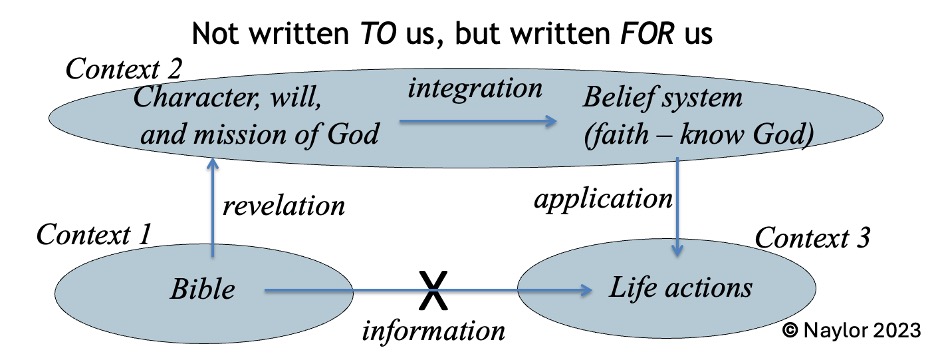
As illustrated in the contextually sensitive hermeneutical diagram presented in previous articles and reproduced here, it is not possible to move directly from Scripture to application. Rather, we read biblical texts through our contextual lenses, shaped by prior assumptions. The hermeneutic proposed here offers guidance by keeping the focus of interpretation aligned with the Bible’s primary purpose: to draw us into relationship with God in Christ. It helps us navigate the dangers of unexamined cultural assumptions by framing interpretation as a process of theological and relational formation—one that seeks faithful contextual expressions of God’s revealed will, character, and mission, rather than assuming that the instructions of the text address equivalent situations in our own context.

This hermeneutic acknowledges and accommodates the interpretive lenses we bring to Scripture. It recognizes and facilitates a dialogical engagement between God’s self-revelation in the Bible and our prior theological convictions and cultural assumptions, enabling us to avoid both uncritical readings that ignore cultural dynamics and inflexibility that resists the reshaping of our theology.

Theology is, by nature, limited and human-derived—a finite attempt to comprehend God from within our particular cultural and linguistic location. We should therefore expect our understanding to be incomplete, recognizing the need for ongoing development in order to interpret any passage of Scripture in a manner consistent with God’s intent.[4] In other words, the Bible is designed to nurture in us, as God’s children, an ever-deepening sense of wonder, delight, and love for our Father.

Before we were married, Karen and I lived on opposite sides of the country. This was before the internet, and I lived for her letters. I worked in construction, and at break time I would pull her most recent letter from my pocket and read it again. Why? I already knew what it said—I had read it a dozen times! But I reread it because it made me feel close to her. I wanted to sense her presence. I wanted to connect with her.

I suggest that this is how we should read our Bible—not primarily to get answers, to improve our lives, or to find teachings to apply, but to know God. When I went to Pakistan, my role was not to teach people what they should believe about Jesus, but to expose them to Jesus. It was essential that the Bible be the curriculum, not so they could extract lessons to apply, but so they could encounter God’s love letter and see Jesus.

All biblical passages should be read as part of a larger theological movement through which we discern God’s will, character, and redemptive mission, culminating in Christ. No command, law, or teaching should be applied in isolation from this broader theological framework, since doing so allows our cultural biases and assumptions to dominate interpretation. This error is addressed through the ongoing work of theology—an ever-deepening understanding of God—cultivated by communal engagement with Scripture as the revelation of God’s will, character, and mission. Theology, then, is a creative and continuing dialogue between our faith, God’s Word, and the lived realities of our lives.

Tiers of Theology

Theologies differ according to the contexts in which they emerge. While careful theological work employs shared methodologies—such as exegesis, logical reasoning, systematic categories, and attention to biblical themes—what ultimately distinguishes one theology from another is its particular context. A failure to attend to this reality often leads people, who may otherwise be skilled in exegesis and logic, to interpret and apply New Testament patterns and commands directly to their modern context, without recognizing that faithful obedience to Scripture in different contexts necessarily requires different expressions.

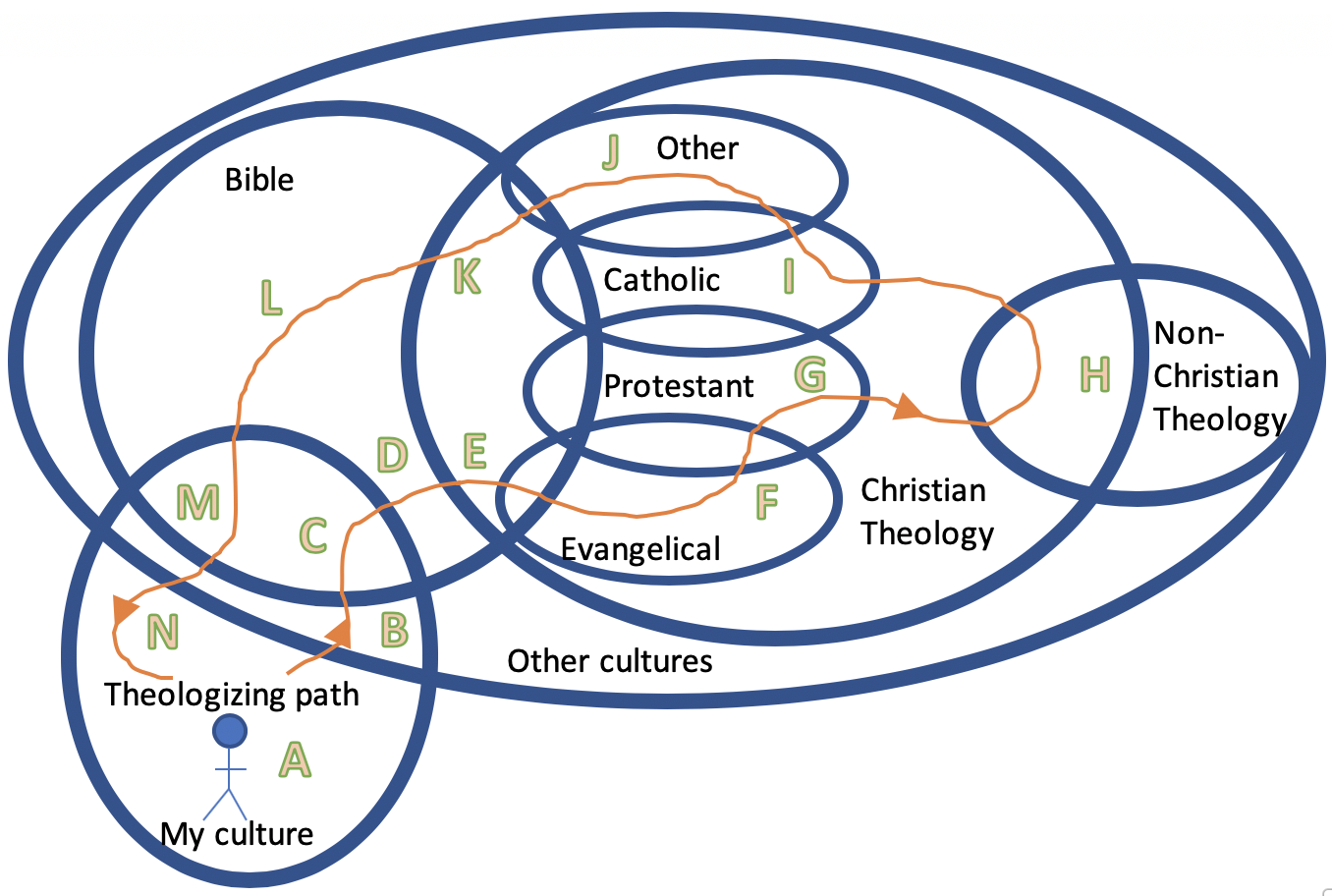
Different histories, perspectives, questions, priorities, and conceptual frameworks shape how a theologian reads Scripture and seeks to understand God. The following Theologizing in Context diagram represents this dominant contextual reality that influences every theological effort. Theological methodology (the inner circle) includes both systematic theology—asking our questions of the text—and biblical theology—discerning the theology of the text. All of this work employs tools such as exegesis and logic. However, the primary point of the diagram is to illustrate that all theology is inevitably worked out using the language and assumptions of our context, the lenses by which we view reality. Even as God communicates in and through an accommodation to our particular location, so we use the contextual lenses of the our context to engage God’s word and develop our theology (experience and expressions of faith).

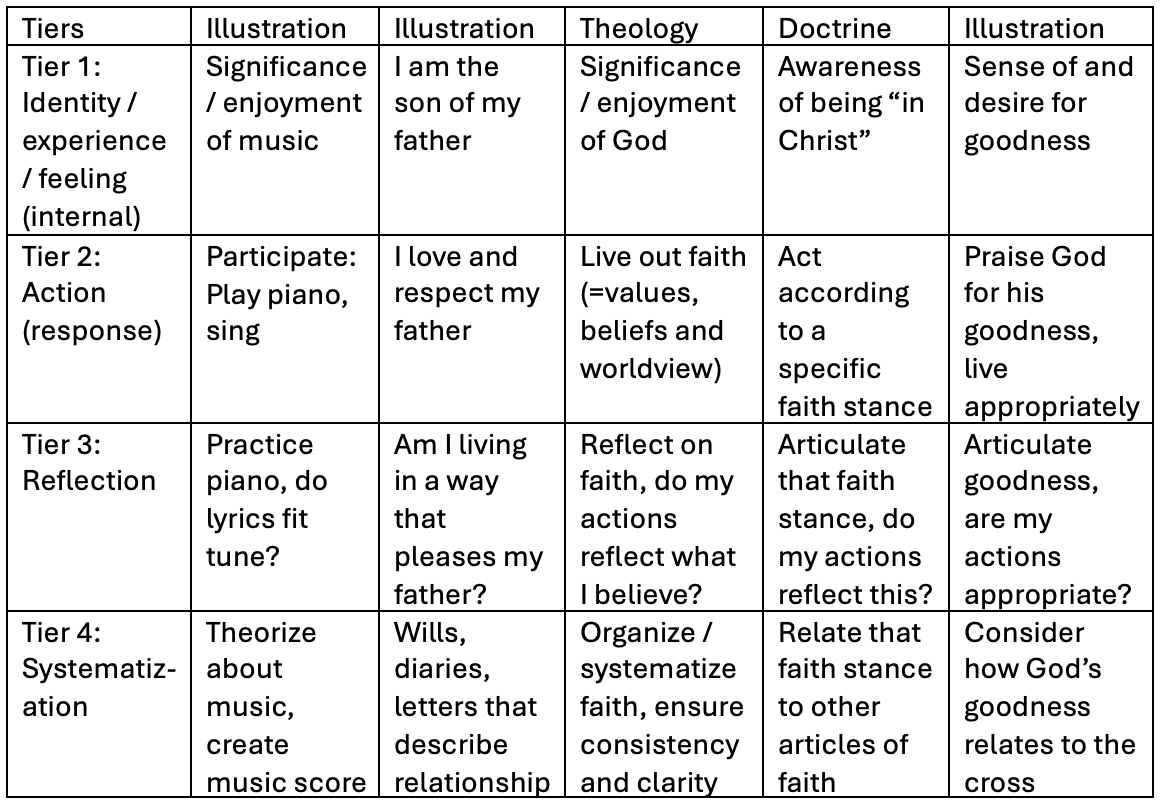
This reality does not diminish or undermine the work of theologizing. On the contrary, acknowledging the contextual dimension as an essential part of the theological process affirms that our understanding of God must be expressed within a community of believers who embody the kingdom in their particular setting. This recognition expands our view of theology beyond a purely scholarly pursuit, revealing it as a lived reality. The following chart, outlining four “tiers of theology,” helps us see how all of us are theologians as we learn to live out our beliefs.[5]

Tier 1 is the experience of reality, of identity or of knowing God.
Tier 2 is our response to that experience.
Tier 3 is a reflection on the experience or the response.
Tier 4 is the articulation of the experience, response and reflection.

The point is that tier 1 theology is where we are meant to live as Christians and is the primary motive for reading Scripture—to know God. We might read about a mother hugging her child (tier 4), reflect on the meaning of that hug (tier 3), or consider the child’s response (tier 2), but the experience of the hug itself is what truly matters (tier 1).

In the same way, when we read God’s Word, we may organize its content (tier 4), reflect on its significance for our lives (tier 3), or respond through appropriate action (tier 2). Yet it is the encounter with God (tier 1) that is central. All of these activities are legitimate expressions of theology, but we are called to prioritize tier 1: encountering God. Only through meeting God can we respond, reflect, and live out the meaning of Scripture in ways that are faithful and appropriate to our context.

Another example is recognizing that knowing about prayer is secondary to the experience of praying. George MacDonald captures this contrast well when he says, “To know a primrose is a higher thing than to know all the botany of it—just as to know Christ is an infinitely higher thing than to know all theology, all that is said about his person, or babbled about his work.”[6]

Alister McGrath helpfully describes cognitive statements or doctrinal propositions—tier 4 systematization—as a map that symbolically represents the relationships among elements of reality. Maps are valuable, but they are not the reality itself. They serve an essential function by orienting us to the world; they can be accurate in a limited sense, yet they lack the depth and immediacy of lived experience. Thus, as McGrath affirms, the purpose of doctrine (tier 4) is to guide us in reading Scripture so that we might know Jesus in our actual lives (tier 1). Doctrine is a theological map—indispensable for orientation, but never a substitute for the reality it depicts.[7] 

This perspective does not dismiss or diminish tier 4 doctrine. When we are confused or disoriented, a map can help us regain our bearings. McGrath notes that doctrine “gives us a framework for making sense of the contradictions of experience.”[8] In moments of pain, loss, betrayal, or anguish, returning to the doctrinal affirmation that God is love can realign us with what God is truly doing in our lives. In this way, tier 4 doctrine becomes a lens that connects biblical truth to our lived experience.

The relevance of this discussion for considering the role of women in ecclesial leadership is that categorical restrictions on women in pastoral roles based solely on gender often reflect limited attention to both the contextual dynamics of the New Testament witness and one’s own cultural location. In constructing a systematic theology—the tier 4 “map”—such approaches may overlook the extent to which the cultural distance between the first and twenty-first centuries calls for different expressions if the biblical concerns that gave rise to the original commands are to be faithfully expressed today. Because the meaning and function of leadership are shaped by cultural assumptions and social practices, care is needed to avoid transferring one cultural pattern directly onto another in ways that do not fully reflect the author’s intention.

The view that ecclesial leadership reflects a divinely intended gender hierarchy, and therefore limits the roles of elder or pastor to men, arises from particular readings of the New Testament’s first-century concerns and from differing judgments about how Paul’s pastoral aims are to be embodied within contemporary contexts. Greater attention to both the historical setting of these texts and how the authors’ concerns can be expressed differently in the cultural realities of the present should, at the very least, foster a gracious sensitivity and tolerance for how those aims can be faithfully practiced today.

Scripture is, above all, a covenantal text that draws people into right relationship with God through the Lord Jesus Christ. Consequently, any doctrine or principle we derive from Scripture, and any application we formulate, is secondary to the primary reality of encountering the presence of God. This emphasis underscores the importance of the hermeneutic of reading the Bible as revelation as fundamentally a process of theological development—one that is centered on knowing and encountering God (tier 1).

In the next article, I will provide biblical support for this proposed hermeneutic by examining the teaching of Jesus and the apostles. Their orientation and practice challenges approaches that apply commands or instructions directly without accounting for the cultural distance between the biblical text and our contemporary context.

Footnotes:

[1] This is the title of Chapter 18 in Lesslie Newbigin’s book, The Gospel in a Pluralist Society (Grand Rapids: Eerdmans, 1989), 222.

[2] Kevin J. Vanhoozer, Is There a Meaning in This Text? The Bible, the Reader, and the Morality of Literary Knowledge (Grand Rapids, MI: Zondervan, 1998), 206.

[3] This is not intended to disparage the role of teachers or theological scholars. The point is simply that we are all theologians. Some of us may be far more mature and advanced in our walk with God than others, but all have access to God’s self-revelation and are invited to reflect faithfully on it within the community of faith.

[4] By “God’s intent” or “the author’s intent,” I am not suggesting access to some extra-biblical resource by which Scripture can be interpreted. Rather, the phrase refers to the text’s meaning that has been generated by the author and communicated through the written words. This meaning exists independently of any particular reader’s understanding—a critical-realist orientation. It therefore stands in contrast to purely subjective readings such as “what this means to me” or “what this means in this situation.” The language of “author’s intent” directs our attention to the text itself, inviting us to discern, as faithfully as possible, what it meant within its original context and for its original audience. That context includes attentiveness to the broader scope of the author’s writings and arguments, which together help guide our understanding of the message being communicated.

[5] This chart was inspired by Millard J. Erickson’s 3-tiered model of theology in Christian Theology. Baker Academic, 2013. Pp. 42-43.

[6] George MacDonald, “The Voice of Job,” in Unspoken Sermons, Series II (Kindle ed., 1885), 219.

[7] Alister E. McGrath, Understanding Doctrine (Grand Rapids, MI: Zondervan, 1990), 41–42.

[8] Ibid., 50.


127d. Developing a Hermeneutical Lens to Consider the Place of Women in Ministry—Part 4

Recognizing the many influences that shape how we read and obey the Bible can make us more aware of our limitations, lead us to interpret with greater care and skill, foster a humble posture of ongoing dialogue, and help preserve our unity. All readers are invited to respond and challenge what I have written. I will be grateful for your insights and for continuing the conversation.

Some material in this article is based on my 2013 DTh thesis: “Mapping Theological Trajectories that Emerge in Response to a Bible Translation.”

NOTE: Chatgpt was used for editing, but not generative purposes.

Part 4: A Framework to guide the Process of Interpretation

Years of evangelism, Bible translation, and disciple making in Pakistan influenced my development of a consistent hermeneutic—a way of faithfully interpreting the Bible without privileging one passage over another on the basis of extra-biblical standards. One incident stands out as formative. During a Bible study with new Sindhi believers, our discussion centered around Korah’s rebellion in Numbers 16. I had been uncomfortable with God’s judgment which included not only the rebellious Korah but also his entire household and relatives:

The earth opened its mouth and swallowed them and their households, and all those associated with Korah, together with their possessions. They went down alive into the realm of the dead, with everything they owned; the earth closed over them, and they perished and were gone from the community (Num 16:32-33 NIV).

One man sins and everyone related to him perishes. Where is the justice in that? I wondered. Yet, in our discussion, I discovered that my Sindhi brothers had no such reservations. In their communal orientation, identity is not grounded in the individual—my Western assumption—but in familial relationships. Korah, as the head of the family, fully represented all its members; they rose or fell on the basis of his actions. In Sindhi eyes, this outcome was not only appropriate but expected. One brother even remarked, “The reason we understand the Old Testament and you do not is that it is just like our culture!”

What I came to realize is that our engagement with—and interpretation of—Scripture always takes place within unavoidable social and cultural frameworks. Our cultural background and history shape our values and beliefs, and the assumptions and questions we bring to the text influence the meaning we draw from it. This is true not only for difficult or puzzling passages, but for every verse of Scripture. It is not just certain texts with cultural implications that are filtered through our cultural lenses, but all texts, because all texts are culturally shaped. Whether it is John 3:16, the food laws of the Torah, household instructions in the Epistles, or Paul’s prohibitions concerning women, each passage is culturally located and is engaged through our own cultural lenses. We cannot study, understand, or apply God’s Word without being immersed in and shaped by culture—like a fish in water.

This reality is not a bug or a flaw; it is a feature designed by God. Scripture does not invite us to identify abstract, absolute propositions by which to order our lives and relationships. Rather, it calls us to engage the will, character, and mission of God through our limited cultural perspectives, in order to discern how to live in faithful relationship with Jesus within our particular cultural, historical, and social contexts. Only God is absolute, and we truly encounter God only through our finite, culturally situated understandings.

Like a healthy marriage, our relationship with God through Scripture is shaped by ongoing interaction, motivated by a desire to live out faithful and life-giving expressions of love and grace. Boundaries, roles, and patterns emerge in order to protect and nurture the relationship, but they are secondary rather than foundational. No single marriage represents a universal ideal; instead, diverse, culturally shaped marriages can faithfully embody God’s design and intention for husband and wife. Therefore, it is inappropriate to impose one cultural pattern of marriage onto another context.

This same interpretive posture guides how we apply biblical commands today—not as fixed patterns to be transferred directly, but as inspired, contextually shaped expressions that reveal God’s will, character, and mission and invite discernment of faithful, culturally appropriate expressions in our own setting.

The tension between text and context becomes especially vivid for communities of faith when biblical descriptions and commands conflict with the normative values and behaviors of a particular community. Such clashes highlight a universal reality: cultural context plays a decisive role in every act of interpretation. When a biblical command or description resonates with a culture, the tendency is to identify a perceived cultural equivalent and invest it with divine authority. When it does not resonate, the tendency is to reinterpret or sidestep the text in order to accommodate prevailing cultural norms. This series of articles point towards a third option. At this stage, however, the primary aim is to underscore the influence of culture and the need to take it seriously.

In the previous article we were confronted with how cultural and linguistic constraints limit our ability to interpret Scripture. The point was not to make us despair of understanding and applying God’s word, but to help us avoid approaches to Scripture that ignore—or remain unaware of—those limitations. Now that these realities—realities ordained by God—have been brought to our attention, we can consider a framework to help us confidently engage God’s word in spite of the limitations of our context.

The proposal is that we

  1. Adopt a posture of both humility and confidence through a critical realist epistemology.
  2. Pursue truth within our limitations through three key practices:
    1. Reading Scripture with the expectation of encountering God,
    2. Engaging Scripture with sensitivity to our contextual lenses, and
    3. Exploring the Scriptural insights of those who live in other cultural settings.
  3. Welcome humble intercultural interpretation of Scripture.

A Critical Realist Epistemology

Epistemology concerns how we can know truth and reality. Because our understanding is shaped by culture, Critical Realism offers a way to pursue truth while acknowledging those limitations. It recognizes that all knowledge is mediated through particular perspectives. For Christians, this approach involves trust—confidence that God both desires and is able to reveal His character, will, and mission to those who are open to receive His revelation.

The only Absolute is God and, as human beings located in historically, socially and culturally bounded contexts, we have only relative access to God. “God is and human beings become”[1] and therefore all theology “needs to be understood in sociocultural context.”[2] Truth and reality not subject to the common conditions of human knowledge are only found in God, not in our concepts of God nor in our statements about God.  Our access to the Absolute is through personal experience that is culturally shaped. Yet the Christian conviction is that it is true and significant access, because God is the Triune Creator who communicates with creation. “Total relativism destroys the possibility of meaning”[3] and the faith stance that God is and that the Absolute communicates successfully with humanity affirms the possibility of meaning.[4]

Critical Realism assumes that

  1. There exists a reality independent of our individual experience, a reality that is true in and of itself, whether or not we perceive it. Ultimately, this is God himself, but secondarily it is what God has created and established as the world we live in.

For example, we have a tree in our front yard and I believe the tree is there; however, the tree exists independent of my perception or belief.

  1. We have access to this reality (truth), through our senses and through our relationships.

I can see the tree, touch it, climb it or cut it down.

  1. Our access to reality is perspectival, not absolute. We experience reality through the interpretive lens shaped by our cultural and personal context. Just because perspectives are limited or incomplete does not make them incorrect. Yet any one perspective will be less than a comprehensive expression of reality.

The tree is experienced differently depending on the one engaging it. An environmentalist, logger, child, squirrel, or bird each experience the same tree differently but that does not mean their perspectives are incorrect, yet neither are they fully equivalent to the reality of what the tree is in and of itself.

In summary, Critical Realism affirms that reality exists independently of our perceptions and that we can know it truly, though always from a particular and limited perspective. It calls for humility even as it enables us to speak with confidence. We acknowledge our limitations while trusting that we can grasp real truth and express it in culturally appropriate ways.

N.T. Wright describes critical realism as “a way of describing the process of ‘knowing’ that acknowledges the reality of the thing known, as something other than the knower (hence ‘realism’), while fully acknowledging that the only access we have to this reality lies along the spiralling path of appropriate dialogue or conversation between the knower and the thing known (hence ‘critical’).”[5]

Peter Laughlin puts it this way, “A critical realist account does not claim that there is no objectivity to be had at all, but that there is no subject-less objectivity.”[6]

This culturally conditioned perspective applies both to the biblical authors conveying God’s revelation and to our own reading of the text. It also determines how we apply Scripture. All ethical values, priorities, and practices are expressed through culture. Because Scripture itself is culturally conditioned, it does not function as a universal rulebook for behaviors and ethics. Instead, we trust that its (culturally embedded) revelation is a true revelation, and that our (culturally conditioned) reading can genuinely reveal God’s will, character, and mission. With confidence in God’s faithful self-disclosure, we seek not merely to follow rules, but to conform our lives to the likeness of the Father revealed in Jesus Christ.

Three Practices to Pursue Truth within our Limitations

When we embrace a critical realist epistemology, we can identify three practices that enable proper interpretation of Scripture.

  1. We can read with expectation that God’s will, character and mission can be discovered through the biblical text. Engaging Scripture as revelation rests in God’s promise, “You will seek me and find me when you seek me with all your heart” (Jer 29:13).
  2. We can pursue a dialogical engagement between text and context that will move us towards ever increasing understanding. Because culture is our lens for engaging Scripture, we require the dynamic process of a “hermeneutical spiral” (described below) to test assumptions and find appropriate contextual expressions of kingdom living.
  3. We can engage believers in other times and contexts. This is the practice of exploring the wisdom and godliness of the broader community of believers throughout history and those who live in other cultural settings. Such interactions and challenges provide checks and balances for the way we live out our faith.

These three practices[7] move us towards contextually relevant Christ-centered expressions of faith and enable us “to test and approve what God’s will is—his good, pleasing and perfect will” (Rom 12:2).

The first practice that we can read Scripture with expectation that “God’s will, character and mission can be discovered” will be explored in the next article, “Part 5: Developing theology through the hermeneutic of reading the Bible as revelation,” as this is a key dynamic of the hermeneutic being proposed.

The second practice of the dialogical engagement between text and context is illustrated by the Faith-Text-Context Tension diagram:

The three corners of the faith–text–context triangle illustrate that people live in a context, and their faith (worldview, beliefs and values) is the “grid” through which they give meaning and order to that context. Text is the self-revelation of God given to us through the Bible. The reciprocating arrows between each aspect indicate the interactive dynamic or creative tension that occurs between each of the three pairs as people discuss their understanding. Tension emphasizes that while affirmation and support occur, each interaction includes both a challenge and critique that call for resolution and that shape the faith of the community.

The interaction can be expressed through D.A. Carson’s “hermeneutical spiral.”[8] The interpretation of the word of God through the text–faith and faith–context tensions is not a linear process but involves a (hopefully) upward spiral that implies an ever-increasing conformity to God’s revelation. The upward direction indicates a sincere engagement of the text that further develops a faith stance. This dynamic is not accomplished by the text alone nor by the culture alone, but by the intersection of the two as believers develop their faith. This process of dialogue “spirals with each question toward a better understanding of the salvation that comes through faith and that leads to grace and humility.”[9]

Furthermore, any adjusted faith perspective is tested for consistency and benefit within the life experiences of the community. With increasing insight into how God’s revelation speaks into the life and context of believers there is greater convergence between the meaning of the text and the outworking of that meaning in speech and behavior. This communal pursuit of God through the text and context tension is governed by God’s Spirit through the believers’ devotional posture of prayer and submission.

For the third practice of engaging believers in other times and contexts, Hiebert (The Gospel in Human Contexts, 2009. p. 29) explains the necessity and function of dialogue with others:

A critical realist epistemology differentiates between revelation and theology. The former is God-given truth; the latter is human understandings of that truth and cannot be equated fully with it. Human knowledge is always partial and schematic, and does not correspond one-to-one with reality. Our theology is our understanding of Scripture in our contexts. It may be true, but it is always partial and perspectival. It seeks to answer the questions we raise. This calls for a community-based hermeneutics in which dialogue serves to correct the biases of individuals. On the global scale, this calls for both local and global theologies. Local churches have the right to interpret and apply the gospel in their contexts, but also a responsibility to join the larger church community around the world in seeking to overcome the limited perspectives each brings, and the biases each has that might distort the gospel.[10]

Our own local theology is culturally embedded, just as everyone’s theology is—shaped by distinct cultures, histories, emphases, and languages. By engaging each another across these differences, we develop a more complete and robust theology.

The Benefit of Humble Intercultural Engagement

Each community of believers develops their own expressions of biblical faith through the process illustrated in the Contextually Sensitive Hermeneutic diagram provided in an earlier article:

Engaging God’s Word within a culturally embedded community is not a simple matter of applying the Bible’s “plain sense” directly (the “information” arrow). Each context necessitates a particular expression of faith, a translated rather than diffused expression.[11] The embedded cultural dimension of Scripture resonates differently within different communities, and the questions each community brings to the text inevitably give rise to diverse expressions of faith—each with its own strengths and weaknesses.

Interpretation is a complex, dialogical, and theological process that always moves through the “revelation,” “integration,” and “application” arrows of the diagram whether or not the reader of Scripture is aware of it. Because this process is mediated through cultural lenses, it results in differing priorities and emphases depending on the context. This is comparable to the tree illustration given above: different perspectives view the tree truthfully, yet differently.

This diversity of faith expressions exposes areas of weakness in our own theological orientation and challenges us to make corrections. At the same time, it can affirm culturally shaped expressions as we discern a shared pursuit of God’s will, character and mission—one that requires contextual nuance because of our particular location.

Through the Spirit’s guidance, communal discernment, dialogue with other theologies and faithful obedience, this process leads to expressions of God’s truth that maintain integrity with God’s desires and are genuinely contextualized.

In the next article we will explore how the hermeneutic of reading the Bible as revelation guides theological development and results in robust and coherent expressions of faith.

Footnotes:

[1] G.L. Barney, “The Challenge of Anthropology to Current Missiology,” in International Bulletin of Missionary Research 5, no. 4 (1981):174.

[2] Ibid.

[3] C. R. Taber, The World Is Too Much with Us: “Culture” in Modern Protestant Missions (Macon, GA: Mercer University Press, 1991), 172.

[4] Mark Naylor, Mapping Theological Trajectories that Emerge in Response to a Bible Translation (DTh thesis, University of South Africa, 2013), 276.

[5] N. T. Wright, “The Challenge of Dialogue: A Partial and Preliminary Response,” in God and the Faithfulness of Paul: A Critical Examination of the Pauline Theology of N. T. Wright, ed. Christoph Heilig, J. Thomas Hewitt, and Michael F. Bird (Tübingen, Germany: Mohr Siebeck, 2016).

[6] Peter Laughlin, Jesus and the Cross: Necessity, Meaning, and the Atonement (2014), chap. 3.

[7] These three practices can be compared to and contrasted with the Wesleyan Quadrilateral of Scripture, tradition, reason and experience. All four dimensions of the quadrilateral are integrated into the three practices presented here. See T. A. Noble, “Wesleyan Quadrilateral,” in New Dictionary of Theology: Historical and Systematic, ed. Martin Davie et al. (London; Downers Grove, IL: Inter-Varsity Press; InterVarsity Press, 2016), 955.

[8] D. A. Carson, “A Sketch of the Factors Determining Current Hermeneutical Debate in Cross-Cultural Contexts,” in Biblical Interpretation and the Church: The Problem of Contextualization, ed. D. A. Carson (New York: Thomas Nelson Publishers, 1984), 13–15.

[9] D. Kirkpatrick, “From Biblical Text to Theological Formulation,” in Biblical Hermeneutics: A Comprehensive Introduction to Interpreting Scripture, ed. Bruce Corley, Steve Lemke, and Grant Lovejoy (Nashville: Broadman & Holman, 1996), 277.

[10] Paul G. Hiebert, The Gospel in Human Contexts: Anthropological Explorations for Contemporary Missions (Grand Rapids, MI: Baker Academic), 29.

[11] This is Lamin Sanneh’s terminology. See Part 3: Why we ask “why”: The Limits of Culture and Language.


127c. Developing a Hermeneutical Lens to Consider the Place of Women in Ministry—Part 3

Recognizing the many influences that shape how we read and obey the Bible can make us more aware of our limitations, lead us to interpret with greater care and skill, foster a humble posture of ongoing dialogue, and help preserve our unity.

This article uses material from my Intercultural Theology course given as an instructional lecture series with Northwest Baptist Seminary. All readers are invited to respond and challenge what I have written. I will be grateful for your insights and for continuing the conversation.

NOTE: Chatgpt was used for editing, but not generative purposes.

Part 3: Why we ask “why”: The Limits of Culture and Language

Asking “why” when confronting a biblical command acknowledges our limited ability, as enculturated human beings, to grasp the heart and purposes of God amid the cultural and linguistic realities that shape our interpretation. A hermeneutic that reads the Bible as revelation begins by recognizing that we are created with inherent cultural and linguistic limitations that constrain our understanding of Scripture. These limitations call for humility and caution, reminding us that our context influences how we interpret a passage and can lead us to mistaken conclusions.

The Cultural Dimension

In my intercultural theology class, I ask students, “How much of the Bible is God’s word, and how much is cultural?” The answer, of course, is that the Bible is 100% God’s word and 100% cultural because Scripture is, by its nature, a culturally conditioned document. It is easy to demonstrate that the Bible includes the words of human beings. For example, in 1 Samuel 9, Saul says to his servant, “Come, let us go back, or my father will stop thinking about the donkeys and start worrying about us” (v. 5, NIV). Clearly, these are the recorded words of a person in history. Moreover, every part of Scripture was written by human authors, so in this sense the Bible is fully the word of human beings.

How, then, can the Bible be the word of God while simultaneously being fully cultural? The task of the exegete is not to separate what is “God-breathed” (2 Tim 3:16, NIV) from what is cultural, but to recognize that God communicates his truth through the whole Bible—through human language, human understanding, human history, and human culture. The message is God’s; the medium is the cultural dimension of the Bible.

This stands in sharp contrast to the Islamic view of the Qur’an. According to Muslims, the Qur’an was written in Arabic in heaven and an original copy exists eternally with God. This heavenly message was dictated to Muhammad, and therefore, in their understanding, the Qur’an contains no human element whatsoever.

A neighbor of mine in Pakistan, a Muslim religious teacher, once borrowed a New Testament from me. When he returned it, he said, “This is not God’s word; it contains God’s word.” I asked what he meant and he pointed to a passage that said, “Jesus got into a boat.” “That,” he said, “is narrative—history. That is not what God actually said.” Then he turned to the Sermon on the Mount and read a few verses. Smiling, he said, “Now that is God’s word.”

What is the Christian, evangelical response to this?

It is this: Jesus did not merely deliver God’s word like a prophet; he is God’s Word. God’s self-revelation is not limited to spoken messages but is embodied in a person. Everything Jesus did—every action, every story—is a revelation of God.

In a similar, but limited way, throughout all of Scripture, God engages human authors and accommodates himself to human language and contexts in order to reveal his truth, character, will, and mission. By definition, the gospel must be expressed within the human realm—using human language and concepts—because it is, fundamentally, the communication of good news.

Not only is the Bible itself culturally shaped, but every reader approaches the text through culturally shaped lenses. The worldview in which we have been enculturated provides the interpretive framework we use to determine what is significant in a passage of Scripture. All theology—the human study of God—is perspectival. These cultural lenses can blind us to unfamiliar contexts, and it is easy to uncritically impose the theological assumptions we bring to the text. As a result, interpretations based on the “plain sense” can reflect our expectations and assumptions more than the intentions of the biblical authors.

There is no one-to-one correspondence between cultures. Concepts may overlap, but they require unique expressions depending on context. Universals can be expressed only in broad terms (e.g., love, grace), yet they must be defined and developed metaphorically or by stories within the parameters of each cultural setting in order to be applied appropriately.[1]

One evening, while traveling on the ferry, I noticed a star appear. It seemed to be behaving strangely—rocking back and forth and moving around. My first thought was, “What is wrong with that star?” The problem was my point of reference. Because I was moving with the ferry, everything on the vessel appeared stable, making the star look as though it were wavering. Only when more stars appeared did it become clear that the star was stable in relation to the others.

In a similar way, when we encounter a concept that lies outside our interpretive framework, it can seem absurd or illogical because we lack the contextual frame that would give it stability and coherence. We naturally rely on the “obvious” assumptions of our worldview or perceived framework of reality when forming conclusions. Ideas outside our worldview can appear incorrect because they fall beyond our frame of reference.

Even more subtle is the way we can be misled by concepts and words that seem obvious to us. We bring an enculturated understanding of ideas such as authority and the implications of gender to the biblical text, inevitably assuming meanings that seem normative and fit logically within our conceptual framework.

The message originates with God, but it is interpreted and expressed through human cultural lenses. While we can—and do—discover God’s truth in Scripture, the cultural dimension of that communication must be taken seriously.

The Linguistic Dimension

The nature of language also makes the interpretive task complex.

Imagine I find a lamp that I want to buy for our home. When I try to describe it to Karen, I quickly realize that a photo would communicate far better than my words. Seeing the item for herself gives a clearer, more accurate sense than any description I could give. Why is that?

Joel Green identifies four limitations of language:[2]

  1. Language Is Linear. To describe the lamp, I would have to begin with one feature and then sequentially describe others, one after another. Verbal description reshapes meaning differently from visual perception, which is holistic, immediate, and comprehensive. Language presents ideas in sequence through symbols (words) that refer to shared experiences and concepts. These cumulative descriptions gradually construct a complex understanding in the mind of the hearer.
  2. Language Is Selective. Each lamp contains details that a photo can capture instantly but that I cannot describe without selecting certain features and leaving out others. A speaker’s choice of words is shaped by personal assumptions and experiences which inevitably leaves “gaps” that the listener must fill in—sometimes in ways the speaker never intended.
  3. Language Is Ambiguous. Every sentence evokes a mental image in the hearer that may approximate—but never fully match—the speaker’s intended meaning. If I say, “I painted the steps in my house last summer,” you can understand the sentence easily enough. But what image comes to mind? How many steps were there? What were they made of? Were they inside or outside the house? What tools did I use—a brush or spray paint? And did I actually apply paint to the steps, or did I perhaps paint a picture of the steps on a canvas?
  4. Language Is Culturally Embedded. When we read the New Testament, we inevitably interpret it through the lens of our own cultural experience. Every reading of the New Testament is therefore an act of cross-cultural communication—an engagement between our world and the world of the biblical text. For example, our experience of a communion service shapes how we read Paul’s description in 1 Corinthians 11:17–34. The passage, in turn, helps us interpret our practice. But in reality, our experience tends to dominate what comes to mind when we think about celebrating communion or reading that passage. This is not surprising since the text is commonly used during communion services. Yet one of the major themes Paul emphasizes—the idea of a community meal, where everyone eats together—plays only a small role in the way most Canadians understand or practice communion.

In addition to these four limitations of language, the communicative process itself is not straightforward. Every written or spoken expression requires a language system, and that system cannot function without a wide range of shared understandings between speaker and listener. Words operate as symbols—labels that point beyond themselves to the physical or conceptual realities they represent.

For example, the single syllable “God” refers to the Creator of the universe—an infinite reality far greater than the word that names him. Readers or listeners can grasp the biblical author’s intended meaning only by drawing on their own experiential and cultural frameworks to approximate what is meant. When Scripture describes God as “Father,” for instance, the hearer interprets this image through personal exposure to the concept and through experiences of having or being a father, all of which are shaped by a cultural understanding of what “fatherhood” entails.

According to Charles Kraft,[3] communication occurs as we recreate the author’s meaning in our own minds, using the concepts and words familiar to us—because these are the only tools we possess for understanding. Once we form this perceived meaning, we can do several things with it:

  1. we can articulate it in our own words,
  2. we can respond to it, or
  3. we can draw conclusions from it.

Articulating the meaning is not an act of theologizing but an act of translation—rendering a perceived meaning within a context different from the original text. The latter two actions—responding and drawing conclusions—constitute theology, as we infer doctrinal or ethical positions from the text. The key point is that this entire process takes place within our cultural context and is shaped by it at every step.

For example, after reading Gen 1-2 we can articulate that God created the world and everything in it (translation). However, when we conclude from this text that God is greater than us and greater than the universe, or that God is good, we are theologizing.

There is no “middle step” in which we extract a culturally neutral proposition from Scripture and then insert it unchanged into our linguistic framework. Rather, theology is always a contextualized reflection, shaped by culture at every stage—from translation, to interpretation, to application.

The translation dimension

A further implication of the cultural and linguistic dimensions of interpretation concerns translation, which itself is a form of interpretation. If we assume that we possess the “universal truths” of the gospel in a pure, culture-free form, then the expressions of other cultures need not concern us; people in other contexts would simply be expected to adopt what we already have. Yet such “universal truths” are always experienced as local, contextualized expressions because they are perceived through our own cultural location.

This raises an important question: How do we communicate truths through other languages and cultural forms—whether in translating the Bible, sharing the gospel or communicating theology—when we ourselves can only access those truths in a limited fashion through our own cultural lenses?

Lamen Sanneh distinguishes between mission by diffusion and mission by translation.[4] The former characterizes Islam, while the latter is the pattern of Christianity. Mission by diffusion means that a religion is tied to a particular cultural identity and therefore maintains its integrity by transplanting that culture wherever it spreads. This is evident in the central role of Mecca, the Qur’an in Arabic, and Shariah Law in Islam. Muslims believe that the truth of their faith can only be expressed in Arabic: the Qur’an is memorized in Arabic, prayers are offered in Arabic, and religious writing and art are shaped by Arabic language and culture.

In contrast, mission by translation recognizes that the receptor culture need not be rejected or replaced. Instead, Christian faith, the Bible, the gospel, and theology are contextualized within the new setting. As Kraft defines it, contextualization is “the process of learning to express genuine Christianity in socioculturally appropriate ways.”[5] Timothy Tennent (2007:2) similarly describes “theological translatability” as the ongoing reality in which “the universal truths of the gospel are being revisited and retold in new, global context.”[6]

As an example, consider the Psalms. Although originally written in Hebrew poetry, they can be reshaped into another language to convey their depth of meaning. In Pakistan, a significant part of church worship involves the Punjabi Zaboors found in the popular Punjabi hymnal—select Psalms that have not merely been translated but rephrased in Punjabi poetic style by a respected Christian poet. These songs resonate deeply with the Punjabi Christian community.

Bible translation, which I have been involved in for more than 35 years, is an example of the conviction that Scripture is fully translatable—a conviction affirmed throughout Christian history and expressed today in translation efforts around the world. Theologically, this rests in part on the coming of the Spirit at Pentecost, when the apostles proclaimed the same gospel in many different languages (Acts 2). In that moment, other languages and cultures were affirmed as fully suitable vehicles for expressing the gospel.

These cultural, linguistic, and translational complexities create a challenge in relation to the Fellowship’s statement of faith. The article on the Bible affirms our belief that “the Bible is the final authority in all matters of faith and practice and the true basis of Christian union.” But how are we to interpret Scripture in light of the contextual displacement we inevitably experience whenever we read the biblical text or seek to communicate it in another cultural setting?

This is the question we will address in the next article.

[1] The important relationship between metaphor and theology, as opposed to propositions and theology, will be developed in Part 5: Developing theology as key to the hermeneutic of reading the Bible as revelation.

[2] Joel Green, “The Challenge of Hearing the New Testament” in Hearing the New Testament: Strategies for Interpretation (Eerdmans, 1995).

[3] Charles Kraft, Communication theory for Christian Witness (Maryknoll: Orbis, 1991), 72-80.

[4] Lamin Sanneh, Translating the Message (Maryknoll: Orbis, 1989), 7,8.

[5] Charles Kraft, Anthropology for Christian Witness (Maryknoll: Orbis 1996), 376.

[6] Timothy Tennent, Theology in the context of world Christianity : how the global church is influencing the way we think about and discuss theology (Grand Rapids: Zondervan 2007), 2.

127b. Developing a Hermeneutical Lens to Consider the Place of Women in Ministry—Part 2

Recognizing the many influences that shape how we read and obey the Bible can make us more aware of our limitations, lead us to interpret with greater care and skill, foster a humble posture of ongoing dialogue, and help preserve our unity.

I know I have blindspots; the trouble is I can’t see where they are. My desire is not to be right, but to pursue truth and so I am open to correction. All readers are invited to respond and challenge what I have written. I will be grateful for your insights and for continuing the conversation.

NOTE: Chatgpt was used for editing, but not generative purposes

Part 2: True Obedience: Embracing the Heart of God

As an evangelical Christian committed to the authority of Scripture, I hold a non-hierarchical[1] view of male-female relationships in the church and family. A hierarchical complementarian friend once asked me: “How can you believe that a woman can serve as a pastor or leader in the church when the Bible clearly commands that a woman is not to teach or have authority over a man (1 Tim 2:12)?” In his reading, it seems obvious that God’s created order excludes women from leadership or decision making over men.

The challenge is to demonstrate that I am legitimately and faithfully submitting to God’s will—something both I and my friend are committed to—while ensuring that I am not being swayed by cultural narratives that distort God’s design for his church. This concern is legitimate, since the values of any time and culture inevitably shape our perspectives and decision-making (for both my views and the views of my friend).

The Path of “Why?”

The path to answering my friend’s question is neither to reject this command of the apostle Paul nor to accept it in the rigid manner my friend insists is the only faithful option. Rather, the call is to ask “Why?” This is not the rebellious question of disobedience—“Why should I obey?”—nor a skeptical question shaped by worldly values—“Why should this command overrule our superior understanding?” It is, instead, the sincere question of a child seeking to fulfill the Father’s will: “Why was this command given?”

True obedience follows a path of discerning the gospel meaning and purpose behind any and every command in order to live it out contextually and faithfully. In so doing, we aim to embody light and life, so that God’s will, character, and purposes are demonstrated in our lives.

The Complexity of Obedience

While my friend’s question could be examined on exegetical grounds, I believe it is more important to challenge the hermeneutical assumption behind it, namely, that understanding and application are straightforward. I suggest that moving from a command in Scripture to obedient action requires a reliable and consistent hermeneutical process in order to answer the question, “What does it mean to fulfill this Scripture in my life as a sincere follower of Jesus?”

At first glance, obedience may seem straightforward: “God said it, I believe it, that settles it.” God commands and we obey. While such trust is admirable—and genuine faith does require obedience—I believe this formula oversimplifies what it means to be faithful children of God in at least three ways:

  1. It overlooks the essential step of interpretation that lies between “God said it” and “I believe it.” We must ask to whom God was speaking, why the command was given, and what response was intended—contextual questions necessary for understanding what we claim to believe. Because our reason is limited and fallible, humility and faith are required so we do not assume too quickly that we have understood.
  2. It fails to account for the cultural distance between the original setting and our own. Meaning is embedded in culture, and without sensitivity to the differences, misunderstanding and misapplication are inevitable. Because culture shapes all communication and perception, our understanding is always perspectival rather than absolute.
  3. It emphasizes conformity to a specific command without discerning its purpose in light of the deeper realities of God’s will, character, and mission. Grounding obedience in theology (faith) is powerful because it keeps the divine Author central and aligns us with our created purpose—to know God. Yet theology remains a human construct, shaped by our interpretation and cultural context.

These three dimensions of what obedience requires are what I hope to draw out through this hermeneutic in order to provide a consistent and transformative way of conforming our lives to the gospel.

Embracing the Heart of God

Scripture calls us not to live merely as rule-followers—an inadequate approach that overlooks the interpretive lenses we inevitably bring—but to use Scripture to discern the heart, character, and mission of the One who gives the commands. Following Jesus means moving beyond conformity to rules in order to embrace a relational, Spirit-led participation in God’s purposes. It is not enough to know the content of God’s commands and then conform our lives to those commands. That approach will likely lead to misapplication, and even to a prideful spirit that criticizes those who interpret the commands differently. True obedience is rooted in theology: embracing and embodying the heart of God. Such an approach fosters humility and grace as we recognize that fellow believers may obey differently, yet with the same desire to please God.

This hermeneutic is based on the claim that reading Scripture begins by asking, “Why does God command this?” Our aim is to know the heart of God—his purposes and intentions behind the command. We are building a theology that moves us beyond the status of servants toward being children of God (Rom 8:14–17; Gal 4:4–7) and friends of Jesus (Jn 15:14–15). We share his heart, are guided by his Spirit, and live under the new covenant in which God has written his law on our hearts (Heb 8:10).

Obedience, then, is not a matter of choosing between compliance and rebellion; it is about cultivating a relationship with God that goes beyond mere conformity to commands. We long not simply to do what he says, but to be like him. This practice of asking “why” allows us to draw appropriate boundaries for life because we prioritize understanding God’s desires and, like the apostles, we work out fresh expressions of God’s purposes in our own contexts.

In the next article, we will explore the limits of culture and language that make it necessary for us to ask “why?”.

Footnotes:

[1] When the article was first published, the word “egalitarian” was used. Unfortunately, this was misread as “non-complementarian,” thus it has been replaced with the more accurate “non-hierarchal.” See Part 7: Addressing disputed verses on women in leadership through the hermeneutical lens for a more detailed description of a “non-hierarchical complementarian” position. The hierarchical complementarian position maintains that the distinct roles of men and women as established in creation point to a universal pattern of male headship, particularly significant for church leadership and family decision making. By contrast, the non-hierarchical complementarian position affirms the complementary nature of male and female and their roles but denies that these distinctions necessitate male authority or primacy in decision making in the church or family.


127a. Developing a Hermeneutical Lens to Consider the Place of Women in Ministry—Part 1

My experience as a Bible translator living cross-culturally, along with completing a missiology DTh in intercultural studies, has given me an understanding of how language and culture affect communication. I have come to believe that the dynamics of human interpretation—both its power and its limitations—point us toward a hermeneutical lens that can guide our faithful interpretation of God’s communication in Scripture.

Some material in these articles has been taken from my Intercultural Theology course given as an instructional lecture series with Northwest Baptist Seminary. That course provides a more extensive examination of some concepts introduced here.

I know I have blindspots; the trouble is I can’t see where they are. My desire is not to be right, but to pursue truth and so I am open to correction. All readers are invited to respond and challenge what I have written. I will be grateful for your insights and for continuing the conversation.

The occasion for this reflection is the dispute over women in church leadership—a disagreement that may lead to division within our Canadian Fellowship of churches. My aim is to propose a biblically faithful way of reading Scripture that allows for the affirmation of women in leadership. I hope to show that this position does not arise from cultural compromise, disobedience, or a rejection of Scripture. While it may not change convictions about male-only leadership, I pray that it will encourage a gracious recognition that this view is rooted in a high regard for Scripture, a desire to glorify Jesus, and a passion for God’s kingdom. Therefore, rather than separation, I pray for a response marked by grace and continued mutually beneficial partnership.

Recognizing the many influences that shape how we read and obey the Bible can make us more aware of our limitations, lead us to interpret with greater care and skill, foster a humble posture of ongoing dialogue, and help preserve our unity.

There are seven articles that develop the hermeneutic as follows:

  1. Reading the Bible as revelation: An introduction to the hermeneutic
    • Rather than reading the Bible as a manual of commands to obey, the Bible is a revelation of God’s will, character and mission to which we conform
  2. Obedience as conformity to the heart of God
    • Obedience is about children striving to be like their father rather than servants following rules
  3. Why we ask “why:” The Limits of Culture and Language
    • Recognizing the limitation of our cultural location gives us pause so that we do not take illegitimate shortcuts in our understanding.
  4. A Framework to guide the Process of Interpretation
    • Useful responses to help navigate cultural limitations and lead us to a more robust interpretation of Scripture.
  5. Developing theology through the hermeneutic of reading the Bible as revelation
    • Since we generate our interpretation through a theological grid and within a cultural context, the development of theology needs to be done with care.
  6. Biblical support for the proposed hermeneutic
    • Discovering Jesus’ and the apostles’ hermeneutic of reading the Bible as revelation.
  7. Addressing disputed verses on women in leadership through the hermeneutical lens
    • Examining verses that are used to forbid women from ecclesial leadership through the hermeneutic of reading the Bible as revelation.

NOTE: Chatgpt was used for editing, but not generative purposes

Part 1: Reading the Bible as Revelation: An introduction to the hermeneutic

Hermeneutics “is the science and art of interpreting the Bible.”[1] It involves discerning how we move from the biblical text to theological understanding taking into account the complexity of that process. Hermeneutics can be described as reading Scripture in community for the purpose of bringing our beliefs, commitments and behaviors into alignment with God’s revealed purposes. This work is complex because of the historical, geographical, linguistic, and cultural distance between the world of the biblical authors and audiences and the contexts of modern readers.

The hermeneutic proposed in this series of articles arises from the process of theological development that naturally takes place among believers in their contexts: Readers engage with the text through the assumptions, questions, and priorities they bring to it, and they shape their theological understanding according to the perceived relevance of the message within their setting. When they are committed to being faithful to the intention of the divine Author, the Holy Spirit guides them to understand and embody the will, character, and mission of Jesus.

The hermeneutic I will propose is grounded in the understanding that we are not called to obey and follow the Bible; instead, the Bible calls us to obey and follow Jesus. For those who struggle with discerning the difference, consider the Pharisees who diligently studied the OT scriptures. They had obedience to God—known as the tradition of the ancestors (Mt 15)—down to a science, but in their attempts to obey God’s commands, they missed (and dismissed) the incarnate Word.

Jesus claimed he brought “new wine” that disrupted those traditions (Mt 9:17; Mk 2:22; Lu 5:37-39). He challenged the religious teachers to re-evaluate their understanding through the lens of who he was, the nature of his kingdom, and what it would mean to follow and obey him. Jesus declared to the Pharisees in Matthew 12 that “something greater” than the temple, the law and the insight of Solomon was present, something that not only overthrew nationalistic visions, legal foundations and established wisdom, but also established a kingdom-centered way to engage life beyond conformity to commands—a kingdom with a person, Jesus, on the throne, who rules by his Spirit.

The implications of these passages for this hermeneutic will be explored in a later article, but these comments establish at least one reason to clarify how we are to discern God’s will from our reading of Scripture: we are not responsible to maintain the theology of godly leaders of the past, no matter how much we respect them. Instead, we are called to test the spirits, the theologies, and the narratives that surround us according to Jesus’ “new wine.” A hermeneutic that does justice to Jesus’ new wine should help us address conflicting theologies of gender, theologies of hierarchy, and theologies of human authority in the kingdom God.

Summary Description of the Hermeneutic

The following is a summary of the “hermeneutic of reading the Bible as revelation,” or the “contextually sensitive hermeneutic,”[2] which will be referred to throughout the articles:

We are called to read Scripture as God’s self-revelation, given through prophets and apostles within their historical and cultural settings. By discerning God’s will, character, and mission in each passage, we focus on the divine Author, engage a broad theological framework and acknowledge the differences between the biblical context and our own. This keeps us from assuming that culturally shaped instructions or practices in Scripture must be reproduced today. Instead, we pursue obedience by conforming our lives to God’s revealed character and purposes. God’s people express obedience in ways that (1) navigate cultural differences, (2) remain consistent with what we have discerned about God from Scripture, and (3) embody God’s mission within the local body of Christ through contextually meaningful behaviors.

This hermeneutic addresses the following challenges to interpretation that will be explored in these articles:

  1. We always interpret from a theological perspective—a human construct developed over time through exposure to God’s revelation and other influences.
  2. We always interpret from an enculturated position, using the language and concepts granted to us from our context.
  3. Communication is complex and requires dialogue within community in order to move to appropriate action and application.
  4. As fallen humans, we are limited and susceptible to misunderstanding and inconsistency. Humility before God and openness to correction is required.
  5. A biblical understanding of concepts such as authority and the implications of gender should not be assumed when reading a verse. Instead, we need to recognize the influences and assumptions that shape our theology (faith) and then test them.
  6. We cannot assume that even a “clear” verse is properly understood. Because of the historical and conceptual distance between us and the original author/audience, there are contextual dilemmas and tensions that are not immediately obvious.
  7. Obedience is not about following rules and emulating biblical patterns, but conforming to God’s revealed will, character and mission.
  8. Conforming to God’s revealed will, character and mission requires expressions that are contextually meaningful.
  9. We are constantly engaging in a dialogical process between theology (faith), text (Scripture) and context (the influences that shape our thinking and understanding of reality). This liminal reality is our human condition and it encourages us not to establish practices based on a few verses but on a robust theology that reveals God’s deeper purposes. Only then can we confidently apply our conclusions to ecclesial contexts today.

This hermeneutic welcomes dialogue with others—across history, within our own culture, and interculturally—to confirm that our interpretation aligns with Scripture and that our application genuinely reflects the message we aim to live out.

It also implies that it is not appropriate to take any narrative, command or promise in the Bible and apply it directly to our situation today. Nor is it possible to extract a “kernel” of truth or a timeless principle that can be understood apart from a cultural context or that can be applied universally. All communication is culturally embedded.

The following Contextually Sensitive Hermeneutic diagram illustrates the process:

The bottom (information) arrow with the “X” shows that we should not read the Bible as if its teachings move directly from the text to our situation without interpretation. We cannot simply take biblical instructions and apply them straight to our context because we are dealing with two different cultural contexts—the biblical culture and our own. A direct, culture-to-culture transfer is impossible because of assumptions, priorities, and questions that shape our beliefs.

Instead, we approach Scripture as God’s self-revelation—his nature, will, and mission—communicated in a time, place, and cultural setting different from our own (left arrow—revelation). From that revelation, we develop a theological understanding of who God is and what he desires (top arrow—integration). Only then can we express our obedience in culturally appropriate actions today (right arrow—application).

In summary: The meaning of any passage reveals God’s intention within a particular context distinct from our own. Discerning God’s will, character, and mission from that intention calls us to trust in him and to shape our lives in conformity with his purposes—grounded in our relationship with God in Christ, rather than by mere adherence to instructions or commands found in the passage[3].

Examples of how the hermeneutic is used

It may be helpful at this stage to point out how the discovery method of disciple making uses this hermeneutic to engage God’s word in order to develop theology. In disciple making the goal is not to pass on a theological system or doctrinal statements, but to assist believers in their discovery of who God is, what he wants, and what he is doing in this world. Group participants learn to read the Bible as revelation. Thus, key questions for any passage are, “How does this message show us God’s will, God’s character and God’s mission?” Once agreement is reached on what God is like, what he wants and what he is accomplishing, participants are challenged to conform their life to that vision[4].

A personal motivation for promoting this hermeneutic arises from my experience ministering among orthodox Muslims in Pakistan whose religious orientation parallels that of the Pharisees. When our focus is on submitting to Scripture as the primary way of following Jesus, we risk adopting an Islamic understanding of obedience—submission to Allah by conforming to traditions and laws. We evangelicals distort our theology when we treat Scripture as a collection of commands to obey rather than as a revelation of God our Father to whom we conform our lives.

Without doubt, the Bible has been given to us as a guide into obedience, but how that process should be worked out is the question.

No text is directly applicable to us or our context today, no matter how “plain” the meaning may appear. Scripture is written for us (2 Tim 3:16 NIV: “All Scripture is God-breathed and is useful for teaching, rebuking, correcting and training in righteousness”) but it is not written to us, because we are not the original audience being addressed.

What does it mean for the Bible to be given “for us” but not “to us”? The point of the Bible is not primarily to help us live a moral life pleasing to God but to bring us into relationship with God through Christ (Jn 3:16; 20:31). We come alive “in the Spirit” so that we can live out our adoption as children (Rom 8). Our ultimate aspiration is not to be obedient servants but children whose lives are conformed to the image of Christ.

Obedience that is not rooted in the outworking of the gospel drifts toward the legalism of the Pharisees. In orthodox Islam, the true believer is the one who submits to Allah’s will—a noble aim as far as it goes, evoking the image of a servant awaiting the master’s command. When the master is God, such devotion is honorable. But this is not the orientation of a follower of Jesus. We are called to embody the vision of the kingdom which goes beyond keeping commands to sharing the heart and desires of the One who gives them. Our task is to discern the purposes of Jesus in each situation and respond out of love for the King, desiring what he desires. Jesus loved the Rich Young Ruler not because he had kept the commands from his youth, but because he hungered for the kingdom in a way that reached beyond the commands.

We are called to live under a new covenant of grace—not to bind ourselves to commands, however clear they may appear. Consider children being told, “Do not touch the stove!” This is a clear command, and obedience means staying away from danger by literally not touching the stove. But maturity means learning to touch the stove properly; understanding both the command and the purpose behind it allows the command to be obeyed by appropriately touching the stove.

This conviction is parallel to the theological realization that Jesus did not come primarily to save us from guilt, shame and fear. Those conditions are the result of sin—rebellion against God—and therefore, they are appropriate consequences. Rather, by saving us from sin (Mt 1:21; Jn 1:29; 2 Tim 1:15; 1 Jn 3:5) and bringing us into a right relationship with God, Jesus simultaneously frees us from guilt, shame and fear. Our focus, then, is not on the secondary symptoms but on the primary issue—rebellion from which we must repent. To be saved from sin is to be redeemed into a right relationship with God (Rom 3:21-26[5]) with a desire is to live “in Christ.” 

Similarly, but with a profound hermeneutical rather than theological reorientation, our primary use of Scripture is not to find commands to obey—that would be focusing on secondary concerns. We first discover and then conform ourselves to God’s will, character and mission as good children who want what their father desires for them. This does not lead to disobedience but to conforming to the “new wine” of kingdom living expressed in ways fitting for our context. For the believer, it is the only way to be truly obedient.

The pathway from text to application

The pathway from the biblical text to its appropriate application is not straightforward or simple and there is potential for error—even for those who desire to follow God’s will. It is possible even for dedicated biblical scholars to misinterpret or misapply God’s word, missing God’s intent for a specific time and place. The Pharisees in the time of Jesus are an obvious example of this danger. Nevertheless, by remaining aware of interpretive pitfalls and by following the hermeneutical patterns and priorities evident in Jesus’ own ministry—reflected and reiterated throughout the New Testament—we can live out biblically informed expressions of our faith.

At the same time, it would be unwise to ignore the wealth of understanding and insight provided by godly scholars throughout the centuries who have guided the church in how to live out the Christian life in a worshipful and impacting manner. What is required is to refresh our theology in each new setting and generation by revisiting the authoritative text (the Bible). This allows us to benefit from and critique the wisdom and traditions of our past by giving priority to how Jesus dealt with Scripture and the issues of his day.

This wrestling between traditional theologies and Scripture does not happen in a vacuum. We struggle to be “in the world, but not of the world” (John 17:14-16) and every generation and culture is faced with narratives that clash with kingdom values. Like the churches of Pergamum and Thyatira (Rev 20:14-15, 20), we can be tempted towards compromise. How can we find expressions of our faith that both resonate authentically with our context and uncompromisingly reflect the light of Jesus and what is true to God’s will, character and mission?

As an example of how our interpretive process can go wrong, one of my students reported that in Africa some tribes “are Christian, but still practice polygamy and believe it is biblical. These tribes argue their case by stating that the fathers of our faith (Abraham, Jacob, David, etc.) practiced polygamy, showing that it is a cultural matter—not a sin issue.”[6]

I view this interpretation as poor contextualization based on an inappropriate hermeneutic. It reveals a legalistic approach to Scripture (i.e., look for biblical examples to follow, commands to obey, or promises to claim by using the Bible as a “manual”), rather than developing theologies of marriage and gender by discovering the will, character and mission of God. Developing our theology through the lens of how Jesus revealed the Father is key for Scripture interpretation and prevents us from building theological frameworks and practices based on select biblical practices and commands.

In the following articles, I will seek to demonstrate the necessity of this less direct approach to interpreting Scripture, explain how this hermeneutic guides us toward appropriate application, show how it is employed within Scripture itself, and finally use it to examine passages often cited to restrict women’s roles in ecclesial leadership. Because the controversy prompting this reflection arises from a shared desire to obey God, the next article will explore what it means to be obedient to God’s Word.

Footnotes:

[1] Donald K. Campbell, “Foreword,” in Basic Bible Interpretation: A Practical Guide to Discovering Biblical Truth, ed. Craig Bubeck Sr. (Colorado Springs, CO: David C. Cook, 1991), 19.

[2] Both of these descriptions are used in these articles. “Hermeneutic of reading the Bible as revelation” focuses on how the Bible is to be read, while “Contextually Sensitive Hermeneutic” emphasizes the intimate connection between meaning and context.

[3] Scholars will recognize this approach as a version of theological hermeneutics. “When we speak of theological exegesis, particularly when we acknowledge the Spirit’s role… we are speaking … of the way that God, working through the text, is reshaping us.” from Richard B. Hays, “Reading the Bible with Eyes of Faith: The Practice of Theological Exegesis,” ed. Joel B. Green, Journal of Theological Interpretation, Volume 1, no. 1–2 (2007): 15.

[4] This approach affirms the sufficiency of Scripture as the curriculum, the Holy Spirit as the teacher, and the dynamic of the community for challenge and correction. This foundational engagement of believers with God’s revelation does not negate or neglect God’s blessing in the church of those with apostolic (missions), prophetic (proclamation), evangelistic (gospel message), shepherding (pastoral), and teaching (training in righteousness) callings (APEST, see Eph 4:11).

[5] “If then sin as unrighteous activity means activity that ruptures our relationship with God, righteousness or being ‘made righteous’ means to have the effects of sin nullified by entering into a restored relationship with God” (Achtemeier, P. J. (1985). Romans (p. 63). Atlanta, GA: John Knox Press).

[6] J. Claybaugh, CICA: Transforming Discipleship session 2, Fall 2025. Used with permission.


110. Response to Stiles’ Critique of DMMs

Response to Mack Stiles’ article “What Could Be Wrong with ‘Church Planting’? Six Dangers in a Missions Strategy

I appreciate Stiles’ irenic tone in which he seeks to point out “weaknesses” and give “cautions” for “Church Planting Movements” (CPMs) or “Disciple Making Movements” (DMMs).  Such push back is important in missions since we all have blind spots and can get excited over new developments without noticing potential problems.  The need for careful examination is especially true for us in Fellowship International since we are promoting and investing in a DMM strategy.  Where the weaknesses or cautions are invalid, we need to have a good argument for why we see things differently.  Where they are valid, we need to be alert and avoid the danger as much as we can even as we move ahead.

For ease of reference, the following 9 responses are provided in the order they appear in Stiles’ article.

  1. Critique: Local rather than Biblical Culture (under Critique 1. Sloppy Definitions of Church)

Because CPM advocates say that they “don’t want Western church,” Stiles assumes (correctly) that CPM advocates want a church that is contextualized within the local culture.  He opposes the idea of producing “a church that imitates local culture,” claiming that the goal is a “biblical culture.”  He goes on to explain that ethnic and cultural identities should not be erased, but should be “secondary to our new identity as the people of God.”

Summary answer: God intends churches to be culturally appropriate expressions of the body of Christ.

Detail: Stiles’ concern is that any expression of church should not compromise God’s intention for the body and bride of Christ with the “blindnesses and brokenness” of any culture. This is important and should be affirmed. Where he errs is by stating that a church should not “imitate” culture, which implies that it should not be a part of, or an expression of culture. In fact, missiologically speaking, the opposite is true: each congregation should “own” both gospel and church as an essential part of their culture, rather than as a foreign import.

Stiles’ error is partly categorical and partly theological. “Biblical culture” in the sense Stiles is using the term is a different category than is intended by referring to human “cultures.” Anthropologically speaking, “culture” is the way a self-defined group of people create meaning in their interaction with their environment. It is the “total process of human activity” which comprises “language, habits, ideas, beliefs, customs, social organization, inherited artifacts, technical processes, and values” (Niebuhr, 1951. Christ and Culture. p. 32) within any given community. It is therefore impossible for a church to exist without worshiping and serving through cultural expressions. Similarly, it is necessary for an individual to maintain their cultural identity on one level while claiming a new identity as a child of God.  These two aspects are not contradictory, but complementary.

By using “biblical culture,” Stiles is likely referring to biblical values and principles that believers are to live by within their culture – a necessary and appropriate goal. But he has used “biblical culture” in a way that wrongly implies a contrast with the local culture. Because “biblical culture” cannot replace a local culture nor fit within the definition of culture as described above, it belongs to a different category. Using “biblical culture” as if it is a substitute for local culture ignores the reality that the changes the gospel brings occur in and through culture, rather than supplanting it. A simple example that demonstrates this misuse of the term “biblical culture” is language. Language is an integral part of any culture. If one culture was supplanted by another, the first culture would lose its language, among other things, because the dominant culture’s language would replace it. However, it is not the goal of any missionary to replace a local language with a “biblical language,” any more than a local culture should be replaced with a “biblical culture.” In fact, when one culture assumes the use of its language in worship, it can be an indication of the dominant culture imposing itself upon another people group rather than respecting the depth of identity and significance found in each culture. Lamin Sanneh (1989) powerfully argues for the “translatability” of the gospel (with parallel implications for the church) in Christian mission in Translating the Message: The Missionary Impact on Culture. This approach to culturally shaped expressions of church and gospel is in contrast to the Islamic orientation towards its mission: “[C]ultural diversity belongs with Christian affirmation in a way that it does not with Islam” (p. 212). 

Theologically, Stiles’ mistake is a lack of recognition that both gospel and church are intended by God to have unique cultural expressions, rather than importing or imposing gospel and church expressions from one culture to another. Of course, Stiles’ argument is not that a foreign culture should dominate; his concern is that a church should conform to biblical teaching, rather than to culture. However, this is a false dichotomy; there is no church or gospel without culture. “Biblical teaching” is analogous to content while culture is analogous to language. Culture is the “language” through which the “content” of human thought or action finds expression. Thus the incarnation of Jesus is God’s expression of salvation within human life and culture; God’s salvation did not occur in a cultural vacuum. Culture is the locus of gospel and church, and they cannot exist separate from it. Culture is to be redeemed; it cannot be avoided.

In Acts 2 the disciples begin proclaiming the gospel in other languages, a theologically profound message from God of how he accepts all cultures as the media within which  church and gospel find expression. The rest of the book of Acts and the Epistles are lessons of how contextualization of the gospel message and church takes place in different cultural settings. The consideration of circumcision in Acts 15 is a prime example, as well as the rejection of clean and unclean food distinctions (Mt 15, 1 Cor 10). Part of the apostle Paul’s amazement in discovering the “mystery” of God’s plan was how God’s intention was to include other cultures in “God’s household” (Eph. 1-2) – a unity that embraces cultural diversity. Contextualization within a local culture is the methodology that all missionaries should aspire to, as expressed by the CPM missionaries quoted by Stiles: they did not want their own cultural preferences to override local expressions of church.

  • Critique: Speed (under Critique 1. Sloppy Definitions of Church)

Stiles suggests that churches should be established on biblical principles and “here’s the rub: it takes time.” At the end of the article he repeats the idea with “Speed is not the call.” The implication is that CPMs and DMMs are focusing on getting the work done quickly.

Summary answer: the concern in CPMs and DMMs is not speed, but multiplication.

Detail: The danger of prioritizing efficiency and speed in church planting is a valid concern because as humans we look for shortcuts and want results now. A harvest requires patient waiting for the plants to germinate, grow and mature. God usually does things slowly and missions is a slow and methodical process because it focuses on building relationships.  Nonetheless, the implication that DMMs are trying to bypass the more appropriate, but slower, path of God’s church planting methodology, is unfair and misses the point.  The goal of DMMs is not speed, but multiplication. The vision and hope is one of planting the Gospel in “good soil” resulting in an exponential response with a vast “harvest.” Because this is a biblical vision given to us by Jesus, it is a possibility and something God wants to bless.

Stiles focuses his criticisms on the word “church” in “Church Planting Movements,” but the key to this phrase is the last word: “movements.”  The vision of DMMs is that the Gospel can be spread through a multiplication process whereby those who are learning to obey Jesus through studying the Bible can pass that “virus” of disciple making on to others.  The power in the DMM dynamic is the move away from leadership-heavy organizations towards disciple making movements in which all believers are encouraged to (1) use the Bible as the primary authority and to obey what it says, and (2) spread that methodology through their relationships with others.

Is it valid to encourage believers early in their walk with Christ to lead a Bible study with unbelievers or other new believers?  Or should the process be slowed down with a greater reliance on the teaching of trained leaders within traditional church structures and processes, as Stiles prefers?  Church history suggests that there may be a pendulum effect between the passion of movements spreading the gospel quickly, and the establishment of organizations. As churches form and communities are organized with pastoral leaders, the fire of multiplication stimulated by apostolic leaders dies down and a “new normal” in the community is established.  Perhaps, because of global communication, we are able to observe something like this pendulum happening today – the complete life-cycle of the rise, establishment, stagnation, and demise of faith can be seen in real time around the world.  These expressions have their parallel in the NT as seen in the celebration of thousands coming to Christ in one day in the book of Acts, the establishment of Christ-centered believers in a particular locality throughout the Epistles, and the threat of at least one church having their “lampstand” removed in Revelation.

Stiles cites with approval the suggestion of a friend that Paul’s extended time in Ephesus (3 years) indicates that he “delayed total indigenous leadership.” Perhaps this was not “delay” but a time to raise up leaders so that Paul could move on.  If leaders were prepared so that Paul could leave, then it is likely they were serving as leaders very early on, maybe even leading studies of the Scriptures, so that Paul could feel comfortable leaving.  This latter scenario fits well with the DMM call to raise people up quickly into a disciple making ministry. This is not incompatible with training and appointing leaders; effective DMMs demonstrate good strategies for developing leaders.

In his conclusion, Stiles suggests that people “dial it back.”  This is an unfortunate choice of words.  When there is a movement of God’s Spirit toward revival, or even people working and praying for revival where results are few, I don’t think the advice should be to “dial it back,” but to “bring it on.” I would not criticize his methodology of church planting that he describes near the end of the article. It is one way to go about the task. But I would suggest that perhaps even his church’s approach to “grow and teach and model and correct” may find benefit through adopting and adapting some of the CPM practices that he is criticizing. It may also be true that established churches that are taking it slowly could benefit from the fire of a passionate pursuit to obey Jesus that is seen in DMM movements.

  • Critique: Calling gatherings “Church”(under Critique 1. Sloppy Definitions of Church)

Stiles’ experience is that DMM practitioners demonstrate an “inability to define a church” and are promoting gatherings that are not biblical churches because they are not grounded in “basic foundational principles.”

Summary answer: A focus on making disciples is the way to a healthy and indigenous expression of church.

Detail: The key strength of DMMs is found in Stiles’ third “tweetable” sentence: “The overarching mission of the church is the Great Commission: to disciple all nations, teaching them to obey everything Christ has commanded.”  This is where DMM begins, with the goal of seeing expressions of church emerge from gatherings that are shaped by their obedience to Scripture.  The goal is for culturally appropriate expressions that include all the elements of a Christ-centered community.  The DNA of the church is actually instilled from the beginning in the DBS process:

  • Worship and praise
  • Prayer and requests
  • Engaging God’s word
  • Conformity to God’s nature as revealed in Jesus
  • Obedience to God’s will
  • Evangelism
  • Accountability

The DMM approach is not what Stiles is familiar with, or even comfortable with, but as long as the leaders of a movement remain biblically grounded and obedient, the establishment of commonly held truths (doctrine) should not be a problem. As Newbigin states (1989. The Gospel in a Pluralist Society. p. 222), “The congregation [is the] hermeneutic of the Gospel.” The goal of DMMs is for people to live out this principle as a congregation, centered on Jesus, within their context.

  • Critique 2: Vulnerable to Error and Heresy

Stile’s states that “CPM calls for an extreme commitment to indigenous leadership, they often leave these young believers open to destruction”

Summary answer: This danger is not unique to DMMs and safety measures are built in.

Detail: When multiplication occurs, it is “messy.”  In stable traditional church structures, hierarchal control keeps things in order under the guidance of recognized leaders. In DMMs, however, rather than maintaining a repository of truth in the hands of a few leaders, there is greater freedom and responsibility for average believers (disciples) to determine what God has revealed. This is done with group encouragement, input and correction in Discovery Bible Studies (DBS).  There is potential for error and heresy.  However, it is also possible for error and heresy to be entrenched within an ecclesial organization and perpetuated through the leaders. So this danger is not unique to CPMs and DMMs, but is a warning for all believers and church structures.

It could also be argued that DMMs principles hold the key for preventing and correcting error even more so than traditional church structures in which control of accepted truth is held by a few.  In the DBS process, the Word, rather than a human authority, is the teacher.  The focus is to discover what the Bible says, and people’s ideas are constantly challenged by the question, “where is that found in the passage?”

Furthermore, it could be argued that, historically, heresies have not arisen from the rapid spread of people engaging God’s word, but from those who proclaim themselves as teachers with special or authoritative insight into God’s Word. Again, in such a scenario, it is the ones steeped in God’s Word with a habit of seeking the truth (like the Bereans of Acts 17:11) who are less likely to be vulnerable to being led astray.

A word should be said about the “extreme commitment to indigenous leadership.” I suggest that the adjective “extreme” is a better descriptor of autocratic leadership found in hierarchical structures. DMM leaders are taught not to have confidence in their own experience and education, but to consistently lead people back to the Bible in a discovery process, making young believers less “open to destruction.”

Another concern raised is that “mature teachers and preachers are sidelined in the CPM model in the name of indigeneity.” Although I am not aware of an example of leaders being “sidelined” in CPM, it is true that CPM has a strong focus on empowering local believers to become competent leaders rather than relying on cultural outsiders.  This does not mean that outsiders do not have a role to play, but the priority is on training insiders to become leaders as a way of encouraging multiplication. This can be appropriately described as a “commitment to indigenous leadership,” but it can scarcely be called “extreme.”

  • Critique 3: Temptations to Pragmatism

Stiles’ fear is that people “jettison scriptural principles about the church” out of a desire for results.

Summary Answer: The solution is to continue testing all methodologies to ensure that they are consistent with Jesus’ mission and vision for the church as revealed in the Bible. Such a practice of testing the spirits in the light of Scripture is consistent with CPMs and DMMs.

  • Critique: Missionary fad? (under Critique 3: Temptations to Pragmatism)

Stiles notes that “missionary strategies come and go” and suggests that CPMs fall under that category. He emphasizes this by saying that it is new (circa 2001) in the overall history of missions and yet old in the world of modern missionary methods.  Since CPMs have morphed into DMMs as “a kind of next-generation CPM with a focus on obedience-based discipleship and discovery Bible studies,” this is more of a “missionary fad” rather than a “clear proclamation of gospel truth in the context of healthy biblical churches will last until Jesus returns.”

Summary answer: Identifying what God is doing in the world is responsible and appropriate.

Detail: The idea of “fad” is pejorative and quite unfair to and dismissive of this current movement in missions.  It is much better to recognize that missionaries and missiologists have always looked for ways to describe what they see God doing and to share with each other those activities that have been fruitful. In this day of global communication, it is a positive and not a negative development that we can quickly discover and analyze where there is a movement of the Spirit so that we can seek to pattern our ministry after fruitful practices. Looking for healthy patterns is not new, it is a matter of respect for what God has done and is doing through his people. Two historical examples are the prayer meetings that preceded revivals in various parts of the world, and the three “self-“ principles (self-governance, self-support, self-propagation) promoted by Henry Venn and Rufus Anderson as a basis for the establishment of indigenous churches for the American and British Protestant mission in the 19th century.

It is also important to realize that any new methodology is constantly being tested and evaluated for biblical support and appropriateness to the task of seeing the message of the Gospel proclaimed and people being discipled and gathered into Christ-centered communities.  Those who have become seriously involved in DMMs have critiqued the concepts and recognize that this approach is not a “magic bullet” or a “fad” but a process of engaging a culture using proven fruitful practices so that multiplication is encouraged and people are saved.  It is not a “one size fits all” shortcut but an approach that takes both Bible and context seriously so that adaptation of the methodology occurs in each setting in such a way that integrity to the Word is maintained.

  • Critique 4: Lack of Clarity

Stiles thinks that CPM is often “fuzzy” about biblical conversion and what constitutes the gospel.

Summary Answer: I do not know what Stiles is referring to.  Since a major fruitful practice found in DMMs is to study and obey the Bible, people encounter Jesus as Lord and Savior in the Word. (I have a suspicion that Stiles may have a particular theory and formulation of the gospel and salvation that is used as a lens to interpret Scripture. See below on “Over-Contextualization”).

  • Critique 5: Ethnically Homogenous Congregations

Stiles claims that “All churches should desire to be international churches.”

Summary answer: The “person of peace” principle looks for natural networks.

Detail: The concept of culturally homogenous churches actually has a strong and healthy history with respected missiologist Donald McGavran (1954) bringing the reality of family and kinship ties to prominence in his book The Bridges of God.  He recognized that people have distinct ethnic identities and the gospel needs to cross cultural boundaries and become part of the worldview of a people group in order for them to be transformed by the gospel.  God must “speak a person’s language” both literally and metaphorically. That is, the gospel must be seen as relevant for them to accept the message for themselves.  Respecting other cultures prevents an outside culture from acting in a colonizing manner by forcing them into a mold.

An assumption of the DMM strategy is that in order for the gospel to penetrate and transform a people group, it must first be seen as speaking to them within their context.  Their identity must not be compromised or overruled by those with a different cultural identity.  Thus the principle of “person of peace” (POP) has been promoted.  These POPs are the gatekeepers of a network who metaphorically open the door for others to engage God’s word.

Culturally distinct expressions of the gospel and the church are valued and not disparaged with DMMs. These varied expressions are considered to be like facets of a diamond – each providing insights that further the church’s appreciation for and worship of God.  This picture is ultimately fulfilled in Rev 7 where a multitude of nations are before the throne, each praising in their own tongue and manner, reflecting their love for and submission to God.

While it is not wrong to be an “international church,” as Stiles insists, it is only one local expression of the universal church.  It, too, has its limitations and difficulties that are not found in distinct ethnic expressions of church. A more inclusive and (I believe) appropriate approach is to encourage local churches to have an international agenda with respect to other churches and believers in a manner that maintains each congregation’s cultural and ethnic integrity.  That is, they desire to be connected with their brothers and sisters across geographical and ethnic boundaries for fellowship and correction (For further reading, see my article, “Navigating the Multicultural Maze: Setting an Intercultural Agenda for FEBBC/Y churches” in Being Church: Explorations in Christian Community, 2007).

  • Critique 6: Over-Contextualization

Stiles also believes that “Many involved in CPM … cut and paste the gospel, even giving different interpretations to clear biblical texts so that we can fit the gospel to culture, [and so give] up the biblical narrative.”

Summary answer: Stiles has confused syncretism with contextualization.

Detail: Contextualization is inevitable in our preaching and teaching, including the way the gospel message is communicated. The question is: does the message we present resonate with the culture AND maintain biblical integrity?  If the message maintains biblical integrity, but does not resonate, we are in danger of creating dual systems.  That is, we are presenting a foreign system that is added to the systems lived and understood by the insiders because it is not perceived as relevant to who they are. If the message resonates with the context, but does not maintain biblical integrity – i.e., the gospel has been compromised – that is syncretism.  One of the best and well-known examples of good contextualization of the gospel is “Peace Child” (1976) written by Canadian missionary to New Guinea, Don Richardson.  His first presentation of the gospel to the Sawi people was accurate, but did not resonate the way he intended – it was not appropriately contextualized. When he retold the gospel message with Jesus as the “Peace Child,” it resulted in a contextualized presentation of the gospel that maintained integrity with Scripture while resonating with the context. (For another example and further explanation, see my own contextualization journey among Sindhis).

Stiles has confused an appropriate representation of the gospel message that can be understood by the audience with a distortion of the gospel message due to some kind of compromise with cultural values.  The way to deal with the problem of syncretism is not to have one particular presentation of the gospel that is considered universal – this only results in dual systems. It also reveals a mono-cultural blindness that says, “The way I express the gospel is the only true way,” and does not recognize that our own expression is also culturally shaped.  The solution is to use the Bible as the final authority and ensure that people engage all the teachings of the Bible so that their beliefs and practices are challenged by what God has declared and what Jesus has revealed.  There is a reason why the first four books about the life of Jesus the New Testament are called the Gospels. The gospel may be summarized into a short statement, but all such statements are contextualizations designed to fit a particular way of viewing the world and they come with unspoken assumptions. The full message of the gospel is as broad and deep as Jesus himself, who declared that he is “the Way, the Truth and the Life” (John 14:6).

References:

  • McGavran, DA 1955. The Bridges of God: A Study in the Strategy of Missions. New York: Friendship Press.
  • Naylor, M 2007. “Navigating the Multicultural Maze: Setting an Intercultural Agenda for FEBBC/Y churches” in Being Church: Explorations in Christian Community. Langley BC: Northwest Baptist Seminary.
  • Newbigin, L 1989. The Gospel in a Pluralist Society. Grand Rapids: Eerdmans.
  • Niebuhr, HR 1951. Christ and Culture. New York: Harper & Row.
  • Richardson, D 1976. Peace Child, Ventura: Regal Books.
  • Sanneh, L 1989. Translating the Message: The Missionary Impact on Culture. Maryknoll: Orbis.

107. Developing an Appropriate Posture towards Followers of other Religions

When engaging in evangelism and Discovery Bible Studies (DBS), it is important to be mindful of our posture towards other belief systems. The assumptions we hold and how we present our perspectives can either build bridges towards or alienate those we are seeking to reach. I also believe that our role as believers is not to help people change their religious “brand” to our particular expression of Christianity. Rather, it is to introduce Jesus to them in such a way that they use Scripture and the person of Christ as the grid through which they evaluate their life and beliefs. We walk with them on a journey in which both of us move on a trajectory of faith as we learn to live out our faith in a way that corresponds to God’s revealed desire for us. This will challenge the assumptions we have been enculturated into, whether that comes from Christian roots or from another belief system.

My approach to the followers of other religions is based on a personal theology of religions. We all have a theology of religions. Although seldom articulated and often muddled, our view of the validity of other religious beliefs, how religions function and how they ought to be addressed affects our relationship with believers in other traditions. I would encourage all those relating to people from a different religious background to become mindful of their personal theology of religions that determines how they engage others. To aid in the process, please consider the following definition of a theology of religions from a Christian perspective followed by a series of questions that can guide you in that task.

A theology of religions from a Christian perspective is a reflection on how the worldview, beliefs and values of other religions intersect with biblical faith. It includes conflicts, areas of agreement and, in particular, how the Gospel message and God’s mission to the world guide Christian believers in how they are to respond and relate to the followers of other belief systems.  The goal is to develop a deeper level of understanding of and appreciation for how others find meaning in life, as well as establish an appropriate posture for the Christian who proclaims the Gospel of Jesus. “Theology of religions also aims to formulate principles and guidelines regarding the practical coexistence, witnessing toward and dialogue with members of other faiths.”1 

Questions that can be used as a guide in this task:

  • How are concepts of the Absolute consistent with and how do they contradict the biblical revelation of God’s nature?
  • In what way is the mission of God reflected in the other religion?
  • What descriptions of the nature of humanity resonate with the biblical picture? How can the contrast be described and addressed?
  • What are the big questions of life being asked by the other religion and how compatible are they to the big questions addressed in the Bible?
  • Does the “problem of the world” addressed by the other religion reflect the biblical focus?
  • How does the solution to the “problem of the world” correspond with the story of the cross of Christ?
  • How do answers in the other belief system resonate with the Christian faith, and how do they “miss the mark”?
  • What language (e.g., terms for God, worship, etc.) can be used that communicates in a receptor sensitive way while maintaining integrity with the biblical record?
  • What form of interreligious dialogue is appropriate and profitable? Why?
  • How do the followers of another belief system view Christianity? Why? What are the implications for interreligious dialogue?
  • What posture should a Christian have towards other belief systems and their followers? How is that posture to be expressed and developed?
  • What priority should be given to an understanding of and appreciation for religious thought outside of Christian faith? Why?
  • What kind of participation in other religious practices is appropriate for a follower of Jesus? Why?
  • How do the perspectives on God, humanity and the big questions of life in the other religion help shape your own personal theology?
  1. Beyers, J., 2017,‘A historical overview of the study of theology of religions’, in HTS TheologicalStudies/Teologiese Studies, suppl. 12, 73(6). www.ajol.info/index.php/hts/article/viewFile/164941/154437. Page 3.

106. Theologizing Map

Theologizing is the personal rational exploration, development, and reflection of theological understanding. It is “faith seeking understanding” (Anslem of Canterbury).

  • We all do this because we are constantly making sense of our world. 
  • We all do this differently because we start in different contexts with a variety of experiences. There are many paths to choose from and questions to prioritize; a multitude of voices clamor for our attention and there are innumerable distractions. Moreover, we are limited in time, ability and interest.
  • Some do this better than others. Teachers of theology have spent considerable time exploring different areas of Christian doctrine and can provide important information like a tour guide in the holy land. Without a guide, all we see isa pile of bricks and dirt, but with a guide we are able to connect history with the Bible.
  • It is possible to get lost. Inadequate or inappropriate theology is a real danger. The danger cannot be avoided by ignoring theological development; that will only ensure a weak or misguided theological position. Instead, diligence and ongoing interaction with God’s word, other believers, and trusted teachers can keep us growing in our understanding of how God’s revelation of his will and nature can be expressed appropriately within our cultural context.

The following “theologizing map” of interlocking circles is a visual aid to understand some key interactions that influence people in the development of their theological perspective.

THEOLOGIZING MAP

Explanation of circles:

  • Culture is “a way of life – everything that people say, do, have, make, and think – that is learned and shared of a particular society” (Vanhoozer, Everyday Theology, 2007). All of us live and perceive reality through cultural lenses; culture is the “language” through which we perceive, engage, and communicate reality.
  • My culture is, of course, just one of many cultural settings. The point is that all people begin their theologizing from within a particular orientation and evaluate all other cultures and teaching from that perspective.
  • Bible is located within the culture circle because it is a contextually shaped accommodation for the sake of communication. It is 100% human language and culture and 100% God’s word since it is the channel through which God has revealed his will and nature.
  • The four small circles (F, G, I, J) within Christian theology represent foundational doctrines that are formative for particular Christian traditions and they intersect with each other to some extent.
    • Doctrine is the “making sense” of faith. That is, it is the rational articulation of faith that categorizes and justifies, from a biblical basis, the questions and challenges of a cultural context. It is characterized by group support, historical longevity, and traditional affirmation, and provides the necessary foundational beliefs that define group identity.
  • Christian theology is the study of God rooted in God’s self-revelation found in theBible. This can be formal or informal, profound or simple, written or unarticulated, reasoned or assumed.
  • Non-Christian theology is all development of theology not based on biblical sources, including general revelation and the beliefs of non-Christian religious systems.

Explanation of the points on the map:

  • Theologizing path is a visual representation of key interactions that are possible in the development of a personal theology. 
  • The image of the person indicates that as we enter into a theologizing process, we do so located in our cultural context. All that we are taught is perspectival and the questions raised and challenges faced are contextual in origin.
  • A –initial theologizing consists of our enculturation in a social context. Like language, ideas about reality are absorbed, worldviews are learned and then assumed, feelings of identity or foreignness are adopted, questions and concerns are all acquired from others. The meanings of theological beliefs, such as heaven, hell, God, angels, demons, soul, and spirit, are assigned from cultural idioms, images and concepts.
  • B –indicates the way our initial theologizing is reshaped when we realize that our way of understanding is not absolute.
  • C –reflects the beginning of the development of true Christian theology as we engage God’s word.
  • D – occurs when there is a realization that the Bible has been influenced by cultural influences other than our own and we begin to explore how those contextual realities have shaped the message.
  • E –is the interaction with others who are also engaged in Christian theological development.
  • F,G,I,J –are the doctrinal stances of different Christian traditions that can be explored through the writings of those who represent those beliefs.
  • H –is the interaction and influence that comes from non-Christian sources or nature (general revelation). Questions, challenges and insights from these sources influence the way we see the world and thus how we describe and understand our theology.
  • K –is parallel to E, except that the interaction with other theologizers includes an exploration of their orientation to Christian traditions.
  • L –is parallel to D but with the added ability to evaluate how the Christian traditions have interpreted God’s word in light of our own exegetical study ofGod’s word.
  • M –is parallel to C but more robust since we have explored and evaluated the theology of others.
  • N –represents the need to express our theology verbally and through action in the context of life. Theology that does not shape faith and behavior is a futile exercise. Living out our theology provides further motivation to continue our theologizing as we are faced with more questions and deeper challenges.

96. Navigating Intercultural Partnerships

Note: This article has been simultaneously published in Nexus of the Fellowship Pacific region.

The Importance of Intercultural Partnerships

In today’s world, many partnerships involve people from different cultural backgrounds.  Each group comes to the table with a different set of assumptions concerning decision making procedures, hierarchical structures and kingdom priorities.  While creating a more complex scenario than mono-cultural networks, the benefits of intercultural partnerships can be significant, especially when working cross-culturally. A positive connection with cultural “insiders” that capitalizes on their expertise can mean the difference between success and failure.

In this time of incredible complexity both locally and globally, the benefits of partnerships greatly outweigh the frustrations

As underscored by the “body” image provided by Paul (1 Cor 12), one reason God has made us different (and limited) is to encourage us to pursue unity through the appreciation of each other’s gifts. It can be tempting to avoid partnerships and retain full control of our ministry in order to steer clear of the discomfort of interpersonal relationships. However, the result may be irrelevance, a “reinventing of the wheel” and limited impact.  In this time of incredible complexity both locally and globally, the benefits of partnerships greatly outweigh the frustrations.

Managing Intercultural Partnerships

It is hard enough to manage partnerships within one cultural milieu, but when they are developed cross-culturally, the potential for misunderstanding is increased dramatically on a number of fronts: financial disparity, accountability practices, language barriers, cultural expectations. Such tensions can easily unravel partnerships, especially if the partners are unaware of how their own cultural assumptions color their thinking and are therefore unable to correctly interpret the problem. Lederleitner1 outlines the problem of unmet expectations in a partnership relationship in this way:

  • I am in a situation where my expectation is not met.
  • Instead of categorizing the behavior as neutral, I decide it is bad or wrong.
  • I then innately, almost unconsciously, begin to infer negative intent and attributes to the person who did not act in accordance with my expectation.

Fortunately there are steps that can be taken to prevent fractured partnerships:

Cultivating Healthy Intercultural Partnerships

1. Be aware of cultural assumptions and their implications. For example, when involved in negotiations, some cultures rely on straightforward, direct speech. This perspective is common in Canada.  Alternatively, some cultures find direct speech aggressive and insensitive.  Many Asian cultures have this tendency. A Canadian may attempt to address a problem head on and judge their partner’s discomfort as being evasive and uncooperative, even dishonest.  Alternatively, the Canadian may be seen as controlling and rude.  Being educated in cultural orientations such as direct versus indirect speech can prepare partners to expect differences.

2. Master your story. In Crucial Conversations, Patterson et al2 provide a helpful technique that can be used when faced with unmet expectations. Our tendency to “infer negative intent and attributes” (our “story”), can be prevented by using the tool STATE, an acronym that describes a process that allows us to “step back” from our negative conclusions and evaluate them before they affect our attitude towards our partner.

  • Share your facts (neutral realities all can agree to)
  • Tell your story (your interpretation of the facts)
  • Ask for other’s paths (their interpretation of the facts)
  • Talk tentatively (recognize that your story may not be accurate)
  • Encourage testing (of the story provided)

3. Learn your partner’s “Language of respect.”3 This refers to “the culturally defined actions and behaviors by which people express respect for others.”4 Since people show respect via culturally acceptable actions, it is important to adopt those actions when working cross-culturally to ensure that your partner is comfortable and feels respected.  This is especially important when disagreements arise because, when under stress, people tend to resort to their default positions and assumptions.

4. Have a conversation around how to address problems, not just around problems themselves. This creates a learning atmosphere of open dialogue in dealing with minor concerns that prepares the ground for more difficult issues.

Through our experience and training in navigating intercultural relationships, Fellowship International is available to support Fellowship churches as they seek to develop synergistic partnerships across cultural barriers for the sake of the kingdom of God.  If you would like to know more of how Fellowship International can be your “Gateway to the Nations,” please contact us.

____________________

    • 1 Lederleitner, M 2011. Resolving Conflict with Cross-cultural Partners in The Evangelical Missions Quarterly, April 2011, pp 1-2.
    • 2 Patterson, K Grenny, J McMillan, R and Switzler, A 2002. Crucial Conversations: Tools for Talking When Stakes Are High. New York: McGraw-Hill, 119-140.
    • 3 This phrase and basic concept is taken from Law, E 1993. The Wolf Shall Dwell with the Lamb. St. Louis: Chalice Press.
    • 4 For a fuller explanation of this skill, see Naylor, M 2008. Resolving Intercultural Tensions 3: Speaking Another’s Language of Respect.


Contact Mark


First Name

Last Name

Email

Email 2

Comments

Type the characters you see.


95. Expand your “Personal Jerusalem”

Draw your “Personal Jerusalem”

Take 5 minutes and draw your “personal Jerusalem.”  This is a concept I introduce to churches when coaching them to practice methods of effective evangelism using “Significant Conversations.”  Based on Acts 1:8, “you will be my witnesses in Jerusalem…,” this tool highlights each participant’s network of relationships that define our lives.  First, sketch a figure in the center of a piece of paper to represent yourself.  Then draw lines out from the figure to represent the various areas of your life in which you interact with people, eg., family, friends, neighbors, co-workers, teammates etc. Draw extended lines from each of those primary lines and at each new line write down the name of someone with whom you connect regularly and who does not have a commitment to follow Jesus.

Now ask yourself: “Does the cultural make-up of my ‘personal Jerusalem’ correspond to the ethnic diversity of those among whom I live and work?”  This is a personalized variation of an important church planting question: “Does the cultural make-up of our congregation correspond to the ethnic diversity of the broader community among whom we live?”  Even as churches can take steps to establish an “intercultural agenda” in order to develop relationships across cultural boundaries, so individual believers can introduce changes in their lives that lead to enjoyable and significant interaction with immigrants – interactions that have eternal consequences.  Maybe it is time to expand your “personal Jerusalem.”

The Mandate

As followers of Jesus Christ, we have been given the mandate to “make disciples of all nations” (Mt 28:19).  What is intriguing about this command is Jesus’ emphasis to intentionally cross cultural barriers in order to establish significant relationships with other ethnic groups.  In past eras, apart from relatively few missionaries, it was difficult for most believers to personally participate in this aspect of our Lord’s desire for us. However, God has now given Canadians the privilege of welcoming people from around the world and, for believers, this translates into an opportunity to participate directly in the Great commission.   No matter what our ethnic background is, the door is open to develop cross-cultural relationships that allow us to “make disciples of all nations.”

Because I live on Vancouver Island, I often travel on the ferry and local transit to get to Northwest Baptist Seminary on the Trinity Western University campus in Langley, BC.  The variety of languages and ethnic groups I encounter are evidence of the opportunity God has given us to fulfill the Matthew 18 commission in our own country.  On one bus, I happened to sit across the aisle from a young Asian woman.  I noticed she was reading a copy of “Our Daily Bread1.”  Intrigued, I asked her if she read the publication regularly and where she had obtained it.  She informed me that she was from mainland China, a friend had given her a copy and this was her first real exposure to Christianity.  She had many questions, and we chatted for the entire ferry trip as I explained the gospel to her. It was an invitation from God to join him in his mission within our Jerusalem.

Participate Now!

There are a number of practices that we can introduce into our routines that will position us to participate in the Great Commission.

1. Say “hi.” Some immigrants feel like guests who have crashed a party.  They are unsure of their welcome and would appreciate affirmation that it is OK to be here.  They have moved around the world and we only need to cross the street to introduce ourselves.

2. Talk about what interests them. If they are from India or Pakistan, they may be avid cricket fans.  Watch a game with them and get them to explain the game to you.  I spent an enjoyable half hour in Pakistan recently watching cricket with a friend’s 6 year old nephew.  He regaled me with stories of his cricket prowess.

3. Develop new shopping habits. If an immigrant family has opened a shop or restaurant, become a frequent customer.  Not only does this validate their presence, but you are able to build a relationship within their context.

4. Serve. Many immigrants are uncertain of what is acceptable and what is not.  It can be an ordeal just to apply for a driver’s license.  Walking with someone through that process strengthens the relationship through appreciation and gratefulness.

5. Be served. If serving is only one-way, the relationship will become uncomfortable and stilted. One church invited a local Punjabi community to share their Punjabi food and culture with the congregation.  If the church had insisted on providing the food and entertainment, it would not have worked.  Because the Punjabi community was given the opportunity to serve others and to share the things they were proud of, they felt validated.  This became a yearly event.

Develop Skills

When cross-cultural relationships are initiated, we are introduced to values and perspectives that are outside of our experience.  The learning curve can be steep, but tools are available to orient and equip those who are serious about developing healthy and mutually satisfying relationships.

1. Eric Law’s “languages of respect.” In his book, The Wolf Shall Dwell with the Lamb2, Law points out that it is insufficient to act in a respectful manner according to our understanding of what constitutes respect.  Instead, we need to learn to communicate with others according to their norms of what expresses respect.  This requires an awareness of our own biases, an openness to appreciate the benefits of a different perspective and a willingness to learn and practice new ways of relating.

Recently, I was online reading critiques of an East Indian restaurant recommended by my son, Matthew. A few were harsh with complaints about the poor service.  I mentioned this to Matthew, who grew up in Pakistan.  He laughed and said it was one of the aspects that made the ambiance seem authentic.  He found the lack of effusive accommodation and smiles appealing and natural, just like he had experienced in Pakistan.  This does not mean that the restaurant owners are rude and do not know how to serve their customers; they are functioning with a different set of values than the average Canadian.  The reviewers based their judgments on western expectations and were unwilling to consider a different way of functioning as valid.

For practical suggestions on how to discover and explore another ethnic group’s language of respect, see the Cross Cultural Impact article “Resolving Intercultural Tensions 3: Speaking Another’s Language of Respect.”

2. Develop your Cultural Quotient3.  In his book, Cultural Intelligence: Improving your CQ to engage our multicultural world4, David Livermore explores four dimensions of cultural intelligence: knowledge, interpretation, behavior and perseverance.  Each of these dimensions is important for competence in cross-cultural relationships.

Knowledge includes self-analysis about what I value as well as why.  It involves the gradual accumulation of information about other cultures.

Interpretation refers to the skill of seeing an action and understanding it according to the viewpoint of the actor.  A Sindhi friend, who is a believer, came into the translation office in Pakistan and exclaimed, “Oh my God!” He then turned and went out again. According to my cultural context, that expression sounds disrespectful.  So when he returned I asked him why he said, “Oh my God!”  He explained that it was an expression of gratefulness because as soon as he had entered the room, God put into his mind something he had forgotten.

Behavior goes a step beyond knowledge and interpretation to changing our actions in order to conform to what we have learned.  Until our actions reflect our thoughts, we have not really learned to be empathetic to another way of life.

Perseverance demonstrates sincerity.  There will be difficulties, hurt feelings and misattributions5 that need to be overcome.  But the rewards, both relational and eternal, that come from adding a cross-cultural component to our “personal Jerusalem” make the effort worthwhile.

Mark spends part of his time assisting churches in developing effective cross-cultural outreach. If you are interested, please contact him via the Contact Me form. If you would like to leave a comment about this article, please use the “comment” link at the bottom of this article.

____________________

  • 1 Our Daily Bread is a popular evangelical devotional publication by RBC Ministries.
  • 2 Law, E. 1993. The Wolf Shall Dwell with the Lamb. St. Louis: Chalice Press.
  • 3 Online CQ assessments are available. For example, the following link is designed for short term missions.
  • 4 Livermore, D. 2009. Cultural Intelligence: Improving your CQ to engage our multicultural world, Grand Rapids:Baker.
  • 5 See Lane, P. 2002. A Beginner’s Guide to Crossing Cultures: Making Friends in a multi-cultural world, Downer’s Grove:IVP, for a good description of “misattribution” and what to do about it, pp. 27-30.

89. Fear, Shame and Guilt:

A Model for developing a Contextualized presentation of the Gospel

In the previous articles of this series, I argued that there are cultural reasons why one biblical picture of the atonement may resonate1 with a people group, while others will be problematic.  I suggested that believers who seek to communicate the significance of the cross of Christ across cultural barriers will need to be aware of the cultural values and perspectives of the people they are addressing in order to discover appropriate metaphors that reveal the gospel message in a way that speaks to their felt needs.  In this article, I use Roland Muller’s three cultural dichotomies as a model towards analyzing cultures for the purpose of discovering an explanation of the atonement that will connect with the hearers.


Understand the Intended Audience

A missionary to Japan, Norman Kraus,2 realized that the forensic metaphor of the atonement, familiar to North American evangelicals – that Jesus died to pay the penalty for our sins – did not make sense to the majority of Japanese.  In exploring the assumptions behind this rejection of the atonement, he discovered that they were interpreting the presentation according to a very different understanding of justice.  The Western concept of justice requires an impartial decision based on immutable laws leading to a debt that must be paid. For the Japanese the issue is not guilt banished through punishment, but shame that must be overcome through the establishment of right relationships and the restoration of honor.

Evangelical scholars excel at exegeting3 the Scriptures.  At the heart of our faith is a commitment to God’s word, and much work has been done to understand the meaning of God’s word within the setting of the author and original audience, as well as to determine the relevance and impact of that revelation for a 21st century audience.  The cross-cultural worker, however, has to move one step further, and discover ways to communicate that message in a relevant and impacting manner to hearers with different values, perspectives and worldview.  They must not just exegete the Scriptures, but also the cultural context in which the audience lives. The way the gospel impacts and is significant to cross-cultural communicators may be very different from their hearers because of the cultural grid through which they organize and perceive the world and reality.

It takes time, relationships and intentional exploration to discover and comprehend the cultural complexities of a people group.  There are a number of resources available to cross-cultural communicators that aid in the development of a “Cultural Quotient,” and promote the development of the skills needed to understand a different people group.4

Identify the Cultural Orientation towards Spiritual Brokenness

If Kraus is correct in his assessment, the implications for the presentation of the gospel are critical.  The communicator of the gospel must either explain the Western paradigm for justice within which the forensic metaphor can be understood, or discover a different metaphor for the cross, one that would resonate with the Japanese view of reality.  The former approach is not viable for a number of reasons.5 First, it requires the hearers to adjust their assumptions and accept foreign values.  This limits the attractiveness of the gospel message to those who are willing to move away from their culture to some extent. Second, the message remains unattractive to the majority of community members who only value those things that fit within their way of perceiving reality. Third, time and energy are required for a hearer to understand and assess the value of the message for their lives.  Unless the person has a strong dissatisfaction with their current spiritual condition, has the patience to spend the time it takes to puzzle through the presentation, and has a significant relationship with the messenger, they are unlikely to make the investment required to decipher a message that, at first hearing, seems irrelevant to their context. Fourth, even if the hearers can grasp the presentation intellectually, it still does not touch their felt need. Understanding is insufficient, there must also be perceived significance.

Roland Muller proposes three dichotomies6 at work in cultures that reveal people’s sensitivity to brokenness and dysfunction in their lives. These three dichotomies provide a helpful framework7 that can be used discover the primary spiritual felt need of a specific people group.  He suggests that all cultures exhibit each of these dichotomies to some extent, but usually one will be the predominant, default way of judging, processing and alleviating dysfunction.


Guilt – Innocence

The rule of law is a high value in Canadian society.  It is not unheard of, in fact, it is expected, that a father turn his son into the authorities if the son commits a crime.  This elevation of law to absolute status, beyond even family loyalty, is a feature of Western societies.  There are many reasons for this orientation, not least of which is the preeminence of individual values over community concerns or family ties.  To maintain a reasonable level of control, boundaries are set by governments within which an individual has the freedom to function.  These boundaries are continually being renegotiated, but the point here is the establishment of an external standard to which we are obliged to conform.  Because this is such a high value, a dysfunctional action is primarily understood as acting against a law, which is understood as guilt whether or not transgressors feel guilty.

A prominent politician in BC was caught drinking and driving in another country.  It was a scandal when reported in BC, but part of the politician’s defense was that the laws of that country were more lax than in BC, and therefore he should be judged according to those standards and not as harsh as if he had been caught in BC.   For him, guilt was based on a standard of law, rather than on a deeper moral foundation or a sense of identity with a particular community to guide his actions.

“Imagine a classroom full of grade school kids. Suddenly, the intercom interrupts their class. Johnny is being called to the principle’s office. What is the immediate reaction of the other children? “What did you do wrong?” they ask. Even our children immediately assume guilt. Perhaps the school principal is going to hand out rewards, but our society conditions us to expect the worst, and we feel pangs of guilt” (:24).

In a context where brokenness and dysfunctionality are defined in terms of “guilt,” restoration to a state of innocence is the highest value, a condition that often cannot be met.


Shame – Honor

Many cultures (e.g., Japan, Pakistan and other Asian and middle Eastern countries) function on the basis of shame and honor.  People assess their value by the way they are perceived by others. Their interpersonal relationships provide the motivation for their actions. The issue of brokenness is not guilt – whether or not they have transgressed a law – but shame – how a particular action is perceived by themselves and others within the context of a community that determines their identity.

“Why did you leave?”

When Berean8 became a follower of Christ he was kicked out of his extended family and forced to live apart from his wife and three girls for a period of two years.  At that time, his younger brother came to him and said, “Why did you leave?  Mother has been weeping and weeping for you.  Come home.”  Upon his return, his father commanded, “Don’t say a word.  I don’t want to hear about your faith.”  He then went to the neighbors and told them that his son had turned from his Christian faith and become a Muslim again.  The concern was the family honor in the eyes of the community, not adherence to a law or concern about facts.

Muller provides his own experience of living within a shame-honor culture but functioning according to a personal guilt-innocence paradigm:

“I would try to act correctly and they would try to act honorably, not shamefully. I was busy trying to learn the rights and wrongs of their culture and explain them to new people arriving from the west. But somehow my framework of right versus wrong didn’t fit what was actually happening. The secret wasn’t to act rightly or wrongly in their culture. It wasn’t that there was a right way and a wrong way of doing things. The underlying principle was that there was an honorable and dishonorable way of doing things” (:47).

Failing the expectations of those who speak for their community is the ultimate catastrophe. Restoration to acceptance and a position of honor is the need, a requirement that may be impossible.


Fear – Power

Other cultures, notably animistic cultures and many African contexts, see the world primarily as a power struggle.  The spirit world is very real and much effort is spent either appeasing powers that may harm, or appealing to powers that may address the individual’s needs by giving control over harmful spirits.  Transgression in this context is defined as an offence to the existing powers, the results of which are evident in disasters and personal set-backs, rather than through a set of laws.

This perspective is evident among Sindhis as well, who often look to saints and holy men to provide amulets with Quranic verses or prescribe rituals so that difficulties in their lives can be overcome.  Muller clarifies:

“In order to deal with these powers, rituals are established which people believe will affect the powers around them. Rituals are performed on certain calendar dates, and at certain times in someone’s life (rites of passage), or in a time of crisis.

In order to appease the powers of the universe, systems of appeasement are worked out. They vary from place to place. Some civilizations offer incense while some offer their children as sacrifices to gods. However it is done, a system of appeasement, based on fear is the norm for their worldview” (:44).

In a fear – power system, the transgression is often unidentified.  That “sin” (offense to a spirit power) has occurred is evident from the difficulty or catastrophe that has occurred.  Restoration to success or healing requires an outside power to counteract the action of the spirits who have caused the difficulty. The suffering person may need to try many different rituals before the correct appeasement is discovered.


Back to Eden

Roland Muller provides a biblical basis for these cultural dichotomies from the story of the fall in Genesis which he calls “the Eden effect” (:15).  When Adam and Eve disobeyed God – the essence of sin from a biblical perspective – three things occurred.  First, they realized they were naked (Gen 3:7), the experience of shame.  Second, they hid themselves from God (Gen 3:8), the experience of fear.  Third, their disobedience was exposed (Gen 3:17), the experience of guilt.  These three aspects of the fall or brokenness of humanity are evident in every culture, and have one original cause: rebellion against God.

Each culture strives for wholeness in each of these areas, with one aspect being the primary concern.  To some extent, cultures succeed in mitigating some of the impact of the fall, but the effects are still suffered by all.  When Jesus came as the savior of the world, he addressed the heart of the matter: sin.  Rather than a focus on past wrong deeds we have done, sin describes a rebellion or turning away from God’s desire for us, a rejection of the one who is the source of life and light and goodness.  Therefore, Jesus begins his ministry with a call to repentance (Mk 1:15). He turned people from their rebellion and provided a way back into a right relationship with God through the cross.  How that rebellion and restoration is expressed will depend on the emphasis within each people group, whether guilt, shame or fear.


Discover what Resonates

the cross demonstrates God’s love by Jesus voluntarily identifying himself with our sin, and therefore our shame

Kraus searched for an atonement metaphor that would resonate with the Japanese view of reality. This commitment is a necessity for the cross-cultural worker who believes that the gospel can be communicated through all languages and known within all cultures. The goal is to discover a metaphor that resonates with the values and perspectives of the hearers.  The picture adopted by Kraus was that the cross demonstrates God’s love by Jesus voluntarily identifying himself with our sin, and therefore our shame.  The establishment of a relationship with us while we are in a state of shame restores our honor.  We repent of that which causes shame and rely on God’s values for our meaning in life.  This brief description does not do justice to Kraus’ development of the meaning of the cross in a Japanese context and should not be critiqued solely on the basis of my representation. For the person who desires to communicate the gospel cross-culturally, his reflections are worth studying because they reveal a contextualizing process that is helpful in other contexts as well.  The result is a metaphor that is “easily understood” in the Japanese setting and also uses “images that are theologically sound and not so enmeshed in the culture that they fail to challenge the culture with the scandal of the cross.”9

Each dichotomy provides a framework within which potential metaphors can be discovered that may resonate with a people group.


Guilt – Innocence

A classic metaphor for this dichotomy is provided by CS Lewis in the first book of the Chronicles of Narnia, The Lion, the Witch and the Wardrobe.  Edmund has repented of his treachery and been rescued from the Witch, but sin is not so easily removed. There is something that Aslan (the lion who is a picture of Jesus) needed to do:

‘You have a traitor there, Aslan,’ said the Witch. Of course everyone present knew that she meant Edmund. But Edmund had got past thinking about himself after all he’d been through and after the talk he’d had that morning. He just went on looking at Aslan. It didn’t seem to matter what the Witch said.

‘Well,’ said Aslan. ‘His offence was not against you.’

‘Have you forgotten the Deep Magic?’ asked the Witch.

‘Let us say I have forgotten it,’ answered Aslan gravely. ‘Tell us of this Deep Magic.’

‘Tell you?’ said the Witch, her voice growing suddenly shriller. ‘Tell you what is written on that very Table of Stone which stands beside us? Tell you what is written in letters deep as a spear is long on the fire-stones of the Secret Hill? Tell you what is engraved on the scepter of the Emperor-Over-Sea? You at least know the Magic which the Emperor put into Narnia at the very beginning. You know that every traitor belongs to me as my lawful prey and that for every treachery I have a right to a kill.’

‘And so,’ continued the Witch, ‘that human creature is mine. His life is forfeit to me. His blood is my property.’

At last they heard Aslan’s voice, ‘You can all come back,’ he said. ‘I have settled the matter. She has renounced the claim on your brother’s blood.’10

Aslan “settled the matter” by giving his life to pay the penalty demanded by the “Emporer’s Magic” so that Edmund could be set free.


Shame – Honor

A Japanese woman who came to Christ as an adult was explaining her conversion experience to my wife, Karen.  When she spent time with her friends, she would come away feeling dissatisfied and she concluded that her friends, although average Japanese girls, talked and acted improperly.  Then, one day, the realization dawned that she was no different, and she began to be sensitive to her “dirty heart.”  She did not know how to deal with her “dirty heart” until she began to explore the message of Jesus, and found cleansing in him.  Karen pursued the conversation and asked, “What is the word for ‘sin’ in Japanese, and what does it mean?”  The woman replied that it referred to evil deeds like murder and stealing.  Karen then pointed out that the word being used for “sin” did not fit with her conversion story.  She had not committed “sin” (according to the Japanese word mentioned).  Instead, she had grown to be ashamed of the way she had fallen short of an ideal that she longed for.  Most Japanese would not feel a need for salvation from “sin,” but it is possible that many, like this woman, would sense the brokenness and shame of a “dirty heart.”


Fear – Power

Paul Long provides a powerful true story of the conversion of a chieftain, Kalonda, within a fear – power worldview.  Kalonga summoned Long who went to see him with a few other Congolese Christian leaders.  After proper greetings, Long asked Kalonda what the meeting was about:

Kalonda’s reply startled me. “Tell me about the white man’s God.”

When I throw down this medicine … my spirits will withdraw their protection. And I will die

“The God I follow is not a white man’s God. He is the Father of the New Tribe. His people. Jesus Christ is the great Chieftain of the New Tribe. And He accepts anyone who will follow Him. My friends here are also members of the· New Tribe. They will tell you about it.” And I turned to my Congolese colleagues who really understood the battle old Kalonda was facing. One of my companions was an old witch doctor turned Christian and now an effective pastor among his people. I accompanied with deep concern the battle taking place between the powers which are real and the liberation which is possible.

Copper charm bracelets adorned the once-strong spear arm at the old chief. “You still trust in your medicine,” observed Pastor Mutombo. “Why do you ask about another God?”

With great reluctance, the old man slipped the bracelets from his arm, dropped them in the dust, and said, “Now tell me, ‘Teller of the Word’ about your powerful God.”

With those copper bands lying at our feet, I began to realize something of the price he was having to pay for what he asked. He had just renounced his potency.

“Now,” the pastor continued, “the war medicine on your belt shows where you look for power.”

After a long, thoughtful pause, the old warrior cut the small skin bag from his belt and dropped it in the dust.

“Now the ‘counter-hex’ packet at your neck.” The old man put a trembling hand to the thong around his neck. This little charm held his protection against all his enemies and made their magic of no power. Silently we waited until, at length, he broke the thong and let his “security” fall at our feet. Grunts of respect for his courage echoed around the ring of watching tribesmen.

“This is all the protection I have,” Kalonda said. But the pastor was evidently waiting for another, more costly surrender. “Now get your ‘life charm’ Kalonda, and I will tell you about the God of the New Tribe.”

The old man trembled, broke out in perspiration, shook his head and wrapped his tattered blanket across his bony chest. The three old wives had remonstrated with his renunciation of his medicines, and, with this last demand, they commenced the death wail, and started tossing dust in the air over their heads.

“Teller of the Word,” he said, holding out his little packet in his bony hands, “you have asked the life of Kalonda! This medicine has protected my life from all my enemies for many years. Many still live who hate me and have curses on my life. When I throw down this medicine all their curses will fall on me, my spirits will withdraw their protection. And I will die. But Kalonda is not afraid to die.”

As the packet dropped in the dust, the old chieftain straightened to his full height, lifted his old eyes to the distant hills, and waited for death.

It took a long time to answer questions from old Kalonda and his people. Questions about the God, he said, he had always feared but never known. As the afternoon shadows lengthened, the old chieftain arose with dignity before his people. In a quiet, confident voice he announced, “Kalonda has a new chieftain. I follow ‘Yesu Kilisto’ and He will help me across the river, lead me through the dark forest, and take me to His village where I can sit with His people. I belong to the New Tribe. Kalonda wants all his people to follow Nfumu Yesu, [Chieftain Jesus], and go with Him to the Village of God.”11


Conclusion

The essence of contextualization is the communication of a truth using the concepts, metaphors and categories of understanding that form the frame of reference and communication of a group of people.  The right terminology and images cannot be discovered without serious reflection of their culture and worldview.  The cross-cultural communicator of the gospel is required to initiate a “dance” between the text of God’s word and the reality of the context in order to discover those “bridges” that communicate the truth of the cross.  Even if the message is not accepted at first, the response should be, “Oh, we need that. I wish it was true!”


Mark spends part of his time assisting churches in developing significant cross-cultural relationships. If you are interested, please contact him via the Contact Me form. If you would like to leave a comment about this article, please use the “comment” link at the bottom of this article.

____________________


  • 1 As in the other articles in this series on conversion metaphors, “resonance” refers to the way the hearer perceives and responds to the message.  It goes beyond comprehension to describe the impact of the passage upon the values and beliefs of the reader or listener.  But it is not limited to positive acceptance by a people group. When the message resonates, this “does not mean that a challenge to or contrast with cultural values is not possible.  The concept of resonance refers to any concept which speaks either negatively or positively to the reality within which the person lives. The point is that it speaks relevantly and significantly” (Naylor 2004:7-8).
  • 2 In Jesus Christ our Lord: Christology from a Disciple’s perspective (Scottdale, Penn: Herald, 1990), Norman Kraus examines Christology as an exercise of contextualization within a Japanese society.  Joel B. Green & Mark D. Baker summarize his work with helpful illustrations in Recovering the Scandal of the Cross: Atonement in New Testament & Contemporary Contexts (Downers Grove: IVP, 2000), 153-170.  The latter is the primary source for this illustration.
  • 3 To “exegete” is to interpret or explain a text or context so that the meaning intended by the author (or “meaning-makers” of the context) is communicated to others.
  • 4 I would be glad to send you a list of my recommended books on developing cross-cultural skills.  Please use the form below to contact me.
  • 5 The adoption of a shame-based metaphor presentation of the atonement should not be misrepresented as a rejection of the penal substitution picture of the atonement.  Even as North American Christians can grow in their appreciation of the cross of Christ by seeing the impact of the cross through the eyes of a shame culture, so believers in Japan who have been delivered from shame can in turn develop a deeper sense of gratitude by recognizing how Jesus’ sacrifice also saves us from guilt.
  • 6 The three dichotomies, complete with underlying theory and theology are developed in Roland Muller’s book, Honor-Shame: Unlocking the Door (Xlibris, 2000).  The page numbers in the body of the text refer to his book.
  • 7 All models have their limitations, and this is no exception.  However, it is a helpful tool to begin the complex process of understanding another culture for the purpose of gospel communication.
  • 8 Not his real name.
  • 9 Green and Baker, 168.
  • 10 CS Lewis, The Lion, the Witch and the Wardrobe. (Harmondsworth: Penguin, 1950), 128-130.
  • 11 Recounted in Hiebert, P Anthropological Insights for Missionaries. (Grand Rapids: Baker, 1985), 199-201.

86. Contextualization and the Essence of the Gospel

This article tries to explain why a contextualization of the gospel, such as described in Shaping the Gospel Message so that it Resonates, does not compromise the Bible or the gospel message. It argues that one universal explanation of the cross is insufficient to communicate the gospel message because of the depth of the gospel and the diversity of the nations.


“Don’t talk to him.  He has a demon!”

It was a fairly cool day in the Sindh, Pakistan when I sat down on the cot in the courtyard of Nathaniel’s1 house to chat with him.  I noticed another man in the corner of the courtyard, sitting by himself.  I asked Nathaniel who he was.  “He is my uncle,” he replied.  “But don’t talk to him.  He has a demon.”  I was somewhat taken aback by this and rehearsed in my mind any teaching or training I had received in Canada that would have equipped me to deal with a demon.  I came up with a blank and so took Nathaniel’s advice.


each culture’s reading and experience of the world is vastly different

While living in Pakistan we came to the realization that the stories of Jesus’ authority over demons had a far different impact for Sindhis than the stories had for Canadians.  While Sindhis welcome the possibility of overcoming a very real fear in their lives, Canadians tend to be puzzled about the lack of demons in the world and discuss how “demons” should be understood.  The contexts determine the significance of the story.  Because each culture’s reading and experience of the world is vastly different, people’s responses to the stories are different as well.  Similarly, some expressions of the gospel message that are impacting in Canada do not connect with the Sindhi people.


The Main Question

Some people assume that there is one particular understanding of the significance of the cross that is “real,” all other biblical descriptions or images are considered mere metaphors of that one perspective.  But is this so? Or are all the images equally true and “real” expressions of the atonement?  In particular, is the “penal substitution” description of the meaning of the cross, i.e., that “Jesus satisfies the wrath of God by enduring the punishment we deserved on account of our sins,”2 the essence of the gospel message, or is it one expression out of several, albeit one that helps those understand the gospel who have a particular worldview?


I propose that the “penal substitution” picture is a true and valid explanation of the gospel that, along with other equally valid metaphors, helps us understand and experience the reality of Christ’s work on the cross.  It is a picture that connects well in a culture that values the rule of law and sees justice as a leading principle. However, it is not the only valid image.  Other cultural contexts require different or additional descriptions to appropriately grasp the enormity of the gospel message. Due to the nature of the gospel, multiple images are required to do justice to the universe-altering impact of Jesus’ death and resurrection; and, due to the nature of cultures, multiple images are required to speak to the diversity of worldviews and experiences of reality.


What I am NOT saying

When I speak of an “image” or “picture” of the gospel, I am not suggesting that it is less than, or other than, the gospel. Rather, the use of images and metaphors is a necessary form of communication that allows us to comprehend the gospel by using symbols and concepts familiar to us.  It can be compared to the image of God as “father” in the New Testament.  This description of God used by Jesus is a contextualization of an absolute truth; it is an aspect of God’s character that constitutes reality. Jesus uses a cultural symbol and metaphor (“father”) so that we may grasp the relationship that God desires to have with us. The depth of God’s love for us is revealed through our experiences of familial love in our human contexts.  In the same way, proper contextualization of Christ’s death on the cross draws on appropriate and impacting images from the cultural setting in order to communicate in a way that resonates with that culture.  By “resonates,” I mean that it connects in a meaningful and relevant way so that lives are transformed.


When I suggest that a contextualization of the gospel will use a different metaphor for salvation than “penal substitution,” this should not be construed as a denial of the truth of that description.  A judicial or legal perspective of our standing before God is a biblical picture. Perhaps the clearest imagery used to support this view comes, not from the New Testament, but from the suffering servant in Isaiah 53:

But he was pierced for our transgressions,
he was crushed for our iniquities;
the punishment that brought us peace was upon him,
and by his wounds we are healed.
We all, like sheep, have gone astray,
each of us has turned to his own way;
and the LORD has laid on him
the iniquity of us all (NIV, verses 5,6).

This understanding of the meaning of the cross recognizes that God cannot overlook sin, and the consequence of sin is God’s wrath, i.e., death (Rom 6:23).  Furthermore, it emphasizes substitution, the need for Jesus to die so that we can live.  “Either we die or he dies.”3 “But God demonstrates his own love for us in this: while we were still sinners, Christ died for us” (Rom 5:8).


Many Images, One Gospel

These are important truths that cannot be lost, but more than one explanation can accommodate them. Moreover, it is important for the sake of communication of the gospel into other cultural contexts that we do not to elevate one concept, such as “penal substitution,” above the other images of atonement given to us in the Bible in order to communicate these realities.  If we assume that the “penal substitution” scenario, in which we are acquitted of punishment because Jesus pays the price through his death, is the one and only true description of the work of the cross, then all the other images – redemption, ransom, propitiation, sacrifice, forgiveness, deliverance, etc., – become “mere” metaphors pointing to the one penal substitution truth.  In contrast, contextualization assumes that all the biblical descriptions of the death and resurrection of Jesus can be used to bring people to faith in Christ, and their emphasis and expression will depend on the context.


There are a number of reasons why teaching penal substitution as the only true and real understanding of the significance of the cross is problematic:

  • First, it undermines the impact of the other biblical images, which are also true and real descriptions of the cross of Christ, by attempting to make them “fit” into a penal substitution model.
  • Second, when it is considered the only “real” description of the meaning of the cross, people attempt to answer all questions about the atonement according to that one picture. The result is that the logical implication of the metaphor can be pushed too far leading to a perversion of the gospel message.  For example, I have talked to a number of people who have abandoned their faith because this expression was interpreted as “divine child abuse” or a cruel manipulation.
  • Third, it fails to recognize that a worldview grid that emphasizes law and justice makes this particular image resonate in a western culture.  As a result, it is sometimes used as the default explanation within cross-cultural contexts even though other biblical images would have a better impact and communicate a clearer message of the cross.


The Core of the Gospel message

There are aspects of the gospel message that must not be lost, no matter what image is used to communicate the gospel.  The core is that Jesus’ death and resurrection accomplishes our deliverance from sin (1 Cor 15:3,4).  The images used to communicate that reality will depend on the context of the audience and will require the message to be shaped in a way that speaks to them in their cultural forms and language.  The following article will explain why contextualization is inevitable, and provide the beginning of a theology of culture to support the claim that any and all explanations of the cross are culturally shaped.  A future article will provide one particular model of the atonement that facilitates the contextualization of the gospel in other cultures.

Mark spends part of his time assisting churches in developing significant cross-cultural relationships. If you are interested, please contact him via the Contact Me form. If you would like to leave a comment about this article, please use the “comment” link at the bottom of this article.

____________________


  • 1 Not his real name.
  • 2 Green, J & Baker, M 2000. Recovering the Scandal of the Cross: Atonement in the New Testament and Contemporary Contexts. Downers Grove: Intervarsity Press, 13.
  • 3 Morris, L. 1955, 1983. The Apostolic Preaching of the Cross. Grand Rapids: Eerdmans, 213.

84. Learning to talk ENGLISH

Cross-Cultural Confusion

Early on in my attempts to deepen my ability to converse in the Sindhi language, I learned a new idiom for “dying,” which is similar to the English “to pass on.”  I decided to use it while conversing with an acquaintance and said casually, “When I pass on…”  He started and a look of amused disgust came over his face.  I immediately stopped the conversation and asked, “Did I not use that idiom correctly?”  “No,” he replied, “That idiom is never used when speaking of yourself, only of others.  When you referred to your own death in that way, it implied that you considered yourself an important person.”  In other words, rather than being a casual reference to my death, I had communicated an arrogant and self-important attitude.

Similarly, but with a different effect, consider the following illustration:

[An ESL (English as second language) student] learned an idiom “kick the bucket.” It had nothing to do with “kick” or “bucket.” She learned that it meant somebody is dead. She also learned that idioms have the potential to shorten interpersonal distance. The next day, she was told that her president’s father just passed away. When the president walked into the general office, [she] made a point to approach him saying, “I am so sorry that your father just kicked the bucket!”1

there are skills that can be learned

Such amusing and embarrassing examples that result from a misunderstanding of the impact and mood of idioms cause much grief for ESL speakers.  But they also provide a challenge for churches in multi-ethnic communities here in Canada who wish to reach across cultural boundaries to talk about spiritual issues with those who have a limited grasp of English. In cross-cultural evangelism, significant discomfort comes from the inability to connect and converse well with people who are from a different background.  Potential embarrassment and a sense of inadequacy to handle the inevitable misunderstandings cause people to shy away from conversation with ESL speakers. In addition, the ESL speaker can quickly become confused and embarrassed due to their unfamiliarity with idiomatic English. As a result, they feel overwhelmed and incapable of responding adequately.  Fortunately, there are skills that can be learned that will overcome these difficulties and allow for comfortable and productive conversations with second language English speakers.

Communication Skills = Effective Ministry

As British Columbia becomes increasingly multi-cultural and multi-lingual, churches will need to develop English communication skills in order to minister effectively to immigrants and others with ESL limitations. A previous article encouraged our churches to learn each other’s cultural “language of respect.”  In this article I would like to describe different, but equally necessary, conversation skills for mother tongue English speakers that will enable them to converse effectively with those who have limited ability in English.  This is accomplished by developing sensitivity to our use of idioms that can cause confusion and embarrassment.  When we provide a safe and comfortable speaking environment, ESL speakers will be more inclined to engage in conversation, rather than withdrawing to protect their dignity.

In an insightful and helpful article, Wen-Shu Lee explains the impact of idioms and also outlines steps that native English speakers can take in order to bridge the gap of understanding for ESL speakers.2 The development and use of the skills outlined below will create a comfortable conversational environment for all participants.

The nature of Idioms

Idioms are colorful shortcuts that communicate on an emotive as well as intellectual level.  They determine the mood of the conversation and are exclusive in nature.  That is, they refer to common narratives within a culture and they relate to the values and perspectives that are the given assumptions within the broader community.  For example, the figurative meanings of the following idioms, “bought the farm,” “get your feet wet,” “get your hands dirty,” and “a wild goose chase,”3 cannot be comprehended by an outsider without explanation.

But on an even more complicated level, idioms have a “relational meaning.”4 There are certain contexts in which their use is appropriate, and other contexts in which their use is out of place.  The two illustrations at the beginning of the article clearly demonstrate this reality.  Understanding the meaning of the idioms does not equip a person to the subtle nuances that guide their acceptable use.

As a further dynamic of idioms, they function as a key to “interpersonal closeness.”5 The use of idioms among friends is an indication and affirmation of the individuals’ identity and connectedness as a group.  Idioms refer to common values and experiences that constantly reaffirm that the participants are legitimate insiders of the group.  A lack of use, misuse, or confusion of idioms marks the speaker as an outsider.

The father of a friend of ours was dying.  She commented sadly, “He is so weak.  He is just bones and skin.”  We knew what she meant, but her error indicated that she was an outsider to our cultural context.

Skills to help ESL speakers feel wanted and comfortable

Lee provides four steps that English speakers can take to establish productive and comfortable conversational relationships with ESL speakers:

Step 1: Establish a New Conversational Decorum6

cultural sensitivity and candid discussion

As pointed out in the article on learning another’s language of respect, “Success in navigating intercultural relationships is dependent upon the practice of hearing and speaking the other’s language of respect.”7 As one application of this principle, it is important to establish mutually acceptable ways to address the errors that arise in conversation.  This requires cultural sensitivity and candid discussion. Talk openly and in general terms about how and when ESL speakers would like pronunciation and grammar corrected, as well as when to provide correction concerning the use of idioms.  Beware of how you indicate mistakes when they occur. Pointing out errors in some cultures is insulting unless done in the correct manner.  Laughter and light-hearted comments can inadvertently sting.  Watch for, and address, signs of withdrawal from the conversation and sensitivity to correction that may indicate hurt feelings or embarrassment.

Step 2: Differentiate Goal-Oriented Talk from Metatalk8

By goal-oriented talk, Lee is referring to ordinary conversation where the interaction is comfortable and unproblematic so that the participants only need to focus on the topicMetatalk, on the other hand, occurs when the participants step back from the topic and discuss the way the conversation is being conducted.  This occurs on two levels linguistic metatalk and relational metatalkLinguistic metatalk focuses on the meaning of a word or idiom, while relational metatalk addresses the appropriate context in which the word or idiom can be used.

In the “kicking the bucket” illustration, goal-oriented talk would occur if the president responded to the content of the student’s comment, either by ignoring the inappropriate idiom and thanking her, or with indignation to the implied callousness.  Linguistic metatalk would occur if they discussed the different idioms that could be used to describe someone dying.  Relational metatalk addresses the scenarios in which such idioms can be appropriately used.

Step 3: The Principle of Double/ Multiple Description9

This step requires English speakers to be aware of the idioms they are using and the references they are making that may be obscure to an ESL speaker.  They then provide additional descriptions that orient the hearer to the meaning of their statement.  This added effort is a concession to the reality that ESL speakers do not have sufficient familiarity with the Canadian context that would allow them to comprehend the singular meaning intended.  The ESL speaker generally requires additional cues in order to direct them to focus on the meaning intended.

For example, if at night I say to my wife, Karen, “toothbrush?” the familiarity of the context and our common experience causes her to respond, “yes, please,” with the expectation that I will bring her toothbrush to her.  If, on the other hand, I was to turn to her on one of our walks during the day and say, “toothbrush?” she would look at me blankly because the contextual cues do not provide enough information for that cryptic statement to have meaning.  Similarly ESL speakers struggle to identify the contextual cues and make the connection between the comments made and the Canadian context.  In order for a conversation to continue with a sense of control and comfort, it in incumbent upon the English speaker to provide that connection for the ESL speaker by using double or multiple descriptions.

In the “kicking the bucket” example above, the person who introduced the student to the phrase would have done well to clarify the focus of the comment, how it relates emotionally, the context it is used in, and what it says about our relationship to the hearer.  For example, “This phrase is used when there is no emotional attachment to the person who died and never used with those who know the person.  It is used when the death of the person is spoken of in a disrespectful or light-hearted, rather than serious, manner.”

Step 4: Find Relevance in ESL Speakers’ Cultural Context10

The final step helps ESL speakers relate the idiom to their own context.  By exploring various scenarios of death in their culture and the significance of the relationship with those who died, parallel situations may be discovered that will give the ESL speaker a “feel” for when the idiom can be used appropriately.  For example, a reference to the death of a respected grandfather will require a different attitude and perspective than the death of an ornery mule on the farm.  The former requires a more formal “passed away,” whereas “kicked the bucket” is appropriate for the latter.


These four steps can also be used as a method of contextualizing the gospel cross-culturally.  In the next article we will consider an example of how to help someone from another culture understand how Jesus as redeemer relates to their life by using these four steps.

Mark spends part of his time assisting churches in developing significant cross-cultural relationships.  If you are interested, please contact him via the Contact Me form.  If you would like to leave a comment, please use the “comment” link at the bottom of this article.

____________________


  • 1 Lee, Wen-Shu 2000. That’s Greek to Me: Between a Rock and a Hard Place in Intercultural Encounters in Intercultural Communication: A Reader. 9th Ed. Samovar, Larry A. and Porter, Richard E. Eds. Belmont: Wadworth Pub, 220.
  • 2 ibid., 217-224.
  • 3 ibid., 217
  • 4 ibid., 218.
  • 5 ibid.
  • 6 ibid.
  • 7 Naylor, M. Resolving Intercultural Tensions 3: Speaking Another’s Language of Respect.
  • 8 Lee, That’s Greek to Me, 218.
  • 9 ibid., 220.
  • 10 ibid., 221.

61. Resolving Intercultural Tensions 2: Understanding Leadership in High and Low Power Distance Contexts

NOTE: A companion workshop to these articles is available to multi-ethnic churches that provides information, exercises and interaction to encourage the implementation of those disciplines that promote healthy intercultural relationships. Please contact Mark via the Contact Me form.

The Power Distance Contrast

Pir with disciplesIn Pakistan there is a strong tradition of “holy men” who are called Pirs. One day I had a visit from a young man who informed me that he was the Pir of his village. I was puzzled by this because he was dressed in modern clothes and did not have the religious, spiritual air one would expect from a revered holy man. He explained that in the tradition of his tribe, the honor and authority of the Pir was passed on from father to son and his father had recently passed away. For his part, he did not believe that he was able to give blessings to people, nor that his prayers were especially efficacious. In fact, when his father died and the mantle was passed on to him, he tried to refuse it.

HPD = High Power Distance

He told the people that he didn’t believe and that he didn’t want the responsibility. They replied, “It does not matter what you believe. You are the one chosen for this position and no other.” Pakistan is a High Power Distance culture (HPD). 1 It is the role and status of the leader, rather than his or her particular character or ability that is of greatest concern. In this context a high priority is given to maintaining harmonious relationships and affirming the historical traditions and social structures. Rules of conduct are paramount, and anyone who does not function within that protocol is ostracized, no matter how reasonable or beneficial their proposals might be. In HPD cultures, it is assumed that the status quo is the way life is intended to be; the established hierarchy is ordained, competition is bad, and conformity to tradition and roles is good.

LPD = Low Power Distance

Canada, on the other hand, is a Low Power Distance culture (LPD). Titles and status mean little if the person in charge cannot fulfill their responsibilities. Harmonious relationships may be sacrificed in order to pursue a particular goal and the measurement of success is accomplishment. In LPD cultures, it is assumed that reversal of fortunes is a part of life, competition is good and no one has ordained or fated priority.

When I was doing my master’s thesis on Chronological Bible Storying among the Sindhi people on the story of the washing of the disciples’ feet (John 13), one aspect that the Sindhis who were interviewed emphasized over and over again was the importance of the disciple to always obey the teacher. They were appalled at Peter’s audacity when he refused to let Jesus wash his feet, and they found Jesus’ stern response, “You will not have any part of me,” to be necessary and appropriate. HPD cultures, like Pakistan, consider the student insubordinate and rude who would question or contradict a teacher. Rote learning is the preferred method of learning as it emphasizes the teacher’s status above the student. In contrast, a teacher in a LPD culture like Canada encourages the student to challenge and question. Ideas and the stimulation of the mind are of first importance.

Due to Power Distance, leadership within a LPD context will function differently than within HPD groups. Awareness of this dynamic in interpersonal relationships along with appropriate adjustments can greatly reduce tension in multicultural churches.

The Cross-Cultural Leadership Dilemma

LPD: Authoritative, unilateral decisions … make the members feel marginalized and unnecessary

In a LPD culture, the leader is working with people who see each other as equals and believe that healthy relationships are characterized through an even handed give and take of ideas and input. Authoritative, unilateral decisions from the leadership make the members feel marginalized and unnecessary. To feel a part of the group, the members provide significant contributions in an atmosphere of cooperation and team work. This orientation is due to the cultural influences prevalent in LPD societies. In Serving with Eyes Wide Open, David Livermore provides the following illustration of how we enculturate our children into this mindset, “[My wife] Linda and I have had African friends in our home who are amazed at the amount of voice we give our girls in everyday decisions. It’s second nature in the morning, let them pick out the clothes they’re going to wear, offer them options of things we could do together on the weekend, and encourage them to ask the “why” question. We as Americans score much lower on the power-distance scale than most African cultures do.” 2

HPD: Authoritative, uncontested decisions … provide a sense of stability and security

In contrast, a HPD culture is guided by priorities that maintain the hierarchical status quo. The role of the leader must be constantly reaffirmed through a number of gestures and responses (bowing, titles, submission, seating arrangements, etc.). The leader controls the flow of ideas and all ideas are vetted by the leader in private before being presented before others. Authoritative, uncontested decisions from the leader provide a sense of stability and security. These decisions are based upon prior negotiations, networking and relationships established before any formal announcement. An Iranian student studying in the States revealed this view of authority with his comment, “The first time my professor told me, ‘I don’t know the answer-I will have to look it up,’ I was shocked. I asked myself, ‘Why is he teaching me?’ In my country a professor would give a wrong answer rather than admit ignorance.” 3

Why do people from a HPD setting, such as a pastor from Korea, find it difficult to take up leadership responsibilities in a LPD context like Canada?

HPD: It is hard … to constantly face challenges to their authority

It is hard for a person from a HPD context to constantly face challenges to their authority. Their pronouncements will not only be questioned but they may be contradicted in the presence of others. They will need to deal with actions and speech that the default understanding through their HPD grid will interpret as insubordination, power struggle and insult. Thus, even if invited directly, people from a HPD context will often refuse participation in leadership roles in a LPD context such as a typical congregational Canadian church, because they have seen how decisions are made. They have witnessed the way leaders are, in their eyes, insulted, contradicted, and undermined. While they may admire the graciousness and persistence of the leader, they do not believe that they could handle that stress and perceived disrespect. The price is too great.

LPD: contrasting views are not considered rude or an affront to the teacher

In a LPD context, the leader can act as a facilitator rather than the expert and decision maker and people will respond because their contrasting views are not considered rude or an affront to the teacher. However, for HPD group members to volunteer information that presents new thoughts or ideas runs the risk of contradicting, displeasing or undermining the authority or status of the teacher. Even when assured that this is not the case for an LPD leader and it is acknowledged intellectually, the feeling of rudeness persists because of the strength and influence of their native culture. For example, I tend to be HPD oriented when it comes to children showing respect to adults by using a title (e.g., mister, uncle) rather than the adult’s first name. Even though I know that the child is not being rude, it still feels rude.

LPD leaders, such as those brought up in a Canadian context, are oriented towards efficiency, open communication and working on a level playing field. The default assumption is that the major decisions will be made during meetings where all can speak. However in HPD settings, there are dynamics of relationships that curb the freedom to speak within formal meetings or in the presence of people whose status requires silence or acquiescence. The successful leader must build relationships, understand the informal networking and hierarchy, and establish decisions well before the meeting. Unfortunately, for the LPD oriented leader, such networking seems inappropriate because such behavior is labeled as “lobbying,” “politics,” “going behind people’s backs,” or “manipulation” within an LPD context.

Furthermore, in a formal setting like a meeting, a LPD leader’s tendency will be to provide opportunity for people to participate, while being careful not to put anyone “on the spot.” Rather than a direct approach, the leader will ask people in general to “please come forward,” or “speak up.” However, for HPD oriented people it is considered rude to volunteer unless they are a recognized leader representing a particular group because it will be considered pushy or arrogant, and so they wait for a direct invitation. Unless they have been approached previously with an invitation to speak, they will be reluctant to volunteer information and run the danger of inadvertently contradicting the leader.

The LPD leader in the HPD setting will often seek to be a “servant leader” by not dominating the situation and will try to stimulate an ethos of equality and participation with the goal of joint decision making. This approach can easily be read as a lack of leadership by those more comfortable within a HPD context. For such people, a meeting is not an opportunity to work out decisions, but the place where the leader outlines previously determined decisions.

An LPD leader often considers signs of status as distracting or as a temptation to personal pride. Rather than accepting the subservience of others, they try to deflect and distribute the accolades. In a HPD culture this can be read as an abdication of responsibility or even an insult because the duly earned status has been rejected. This dynamic can be observed in Hollywood movies set within a HPD time period or context. Such movies are made for LPD audiences and if the hero is from a noble class, he or she inevitably has a low power distance mindset and deflects their assigned status by declaring equality with the serfs or promoting ability and practical skill as the true mark of greatness. Kevin Costner in Robin Hood, Prince of Thieves is a typical example as he constantly downplays any role based on aristocracy and promotes the virtues of courage and ability as the criteria for leadership.

In addition, the LPD leader may misread a HPD situation and dominate the agenda without doing the preliminary work of gaining the input and support of people through relationship building outside of the formal meeting setting. Although the meeting may appear to function smoothly with clear direction and agreement, it will quickly become apparent through the lack of conformity to the decisions made that what appeared to be consensus was, in reality, silent protest.

In contrast, the “image of a good leader [in the HPD context] is an octopus who has its tentacles extended into the different parts of the community. This person has a network of trusted people who give him or her information about what the community wants, who wishes to participate, has the gifts to fulfill the tasks. This person spends a lot of time before a meeting to acquire the essential information. At the meeting, the concept of invitation becomes very important because no one will volunteer. The leader has to invite people directly to offer their ideas and services.”4

Leadership in a Multicultural setting

LPD:quick to respond to general invitations to voice their opinions

In a multicultural setting5 the dynamic becomes even more complex and the potential for failure increases. Participants from a low power distance context, such as Canada, are quick to respond to general invitations to voice their opinions and they feel free to do so. They are displeased with a leader who stifles participation and seeks to control the decision making process. In order to be true participants, LPD members must engage others in open discussion with the decision undecided for a time.

HPD:the longer they are not directly addressed, the more they sense that they are not valued or respected

However, people from a high power distance context, such as India or Mexico, wait for the leader to tell them what to do and to acknowledge them directly. Without a direct invitation they will keep silent and the longer they are not directly addressed, the more they sense that they are not valued or respected and as a result they feel marginalized. For LPD oriented people, a general invitation is sufficient and they will participate, expecting everyone to read the situation the same way. Because of this dynamic LPD participants will often become vocally frustrated by what they perceive as a controlling leader (resulting in increased tension), while the HPD members will be silently and unobtrusively frustrated with the LPD members who are, from their perspective, insubordinate and disruptive.

HPD people speak through their leaders. Based on the status of the leader, what he or she says is intended to carry more weight than comments from an average member. Unfortunately, LPD participants with their democratic bias towards “one person, one vote” tend to hear the comments as one person’s opinion. Because LPD members value equality, many of them will take the opportunity to speak and will likely view the voice of the leader of the HPD oriented participants as carrying the same weight as their opinion, rather than recognizing that the comments reflect the views of a group. Eric Law provides a good illustration of the clash,

The method [of Bible study] I learned involved asking a series of questions coupled with an experiential exercise. The purpose of the exercise was to help the group delve deeper into the meaning of the text. I did not realize how culture-bound this method was until I facilitated a Bible study group for a Chinese-speaking group. Everything I learned about group process and facilitation of dialogue around scripture did not work. I would ask a question and the response was always a painful silence. I would ask for volunteers to participate in an experiential exercise. No one would volunteer. As a result, I ended up doing all the talking to explain what the text meant to me.6

Cultivating unity within a monocultural group can be difficult. Within a multicultural group the complexity is compounded and can bring a leader to frustration and despair. The dynamics explained above illustrate the problem, but there are disciplines and sensitivities that can be developed so that the cultural maze can be navigated and pitfalls avoided.

In the next article, I will propose a discipline of learning to hear and speak the “language” of respect within another cultural orientation that can help resolve intercultural tensions. In the final article, Eric Law’s innovative concept of “mutual invitation” will be explored as a method of developing productive interaction that can help bridge the power gap between HPD and LPD cultures.


Mark spends part of his time providing churches workshops in developing cultural sensitivity. If you are interested please contact him via the Contact Me form.  If you would like to leave a comment, please use the “comment” link at the bottom of this article.

    ____________________

  • 1 The first article in this series, 60. Resolving Intercultural Tensions 1: Power Distance, provides an explanation of High and Low Power distance cultures.
  • 2 Livermore, David. 2006. Serving with Eyes Wide Open: Doing Short-Term Missions with Cultural Intelligence. Grand Rapids: BakerBooks. p. 123.
  • 3 ibid.
  • 4 Law, Eric. 1993. The Wolf Shall Dwell with the Lamb. St. Louis: Chalice Press. p. 32
  • 5 In these article, cross-cultural refers to a person from one cultural orientation engaging a group of people with a different orientation. Multicultural describes a group of people with a variety of cultural orientations who have the opportunity to relate to each other. Intercultural is used to refer to the interaction between ethnic groups.
  • 6 Law. p. 30.

60. Resolving Intercultural Tensions 1: Power Distance

NOTE: A companion workshop to these articles is available to multi-ethnic churches that provides information, exercises and interaction so that those disciplines that promote healthy intercultural relationships can be implemented. Please contact Mark via the Contact Me form.

Multicultural Fragmentation

The story of Babel (Gen 11) records the story of the first failure of an intercultural enterprise. Since that time, history is replete with examples of multicultural endeavors that crumbled into monocultural fragments. On the day I write this – Feb. 16, 2008 – the morning news reported that Kosovo is declaring independence from Serbia, a division based to a large extent on cultural and ethnic distinctives. At the same time, the world population is on the move as never before, crossing geographical barriers and developing intercultural relationships. Ethnic groups who, in another age, would not have been aware of each other’s existence are living and working in close proximity to each other. Cities worldwide reflect the global phenomenon of ethnic diversity with mono- or multi-ethnic ghettos grouped together to create a montage of the broader reality. A short trip in the transit system of BC’s lower mainland exposes the rider to a variety of color, languages and accents.

Despite daily contact between ethnic groups, barriers of language, history, values, priorities and beliefs create emotional distance, misunderstandings and tensions that result in uneasy interactions. The church of Jesus Christ has responded to this ethnic variety in a number of ways. Guided by multicultural visions found in the Bible, such as the event of Pentecost and John’s vision in Revelation 7, many congregations seek to establish multi-ethnic expressions of the body of Christ. Unfortunately and inevitably, tensions arise and sometimes Babel repeats itself with the failure of the multicultural enterprise and a fragmentation into monocultural groups.

power distance [is] a primary cause of intercultural tensions

This series of articles analyzes the reason for these intercultural tensions and explores ways to resolve them in a way that strengthens the unity of the church. A variety of models that churches can adopt to set an intercultural agenda for their congregations have been explored elsewhere. 1 In this article I would like to explain power distance as a primary cause of intercultural tensions, and in the following articles propose an important discipline that will allow those tensions to be successfully overcome.

Power Distance

High Power Distance cultures (HPD), such as in Korea, India and the Philippines, for example,

…accept that inequalities in power and status are natural or existential. People accept that some among them will have more power and influence than others in the same way they accept that some people are taller than others. Those with power tend to emphasize it, to hold it close and not delegate or share it, and to distinguish themselves as much as possible from those who do not have power. They are, however, expected to accept the responsibilities that go with power, especially that of looking after those beneath them. Subordinates are not expected to take initiative and are closely supervised.2

In contrast Low Power Distance cultures (LPD), such as in Canada and Australia, for example,

…see inequalities in power and status as man-made (sic) and largely artificial; it is not natural, though it may be convenient, that some people have power over others; Those with power, therefore, tend to deemphasize it, to minimize the differences between themselves and subordinates, and to delegate and share power to the extent possible. Subordinates are rewarded for taking initiative and do not like close supervision.3

HPD: stability is established through clear and constantly reinforced hierarchical relationships

In HPD cultures, stability is established through clear and constantly reinforced hierarchical relationships and unspoken rules of personal interaction. Outsiders who fail to follow the rules or undermine the structures in any way are considered rude, ignorant and even dangerous. Because such cultures are usually concerned with issues of honor and shame, such inappropriate action is not addressed directly, but through subtle and indirect gestures – such as protesting through silence – that the member of the LPD culture is usually incapable of perceiving. Maintaining harmony in relationships is a priority and competition is avoided through communal agreement of a person’s place in the hierarchy. A redistribution of power is not valued and is seen as a disruption of the stability and order of society, although people do move into positions of power through accepted channels (e.g., becoming an elder or through inheritance).

LPD: stability is established through insistence on equality, individual rights and the rule of law

In LPD cultures, stability is established through insistence on equality, individual rights and the rule of law. Clarity, reason and directness are tools used to evaluate each situation and mutually agreed upon solutions are sought through open, frank and detailed discussion with all parties. When disagreements cannot be resolved, a vote is taken and the majority rules. Competitiveness is encouraged with the belief that the process is productive, disputes should not be taken personally and resolution is ultimately possible, even though it produces winners and losers. Redistribution of power is valued and such negotiations and struggles are seen as a healthy part of societal interactions. A level playing field is considered essential where the entrepreneur or innovator can excel.

This clash of values causes the primary source of tension when LPD and HPD cultures meet with the desire to work together, such as in a multicultural church setting.

Examples of High Power Distance cultures and Low Power Distance cultures

Eric Law provides an comparative list of High verses Low Power Distance Countries taken from data collected by Hofstede 4:

High Power Distance Low Power Distance
Philippines Austria
Mexico Israel
Venezuela Denmark
India New Zealand
Singapore Ireland
Brazil Sweden
Hong Kong Norway
France Finland
Colombia Switzerland
Turkey Great Britain
Belgium Germany
Peru Australia
Thailand Netherlands
Chile Canada
U.S.A.

It needs to be kept in mind that this contrast should be understood as a generality – especially when referring to countries rather than people groups – and some countries will show a greater tendency to the indicated orientation than others.

Examples of the Clash between High Power Distance cultures and Low Power Distance cultures

1. This clash of values can be illustrated by the different view of money between HPD and LPD cultures. In Europe “old money” is valued. Through inheritance of both title and wealth, the nobility maintain a status of belonging to a people of “quality,” despite the fact the heir may not accomplish anything of practical value. In North America, however, it is “new money” that is admired. To have gone from “rags to riches” is paraded as an accomplishment, whereas inherited money does not have the same air of respect.

2. During my time in Pakistan, an employee made a personal threat on my life due to a decision made in the course of my duties. Because this was considered too serious to ignore, a mediator was brought in who was related by marriage to the employee. Our missions chair and I met with the mediator who suggested that such language as used by the employee should not be taken too seriously. I asked him what language would warrant action and he deflected my question with similar comments about not reading too much into the situation. Because he hadn’t addressed my question, I repeated my question and he again deflected the issue. I persisted and asked the question a third time. This time he unexpectedly exploded in anger – unexpectedly, for the tone of the conversation was congenial – and berated me for my arrogance and pride. My problem, however, was not arrogance but insensitivity to the rules of a HPD culture. His deflection of my question was a signal that I was leading the discussion in an awkward direction that would not lead to proper resolution. However, with my LPD cultural perspective, I was unable to pick up on the subtle hint and insisted on dealing with the issue directly, a method that, in the opinion of our mediator, would have resulted in a greater breakdown of relationships.

3. At one orientation to ACTS seminaries for new students that I attended, the professors engaged in light banter with each other, calling each other by their first name. This is typical LPD culture communication seeking to downplay the distance between the professor and the student, establish an ethos of equality and togetherness and indicate that relationships can be friendly and open. However, I sensed discomfort on the part of those students who had come to Canada from HPD contexts. Rather than communicating a stable hierarchical environment with clear roles, the lack of respect for titles and undermining the status of professor was disconcerting to them.

4. Lanier, in her book Foreign to Familiar, provides a telling illustration when teaching a multicultural class in India. She offered an optional class on a particular subject for those who were interested. She reports, “Of the one hundred and fifty or so students, about twenty-five were Koreans. To my surprise, they all showed up. Some were obviously tired, yet they came. Later, I realized they came because the teacher invited them. They could not disappoint the teacher by not coming”5. Respect for the teacher was required, and non-attendance from the Korean contingent would have, in their minds, communicated a lack of respect.

The Doom of Babel

Without an understanding of the dynamic of power distance that occurs within intercultural relationships, a multiethnic church cannot succeed. The doom of Babel is not the diversity of languages and cultures. That diversity is a blessing from God providing a kaleidoscope of windows onto reality to enrich the cultural traveler who learns to see life through another’s eyes. As Charlemagne said, “To possess another language is to possess another soul.” Rather the doom of Babel is the inability to overcome the barriers that separate ethnic groups so that unity in diversity can be achieved. For the Christian, Pentecost becomes the promise of that unity: diversity retained and valued, yet with the ability to become “one.”

In the next article I will elaborate on the concept of power distance to explain the struggles of leadership within HPD and LPD settings. A further article will provide a solution to intercultural tensions by proposing a discipline of speaking and hearing the language of respect used within the other cultural orientation. Finally, Eric Law’s innovative method of “mutual invitation” will be explored as a method of developing productive interaction in order to bridge the power gap between HPD and LPD cultures.


Mark spends part of his time providing churches workshops in developing cultural sensitivity. If you are interested please contact him via the Contact Me form.  If you would like to leave a comment, please use the “comment” link at the bottom of this article.

    ____________________


  • 1 See Navigating the Multicultural Maze in Being Church: Explorations in Christian Community, published by Northwest Baptist Seminary, 2007, pp. 13-42 and the workshop Intercultural Church Dynamics described in the CILD Seminars.
  • 2 Storti, Craig. 1999. Figuring Foreigners Out: A Practical Guide. Yarmouth: Intercultural Press. p. 130.
  • 3 ibid. p. 131.
  • 4 Law, Eric. 1993. The Wolf Shall Dwell with the Lamb. St. Louis: Chalice Press. P. 22.
  • 5 Lanier, S. 2000. Foreign to Familiar: A Guide to Understanding Hot- and Cold- climate Cultures. Hagerstown: McDougal Pub. p. 94-95.

50. Sports as a metaphor for culture

What is culture? There is a current debate (National Post, March 2-, 2007) about whether fashion should be classified as culture, with implications for government funding.  Canada has policies promoting “multiculturalism.”  I have read books and heard sermons concerning the need for Christians to remain separate from “the prevailing culture.”  These diverse nuances of the term have resulted in confusion concerning the meaning of “culture” for the cross-cultural minister of the gospel.

From an anthropological perspective, which is the primary way the term is used in missiology, culture refers to the relationship that the members of a particular ethnic group have with their environment and each other.  This includes all aspects of life that provide meaning for that people group such as legends, laws, priorities, structures (material, organizational or conceptual), customs and artifacts.  Worldview, on the other hand, refers to the conceptual framework or beliefs about reality from which cultural items gain their significance. 

There are universals common to all cultures (although there is no agreed upon list of these universals), but it is the differences between cultures that provide cultural identity and are the cause of much perplexity and conflict between people groups.  This is the reason why the politically correct program of multiculturalism in Canada is so difficult.  As a philosophy of accommodation so that cultures can co-exist while maintaining their separate identities, multiculturalism is predicated upon an assumption that there are sufficient agreed upon commonalities for such a project to succeed.  However, not only are there disagreements about the identification of these commonalities, but even when they are identified at a theoretical level, the practical outworking of these values is elusive.  For example, western “universals” such as “free speech,” “equal rights,” and the “rule of law” are understood and prioritized in fundamentally different ways in other parts of the world.

hockeyAs a humorous illustration of how cultures conceptualize reality in different ways, consider the following imaginary sports analogy:

The country is Canada.  The city, Hockeytown – a city in which only one sport, hockey, has ever been played.  It is the only sport that has ever been imagined by the residents.  To them hockey is not just one of many sports, but is what defines sport.  Bobb Yorr has just returned from a visit to another city in which he was introduced to the sport of Tennis.  Grett Ski has never been out of his city and so, for him, “sports” is defined by ice rinks, hockey sticks and hockey nets.

  • Grett: Hey, Bobb, long time no see!  What have you been up to?
  • Bobb: I’ve just got back and I’ve discovered another sport.
  • Grett: Another sport?  What do you mean – another way to play hockey?
  • Bobb: Um, well it’s a sport like hockey is a sport, but totally different.
  • Grett: How can it be like hockey and totally different.  That doesn’t make sense.  Do the teams line up differently or something?
  • Bobb: Well there are only 2 players.
  • Grett: What! Only two players on the whole team? How do they take shifts?
  • Bobb: No, only two people in the game, one player on each team and they play the whole game.
  • Grett: No way! Who do they pass to?
  • Bobb: Well, they pass to each other.
  • Grett: That’s just dumb, that’s not hockey at all.
  • Bobb: No it’s called Tennis
  • Grett: Why is it called Tennis? It should be called Two-is if you’ve only got two players.
  • Bobb: Uh… I don’t know.
  • Grett: So you got two guys in the middle of the ice passing a puck back and forth. Sounds boring.
  • Bobb: No, they use a ball and they bounce it with their sticks over the net.
  • Grett: How do they score if they keep wacking it over the net?  Can’t they get it in the net?
  • Bobb: They don’t want to get it into the net or the other player gets points.
  • Grett: So when one player scores the other player gets the point.  They might as well shoot it into their own net then and get an own goal!
  • Bobb: But there is only one net and it is right in the middle of the court.
  • Grett: What’s a court?
  • Bobb: Well, it’s like a rink, but with no ice.
  • Grett: What! That’ll wreck their skates!  Wait, don’t tell me – I bet these guys can’t even skate, can they.
  • Bobb: They don’t want to.
  • Grett: So you’ve discovered a new game like hockey where two guys who can’t skate pass a ball back and forth with their sticks trying hard not to score in the one hockey net that they have put in the middle of the rink.
  • Bobb: Well, sort of…
  • Grett: You’ve been drinking, haven’t you?  How long does this game last?
  • Bobb: It depends.  Different times.
  • Grett: Why? Nobody has a clock in that city?
  • Bobb: No, no they play until one person wins 6 games and that’s a set and then when someone has 3 sets they win the match.
  • Grett: How do you get a set without a match?  If it doesn’t match, how is it a set?  You’re just talking nonsense.  I mean the winner would have to win a minimum of, um, let’s see, 3 carry the 5… 18 games.  He’d be exhausted.  Unless the games are really short.
  • Bobb: They are.
  • Grett: Just one goal per game?
  • Bobb: No, every time someone misses the other person gets some points, but it always changes.
  • Grett: HA! Caught you.  You just contradicted yourself.
  • Bobb: What do you mean?
  • Grett: You said when a person scored into the net the other person got a point, but now you are saying when a person misses, the other person gets a point.  So you are just putting me on.
  • Bobb: No, because when you shoot the ball in the net, that counts as a miss.
  • Grett: When they score, they miss. That’s just crazy talk.
  • Bobb: No, seriously. The first time someone misses the other person gets 15 points and it’s called 15 love.
  • Grett: One mistake and the other person gets 15 goals.
  • Bobb: yeah
  • Grett: And then they start talking about love.
  • Bobb: That’s how they keep score.
  • Grett: So when they drop their gloves, it’s not fighting that they have in mind.
  • Bobb: That’s not part of the game.
  • Grett:  Somebody has been messing with your mind. It’s about time you came home and left that sissy stuff behind.  Come and play a man’s game.

Lesson: Culture is not about playing the same game with different terminology as if a word in one culture means exactly the same thing as a word in another.  Not only that, but the terminology of another culture refers to concepts that are often fundamentally different from our way of thinking.  Culture must be learned by living in another context and seeking to understand how other people think, value and view the world.  Only when we understand how the particular culture of a people group facilitates successful interaction with their environment, can we make sense of their terminology, rules and perspectives.  Rather than trying to understand their worldview through the rules and values of the way we relate to our environment, we enter into a whole new way of experiencing life.

39. Why I don’t believe in “The Christian Worldview”

Part V: Theological Basis for “Christ centered worldviews”

What would this worldview look like if Christ was Lord?

I remember the time a young believer brought a friend to me so that I could explain the gospel to him.  We were living among the Muslim Sindhi people of Pakistan working with FEBInternational.  The friend was illiterate and lived in a rural part of the Sindh province.  As I tried to talk to him about the gospel it quickly became clear that we could not communicate.  The problem was not language, but worldview. His understanding of life and reality was so far removed from mine that I was unable to bridge the gap in any significant way.  If the gospel is to penetrate his family and community, it will not come about by convincing him of a universal “Christian worldview.”  Such an approach would only be greeted with incomprehensible stares.  Instead, a believer must be found who is capable of entering that man’s reality and who can relate the gospel to him according to his worldview.

All societies, through the process of “making meaning” of their context, work out a view of the world that enables them to consistently and successfully deal with their environment.  The goal of the cross-cultural minister is not to convince people to change their worldview in conformity to a “Christian worldview,” but to bring the gospel into their reality in relevant and impacting ways so that Christ can be embraced as Savior and Lord. The question to ask is not “How can I convince them to accept the Christian worldview?” but “What would this worldview look like if Christ was Lord?”

The theological basis for this approach is found in God’s interaction with human beings and particularly in the incarnation.

Islamic vs Christian Theology

In Islamic theology there is no compromise of the character of God with a concept of God becoming human. God is “wholly other” and transcendent.  In Christian theology, the amazing message is not just that he “knows what we are made of; he remembers that we are dust” (Ps 103:14 TEV), but that he has joined us in our weakness through the incarnation.  That is, in order to transform us he first become like us.

The Bible can be translated.  The Koran cannot.  The latter is immovable and demands that human beings conform to its absolute state.  The Koran must be read and recited in Arabic.  On the other hand, the incarnation demonstrates the willingness of God to meet us within our setting, within our worldview.  God spoke to the prophets using their language and the concepts of their worldview; he described the world according to their perceptions.  Jesus lived the perfect human life within a particular cultural, historical and religious setting.  It is within that context that spiritual transformation occurred and the NT gives us a detailed look at how the gospel transformed people’s lives within that particular setting and worldview.  It is this willingness to conform to “those symbols which most profoundly inform our lives” 1, that defines God’s interaction with humanity and Bible translation is founded upon the belief that God speaks to people within their own context.

In a similar way, the goal of missions is not to convince people to leave their worldview and embrace a universal “Christian worldview.” The approach that will build lasting transformation is one that presents Christ as Lord within worldviews.  Gospel transformation of the culture will then occur from the inside out.

Working within the Worldview

A common mistake of the novice cross-cultural minister is to confront people with a particular sin, such as polygamy or bribery or lying or wife beating, which is not viewed as sin by that culture.  Rather than making a transforming impact, the missionary is dismissed as being out of touch with reality.  Instead, by working within the worldview and addressing those issues that people acknowledge as sin, Jesus’ relevance to their lives can be demonstrated.  It is the Holy Spirit that convicts of sin (Jn 16:8).

Hiebert recounts Walter Trobisch’s conversation with a polygamous man who was denied communion in a local church, while his wives were allowed to belong because they only had one spouse:

“Wouldn’t you like to become a church member?”
“Pastor, don’t lead me into temptation! How can I become a church member, if it means to disobey Christ? Christ forbade divorce, but not polygamy.  The church forbids polygamy but demands divorce.  How can I become a church member, if I want to be a Christian?  For me there is only one way, to be a Christian without the church.”
“Have you ever talked to your pastor about that?”
“He does not dare to talk to me, because he knows as well as I do that some of his elders have a second wife secretly.  The only difference between them and me is that I am honest and they are hypocrites.”2

The imported teaching of the sin of polygamy, using the structure of the church to enforce conformity, only served to promote hypocrisy.  The worldview of those people accepted polygamy as a part of life and this perspective was not changed through the demands of the church.  It would be far better to allow the people to define those sins as the Spirit speaks to them and address those sins with the gospel of Christ, than to insist that people conform outwardly to a particular Christian standard.

Changing our thinking

In the book Ministering Cross Culturally, Lingenfelter recounts his attempts to organize and categorize creation myths of the Yapese culture.  He found that the different clans had differing accounts and stories and he could not reconcile them with each other.  The Yapese could not understand his attempt to categorize the stories and said, “Why do you insist on putting these things together? They are completely different!”  Lingenfelter goes on to explain his motivation:

My problem in interviewing the Yapese was that my nature and my training encouraged me to line everything up in rows.  I want to have everything sorted, systematically organized, and fitting into its proper place.  I like to divide everything into constituent parts and then resort them into a clear pattern.  American culture generally rewards this type of thinking.3

Lingenfelter realized that he was evaluating the Yapese culture according to an external standard and submitting their beliefs and values to a foreign perspective.  However the goal of the cross-cultural minister is not to evaluate another worldview according to a universal “Christian Worldview” or external standard, but to enter into that worldview and understand how their beliefs and values serve that community in its relationship with its context.  Only then can the gospel be presented in a manner that resonates with those concepts and assumptions that are accepted representations of the world. Even as Jesus became like us in order to transform us, so we must work according to the constraints of the other worldview’s perception of reality and present Christ as the one who brings healing and salvation from sin within their worldview.

    _______________

  • (1) Wink, W. 1973. The Bible in Human Transformation, Philadelphia: Fortress press. p. 64.
  • (2) quoted in Hiebert, P. 1985. Anthropological Insights for Missionaries. Grand Rapids: Baker. p. 179.
  • (3) Lingenfelter, S.G. and Mayers, M.K. 2003. Ministering Cross-culturally: An Incarnational Model for Personal Relationships, 2nd Edition. Grand Rapids: Baker

38. Why I don’t believe in “The Christian Worldview”

Part IV: The Benefits of “Christ-centered worldviews”

When translating the Old Testament in the Sindhi language of Pakistan or when teaching from the Old Testament to Sindhis I am constantly amazed at the similarities of culture and worldview.  One believer enthusiastically exclaimed to me, “The reason why we understand the OT and you don’t is because it is just like our culture!”  Although a slight exaggeration, nonetheless the similarity between certain OT worldview concepts and concepts of the Sindhi Muslim people is remarkable.

One such concept is the Hebrew word “Sheol,” the world of the dead. Apart from classical literature there is no equivalent concept in the English west and the term requires significant explanation in footnotes and commentaries for the average reader. On the other hand, the Sindhi people have a very similar concept called “pattal,” the Pit.  This is simply the place people go when they die without comment upon their future state.  The development of this concept in the OT, such as the mocking of previously deceased warriors as the soldiers of Egypt come to join them in Ezekiel 32, resonates well with the Sindhi people.

Even as God spoke to people within OT worldviews, so his word can make an impact within the worldview of the 21st century Muslim Sindhi. The cross-cultural minister of the gospel does not present a universal “Christian Worldview” as a replacement for another worldview, but seeks to present Christ as relevant within that worldview.  Even as God spoke relevantly to and through several diverse worldviews in the Bible, so the gospel can be presented so that “Christ-centered worldviews” result.

Gospel relevance and Worldviews

Worldview affects the understanding and application of our one faith in Christ because different perspectives, priorities and values will result in questions and concerns that vary from culture to culture.  While exploring the meaning of Jesus’ washing of the disciples’ feet among the Sindhi people, I was surprised by their strong condemnation of Peter because of his refusal to have his feet washed.  In the Sindhi culture the teacher commands respect to the point of requiring immediate obedience.  The teacher is to be trusted even when the student does not understand.  This is a very different dynamic than is found in the west.  Thus the interaction of the Sindhi people with this passage of God’s word takes on a different flavor than when discussed in a Canadian setting.

During my recent trip to the Sindh I had opportunity to discuss sin and forgiveness with a Muslim acquaintance.  His question was very relevant to his context but of little concern for westerners when considering Christ’s work on the cross. He asked, “How can God forgive the sins that we commit against others?  It is the person we have offended that must forgive.  God cannot provide forgiveness for another.” We looked at the story of the prodigal son and the man commented that the father was able to forgive the son because the son had sinned against the father, not against others.  Despite the number of times I had studied this passage and preached on it, I had never noticed that the son’s sin against others is not dealt with in the parable.

Both these examples demonstrate the importance of working within other worldviews when presenting the gospel cross-culturally. “An insight never strikes us as really true or truly real until it can be related to those symbols which most profoundly inform our lives.”1 In order for the gospel to have impact in a culture, it first must resonate with the fundamental values and beliefs, i.e., the worldview of that culture.

Worldviews as windows onto reality

A further benefit of bringing Christ into worldviews rather than promoting a universal “Christian worldview” is that unique perspectives on reality can result in a fresh understanding of the Bible. A student at ACTS2 shared the following insight gained by viewing God’s word through the eyes of an Asian worldview:

Let me share [an] example of how only two years of living in Central Asia changed how I read Scripture.  It partly has to do with the shame/honour motif.  I used to think that Laban in Genesis was a pretty shady character.  Besides lying in the way he played fast and loose with Jacob’s wages, he also forced him to marry a woman he didn’t want.  And as a Western evangelical Christian, I viewed polygamy as something really terrible.

Then I lived in Central Asia, where to this day siblings often get married in the birth order.  Hospitality shown towards strangers, and especially relatives, is a high value and proof of a host’s decency.  And one of the greatest cultural values is the maintenance of peace (or at least the appearance of harmony), even at the cost of lying.  And though illegal in the republics of the former Soviet Union, polygamy was an historical fact-of-life and to a limited extent it is still practiced unofficially.

No one ever suggested I reconsider my views of Laban, it just happened.  One day I was thinking about that story and suddenly saw it quite differently, perhaps through Central Asian eyes.  A visitor appears at Laban’s tent, who is a relative, no less.  Laban is obliged to host him indefinitely.  Of course Jacob proves himself useful, but then asks to marry the younger daughter when the older one isn’t yet married.  Was Jacob being insensitive or just clueless? Poor Laban — he’s been put in an extremely awkward position.  Should he honour his guest’s request at the price of dishonouring his oldest daughter?  So first he stalls, and gains seven years to plan the next step.  At the end of that time Leah still isn’t married.  (Perhaps because that crafty Laban has already figured out that he could keep Jacob around another seven years if he played things right.)  Regardless of Laban’s motives, his solution is rather clever in that it enables Jacob to get what he wants (Rachel) while preserving Leah’s honour in getting married before her sister.  Thus no one was shamed, as would have been the case if Laban had either refused Jacob’s request or simply acquiesced.  Peace was maintained (though at the cost of trust).  From a Central Asian perspective, good on Laban!3

Present Christ, not a worldview

The role of the cross-cultural minister is not to debunk the worldview of other cultures by presenting one “Christian worldview,” but to present Christ as he relates to their reality. As believers work out the meaning of the gospel within their culture they gain new insights that can both enhance and challenge western theological assumptions.  Each culturally shaped theology becomes a window onto the vastness and beauty of our Lord and Savior. As the gospel of Christ penetrates the culture, there will be transformations in that worldview that will reflect the power of God’s word and bring glory to his name.

In the next article I will provide theological support for “Christ-centered Worldviews” based on the incarnation.

    _______________

  • (1) Wink, W. 1973. The Bible in Human Transformation, Philadelphia: Fortress press. p. 64.
  • (2) Northwest Baptist Seminary is part of the ACTS consortium of seminaries.
  • (3) From a personal email (name withheld by request), March 21, 2005. Used with permission

37. Why I don’t believe in “The Christian Worldview”

Part III: The Problem With a Universal Christian Worldview

Paul Long tells of the conversion of a chief in the African Congo.  Those bringing the gospel demanded that he renounce his charms and medicines before hearing the message, culminating with the destruction of his “life charm”.

“Teller of the Word,” [the chief] said, holding out his little packet in his bony hands, “you have asked the life of Kalonda! This medicine has protected my life from all my enemies for many years. Many still live who hate me and have curses on my life.  When I throw down this medicine all their curses will fall on me, my spirits will withdraw their protection, and I will die.  But Kalonda is not afraid to die.” As the packet dropped in the dust, the old chieftain straightened to his full height, lifted his old eyes to the distant hills, and waited for death.1

The old man did not die, but went on to put his trust in Christ.  This was accomplished through a spiritual power struggle within the worldview of the chief.  The power of the medicine, charms and curses was not denied through logical arguments, but was challenged by the presence of Christ.  Rather than presenting a universal “Christian worldview” that would, for example, deny the power of human “curses,” the “teller of the Word” brought Christ relevantly into the reality of the chief.

The danger of a universal worldview

The premise that there must be a universal Christian worldview can result in unhelpful conclusions. Those who hold this position can easily consider their own culturally shaped worldview as that one overarching worldview. There is also the danger of becoming selective and reductionist in dealing with the biblical record in order to provide support for this particular worldview. The concept of a universal Christian worldview also obliges them to export those assumptions of reality to others without considering the validity of the values and beliefs inherent within other worldviews.

In addition, those who live within an alternative worldview are forced into a position of rejection and maybe despair, not because they want to reject the truth, but because the truth that makes up their reality is incompatible with this culturally structured “Christian worldview.”  They may hear a gospel presentation, but if it is based upon assumptions of a particular “Christian worldview,” it may not be understood or worse, it may simply be rejected as unrelated to their reality.

A fellow missionary in Pakistan prepared the story of Noah’s ark and presented it to her Pakistani colleagues before using it with the intended Muslim audience.  When she finished there was an uncomfortable silence.  Finally one member spoke up, “You’ve forgotten the most important part.  You did not mention the sending out of the dove that came back with the olive leaf!” In editing the story from her own perspective, the missionary had left out that seemingly insignificant detail, which, in the eyes of her colleagues, held the key to the story.  Similarly a western application of the story of David and Goliath is usually the idea that if God is with us we can overcome all obstacles.  However in a society that is based on concepts of shame and honor, David’s motivation of passion for God’s honor (1 Sam 17:26) is more compelling.

Worldviews provide appropriate diversity

Rather than proposing one ideal Christian worldview that all people need to accept in order to be Christians, it is more appropriate to have the impetus for change come from within cultures as people realize the implications of God’s revelation in Christ within their own context. “Historically, the biblical message has found itself couched without inconvenience in a whole series of worldviews.”2 Aylward Shorter points out that “since the gospel is not itself a culture there can be no question of cultural domination.”3 Therefore the gospel can become relevant within other cultures and worldviews.

In Pakistan when a Muslim becomes a follower of Christ, they do not turn away from the God of Islam whom they know as the sovereign creator.  Instead they begin to recognize Allah as their forgiving father through the work of Christ on the cross.  Jesus has been welcomed into their worldview and begins his work of transformation.

In the next article I will explore the ways Christ can be Lord in a plurality of worldviews.

    _______________

  • (1) quoted in Hiebert, P. 1985. Anthropological Insights for Missionaries. Grand Rapids: Baker. p. 201.
  • (2) Taber, Charles R. 1978. The limits of indigenization in theology. Missiology 6  No. 1, Jan.) pp. 203-221.
  • (3) Shorter, Aylward. 1988. Toward a Theology of Inculturation. Maryknoll: Orbis. p. 55

36. Why I don’t believe in “The Christian Worldview”

Part II: Worldview Clarification

Worldview distinct from Theology

In these articles I am arguing that we should speak of “Christ centered worldviews” in the plural, rather than claim that there is only one “Christian worldview” that is correct to which all people should conform. It is important to realize that “worldview” is very different from expressions of faith and theology.  Although they impact each other and are interrelated, their distinct origin and function are such that it is important to not to confuse them, especially when we minister cross-culturally.  The source of theology, according to our faith, is God’s revelation of himself.  Worldview is the interpretation and response of a community or society to its context.  Theology, therefore, is the outworking of God’s revelation within a particular context according to one’s worldview.  Rather than claiming one overarching “Christian worldview,” which can lead to a premature dismissal of another culture’s beliefs and values, it is better to discover what it means for Christ to be Lord within any particular worldview.

Definition of Worldview

The concept of “Christ centered worldviews” (in the plural) requires a clear understanding of the meaning of “worldview.” Worldview is
the underlying perspective of reality at the core of culture which is disclosed in the way culture organizes and relates all aspects of life within a community of people (Kraft 1979:54). It is the “basic assumptions about reality which lie behind the beliefs and behavior of a culture” (Hiebert 1985:45) and “the culturally structured set of assumptions (including values and commitments / allegiances) underlying how a people perceive and respond to reality” (Kraft 1999:384). Worldview is the successful framework created by a community of people for the purpose of providing moral and emotional security by ensuring that there is a consistent guide in dealing with their environment. The reality out there is filtered through a “reality grid” to enable survival by gaining control over the world.1

We tend to believe that the world is really the way we see it, and anyone who questions these assumptions is simply “out of touch with reality.”  People in the west believe that the world is made up of inanimate matter.  Many in Asia believe that the external world does not really exist but is an illusion.  In animistic societies rocks, trees and amulets are full of spiritual powers.

Implications for Evangelism

In Canada we highly value concepts of individual justice and equal rights.  In Pakistan a greater concern is for the honor of family, religion and respected leaders.  Such values are based on a fundamental belief in the primacy of the individual in the west, while in the east hierarchical societal structures are of greater concern.  This requires an adjustment to the way the gospel is presented.

Early on in our ministry in Pakistan a young college aged man visited me to discuss the teachings of Christ.  He eventually believed and was baptized.  But I had made an unfortunate error based on my western bias for the individual.  I had assumed that salvation was a personal, individual decision, as we commonly assume in the west.  I had ignored the family dynamic and the hierarchical, communal decision making that is required in that society.  Because of our lack of connection to the family and the sole focus on the son, the decision of the son was interpreted as rebellion and he lived estranged from his family for two years.  This may have been avoided if we had taken a more communal approach working through, rather than against, the fundamental assumptions of family, life and decisions making.

The Gospel speaks to all Worldviews

Growing up in a western society my faith was constantly challenged with the logical claim that naturalist explanations of disease, weather, accidents, etc., preclude any supernatural explanations such as demons and curses.  Some, like Richard Dawkins follow this logic to the bitter end concluding that any supernatural explanation of natural phenomena or perceptions of design in nature are merely “illusion.”2 Imagine my surprise (and delight) to enter a society3 that, while recognizing scientific explanations as appropriate mechanisms, is still able to integrate that new information into an already solid framework of belief and values that considers every action to have supernatural implications.  Even in the simple act of sitting down, a person will often breathe out “Allah” acknowledging God as the one who grants us rest.  We have been privileged to experience two contrasting worldviews, yet the gospel speaks relevantly to both.

The following article will discuss the problems with the position that there is only one universal Christian worldview.

    _______________

    (1) pp. 8-9 Naylor, M. 2003. Intercultural Communication. (unpublished).  Please contact me if you would like information concerning the quotes.
    (2) Dawkins, R. 2005. Unintelligent Design in Newsweek Special Edition, Dec 2005-Feb 2006, pp 84-85.
    (3) Karen and I worked among the Sindhi Muslim people as FEBInternational missionaries from 1985-1999

35. Why I don’t believe in “The Christian Worldview”

Part I: Communication within worldviews

It is quite common to come across the phrase “The Christian Worldview” in evangelical writings.  I believe that this phrase is unhelpful and misleading particularly for those involved in cross-cultural missions and I would propose an alternative.  I believe that we should instead speak of “Christ centered worldviews” in the plural, rather than claim that there is only one worldview that is correct to which all people should conform.  This is based upon an incarnational understanding of the gospel message.  That is, even as God conformed himself to humanity through his Son, so the gospel message conforms to worldviews in order to bring people to a saving knowledge of Jesus which leads to transformation within that worldview.  I would like to develop and explain this concept in the next few CCI articles.

Worldviews have Different assumptions

When we first went to Pakistan in 1985 I naively thought that people experienced the world in the same way and therefore language learning was simply learning to replace one symbol (word) with another symbol (word) to arrive at the same meaning.  I quickly learned that the Sindhi people have a very different set of assumptions, values and beliefs (worldview) through which they understand and interact with their context.  I learned, for example, that the blanket condemnations of lying and stealing that I grew up with (and which I still greatly value) can be misguided in cultures where values of “saving face” and boundaries of ownership are different.

During my recent trip to Pakistan a good friend told me that his wife is often bothered by Jinn at night and has been having trouble with her arthritis. They had a taviz (a bracelet with a Koranic verse inside) made up for her and as a result the Jinn stopped bothering her and she experienced relief from the pain. Not only that, but when she took the taviz off the Jinn started bothering her again and the arthritic pain returned. While I do not doubt my friend’s honesty in reciting his experience, I am very skeptical that this anecdotal evidence truly points to the work of the Jinn or that the Koranic verse eased the arthritic pain. From my perspective growing up in a western worldview I look for more naturalist explanations. However, from a missiological perspective, it would be less than helpful for me to tell my friend that tavizes do not really work. That would merely, in his eyes, undermine my ability to relate adequately with reality. Instead a more suitable approach is to challenge my friend to align himself to Christ despite the fact that the taviz does work.  This is a means of bringing Christ within his worldview, without judging whether it is my worldview or his that is misguided.

God speaks within worldviews

This approach is further illustrated from my experience with the translation of the OT into the Sindhi language. In speaking his prophetic word through the prophets God demonstrates his willingness to conform his message to a human worldview.  Concepts of Sheol (the world of the dead located beneath the earth), pillars beneath the earth holding up the land, the waters under the earth and the waters above the heavens, all reflect a worldview that does not conform to what we know to be physically accurate descriptions of the world.  But God spoke within that worldview, using those concepts to communicate essential truths so that people can live in a correct relationship with him.  Those concepts, while inaccurate in a strictly physical sense, represent a human attempt to “make meaning” within their experience of their context.  God graciously spoke to them within that worldview.

This brief introduction requires a more detailed definition of worldview that I will provide in the next article.

22. McSushi: Evangelism as “making room” in a pluralist society – Living in a Pluralistic Society (part 4)

"I have become all things to all people so I could save some of them in any way possible." (1 Co 9:22)

Making Room

The beginning of missions is "making room" for others as they are; adjusting our program and perspective to match the concerns and priorities of another society.  It is opening up our lives to hearing and listening as well as acknowledging the right of people to believe differently.  By encouraging an environment in which people can live and celebrate their beliefs without censure, we discover their significant personal and spiritual concerns.  These insights both enrich our own faith experience while providing opportunity to initiate the interaction of others with the challenges of the gospel message.

This is not a call to compromise our faith, but the opposite.  It is an expression of confidence in the incomparable Christ who is the image of the invisible God. The gospel will shine when we engage in open dialogue with those of other faiths.  Rather than condemning or contradicting their beliefs, we earn the right to speak to them of our faith by showing respect for their faith.

My friend Izhar is a follower of Sufism, a mystical movement in Islam.  One day he decided to watch a movie and as he was leaving the house he picked up his colored scarf which symbolized his intention to follow the teachings of his master.  As he put it on around his neck, he realized that many scenes in the movie would promote values that contradicted his faith.  This stopped him and he decided not to attend.  When he related this incident to me, I was able to not only confirm those Sufi values and commend him for his faithfulness, but also to remind him of the source of those values in the person of Christ.

Impact

This illustrates important missiological principles that are as valid in Canada as in Pakistan.  In order to impact people with the gospel (1) we must cease to be strange – that implies changefor us rather than for the other, (2) we must become safe – that means being involved with people in their environment where they are free to be themselves, (3) we must be relational – that requires spending time with people as people, not as projects and (4) we must be intentionally different in life-enhancing, attractive ways that speak of Christ, not in censorious, life-limiting ways.

In Pakistan if a person is eating a meal and an acquaintance walks by, they will invite the friend to come and eat.  Often the person will take a token bite in order to enter into the meal.  This needs to be our attitude with other religions: not remaining isolated or hostile to another’s belief but communicating a welcoming interest so people can feel safe to express their faith.  People must first belong, before they will speak of their true concerns.  Their true concerns will only arise within a safe context.  A safe context will only occur when we take that step of vulnerability and make room for others.

Missions: Battle or Pleasure?

War images are often used to describe missions.  This had a detrimental effect on my thinking for long period of time, especially hymns like "Onward Christian Soldiers" which, in a Muslim context, bring up violent images of the Crusades.  I used to view evangelism as a battle, a contest. I felt I was called upon to defend the faith by giving the right answer to difficult questions and pointing out inconsistencies in other belief systems. I thought that evangelism was apologetics and the goal was to win an argument.

In many Muslim countries some missionaries will set up a Christian book table in the bazaar and talk to those who come along.  Such an approach is often less than effective by attracting those who love to argue religion. However, evangelism is actually a lot more fun when it is not a contest. It is enlightening to focus on discovering other people’s values and beliefs rather than searching for ways to correct them. It is less stressful not to challenge their faith, but to explore with them the meaning of life.

The Pharisees often tried to trap Jesus in argument (the taxes question – Mt 22:15-22, and the woman caught in adultery – Jn 8:1-11).  However Jesus always redirected people’s attention from issues of who is correct (contest) and rights (law) to issues of relationship and love.  To develop relationships with people of other religions, we must make room for them as they are.  To impact them with the gospel, we must show them the way of Christ: love as self-sacrifice.  Living in a pluralistic society is not a cause for fear or regret, but a cause for joy and excitement – we now have opportunity to fulfill our purpose as people who show the love of Christ through our relationships with others.

    _______________

  • (1)A pluralist society is one consisting of a variety of societal subgroupings, each with a distinct sub-culture and belief system.  A pluralistic society is a society that is intolerant of any one belief system having priority over the others.
  • (2) This tongue in cheek example is intended to illustrate way we need to be involved with other religions: the essential McDonald trademark remains while the food is culturally specific and far different from the original menu selections.  In the same way we are called to remain faithful to the essential gospel, while expressing that transforming reality through the context of another’s culture and worldview.

21. Living in a Pluralistic Society: Apples in a mixed-fruit culture

In Canada we live in a pluralistic (1) society. How are we as Christians to respond to different philosophies, lifestyles, religions and cultures? What is the right attitude for those who believe in the exclusive claims of Christ? Should we appreciate other people’s cultures?  Should we appreciate other people’s religious beliefs?  It is an illusion to think that we can somehow separate belief from culture as if they were two essentially different elements.  They are integrated and dependent upon each other.  All cultures need to be appreciated and all need to be judged.  All religions need to be appreciated, and all need to be judged.  But how is this done?  What is the right attitude in a pluralist society?

Confidence in Our Faith

The first step is to have confidence in the faith that we have been given.  The gospel is that fundamental perspective from which all of human experience can be evaluated and understood.  It is the absolute that does not rest on an authority beyond itself.  It is the light by which other things are seen.  The only authority is "the name of Jesus" (Newbigin 1989:6).  Like a pair of spectacles that help us to see things with the right perspective, the gospel is the story that we "indwell" and as a result we receive a focal point for meaning.  "The Christian community is invited to indwell the story, tacitly aware of it as shaping the way we understand, but focally attending to the world we live in so that we are able to confidently, though not infallibly, increase our understanding of it and our ability to cope with it" (ibid.:38, italics author).

The response of mission is neither timidity and the tendency not to pass judgment on truth statements, nor anxiety that Christianity may be in danger of collapse or of being overwhelmed by the other belief systems (ibid.:242-3).  Rather confidence ought to be the predominant attitude as we experience the reality of the gospel in our lives.  In a postmodern world it is the religion that is lived, not the one studied, that delivers the goods (Kavunkal 1994:87).  Our foundation is our faith by which we not only face the pluralism, but welcome a pluralist society in which our faith can grow stronger (Newbigin 1989:244).

A Platform of Openness

As evangelicals we need to welcome our pluralist society and not ignore or seek to legislate against it.  It is a pluralist society that guarantees our freedom and provides us the platform upon which truth can be sought and proclaimed.  We must avoid the extreme of demanding that our faith be preeminent and, alternatively, we must not reduce all faiths to a common denominator, as if our distinctives are unnecessary. We must maintain a faithfulness to the gospel while resisting an a priori valuation of other belief systems, an attitude that Lochhead (1988:40) calls "faithful agnosticism." We remain faithful to Christ while admitting to our ignorance of the complexities of another’s foundational values and beliefs. In maintaining such a perspective we are free to celebrate different religious traditions without fear.  It allows us to open the door to explore each other’s faith. As a result we will find things in common.  We will find areas where we can say, "Yes, God has spoken to both of us for all truth is God’s truth." But we will also be given the opportunity to present Christ and the truth of the gospel is a light which cannot be hid.

An Approach of Relevance

Rather than dismissing universal assumptions as unattainable on the one hand, or arguing their absolute necessity on the other, in a pluralistic environment it is more pertinent to allow inductive insights provide a platform from which the relevance of those eternal assumptions can be demonstrated.  The criticism from a postmodern society is not directed against the absolute claims per se, so much as against the cultural, philosophical and historical baggage which makes such absolute claims irrelevant within a pluralist society.

For example, for the average person logical arguments seeking to prove Christ’s resurrection as an indisputable fact mean nothing if the resurrection has no immediate impact on life.  Conversely, if meaning for life stemming from the resurrection is demonstrated then evidence for the resurrection becomes superfluous. Thus the proper approach is not to dogmatically promote historical expressions of absolutes hoping that somehow their relevance will become self-evident. Instead the relevance of our faith in shaping our lives must be the starting point because abstract ideas that are not evidenced in life will not be entertained as true no matter how clever the logic.

This should not be misconstrued as a call to compromise the truth claims of the gospel whenever the immediate relevance to a specific issue is elusive.  Rather the search for the relevance of the truth claims of the gospel must continue until a life expression of that reality is found.  The task of mission thus becomes a demonstration of and living out of the gospel that provides a practical reason for accepting those truth claims as a paradigm of living based on trust rather than certainty.  In a postmodern mind it is the experienced reality that can be trusted; logical arguments provide only an illusion of certainty.

The Missions Factor

What this has to do with missions is this: the way we reach out to our communities in Canada should be fundamentally the same as the way missionaries reach out with the gospel cross-culturally.  Not with the idea that we change people to become like us, but we change to become like them so that together we can experience the relevance of Jesus as Lord in a setting very different from the western church.  When we experience life and develop solidarity of thought with others, then our faith can be taken seriously by those living outside the boundaries of the evangelical camp.

A story is told of a corrections officer who in public prayer at the prison prayed Christian prayers.  This exclusive mind set, demonstrating the conviction that "my belief" should dominate, was not appreciated. Consequently, in an effort to ensure that the prayers would be acceptable to Christians, Hindus, Jews, and Muslims, prayers were offered to the "great absolute reality." Understandably this solution was found to be insipid and unsatisfactory.  Trying to find unity in unanimity by focusing on the lowest common denominator is reductionist and doomed to failure for it refuses to acknowledge the essential and contrasting beliefs of those religions.  It is like a raccoon washing a cube of sugar.  By removing everything that made others uncomfortable there soon was nothing of substance left. Finally they decided on a pluralistic solution: give everyone freedom to pray as they believe so that their prayers come from the heart.  The Jew can pray as a Jew, the Muslim as a Muslim, the Hindu as a Hindu and the Christian as a Christian.

In such a setting the reality of people’s faith is celebrated and that environment makes room for our own faith in Christ and calls us to make room for others.  But how far should we go in making room for people in our lives and how does this relate to our call to be a light for the world?  This will be explored in the next article.

    _______________

  • (1) A pluralist society is one consisting of a variety of societal sub-groupings, each with a distinct sub-culture and belief system.  A pluralistic society is a society that is intolerant of any one belief system having priority over the others.
  • References:
  • Kavunkal, J.  1994.  Ministry and Mission: Christological Considerations, in New directions in missions and evangelization 2.  Theological foundations, edited by J.A.  Scherer & S.B.  Bevans, Mayknoll: Orbis, 87-98.
  • Lochhead, D. 1988. The Dialogical Imperative. Maryknoll: Orbis.
  • Newbigin, L.  1989.  The gospel in a pluralist society.  Grand Rapids: Eerdmans.

20. Living in a Pluralistic Society: Appreciating Rainbows

Skepticism concerning One Truth

Billy Joel (1993) wrote a popular song entitled Shades of Grey which illustrates a desperate skepticism stemming from exposure to the convictions and beliefs of others:

Some things were perfectly clear, seen with vision of youth
No doubts and nothing to fear, I claimed the corner on truth
These days it’s harder to say I know what I’m fighting for
My faith is falling away
I’m not that sure anymore

Shades of grey wherever I go
The more I find out the less that I know
Black and white is how it should be
But shades of grey are the colors I see

Once there were trenches and walls and one point of every view
Fight ’til the other man falls – kill him before he kills you
These days the edges are blurred, I’m old and tired of war
I hear the other man’s words
I’m not that sure anymore
Shades of grey are all that I find

When I come to the enemy line
Black and white was so easy for me
But shades of grey are the colors I see
Now with the wisdom of years, I try to reason things out
And the only people I fear are those who never have doubts
Save us all from arrogant men, and the causes they’re for
I won’t be righteous again
I’m not that sure anymore

Shades of grey wherever I go
The more I find out the less that I know
Ain’t no rainbows shining on me
Shades of grey are the colors I see.

This extreme skepticism concerning the existence of a reasonable faith resonates with people in our culture.  The exposure to a faith smorgasbord has caused many to deny the possibility of one universal true faith.  Another extreme perspective is the pluralism proposed by theologians such as John Hicks and Paul Knitter (1) who view all the world’s major faiths as true expressions of one reality.  Thus people can hold to a faith that is "true for them" while not denying others the possibility of their faith being a different expression of the same truth.  This expression of tolerance, inclusiveness and humility concerning the knowledge of truth is also very attractive within our society.

Responses to other Belief Systems

As Fellowship Baptist how are we to hold to our exclusivist faith in the midst of these conflicting perspectives?  How do we proclaim and live Christ as the only savior and lord in the midst of other religions with other lords, different concerns and unfamiliar practices?
One response is to dismiss all other belief systems as evil and false.  However the positive aspects of the major faiths cannot be easily ignored: Mohammad led his people from idolatry to the worship of the one God, the Jewish scriptures are also accepted as God’s word by Christians, Buddha had great compassion for human suffering, Confucius demonstrated rare insight into human nature.
Another response is to say, "Other religions have some truth, but we have all the answers."  As evangelical Christians we believe that the salvation found in Christ is both necessary and sufficient to enter into the kingdom of God.  But to claim exhaustive or absolute knowledge for ourselves is naive and requires that we ignore the "shades of grey." Instead we need to respond in the only truthful way that we have been given: "I can’t solve the mystery of the shades of grey.  But I have a relationship with someone who knows how to live in the middle of the grey.  Jesus said, ‘follow me,’ and as I do, I experience the reality that he promised."
Our exclusive faith in Christ does not require the rejection of all truth claims of other religions, it does not require the view that other religions are without value and it does not require the view that we cannot learn from other religions (cf. Netland 1991:35).  Although we do have a black and white faith and we are faced with shades of grey, we also need to appreciate the rainbow of other faiths we are confronted with.  This does not mean acceptance of other faiths, but respect for other faiths.  It does not mean condemnation of other faiths, but a contrast of other faiths with the reality of Jesus Christ.  We need have no fear of engaging other religions and letting their voice be heard, for that provides the platform for considering Christ – and the uniqueness of Christ cannot be hid.

Missions as Learning From Others

When I went to Pakistan, I was planning to learn about Islam, not from Islam. It was a shock to realize that I had things to learn from another religion, let alone what such an attitude revealed about a disturbing level of ignorance and arrogance on my part.  I discovered that a major part of missions is to discover truth that God has already put into the hearts of people (Rom 2:15), people who are created in the image of God and thus have a spiritual hunger and have been engaged in a spiritual search. Culture and belief systems are interrelated and part of our task is to discover where, within those systems, the Holy Spirit has been at work, even as Jesus promised he would be (Rom 1:19,20 cf. Jn 16:5-11).
We live in a pluralist world, and in Canada within a pluralistic (2) society.  Rather than reacting in fear to this cultural reality, we need an attitude that recognizes the advantages of a pluralist society.  This will be explored in the next article.

    _______________

  • (1) Harold A. Netland critiques the theology of these scholars from an exclusivist position in his book Dissonant Voices: Religious Pluralism and the Question of Truth, (Grand Rapids: Eerdmans, 1991).
  • (2) A pluralist society is one consisting of a variety of societal subgroupings, each with a distinct sub-culture and belief system.  A pluralistic society is a society that is intolerant of any one belief system having priority over the others.
  • References:
  • Joel B. 1993. Shades of Grey, Album: River of Dreams.
  • Netland, H.A. 1991. Dissonant Voices: Religious Pluralism and the Question of Truth. Grand Rapids: Eerdmans.

19. A Black and White Faith in a Culture of Rainbows:Living in a Pluralistic Society

Adapted from
Crucial Issues for Christian Mission 5.3
Living in a Pluralistic Society
 
by Mark Naylor  Oct, 2002

Through our church Karen and I run an unconventional Bible study which we affectionately call our "heretics Bible study".  Within this group we welcome unorthodox opinions and encourage questions that reflect belief systems foreign to Christian teaching.  We then examine how scripture, particularly the teachings of Jesus, deals with some of these issues.  One of the most perplexing questions concerns the validity of the exclusive claims of Christ within a culture of tolerance and pluralism.  Those not committed to the Christian faith have difficulty grasping the reasons for claiming Christ as the only savior.  Those who are believers struggle to formulate an appropriate attitude towards those holding beliefs incompatible with their own.  How are we, who lay claim to a black and white faith, to live within a rainbow culture?  What is the right attitude towards, and how are we to deal with, other faiths?
This article and the following three articles will explore the way which we as Christians are to live within a pluralistic society (1).  This first article describes the challenge we face in a pluralistic society. The second looks at the possible responses to these challenges.  The third considers the attitude that Christians, while holding to an exclusivist faith, need to maintain within a pluralistic society.  The fourth will propose an approach to evangelism in terms of "making room" for others in a pluralistic society.

The Challenge

As Christians living in a pluralistic society we are in a dilemma.  On the one hand we hold beliefs incompatible with other religions and the general consensus of Canadian society as commonly expressed in the media.  On the other hand we are part of a Canadian culture which values justice, equality, freedom and variety.  These values are expressed in terms of tolerance towards a wide spectrum of beliefs and lifestyle choices.  As a result we live in a time in which we often feel discomfited with our exclusive claims of faith.  What is the cause of this rise of pluralism and the skepticism towards exclusive faith claims?  In his book, Dissonant Voices: Religious Pluralism and the Question of Truth, Harold A.Netland (1991:28-33) summarizes the reasons for the rejection of exclusive religious claims:

1) Unprecedented exposure to people of other faiths.  Previously it was only missionaries that had to deal with the challenge of other belief systems.  Now whether in a car pool or a school function, we all interact with those who hold to beliefs very different from ours, beliefs which provide stability and meaning for their lives.

2) Influence of religious skepticism, including biblical skepticism. Many influential thinkers of the past decades have expressed anti-religious views which have caused many to consider religion in purely pragmatic terms, or even to reject religious faith outright.  Even within Christian circles influential theologians have undermined the authority of the Bible with their rejection of an inspirational view of scripture.

3) Impact of relativism and relativistic thought. With no all-encompassing belief system by which to evaluate truth, all philosophical and religious positions have equal status and rights.  This results in the call for tolerance and openness in which the value of any one position is based on the benefits gained, rather than on the assumption that there is a standard of truth by which it can be measured.

4) Distinction between the "public realm of facts and the private world of values." Religion has been limited to the latter category.  Values and religion are a matter of private "preference".  Absolute truth does not exist, all choices are relative to one’s personal taste or cultural tendency.

5) The pragmatic view of religion which "minimizes questions of truth and falsity and emphasizes instead what religion does for its adherents."

6) The assumption that is it arrogant and intolerant to hold one religion as true.  No one is absolute, so how is it possible to declare that an alternate faith, chosen and believed by another, is false? Those on the outside have only limited understanding and are impudent to assume superiority over other beliefs.

7) The rise of the doctrine of soteriological universalism.  "Christologies which see Jesus Christ as uniquely and exclusively divine and thus normative for all persons are increasingly being criticized for being obscurantist and untenable in our pluralistic world."

Dealing with the Challenge

In light of these realities, it is not enough to merely assume that we have the truth and ignore these challenges. Many people in our churches are uncertain how to grapple with these challenges to their exclusive faith claims. If not dealt with openly, some may lose their faith and begin to live a dual life professing faith within religious circles while living as practical skeptics. Others may withdraw from the outside pressure by erecting and extolling the barriers of a Christian sub-culture. People need to validate their faith through the interaction with those who do not share their faith.  Growth is stimulated through challenge and stunted through complacency.

An arrest warrant went out for pastor Yousaf who is serving in a church associated with FEBInternational in Pakistan.  He had been handing out video copies of the Jesus film.  His congregation was furious with him for disturbing their fragile position as a minority within a majority Muslim population.  Their successful co-existence with Muslims depended upon a spiritual withdrawal and lack of confrontation with their neighbors.  Then the Spirit softened their hearts and they acknowledged that the pastor was only doing the task they had all been commissioned by Christ to do.

The choice of engaging our society in Canada does not have such potentially dangerous consequences.  But we do need to learn how to move outside of our church walls and learn to appropriately engage those of other faiths.

Attempts to resolve this tension between the exclusive claims of Christ and the skepticism towards such exclusivism will be evaluated in the next article.

    _______________

  • (1) A pluralist society is one consisting of a variety of societal subgroupings, each with a distinct sub-culture and belief system.  A pluralistic society is a society that is intolerant of any one belief system having priority over the others.
  • References: Netland, H.A. 1991. Dissonant Voices: Religious Pluralism and the Question of Truth. Grand Rapids: Eerdmans.

18. Interfaith Dialogue In Evangelical Missions (Part II)

Approaches to Interfaith Dialogue

E. Stanley Jones was a Methodist missionary in India during the first half of the 1900s who was a strong advocate of interfaith dialogue.  He set the rules for his "round table talks" so that "no one argue, no one try to make a case, no one talk abstractly and no one merely discuss religion," but that all simply share what religion means from personal experience. This openness in validating others’ spiritual experiences did not lead him into a quicksand of syncretistic thought, nor into a relativistic sludge in which the uniqueness of Christ was lost.  Rather he observed that "there was not a single instance I can remember where Christ was not in moral and spiritual control of the situation by the end – those who knew Christ were testifying to something redemptively at work at the heart of life, redeeming them from themselves, and from sin, putting worth and meaning into life, giving an unquenchable hope to men, lighting up the inward depths of life, bringing them into fellowship with God in beautiful intimacy and furnishing a dynamic for human service" (Quoted in Codman-Wilson 1999:214).

Such a result is only possible when certain attitudes in dialogue are cultivated and care is taken to avoid misunderstanding and presumption.

Integrity in Dialogue

Integrity demands that dialogue not be a means of evangelism, nor a replacement for evangelism.  Evangelism in mission seeks for a response leading to transformation.  Integrity necessitates a sincere agenda of understanding in dialogue and not a hidden attempt at transformation.  "Dialogue is merely an opportunity for learning and exploring, whereas witnessing speaks of Jesus Christ" (Pope-Levison 1994:133).  Even as anthropology as a discipline in it own right provides essential insight for the missionary, so dialogue provides essential guidance for the evangelist while being a valid enterprise in its own right.  Dialogue is not for proclamation of the gospel and the call for repentance and faith in Christ, but it provides the understanding that is a necessary prerequisite for relevant and significant gospel communication.

Clarification in Dialogue

Because pluralism tends to reduce God to abstractions, the understanding and clarification of terms and concepts is essential for effective dialogue.  The God of the Bible must be represented clearly and honestly and this is difficult when common vocabulary and agreed definitions are elusive.  The word "God," understood in the Christian context as the Father of the Lord Jesus Christ, has a vastly different nuance in Islam, Hinduism and Buddhism.  This is not overcome simply by choosing correct words, as if our assumed theology will permeate the selected vocabulary.  Rather the underlying stories and assumptions of all participants need airing so that a common ground can be discovered upon which constructive dialogue can be built.

Alternatively, the concepts of other faiths and world-views must not be distorted by squeezing them into the categoriesthat make sense to us.  This does not discourage us from dialogue but underscores its necessity.  Without mutual understanding there can be no communication.  However during this search for common ground, care must be taken to maintain distinctiveness so that the truth of the gospel is not compromised.  "Without my commitment to the gospel, dialogue becomes a mere chatter; without the authentic presence of the neighbor it becomes arrogant and worthless" (Bosch 1991:484).

God speaks to cultures in ways specific to their framework of understanding. Dialogue both reveals these distinctions and demands care in classifying the categories.  For example, a shame / honor society will be more sensitive to the concept of Jesus’ removing our shame, than to the idea of Jesus removing our guilt. In such a context the concept of salvation as overcoming sin needs to be carefully dealt with. Sin as shame is conquered by restoring honor to those dishonored (Sidebotham 2002:1) rather than by removing condemnation from the guilty.  To assume a mutual understanding of concepts such as sin or salvation without exploring possible differences is to run the danger of being irrelevant and misapplying God’s word.

Respect in Dialogue

An attitude of mutual respect with a belief in equality concerning each participant’s personal authority in determining spiritual truth is also necessary in dealing with other faiths.  Neither an air of superiority, nor a feeling of intimidation is appropriate in exploring unfamiliar faith experiences. The positive result should be not only a deeper respect for another’s beliefs and values, but also confidence that the unique message of "Jesus Christ and him crucified" (1 Co 2:2 KJV) can become a river of clear, fresh water even in foreign soil.

The Value of Conflict

Finally, although the beginning of dialogue must establish common ground, the goal of dialogue is not agreement.  Conflict of belief without the demand for resolution is not just inevitable in dialogue, it is invited.  This is not a negative feature, rather it provides the opportunity to declare Christ’s claims as exclusive and unequivocal – as long as we are open to hear the exclusive claims that others will make.  These claims are not declarations designed to end dialogue, but open acknowledgements that commitment is not compatible with plurality of belief, and at least to some extent, the acceptance of one way necessitates the rejection of another.  In this way dialogue opens the doors into understanding the beliefs and values of those who see the world through a framework far removed from our own.

We cull from the story of David and Goliath the assurance that God is with us despite insurmountable obstacles.  The Sindhi Muslim reads the story and applauds the self-abandonment of one whose only concern is God’s honor.  We look at the washing of the disciples’ feet and accept Christ’s action as the model of humility we are to emulate.  The Sindhi focuses on Peter’s response and is confirmed in the conviction that the essence of discipleship is total submission and obedience to the teacher despite culturally unacceptable demands.  Communication between people living in such different worlds can only be facilitated through interfaith dialogue.

    _______________

  • References cited:
  • (1) Bosch, D.J. 1991. Transforming Mission.  Paradigm shifts in theology of mission.  Maryknoll: Orbis.
  • (2) Codman-Wilson, M.L. 1999. Witness in the Midst of Religious Plurality: The Model of E. Stanley Jones in Confident Witness – Changing World: Rediscovering the Gospel in North America Edited by Craig Van Gelder. Grand Rapids: Eerdmans, 203-218.
  • (3) Pope-Levison, P.  1994.  Evangelism in the WCC: From New Delhi to Canberra, in New directions in missions and evangelization 2.  Theological foundations, edited by J.A.  Scherer & S.B.  Bevans, Mayknoll: Orbis, 126-142.
  • (4) Sidebotham, B. 2002. New Paradigm for Outreach to Mid-East Cultures:Gospel Restores Honor to the Dishonored. Shofar: The Operation Reveille 6 (no. 1, First Quarter). Taken from www.oprev.org/1stQtr02.htm#feature3 website of The Operation Reveille

17. Interfaith Dialogue In Evangelical Missions (Part I)

In Pakistan we lived next door to a mosque.  The Maolvi (Muslim clergy) and I would occasionally talk and one day I gave him a New Testament to read.  The next time we met he informed me that "this is not God’s Word.  But it contains God’s Word."  Further clarification revealed his view that scripture is only that which God has directly spoken; historical accounts and descriptions are not scripture. Thus the Sermon on the Mount is scripture, while the description of Jesus gathering his disciples around him on the mountain is not.  This revealed to me the importance of first understanding the perspective of those I was addressing before seeking to evangelize.  Dialogue is an essential prerequisite necessary to ensure accurate communication.  The values and concerns of the hearer must be comprehended before we can phrase the gospel using the terminology and categories that resonate with their situation.

Is there a place for Listening?

There is a deep sense of urgency in evangelical missions efforts that the gospel be presented to those who have never heard.  This desire is at least partly fueled by the Great Commission in Mt 28, and our determination to live by this command is to be commended and affirmed.  At the same time, single minded devotion to a task coupled with a sense of urgency and haste can tempt us to take shortcuts never intended by our Lord, shortcuts detrimental to the kingdom purposes we espouse.  One of these shortcuts is to allow the urgency of evangelism to override the value of listening to and appreciating alternate views of life – a shortcut that undermines the very result we desire to see.

In evangelical circles the emphasis is on proclamation and presenting the gospel with the conviction that we have "a message to tell to the nations."  This is good and right and I want to affirm that nothing written here is intended to undermine these essential commitments.  However, communication is not what is spoken but what is heard.  Until the audience is understood, the message cannot be presented in a way that will represent the true gospel that speaks to their spiritual need. With the urgency of a coming flood, the temptation is to throw logs and rocks onto the bank for protection.  But the wiser and more permanent solution is to first examine the situation carefully so that the work can be strategic and effective.  I would like to argue that interfaith dialogue is not a distraction from missions, but an essential prerequisite to effective cross-cultural evangelistic ministry.

Relativistic compromises among many who advocate interfaith dialogue should not cause us to shy away from such encounters.  We have no reason to fear for our faith because the cross of Christ cannot be overthrown and his church will be built.  Undoubtedly, we will be shaped and we will be changed through the process, but we will also be equipped to present the gospel effectively and relevantly.

The value of Dialogue

Dialogue is an essential component in our approach to other faiths. Through dialogue areas of agreement and disagreement are clarified and this leads to a changed attitude towards each other.  By "witnessing to our deepest convictions whilst listening to those of our neighbors", interreligious dialogue aids in Christian self-criticism as well as critiquing other religions in the light of the gospel (Scherer 1994:183).  It represents an honest seeking for truth, a truth that is as yet unknown in our corner (spiritually speaking) of God’s world.  It acknowledges that God’s Spirit is at work even before there is opportunity to present the gospel and that all of us are "recipients of the same mercy, sharing in the same mystery" (Bosch 1991:484).  This speaks of the mystery of life and spiritual hungers that are common to all.  It does not mean, of course, that salvation can be found in any name other than Christ’s (Acts 4:12), but that God has revealed himself to all people in some form or another (Rom 1:18-23).  Dialogue can reveal to us the way God is speaking to others (see Jesus’ description of the work of the Spirit in Jn 16:8-11) and thus we are better equipped to know how they can receive the gospel message.

Dialogue Opens Doors

Upon relating the incident of Jesus’ washing of the disciples’ feet, a young Sindhi man thoughtfully responded with his own story concerning Mohammad, the prophet of Islam.  Mohammad had cause to travel daily from one town to another.  During a certain part of his travels an old woman who despised the new teachings of Islam would berate him, curse him and cast dirt at him.  One day as he passed by, Mohammad noticed that the woman was missing and so he inquired as to the cause of her absence.  Hearing she was sick, he immediately turned aside to visit her and prayed for God to heal her.  Moved by such graciousness and concern for her well-being the woman became a follower of Islam.

This dialogue left us both richer.  Not only did the young man receive a story of Christ that obviously spoke to him of a spiritual truth, but in response he revealed a value within his own faith that resonates with the realities of the kingdom of God.  The story underlined his perception of the meaning of the washing of the disciples’ feet and provided a bridge between the teachings of scripture and what he knows to be true.  Such interfaith dialogue opens doors through which the light of Christ may shine.

    _______________

  • (1) Bosch, D.J. 1991. Transforming Mission.  Paradigm shifts in theology of mission.  Maryknoll: Orbis.
  • (2) Scherer, James A.  1994.  Missiology as a discipline and what it includes, in New directions in missions and evangelization 2.  Theological foundations, edited by J.A.  Scherer & S.B.  Bevans, Mayknoll: Orbis, 173-190.