127b. Developing a Hermeneutical Lens to Consider the Place of Women in Ministry—Part 2

Recognizing the many influences that shape how we read and obey the Bible can make us more aware of our limitations, lead us to interpret with greater care and skill, foster a humble posture of ongoing dialogue, and help preserve our unity.

I know I have blindspots; the trouble is I can’t see where they are. My desire is not to be right, but to pursue truth and so I am open to correction. All readers are invited to respond and challenge what I have written. I will be grateful for your insights and for continuing the conversation.

NOTE: Chatgpt was used for editing, but not generative purposes

Part 2: True Obedience: Embracing the Heart of God

As an evangelical Christian committed to the authority of Scripture, I hold a non-hierarchical[1] view of male-female relationships in the church and family. A hierarchical complementarian friend once asked me: “How can you believe that a woman can serve as a pastor or leader in the church when the Bible clearly commands that a woman is not to teach or have authority over a man (1 Tim 2:12)?” In his reading, it seems obvious that God’s created order excludes women from leadership or decision making over men.

The challenge is to demonstrate that I am legitimately and faithfully submitting to God’s will—something both I and my friend are committed to—while ensuring that I am not being swayed by cultural narratives that distort God’s design for his church. This concern is legitimate, since the values of any time and culture inevitably shape our perspectives and decision-making (for both my views and the views of my friend).

The Path of “Why?”

The path to answering my friend’s question is neither to reject this command of the apostle Paul nor to accept it in the rigid manner my friend insists is the only faithful option. Rather, the call is to ask “Why?” This is not the rebellious question of disobedience—“Why should I obey?”—nor a skeptical question shaped by worldly values—“Why should this command overrule our superior understanding?” It is, instead, the sincere question of a child seeking to fulfill the Father’s will: “Why was this command given?”

True obedience follows a path of discerning the gospel meaning and purpose behind any and every command in order to live it out contextually and faithfully. In so doing, we aim to embody light and life, so that God’s will, character, and purposes are demonstrated in our lives.

The Complexity of Obedience

While my friend’s question could be examined on exegetical grounds, I believe it is more important to challenge the hermeneutical assumption behind it, namely, that understanding and application are straightforward. I suggest that moving from a command in Scripture to obedient action requires a reliable and consistent hermeneutical process in order to answer the question, “What does it mean to fulfill this Scripture in my life as a sincere follower of Jesus?”

At first glance, obedience may seem straightforward: “God said it, I believe it, that settles it.” God commands and we obey. While such trust is admirable—and genuine faith does require obedience—I believe this formula oversimplifies what it means to be faithful children of God in at least three ways:

  1. It overlooks the essential step of interpretation that lies between “God said it” and “I believe it.” We must ask to whom God was speaking, why the command was given, and what response was intended—contextual questions necessary for understanding what we claim to believe. Because our reason is limited and fallible, humility and faith are required so we do not assume too quickly that we have understood.
  2. It fails to account for the cultural distance between the original setting and our own. Meaning is embedded in culture, and without sensitivity to the differences, misunderstanding and misapplication are inevitable. Because culture shapes all communication and perception, our understanding is always perspectival rather than absolute.
  3. It emphasizes conformity to a specific command without discerning its purpose in light of the deeper realities of God’s will, character, and mission. Grounding obedience in theology (faith) is powerful because it keeps the divine Author central and aligns us with our created purpose—to know God. Yet theology remains a human construct, shaped by our interpretation and cultural context.

These three dimensions of what obedience requires are what I hope to draw out through this hermeneutic in order to provide a consistent and transformative way of conforming our lives to the gospel.

Embracing the Heart of God

Scripture calls us not to live merely as rule-followers—an inadequate approach that overlooks the interpretive lenses we inevitably bring—but to use Scripture to discern the heart, character, and mission of the One who gives the commands. Following Jesus means moving beyond conformity to rules in order to embrace a relational, Spirit-led participation in God’s purposes. It is not enough to know the content of God’s commands and then conform our lives to those commands. That approach will likely lead to misapplication, and even to a prideful spirit that criticizes those who interpret the commands differently. True obedience is rooted in theology: embracing and embodying the heart of God. Such an approach fosters humility and grace as we recognize that fellow believers may obey differently, yet with the same desire to please God.

This hermeneutic is based on the claim that reading Scripture begins by asking, “Why does God command this?” Our aim is to know the heart of God—his purposes and intentions behind the command. We are building a theology that moves us beyond the status of servants toward being children of God (Rom 8:14–17; Gal 4:4–7) and friends of Jesus (Jn 15:14–15). We share his heart, are guided by his Spirit, and live under the new covenant in which God has written his law on our hearts (Heb 8:10).

Obedience, then, is not a matter of choosing between compliance and rebellion; it is about cultivating a relationship with God that goes beyond mere conformity to commands. We long not simply to do what he says, but to be like him. This practice of asking “why” allows us to draw appropriate boundaries for life because we prioritize understanding God’s desires and, like the apostles, we work out fresh expressions of God’s purposes in our own contexts.

In the next article, we will explore the limits of culture and language that make it necessary for us to ask “why?”.

Footnotes:

[1] When the article was first published, the word “egalitarian” was used. Unfortunately, this was misread as “non-complementarian,” thus it has been replaced with the more accurate “non-hierarchal.” See Part 7: Addressing disputed verses on women in leadership through the hermeneutical lens for a more detailed description of a “non-hierarchical complementarian” position. The hierarchical complementarian position maintains that the distinct roles of men and women as established in creation point to a universal pattern of male headship, particularly significant for church leadership and family decision making. By contrast, the non-hierarchical complementarian position affirms the complementary nature of male and female and their roles but denies that these distinctions necessitate male authority or primacy in decision making in the church or family.


127a. Developing a Hermeneutical Lens to Consider the Place of Women in Ministry—Part 1

My experience as a Bible translator living cross-culturally, along with completing a missiology DTh in intercultural studies, has given me an understanding of how language and culture affect communication. I have come to believe that the dynamics of human interpretation—both its power and its limitations—point us toward a hermeneutical lens that can guide our faithful interpretation of God’s communication in Scripture.

Some material in these articles has been taken from my Intercultural Theology course given as an instructional lecture series with Northwest Baptist Seminary. That course provides a more extensive examination of some concepts introduced here.

I know I have blindspots; the trouble is I can’t see where they are. My desire is not to be right, but to pursue truth and so I am open to correction. All readers are invited to respond and challenge what I have written. I will be grateful for your insights and for continuing the conversation.

The occasion for this reflection is the dispute over women in church leadership—a disagreement that may lead to division within our Canadian Fellowship of churches. My aim is to propose a biblically faithful way of reading Scripture that allows for the affirmation of women in leadership. I hope to show that this position does not arise from cultural compromise, disobedience, or a rejection of Scripture. While it may not change convictions about male-only leadership, I pray that it will encourage a gracious recognition that this view is rooted in a high regard for Scripture, a desire to glorify Jesus, and a passion for God’s kingdom. Therefore, rather than separation, I pray for a response marked by grace and continued mutually beneficial partnership.

Recognizing the many influences that shape how we read and obey the Bible can make us more aware of our limitations, lead us to interpret with greater care and skill, foster a humble posture of ongoing dialogue, and help preserve our unity.

There are seven articles that develop the hermeneutic as follows:

  1. Reading the Bible as revelation: An introduction to the hermeneutic
    • Rather than reading the Bible as a manual of commands to obey, the Bible is a revelation of God’s will, character and mission to which we conform
  2. Obedience as conformity to the heart of God
    • Obedience is about children striving to be like their father rather than servants following rules
  3. Why we ask “why:” The Limits of Culture and Language
    • Recognizing the limitation of our cultural location gives us pause so that we do not take illegitimate shortcuts in our understanding.
  4. A Framework to guide the Process of Interpretation
    • Useful responses to help navigate cultural limitations and lead us to a more robust interpretation of Scripture.
  5. Developing theology through the hermeneutic of reading the Bible as revelation
    • Since we generate our interpretation through a theological grid and within a cultural context, the development of theology needs to be done with care.
  6. Biblical support for the proposed hermeneutic
    • Discovering Jesus’ and the apostles’ hermeneutic of reading the Bible as revelation.
  7. Addressing disputed verses on women in leadership through the hermeneutical lens
    • Examining verses that are used to forbid women from ecclesial leadership through the hermeneutic of reading the Bible as revelation.

NOTE: Chatgpt was used for editing, but not generative purposes

Part 1: Reading the Bible as Revelation: An introduction to the hermeneutic

Hermeneutics “is the science and art of interpreting the Bible.”[1] It involves discerning how we move from the biblical text to theological understanding taking into account the complexity of that process. Hermeneutics can be described as reading Scripture in community for the purpose of bringing our beliefs, commitments and behaviors into alignment with God’s revealed purposes. This work is complex because of the historical, geographical, linguistic, and cultural distance between the world of the biblical authors and audiences and the contexts of modern readers.

The hermeneutic proposed in this series of articles arises from the process of theological development that naturally takes place among believers in their contexts: Readers engage with the text through the assumptions, questions, and priorities they bring to it, and they shape their theological understanding according to the perceived relevance of the message within their setting. When they are committed to being faithful to the intention of the divine Author, the Holy Spirit guides them to understand and embody the will, character, and mission of Jesus.

The hermeneutic I will propose is grounded in the understanding that we are not called to obey and follow the Bible; instead, the Bible calls us to obey and follow Jesus. For those who struggle with discerning the difference, consider the Pharisees who diligently studied the OT scriptures. They had obedience to God—known as the tradition of the ancestors (Mt 15)—down to a science, but in their attempts to obey God’s commands, they missed (and dismissed) the incarnate Word.

Jesus claimed he brought “new wine” that disrupted those traditions (Mt 9:17; Mk 2:22; Lu 5:37-39). He challenged the religious teachers to re-evaluate their understanding through the lens of who he was, the nature of his kingdom, and what it would mean to follow and obey him. Jesus declared to the Pharisees in Matthew 12 that “something greater” than the temple, the law and the insight of Solomon was present, something that not only overthrew nationalistic visions, legal foundations and established wisdom, but also established a kingdom-centered way to engage life beyond conformity to commands—a kingdom with a person, Jesus, on the throne, who rules by his Spirit.

The implications of these passages for this hermeneutic will be explored in a later article, but these comments establish at least one reason to clarify how we are to discern God’s will from our reading of Scripture: we are not responsible to maintain the theology of godly leaders of the past, no matter how much we respect them. Instead, we are called to test the spirits, the theologies, and the narratives that surround us according to Jesus’ “new wine.” A hermeneutic that does justice to Jesus’ new wine should help us address conflicting theologies of gender, theologies of hierarchy, and theologies of human authority in the kingdom God.

Summary Description of the Hermeneutic

The following is a summary of the “hermeneutic of reading the Bible as revelation,” or the “contextually sensitive hermeneutic,”[2] which will be referred to throughout the articles:

We are called to read Scripture as God’s self-revelation, given through prophets and apostles within their historical and cultural settings. By discerning God’s will, character, and mission in each passage, we focus on the divine Author, engage a broad theological framework and acknowledge the differences between the biblical context and our own. This keeps us from assuming that culturally shaped instructions or practices in Scripture must be reproduced today. Instead, we pursue obedience by conforming our lives to God’s revealed character and purposes. God’s people express obedience in ways that (1) navigate cultural differences, (2) remain consistent with what we have discerned about God from Scripture, and (3) embody God’s mission within the local body of Christ through contextually meaningful behaviors.

This hermeneutic addresses the following challenges to interpretation that will be explored in these articles:

  1. We always interpret from a theological perspective—a human construct developed over time through exposure to God’s revelation and other influences.
  2. We always interpret from an enculturated position, using the language and concepts granted to us from our context.
  3. Communication is complex and requires dialogue within community in order to move to appropriate action and application.
  4. As fallen humans, we are limited and susceptible to misunderstanding and inconsistency. Humility before God and openness to correction is required.
  5. A biblical understanding of concepts such as authority and the implications of gender should not be assumed when reading a verse. Instead, we need to recognize the influences and assumptions that shape our theology (faith) and then test them.
  6. We cannot assume that even a “clear” verse is properly understood. Because of the historical and conceptual distance between us and the original author/audience, there are contextual dilemmas and tensions that are not immediately obvious.
  7. Obedience is not about following rules and emulating biblical patterns, but conforming to God’s revealed will, character and mission.
  8. Conforming to God’s revealed will, character and mission requires expressions that are contextually meaningful.
  9. We are constantly engaging in a dialogical process between theology (faith), text (Scripture) and context (the influences that shape our thinking and understanding of reality). This liminal reality is our human condition and it encourages us not to establish practices based on a few verses but on a robust theology that reveals God’s deeper purposes. Only then can we confidently apply our conclusions to ecclesial contexts today.

This hermeneutic welcomes dialogue with others—across history, within our own culture, and interculturally—to confirm that our interpretation aligns with Scripture and that our application genuinely reflects the message we aim to live out.

It also implies that it is not appropriate to take any narrative, command or promise in the Bible and apply it directly to our situation today. Nor is it possible to extract a “kernel” of truth or a timeless principle that can be understood apart from a cultural context or that can be applied universally. All communication is culturally embedded.

The following Contextually Sensitive Hermeneutic diagram illustrates the process:
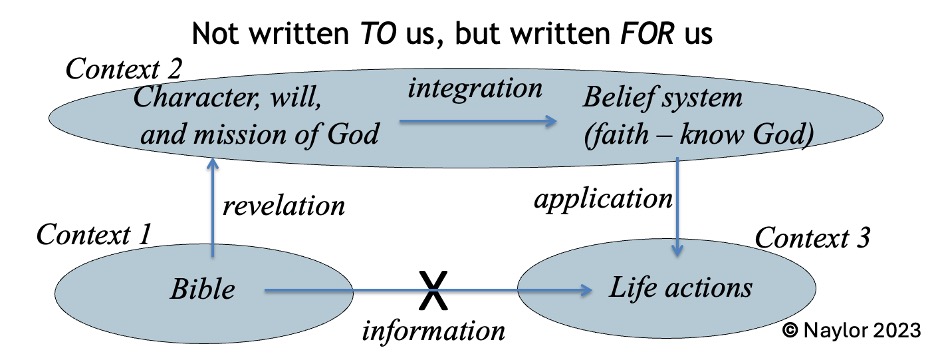
The bottom (information) arrow with the “X” shows that we should not read the Bible as if its teachings move directly from the text to our situation without interpretation. We cannot simply take biblical instructions and apply them straight to our context because we are dealing with two different cultural contexts—the biblical culture and our own. A direct, culture-to-culture transfer is impossible because of assumptions, priorities, and questions that shape our beliefs.

Instead, we approach Scripture as God’s self-revelation—his nature, will, and mission—communicated in a time, place, and cultural setting different from our own (left arrow—revelation). From that revelation, we develop a theological understanding of who God is and what he desires (top arrow—integration). Only then can we express our obedience in culturally appropriate actions today (right arrow—application).

In summary: The meaning of any passage reveals God’s intention within a particular context distinct from our own. Discerning God’s will, character, and mission from that intention calls us to trust in him and to shape our lives in conformity with his purposes—grounded in our relationship with God in Christ, rather than by mere adherence to instructions or commands found in the passage[3].

Examples of how the hermeneutic is used

It may be helpful at this stage to point out how the discovery method of disciple making uses this hermeneutic to engage God’s word in order to develop theology. In disciple making the goal is not to pass on a theological system or doctrinal statements, but to assist believers in their discovery of who God is, what he wants, and what he is doing in this world. Group participants learn to read the Bible as revelation. Thus, key questions for any passage are, “How does this message show us God’s will, God’s character and God’s mission?” Once agreement is reached on what God is like, what he wants and what he is accomplishing, participants are challenged to conform their life to that vision[4].

A personal motivation for promoting this hermeneutic arises from my experience ministering among orthodox Muslims in Pakistan whose religious orientation parallels that of the Pharisees. When our focus is on submitting to Scripture as the primary way of following Jesus, we risk adopting an Islamic understanding of obedience—submission to Allah by conforming to traditions and laws. We evangelicals distort our theology when we treat Scripture as a collection of commands to obey rather than as a revelation of God our Father to whom we conform our lives.

Without doubt, the Bible has been given to us as a guide into obedience, but how that process should be worked out is the question.

No text is directly applicable to us or our context today, no matter how “plain” the meaning may appear. Scripture is written for us (2 Tim 3:16 NIV: “All Scripture is God-breathed and is useful for teaching, rebuking, correcting and training in righteousness”) but it is not written to us, because we are not the original audience being addressed.

What does it mean for the Bible to be given “for us” but not “to us”? The point of the Bible is not primarily to help us live a moral life pleasing to God but to bring us into relationship with God through Christ (Jn 3:16; 20:31). We come alive “in the Spirit” so that we can live out our adoption as children (Rom 8). Our ultimate aspiration is not to be obedient servants but children whose lives are conformed to the image of Christ.

Obedience that is not rooted in the outworking of the gospel drifts toward the legalism of the Pharisees. In orthodox Islam, the true believer is the one who submits to Allah’s will—a noble aim as far as it goes, evoking the image of a servant awaiting the master’s command. When the master is God, such devotion is honorable. But this is not the orientation of a follower of Jesus. We are called to embody the vision of the kingdom which goes beyond keeping commands to sharing the heart and desires of the One who gives them. Our task is to discern the purposes of Jesus in each situation and respond out of love for the King, desiring what he desires. Jesus loved the Rich Young Ruler not because he had kept the commands from his youth, but because he hungered for the kingdom in a way that reached beyond the commands.

We are called to live under a new covenant of grace—not to bind ourselves to commands, however clear they may appear. Consider children being told, “Do not touch the stove!” This is a clear command, and obedience means staying away from danger by literally not touching the stove. But maturity means learning to touch the stove properly; understanding both the command and the purpose behind it allows the command to be obeyed by appropriately touching the stove.

This conviction is parallel to the theological realization that Jesus did not come primarily to save us from guilt, shame and fear. Those conditions are the result of sin—rebellion against God—and therefore, they are appropriate consequences. Rather, by saving us from sin (Mt 1:21; Jn 1:29; 2 Tim 1:15; 1 Jn 3:5) and bringing us into a right relationship with God, Jesus simultaneously frees us from guilt, shame and fear. Our focus, then, is not on the secondary symptoms but on the primary issue—rebellion from which we must repent. To be saved from sin is to be redeemed into a right relationship with God (Rom 3:21-26[5]) with a desire is to live “in Christ.” 

Similarly, but with a profound hermeneutical rather than theological reorientation, our primary use of Scripture is not to find commands to obey—that would be focusing on secondary concerns. We first discover and then conform ourselves to God’s will, character and mission as good children who want what their father desires for them. This does not lead to disobedience but to conforming to the “new wine” of kingdom living expressed in ways fitting for our context. For the believer, it is the only way to be truly obedient.

The pathway from text to application

The pathway from the biblical text to its appropriate application is not straightforward or simple and there is potential for error—even for those who desire to follow God’s will. It is possible even for dedicated biblical scholars to misinterpret or misapply God’s word, missing God’s intent for a specific time and place. The Pharisees in the time of Jesus are an obvious example of this danger. Nevertheless, by remaining aware of interpretive pitfalls and by following the hermeneutical patterns and priorities evident in Jesus’ own ministry—reflected and reiterated throughout the New Testament—we can live out biblically informed expressions of our faith.

At the same time, it would be unwise to ignore the wealth of understanding and insight provided by godly scholars throughout the centuries who have guided the church in how to live out the Christian life in a worshipful and impacting manner. What is required is to refresh our theology in each new setting and generation by revisiting the authoritative text (the Bible). This allows us to benefit from and critique the wisdom and traditions of our past by giving priority to how Jesus dealt with Scripture and the issues of his day.

This wrestling between traditional theologies and Scripture does not happen in a vacuum. We struggle to be “in the world, but not of the world” (John 17:14-16) and every generation and culture is faced with narratives that clash with kingdom values. Like the churches of Pergamum and Thyatira (Rev 20:14-15, 20), we can be tempted towards compromise. How can we find expressions of our faith that both resonate authentically with our context and uncompromisingly reflect the light of Jesus and what is true to God’s will, character and mission?

As an example of how our interpretive process can go wrong, one of my students reported that in Africa some tribes “are Christian, but still practice polygamy and believe it is biblical. These tribes argue their case by stating that the fathers of our faith (Abraham, Jacob, David, etc.) practiced polygamy, showing that it is a cultural matter—not a sin issue.”[6]

I view this interpretation as poor contextualization based on an inappropriate hermeneutic. It reveals a legalistic approach to Scripture (i.e., look for biblical examples to follow, commands to obey, or promises to claim by using the Bible as a “manual”), rather than developing theologies of marriage and gender by discovering the will, character and mission of God. Developing our theology through the lens of how Jesus revealed the Father is key for Scripture interpretation and prevents us from building theological frameworks and practices based on select biblical practices and commands.

In the following articles, I will seek to demonstrate the necessity of this less direct approach to interpreting Scripture, explain how this hermeneutic guides us toward appropriate application, show how it is employed within Scripture itself, and finally use it to examine passages often cited to restrict women’s roles in ecclesial leadership. Because the controversy prompting this reflection arises from a shared desire to obey God, the next article will explore what it means to be obedient to God’s Word.

Footnotes:

[1] Donald K. Campbell, “Foreword,” in Basic Bible Interpretation: A Practical Guide to Discovering Biblical Truth, ed. Craig Bubeck Sr. (Colorado Springs, CO: David C. Cook, 1991), 19.

[2] Both of these descriptions are used in these articles. “Hermeneutic of reading the Bible as revelation” focuses on how the Bible is to be read, while “Contextually Sensitive Hermeneutic” emphasizes the intimate connection between meaning and context.

[3] Scholars will recognize this approach as a version of theological hermeneutics. “When we speak of theological exegesis, particularly when we acknowledge the Spirit’s role… we are speaking … of the way that God, working through the text, is reshaping us.” from Richard B. Hays, “Reading the Bible with Eyes of Faith: The Practice of Theological Exegesis,” ed. Joel B. Green, Journal of Theological Interpretation, Volume 1, no. 1–2 (2007): 15.

[4] This approach affirms the sufficiency of Scripture as the curriculum, the Holy Spirit as the teacher, and the dynamic of the community for challenge and correction. This foundational engagement of believers with God’s revelation does not negate or neglect God’s blessing in the church of those with apostolic (missions), prophetic (proclamation), evangelistic (gospel message), shepherding (pastoral), and teaching (training in righteousness) callings (APEST, see Eph 4:11).

[5] “If then sin as unrighteous activity means activity that ruptures our relationship with God, righteousness or being ‘made righteous’ means to have the effects of sin nullified by entering into a restored relationship with God” (Achtemeier, P. J. (1985). Romans (p. 63). Atlanta, GA: John Knox Press).

[6] J. Claybaugh, CICA: Transforming Discipleship session 2, Fall 2025. Used with permission.

 

108. Five Transitions to Participate as Senders in God’s Global Mission

Move from where you are to where you want to be

Downloads: powerpoint, handout

In my role of coaching churches to do missions well, five transitions have proven effective for churches to make an impact as missionary sending churches.

From Missionary to Missions

  • Rather than supporting missionaries who have a mission, own the mission so that you can be partners with the missionary. Having a common passion is the best way to care for the missionary since it validates their calling.
  • What is the response of a church when a missionary retires? Is it, “What do we do with the money?” (missionary focus) or “How do we carry on the ministry?” (mission focus)
  • A missions orientation helps the church discover who and what to support. When someone comes up with a missions idea or a young person wants to be supported for a short term missions trip ask, “Is this your idea, or is it a mission vision of the church? Find 5 others who are also passionate about this and are willing to form a team for this initiative.”

From Information to Motivation

  • Traditionally mission committees focus on informing the church about missionaries. However, we live in an age of excess information. The only information absorbed is that which is immediately relevant.
  • A better emphasis is to motivate the church by involving them in a decision making process.
  • Rather than presenting one missions project for people to support, provide three. Then get people to vote on which one will make the greatest impact for God’s global mission and make that one your project.

From Passive receptor to Intentional mentor

  • People often doubt themselves and are unwilling to put themselves forward. Appoint respected believers in the church to identify those who may be called into missions and ask, “What is God’s call on your life?  Have you thought about it?  Do you think God may have a plan for you to work in missions?” That can change the direction of someone’s life.
  • One church I coached was a university church with high turnover of students. They came up with the idea of using the four years as a time to mentor people into discovering God’s call.  They did not wait for students to approach them, but initiated the conversation when students began attending.

From Cooperation to Identifying passion

  • Church leadership often thinks that their role is to decide what to do, cast a vision and then get people to cooperate with their plan.
  • Instead,
    • Pray that God would speak to people. 
    • Assume that God’s Spirit is working in people’s lives.
    • Identify and support the passion that God has given them. 
    • Ask: Where do people already have a passion for missions? Where are they already invested? 
    • Celebrate and support that passion. Such people are already motivated.
  • One church used their map of the world in a unique way. Sticky notes were provided for people to put on the map with their name to show either where they had been, or where they had a missions interest. Conversations began and common concerns were identified.

From Supporting to Investing

  • The traditional way of support raising is VERY intimidating. Nobody wants to do it and it can be an overwhelming burden. We are called to bear each other burdens.
  • If the church is already investing in the mission (transition #1), then partnering means taking on the whole burden with the goer, even to the point of raising funds for the goer. 
  • For example, ask the person going into missions to find 3 other people in the church to become a team for the mission. Together they meet, plan and act as if they were all going out on mission. With that perspective, working together with the missionary they can initiate prayer and financial support for the mission.  That is real investment.

101. Why I am a Baptist, but not an “Immersionist”

The “Immersionist” position is that any act of baptism that is not by the mode of immersion cannot be accepted as fulfillment of Jesus’ command to baptize.[1] Their rationale stems from a deep and admirable desire to radically obey[2] Jesus in all things and since the Greek baptizo literally means “immerse,” only that form is a true fulfillment of the command. In thinking through the issue I have come to the opposite conclusion and believe that highlighting the immersion mode diminishes the purpose and meaning of baptism because it emphasizes something peripheral to the command. Both symbolically and with a life-surrendering vow baptism is an act of “plunging … into the very name and life and character of the true God, who is Father, Son and Spirit.”[3] Radical obedience is the fulfillment of the latter vow, rather than a literal adherence to the form of the symbolism. It would be an unfortunate emphasis in our Fellowship churches if, by insisting on the outward appearance, we denied ourselves the fellowship of those who have also made that vow and embraced that symbolism, albeit by a mode that is less expressive than it could be.

Part of the argument provided by the Immersionists is that a transliteration (“baptize”) rather than a translation (“immerse”) of the word baptizo masks its true meaning and was employed in Bible translations for political reasons.[4] While political reasons stemming from church practice and the influence of the monarchy on religious authority were evident at the time of the early English Bible translations, these reasons need not be the sole motive behind the choice to transliterate. As a Bible translator into the Sindhi language,[5] I have often struggled with the benefit and impact of transliterating rather than translating. For example, in the Bible many names have meaning yet the function of identification usually overrides other aspects leading to a choice to transliterate. Barnabas means “Son of Encouragement,” which the original readers would have understood but this meaning is lost in the transliteration. Nonetheless, this loss is considered appropriate since the purpose of the name is primarily the identification of the person, just as a woman called “Joy” is only occasionally reminded of the significance of her name. Even closer to the issue at hand, when translating the New Testament into the Sindhi language for a Hindu audience, we discovered that some Hindu-background Christians were referring to baptism as a “holy bath.” For a time we seriously considered this as an option, but eventually settled on the transliteration “baptism” in order to facilitate a common Christian vocabulary and avoid potential divisions and arguments based on terminology.

Other than political expediency, the desire to avoid controversy and to encourage greater uniformity in Christian terminology, the most important reason for transliterating baptizo is theological. Baptism is far more than a symbol of immersion, its primary significance is as an ordinance. I am a Baptist because I am convinced of believer’s baptism and I value immersion as the most appropriate symbol to express the profound commitment of making a vow of total submission to God in Jesus’ name. The imagery of immersion is powerful and significant. It is an acted out metaphor of the internal reality and I would not want to lose that. But to deny expressions of baptism based solely on the mode raises the physical act to a level that I do not believe Jesus intended. His focus was on the heart not the outward appearance and in order to follow Christ I believe that we need to treat baptism the same way. The commands of Christ lead us to the heart of God, not to outward symbolic actions. A focus on immersion that causes us to reject those baptized by another mode is to move our attention from the purpose and meaning of baptism to a secondary and less important aspect.

In a recent paper Phil Webb[6] stated that “every change that God desires of us is relational and takes place in relationship,” which means that true obedience is done “by the spirit of the law rather than by the letter of the law.” The transliterated term “baptism” is more appropriate than the translated “immersion” because it points to the spirit of the command rather than the mode; “baptism” emphasizes the meaning and purpose of the ordinance and avoids placing too much emphasis upon that which is secondary.

________

[1] Belyea, G., Carter, G. & Frey, R. (2016) Conclusion in Baptism Is … The Immersionist Perspective, Eds. G. Belyea, G. Carter & R. Frey (p. 151). Brampton: Kainos: 151-152.

[2] Stairs, J. (2016). Why the Dripped Should be Dipped! in Baptism Is … The Immersionist Perspective, Eds. G. Belyea, G. Carter & R. Frey (p. 199-200). Brampton: Kainos: 191-204.

[3] Wright, T. (2011). Lent for Everyone: Matthew Year A (p. 149). London: SPCK.

[4] Frey, R. (2016). The Linguistic Evidence in Baptism Is … The Immersionist Perspective, Eds. G. Belyea, G. Carter & R. Frey (p. 22). Brampton: Kainos: 21-32.

[5] https://www.nbseminary.ca/church-health/cild/cild_sindhibible

[6] Webb, P. (2016) Unpublished.

79. Rethinking what we mean by “church”

Shortly after writing the Cross-cultural Impact article on Expressions of Church, I was intrigued to read the following comment by Peter Shaukat in a Catalyst Interchange posting:

I think there is a critical need in a larger theological/ missiological sense to rethink what we mean by church. There is a growing understanding that the church is much bigger than the local congregation, and that the church is a much more multi-faceted reality. Mission agencies and the business community should not be conceived as separate entities but as a part of the church. What we are seeing emerge are affinity groups—like the business community—that don’t capture the full orbed expression of the church, but neither does the local congregation at the corner of State and Main.1

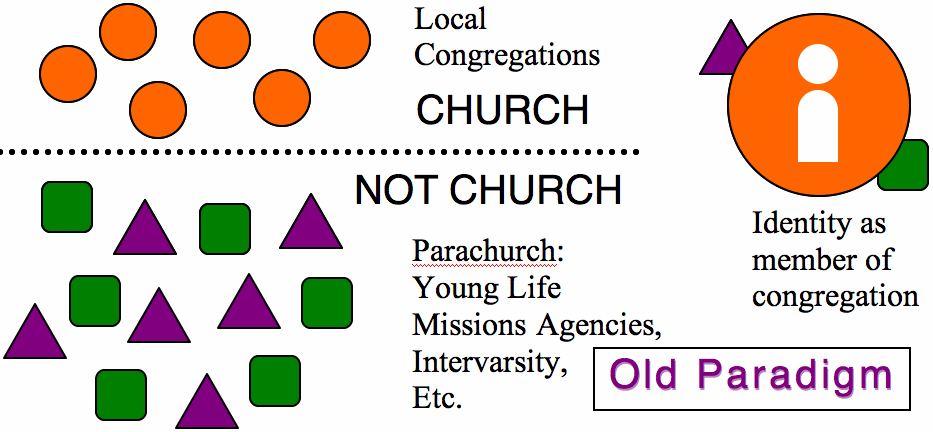
Old Paradigm 2The implication is that local congregations,2 while being important expressions of the body of Christ, cannot claim exclusive rights as the only organization that fulfills the biblical description of church.  Moreover, missions agencies and other “parachurch” Christian organizations, while not calling themselves “church,” provide important and legitimate expressions of what it means to be the people of God.  This moves away from a traditional identification of “church” according to organizational criteria – constitutions, positions of leadership, buildings, etc. – to embrace a more functional view of “church” in which believers come together for Jesus’ kingdom purposes.

The trend of fluid connections to church

revolutionIn his book, Revolution,3 research guru George Barna observes that many young believers are experiencing “church” in a variety of non-traditional ways.  There appears to be a pendulum shift away from the denominational and church loyalties of a few decades ago. The local congregation is no longer the default expression of “church,” but one of a number of options. The evangelical ecumenical movement has not only resulted in believers moving comfortably from church to church, but also with many living as fulfilled believers outside of traditional church organizations. Loyalties are not directed towards a particular organization, but towards a group of friends with whom they relate on a spiritual level for worship, teaching or service.

they view relationships as their church

We have seen this trend within our own home. Our daughter and youngest son are involved in Young Life Canada, a parachurch organization focused on building relationships with teens who do not know Christ as well as mentoring young people into leadership positions.  At the same time, they take advantage of opportunities for significant relationships and worship experiences in other venues apart from Young Life.  The important point is that they view these relationships as their “church” and do not sense a need to commit to a traditional expression of church.

Why fluid connections are good – and bad

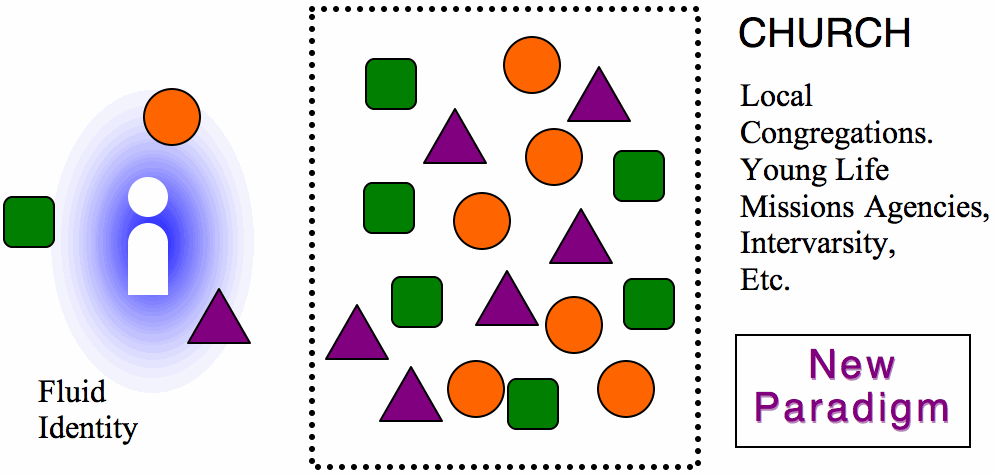
new paradigm 2This trend is both unsettling and liberating. It is liberating because many believers are looking for significant expressions of their faith beyond those commonly available through the local church.  An assumption among many loyal church goers is that true believers should belong to a traditional expression of church.  But if Shaukat and Barna are correct, that is not the only option. While many still gravitate to the traditional local church (our oldest son is an example), there are still others who find connections with believers in a variety of contexts that provide them with significance, discipleship and Christian service in God’s kingdom.  Even if someone does identify with a local congregation, they may be more committed to other ministries and organizations because of the perceived significance of what is being accomplished, and this limits their participation in their local church.

But it is unsettling because when those involved in “parachurch” ministries need to transition into other expressions of church that fit with their changing orientation and position in life, they may fail to do so.  Many of these organizations are focused on a particular age or interest group and this leads to temporary rather than permanent participation. The individual covenant to Christ continues, but the identification with a particular group can be short-lived. Once involvement in an organization is finished, they may not transition to another ministry or a local congregation.  Friends of our daughter are an example of this perspective: while both are committed followers of Christ, their sporadic visits to church services only reinforce their belief that this expression of church has little relevance to their lives.

Focus on significance, not obligation

second-orderI would suggest that a solution to the question of what determines a legitimate church is not to argue for one exclusive expression as the true church, nor to claim that the local congregation as commonly experienced has a privileged position, but to accept all expressions of church as part of what Jesus is doing to build up his followers.  That is, rather than promote one paradigm as supreme or primary, it would be better to recognize that no expression can be complete in itself.  We need each other. This perspective would lead to a level playing field in which membership in a local congregation is considered a second order concern in order for a person to be fulfilled as a follower of Christ.   Rather than promoted as an obligatory step in one’s faith journey, the step is taken because of the significance that particular connection can have for the believer.  This is not self-serving but, as Myers notes, a self-identifying quest that “comes from a deep desire to live beyond one’s self.”4 The criteria for choosing one’s level of involvement are based on strategic and significant purposes, rather than obligation. It is of secondary importance whether this “deep desire” is fulfilled through a local congregation or through another form of Christian ministry.

church-in-wordFurthermore, such an attitude can lead to partnerships by acknowledging how each expression of church complements rather than competes with the other.  For local churches, this would mean recognizing that they are not a complete expression of church in and of themselves, but that they play one role in building up the people of God. Dialogue with other ministries that leads to a refocus of priorities and a reallocation of resources may be required. By partnering with such ministries and celebrating church members’ participation in these ministries, local congregations can develop a synergy through which their purpose and vision is strengthened.  The local congregation need not become redundant or marginalized if it defines itself in a way that provides complementary spiritual support, identity and continuity for those who participate in other ministries.

Christian ministries operating apart from local congregation oversight can also embrace the reality that they are an expression of church, albeit limited. By taking this role seriously, they will look to local congregations and other organizations to help people develop a full expression of what it means to be a follower of Christ.

“Expressions of Church” and Missions

earthTim Lewis speaks of missions as the energy of the church “beyond the edges of the kingdom.”5 Such an enterprise demands the partnership of God’s people as they are involved in a variety of organizations, not just local congregations. Apart from a few notable exceptions, local congregations are not equipped to think strategically beyond their local context.  Validating other ministries as legitimate expressions of church and partnering with them provides local churches with a mission beyond that which they can accomplish alone.  The mission arm of the Fellowship, Fellowship International works with local congregations as that “expression of church” which participates in God’s global mission.
As someone deeply committed to participating in God’s global mission with a desire to see churches established, I find this concept of “expressions of church” particularly helpful when thinking about cross-cultural gospel impact.  When dealing with cultures that have little Christian influence, the question of what forms “church” should have is of utmost importance.  Not only do they need to be significant for worship, discipleship and service but they must also be sustainable and reproducible.

an expression of church was born

When I was visiting a people group in which there was no indigenous church, I had a visit from a young father who was the head of a “household church.”  His four year son, David, was with him and during the visit David was encouraged to tell us Bible stories and pray for us.  The joy of listening to this child speak of Jesus and pray in his name was not just because of the faith evident in that family, but because of what it represented in terms of ongoing impact.  Their “church” was not an organization that was formed by Christians gathering together to initiate a local congregation.  Instead, the organization of this man’s extended family existed before they became believers.  When Jesus became lord of their household, this man took on spiritual leadership and an expression of church was born.  It is sustainable, because it is based on a structure of the extended family that continues from generation to generation, and his child’s recitation is evidence of that potential. It is also reproducible within other families in that culture because it conforms to cultural norms.  This is not the only expression of church needed in that people group, but it is encouraging to see the missiological priority on significance and function in building up the people of God, rather than elevating one organizational form as “church.”


If you would like to contact Mark please use the Contact Me form.  If you would like to leave a comment, please use the “comment” link at the bottom of this article.

      ____________________


  • 1 Peter Shaukat in an interview by Ellen Livingood in Catalyst Interchange Postings April 2009 Vol 4 Issue 4 Business as Missions: How Do Church and Agency Connect? P. 1.
  • 2 For clarity, this article uses “traditional church” or follows Shaukat’s terminology of using “local congregation” for the popular understanding of “church” in the Canadian context, while employing “expressions of church” to include other organizations, eg. “parachurch” organizations, that also demonstrate aspects of fellowship, service and discipleship.
  • 3 Barna, G. 2005. Revolution:
    Finding Vibrant Faith Beyond the Walls of the Sanctuary
    . Carol Stream, Ill.: Tyndale.
  • 4 Myers, J. 2007. Organic Community: creating a place where people naturally connect. Grand Rapids: Baker. P. 62.  Also see further explanation in The Pastor as Spiritual Coach II.
  • 5 Tim Lewis quoted in Kim, Chong. Going ‘beyond the edges of the kingdom’ in Mission Frontiers March-April 2009 p. 7


77. The Pastor as Spiritual Coach (Part II)

see also The Pastor as Spiritual Coach (Part I)

From Programs to Contextualization

Who is to blame: the Congregation or the Leadership?

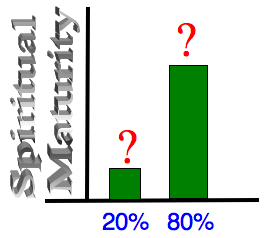
spiritual-maturity1In my responsibility of providing outreach and missions resources to churches, I have come across a curious phenomenon. My experience is that there are a number of people in church leadership who do not have a positive view of the spiritual maturity and commitment of their congregation.  Comments such as “a mile wide and an inch deep,” “20% do 80% of the work,” “half an hour after the sermon is over they don’t remember it, let alone apply it,”  “they don’t take advantage of opportunities to go deeper,” and “they don’t know their Bibles” have been expressed in my hearing.  Why this is curious is that my experience with the people of God in our churches has given me quite the opposite opinion.  I have been constantly impressed, motivated and encouraged by the level of spiritual maturity and commitment to Christ in the people I meet.
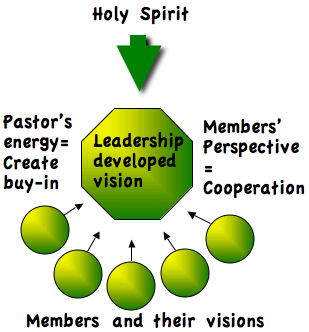
leadership-developed-visionI have an uncomfortable suspicion that a significant part of this negative view of congregations stems from an inadequate approach to ministry by the leadership.  The average church organization, whether labeled traditional, seeker sensitive or missional, has a leadership-driven program which members of the church are encouraged to support.  The response by the congregation tends to be less than expected, especially if support has been indicated by a congregational vote.1 Priorities of attendance, giving and evangelistic participation are not at the level the leadership considers appropriate, and so the congregation is judged to be lacking in spiritual maturity. However, involvement in church organized activities is unlikely to prove to be a good measurement of spiritual maturity.
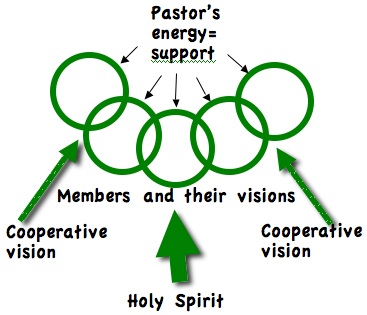
An alternate approach to ministry

member-developed-visions2A couple of months ago, Karen and I proposed to our church an approach to ministry that focuses on the visions and desires of the individuals in the congregation.  Rather than developing a church wide vision and unified program in which all are expected to participate, the pastor acts as spiritual coach to empower believers in their desire to become intentional and authentic followers of Christ within their day-to-day lives.  Instead of encouraging people to “get involved in the church program,” the focus becomes “how can I be a support to you as you serve Jesus in your daily life?” The role of the spiritual coach is to help believers develop spiritually synergistic relationships with people both inside and outside of the church, as opposed to a posture of attending church events or participating in church programs. Instead of approaching people with the call to “join our team,” the pastor asks, “How can I be a part of your ministry?” I believe that such a change in focus would alter the perspective of pastors as they witness people’s concerns, prayers and struggles in their God given role of being salt and light.

Organic Community

help them become more intentional Christians within their current life setting

There are a number of writers who view the church in a similar way.  In his excellent book, Organic Community,2 Joseph Myers encourages leaders to make “the shift from programmer (master planner) to environmentalist (one who follows the principles of organic order to create and shape environments)” (34).  Rather than adopting “models and programs that force prescriptive patterns onto our congregations, … [o]rganic order suggests there are many patterns we can use to connect to God and others.” (40-41).  People are already living according to patterns and rhythms that make sense to them.  Instead of calling them out of a context that defines their life so that they can serve in an organization driven program, it would be more satisfying and impacting to help them become more intentional Christians within their current life setting and relationships.  Myers says, “[A] master plan tries to manufacture life, whereas organic order is an invitation to live.” (28) There is wisdom in encouraging church leadership to start where individual people live, and discover the ways that God is working in and through them. Synergy is created when people are encouraged and guided in the tasks they have initiated themselves, whereas pulling people into a centralized structure can result in frustration.  In this organic dynamic, the scorecard is not attendance at events, but people’s stories.  “Story is the measurement tool of community” (80).  It is the narratives of those who have been impacted through their relationship with people in the church that measures the life of the community.

Another complaint I have come across from church leadership is that a major weakness of the congregation is that people are self-centered.  The claim is that they come to church events with a clientele mentality looking to have their needs met.   However, from my experience, I would agree with Myers that this perspective is a  “misunderstanding that people generally operate from a position of ‘What’s in it for me?’”  He further states that he does not find the presumption to be true, “Most people are not primarily selfish or self-serving.” When people are asked to participate in a project,

organic-communityI do not see that people are asking, “What’s in it for me?” Instead, they want to know, “Why me?” This is not a self-serving question. It is a self-identifying, individual question.
People participate as individuals. They are interested in why they – specifically – are being asked.  They want to know that you have chosen them first and foremost because of who they are, not to fulfill a strategic master plan.

‘Why me?’ comes from a deep desire to live beyond one’s self. A person wants to contribute in concrete ways, possibly in ways that only he or she could.” (62)

I believe that the reason many believers do not participate in the programs of their church is not that they are ignoring their responsibility, but because they are not convinced that those ministries are God’s calling for them. Imagine a ministry mentality that begins and ends with the dreams and visions of the individual members.  Rather than searching for gifted people in the congregation to fulfill the needs of an overall church program, the focus is to create connections and provide support that guides believers to discover the calling of God in their lives.

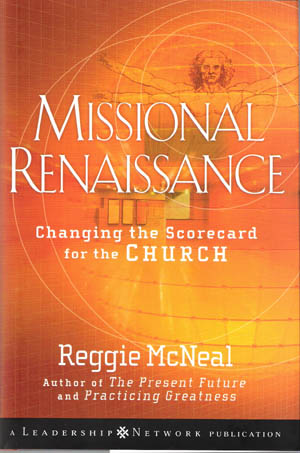
Missional Renaissance

The reluctance of believers to serve church programs is not an indication that they are spiritual immature

Reggie McNeal has one helpful chapter in his book, Missional Renaissance,3 that deals with this congregation-focused orientation.  He begins with a personal anecdote during his days as the leader of a programmatic church.  One day he asked himself, “Are people better off for being a part of this church, or are they just tireder (sic) and poorer?” He realized that he did not know. He “could tell how busy people were with church but not how their lives were going” (89).  In a major shift from this pattern of ministry, he calls leadership to recognize and conform their ministry to the fact that people do not want to fit their lives into the program of the church (96).  The reluctance of believers to serve church programs is not an indication that they are spiritually immature or selfish.  Instead, he claims that “God has created a cultural milieu where people are clamoring to grow…. [So] get out of the church business and into the people business.” (111).  In praising one pastor who has changed from a program director to someone who empowers and releases the people in the congregation, McNeal says,

miss-ren-mcnealHe plays the essential part of empowering leaders to pursue their callings and passions. He strengthens others’ obedience by creating a culture where they can say yes to the Spirit…. [All] the ministries he told me about happened away from the church. This same pastor went on to say, “I wouldn’t have a clue how to do what they do.” The very thought that clergy could preside over these kingdom expressions is ludicrous. Yet many congregational leaders do not trust people to minister out of their sight. (140)
Spiritual Coaching Description

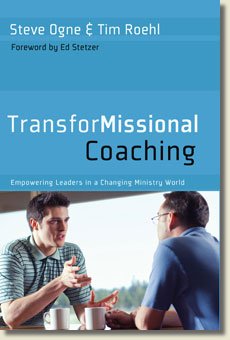
Steve Ogne and Tim Roehl provide a good definition for the spiritual coaching of leaders that pastors can use to create the kind of environment that Myers and McNeal are promoting, “Coaches help people develop their God-given potential so that they grow personally and make a valuable contribution to the kingdom of God.” Ogne goes on to underscore the essential principles (with alterations to emphasize the application to the pastor as spiritual coach),

  1. transformissional_coaching_book“Coaches help people.” Coaching is a relationship…, not a program. It is focused on the [believer], not the program. You coach a [believer], not his or her ministry….
  2. “[D]evelop their God-given potential.” The potential comes from God, not the coach. A coach helps draw out the vision, values, gifts, calling, and passion God has already placed in the [believer].
  3. “[S]o that they grow personally.” Like mentoring, coaching is concerned with the personal (including … family), spiritual, and professional growth….
  4. “[M]ake a valuable contribution” Coaches help [believers] accomplish something for God. Coaches help [believers] identify and fulfill their specific calling and contribution.
  5. “[T]he kingdom of God. ” The kingdom of God is far greater than any one congregation…. [A pastor as spiritual coach will] ultimately equip individuals within their faith communities to engage and transform the culture as representatives of the kingdom of God.4

Spiritual Coaching as a means of Contextualization

The kind of thinking that promotes spiritual coaching resonates with missiological principles.  The temptation of leaders is to take control of the ministry and make decisions that bring immediate results. Programs are implemented that exhibit characteristics the church leadership wants to promote in the church.  The longer and more difficult road, which treats the people and environment being ministered to with respect, is to listen, discover and respond to the rhythms and networks that already exist as a natural part of people’s lives.  This is an important application of the principle of contextualization, an essential methodology for the cross-cultural minister. A problem arises in the North American church sub-culture when this principle is ignored.  Rather than altering the well-known traditional patterns of doing church to fit the ever changing rhythms of life of the community, the response of leadership can be to blame those who refuse to break their rhythms for the sake of a programmatic approach to ministry.  But many believers are not being lazy or spiritually immature.  Instead, they are seeking ways to bring Christ into their lives, rather than sacrificing activities that are fulfilling for the sake of a master plan that does not satisfy their spiritual hunger.


Mark spends part of his time coaching churches for evangelism and missions.  If you would like to contact him please use the Contact Me form.  If you would like to leave a comment, please use the “comment” link at the bottom of this article.

    ____________________

  • 1 For a description of the 4 meanings of a “yes” vote see The Pastor as Spiritual Coach (part I).
  • 2 Myers, J. 2007. Organic Community: creating a place where people naturally connect. Grand Rapids: Baker.
  • 3 McNeal, R. 2009. Missional Renaissance: Changing the Scorecard for the Church. San Francisco: Jossey-Boss
  • 4 Ogne, S. & Roehl, T. 2008. Transformissional Coaching: Empowering Leaders in a Changing Ministry World. Nashville: B&H Pub., pp. 26-27.


73. Expressions of church

“Church” is a word that I am frustrated with.  It is often used without clarity concerning what is being referred to.  We construct buildings that we call “churches.”  We attend a service on Sunday morning by “going to church.”  We have constitutions and statements of faith for the local “church.”  The “church” is discussed as an organization.  It is defined as the people of God.  We talk about the universal “church.”  But perhaps the most contentious aspect comes when issues of membership in the “church,” or faithfulness to the “church,” or concerns about the authority of the “church,” are discussed.

There seems to be an assumption in some circles that what is commonly referred to as the “local church” – an organization with a board consisting of pastors and deacons together with a congregation that meets for worship on Sunday morning – is the proper representation of the New Testament intent.  Thus parachurch organizations, even though they are heavily involved in fulfilling the Great Commission, quickly deny that they are a “church,” while local churches, some of whom choose the maintenance of a status quo over redemptive living, view themselves as the authorized association to which Christians must belong in order to fulfill Jesus’ intention for his followers.

First-order versus Second-order Criteria

I find such delineations somewhat unhelpful.  It seems that a particular form of doing church is being promoted as pre-eminent and legitimate based on second-order criteria, rather than first-order. That is, a certain structure is required (pastors, deacons, etc.) along with a traditional agenda (e.g., regular Sunday worship service with sermons and songs) in order to be a true New Testament church.  The first-order issues, such as discipleship, participation in God’s mission to the world, commitment to the way of Christ, and prayer, are practiced in many settings both inside and outside the local church, without being definitive in our understanding of “church.”


It is like defining a family by the type of house it lives in and each person’s status, rather than according to the interactions and relationships that provide meaning to the members. It is puzzling to me that second-order criteria should be the factor that elevates one expression of “church” as superior. In fact, in the minds of many, the “local church” model of “church” has a divine authority over other institutions and gatherings, even though the latter may have greater involvement in the first-order concerns of the kingdom of God.


Expressions of Church

any activity that fulfills in some way a community aspect of God’s people is an expression of church

There is a way of thinking about “church” that I have found particularly helpful.  Rather than focusing on a particular organized group that is referred to as a “local church,” I like to talk about “expressions of church.”  That is, any activity that fulfills in some way a community aspect of God’s people is an expression of church.  A morning worship service is an expression of church, as is a Sunday School class, an Alpha meeting or a church board meeting.  They are meetings in which people are seeking to live out the implications of being the body of Christ.  Two friends meeting for prayer is also an expression of church, as is a committee meeting for Young Life, or a Bible study with Campus Crusade, or a staff meeting with our mission, FEBInternational.  Whenever and wherever Christians meet together to express, and to further the kingdom of God, that is an expression of church.  Christians who gather together for God’s purposes, whether in camp ministry, missions or a Sunday morning worship service, are an expression of the body of Christ.

Focusing on expressions of church does tend to ignore the important aspect of ongoing commitment and identification with a group of fellow believers. Identity is a key strength that validates and sustains the local church organizations important to our fellowship of churches and should not be treated lightly.  But speaking of “expressions of church” does help to clarify the conversation about “church” and ensure that first-order concerns remain the priority over second-order forms.  It provides a level playing field for discussion of all that God is doing in his mission of redemption to the world, without a priori assumptions of priority of one form of the body of Christ.

The Form is Negotiable

This perspective derives from my experience in missions.  Our primary role while working in Pakistan with FEBInternational was in evangelism and church planting.  As a result there would often be lengthy discussions concerning what “church” should look like in the Sindhi context.  We began to realize that there are many legitimate ways of “doing church.”  In fact, the form is not only negotiable, but it must remain secondary to the first-order concerns. Once the primary concerns of the kingdom are established, then many forms of the church will be revealed as people live out the gospel in their social contexts.  The primary goal is to see Christ become Lord within the prevailing social structures, because out of this a sustainable and reproducible “local church” can emerge; one that not only provides a core identity as the body of Christ, but also maintains those first-order expressions that are the essence of Christ-centered living. Currently the structure that has the most potential among the Sindhi people is that of household churches: Believers who have a Christian identity within their own socially stable family organization through which expressions of church can be observed.

Jesus said, “I will build my church” (Mt 16:18). When we focus on the first-order concerns of the kingdom by building each other up in love so that we can find the full expression of Christ’s transforming power in our day to day lives, then we will experience and express what Jesus meant, and it will be those first-order concerns that will affirm our identity within the body of Christ.


If you would like to contact Mark please use the Contact Me form.  If you would like to leave a comment, please use the “comment” link at the bottom of this article.